Timothy J. Reilly Research Hydrologist US Geological Survey Toxic - - PowerPoint PPT Presentation

timothy j reilly research hydrologist us geological
SMART_READER_LITE
LIVE PREVIEW

Timothy J. Reilly Research Hydrologist US Geological Survey Toxic - - PowerPoint PPT Presentation

Why Soil Health Matters to Recharge Quantity and Quality Timothy J. Reilly Research Hydrologist US Geological Survey Toxic Substances Hydrology Program What is recharge? How do you make a stream flow? Runoff Direct Precipitation


slide-1
SLIDE 1

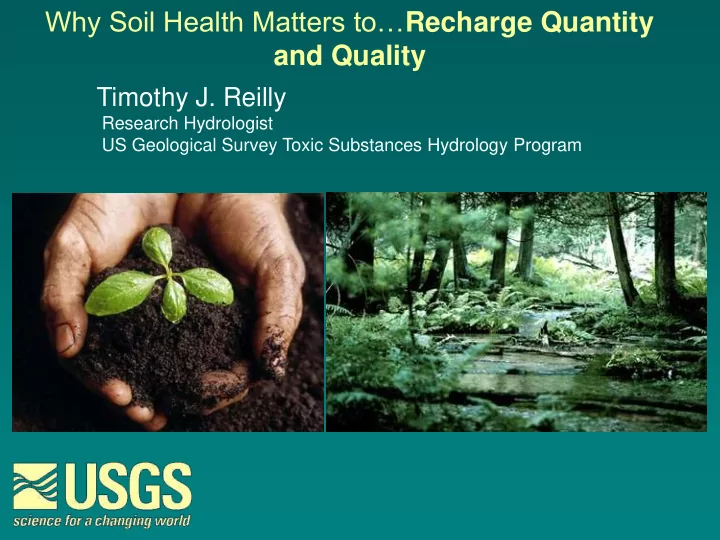
Why Soil Health Matters to…Recharge Quantity and Quality

Timothy J. Reilly

Research Hydrologist US Geological Survey Toxic Substances Hydrology Program

slide-2
SLIDE 2

What is recharge?

slide-3
SLIDE 3

How do you make a stream flow?

Ken Lockwood Gorge , South Branch Raritan River photo by Peter Murphy (www.njmonthy.com)

Runoff Tributaries Direct Precipitation Baseflow

slide-4
SLIDE 4

What is Baseflow?

Baseflow is the longer-term discharge into a stream from natural storages, notably sustaining flow between rainfall events.

http://www.connectedwater.gov.au/processes/baseflow.html

Natural Sources

  • Groundwater
  • Bank Storage
  • Wetlands
  • Lakes
  • Snow
slide-5
SLIDE 5

How does groundwater get into streams?

http://ga.water.usgs.gov/edu/earthgwdecline.html

slide-6
SLIDE 6

How does water get to the water table?

Soil UZ GW Infiltration Percolation E T Storage Baseflow

slide-7
SLIDE 7
  • Poor/no soil structure
  • Reduced porosity
  • Decreased infiltration

and percolation rates

  • Declines in baseflow
  • Habitat loss
  • Water supply issues
  • Declines in surficial

aquifers ...recharge quantity declines! When soil health is poor…

slide-8
SLIDE 8

What’s in that water we’re recharging with?

  • Source of water

– Precipitation/snowmelt – Irrigation/chemigation – Treated wastewater

  • Land use

– Undeveloped – Agriculture – Residential/industrial

slide-9
SLIDE 9

A healthy soil is a living filter!

  • Uppermost layer (O horizon)
  • Mainly plant litter in various

states of decay and humus

  • Topsoil (A horizon)
  • Aggregates made of mineral

particles and humus cement

  • These layers are alive!
  • A teaspoon of healthy soil can

contain 100 million to 1 billion bacteria!

  • That is the same mass as 2

cows/acre!

slide-10
SLIDE 10

What do soil microbes do?

  • Nutrient cycling
  • Fixing– convert nitrogen gas

from the air to forms plants can use

  • Nitrifying – convert ammonia to

nitrate

  • Denitrifying – convert excess

nitrate to nitrogen gas

  • Decompose organic material +

compounds

  • Disease suppression
  • Provide the “glue” to stabilize

aggregates

Bacteria, Michael T. Holmes, Oregon State University Actinomycetes J.P. Martin et al., 1976 SSSA, Madison, WI

slide-11
SLIDE 11
  • Solid Phase

– Organic matter – Charged minerals

  • Liquid phase

– Water films – Macropore flow

  • Vapor phase

– Very important for N2 and VO’s

Where are chemicals stored and transported in soil?

slide-12
SLIDE 12

Soil is essential to recharge quality and quantity…

  • A healthy soil will :
  • Allow water to infiltrate
  • Be porous enough to allow percolation
  • Store and moderate water creating

steady baseflows

  • Filter water by storing or degrading

chemicals

… which provides us with a supply of clean water essential to human life!