Three useful categories Learning a programming language involves: - - PowerPoint PPT Presentation

three useful categories
SMART_READER_LITE
LIVE PREVIEW

Three useful categories Learning a programming language involves: - - PowerPoint PPT Presentation

Three useful categories Learning a programming language involves: Syntax: The grammar rules defning a program (or f ragment). Semantics: The meaning o f various programming f ragments. Pragmatics: How to effectively use language f eatures, libs,


slide-1
SLIDE 1

Three useful categories

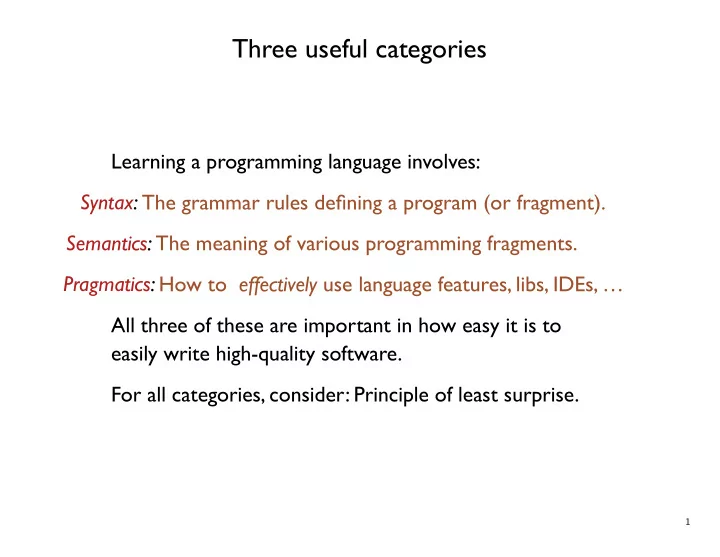
Learning a programming language involves: Syntax: The grammar rules defning a program (or fragment). Semantics: The meaning of various programming fragments. Pragmatics: How to effectively use language features, libs, IDEs, … All three of these are important in how easy it is to easily write high-quality software. For all categories, consider: Principle of least surprise.

1

slide-2
SLIDE 2

Some vocabulary

Do not confuse the following four!

  • value:
  • variable:
  • type:
  • expression:

2

slide-3
SLIDE 3

Some vocabulary

Do not confuse the following four!

  • value: a datum – the fundamental piece of information that can

be represented in the program E.g. 37 or "hi". Values can be passed to functions, returned, stored in variables.

  • variable:
  • type:
  • expression:

3

slide-4
SLIDE 4

Some vocabulary

Do not confuse the following four!

  • value: a datum – the fundamental piece of information that can

be represented in the program E.g. 37 or "hi". Values can be passed to functions, returned, stored in variables.

  • variable: an identifer which, at run time, evaluates to some

particular value.

  • type:
  • expression:

4

slide-5
SLIDE 5

Some vocabulary

Do not confuse the following four!

  • value: a datum – the fundamental piece of information that can

be represented in the program E.g. 37 or "hi". Values can be passed to functions, returned, stored in variables.

  • variable: an identifer which, at run time, evaluates to some

particular value.

  • type: a set of values

E.g. Java’s short = {-32768,..., -1,0,+1,+2, ..., +32767}.

  • expression:

5

slide-6
SLIDE 6

Some vocabulary

Do not confuse the following four!

  • value: a datum – the fundamental piece of information that can

be represented in the program E.g. 37 or "hi". Values can be passed to functions, returned, stored in variables.

  • variable: an identifer which, at run time, evaluates to some

particular value.

  • type: a set of values

E.g. Java’s short = {-32768,..., -1,0,+1,+2, ..., +32767}.

  • expression: a piece of syntax which evaluates to some particular

value. E.g. 3+4*5 or sqrt(16).

6

slide-7
SLIDE 7

Some vocabulary (cont.)

  • literal: a value which literally appears in the source-code.

E.g. Java 37 or 045 are both literals representing the value 37, which is of type int. And 37., 37d, 37e0 are each literal double s. (But pi is not, nor n+m.) (We will often confate a literal with the value it represents, and only say “literal” when we’re emphasizing that we’re dealing with syntax.)

7

slide-8
SLIDE 8

trivia: Interning Java string-literals

Literals occur in the source-code text, and can be processed at compile-time. In Java, string literals are “interned”: If the same string-literal occurs twice, the the compiler is smart enough to only make one

  • bject(*), and use the same reference in both places.

"Cathay".substring(3).equals("hay") Morever: string-literals with + are computed at compile-time.

(*) This optimization is only safe because Java strings are immutable.

8

slide-9
SLIDE 9

trivia: Interning Java string-literals

Literals occur in the source-code text, and can be processed at compile-time. In Java, string literals are “interned”: If the same string-literal occurs twice, the the compiler is smart enough to only make one

  • bject(*), and use the same reference in both places.

"Cathay".substring(3).equals("hay") // true Morever: string-literals with + are computed at compile-time.

(*) This optimization is only safe because Java strings are immutable.

9

slide-10
SLIDE 10

trivia: Interning Java string-literals

Literals occur in the source-code text, and can be processed at compile-time. In Java, string literals are “interned”: If the same string-literal occurs twice, the the compiler is smart enough to only make one

  • bject(*), and use the same reference in both places.

"Cathay".substring(3) == "hay" "Cathay".substring(3).equals("hay") // true Morever: string-literals with + are computed at compile-time.

(*) This optimization is only safe because Java strings are immutable.

1

slide-11
SLIDE 11

trivia: Interning Java string-literals

Literals occur in the source-code text, and can be processed at compile-time. In Java, string literals are “interned”: If the same string-literal occurs twice, the the compiler is smart enough to only make one

  • bject(*), and use the same reference in both places.

"Cathay".substring(3) == "hay" // false "Cathay".substring(3).equals("hay") // true Morever: string-literals with + are computed at compile-time.

(*) This optimization is only safe because Java strings are immutable.

11

slide-12
SLIDE 12

trivia: Interning Java string-literals

Literals occur in the source-code text, and can be processed at compile-time. In Java, string literals are “interned”: If the same string-literal occurs twice, the the compiler is smart enough to only make one

  • bject(*), and use the same reference in both places.

"Cathay" == "Cathay" "Cathay".substring(3) == "hay" // false "Cathay".substring(3).equals("hay") // true Morever: string-literals with + are computed at compile-time.

(*) This optimization is only safe because Java strings are immutable.

12

slide-13
SLIDE 13

trivia: Interning Java string-literals

Literals occur in the source-code text, and can be processed at compile-time. In Java, string literals are “interned”: If the same string-literal occurs twice, the the compiler is smart enough to only make one

  • bject(*), and use the same reference in both places.

"Cathay" == "Cathay" // true (!) "Cathay".substring(3) == "hay" // false "Cathay".substring(3).equals("hay") // true Morever: string-literals with + are computed at compile-time.

(*) This optimization is only safe because Java strings are immutable.

13

slide-14
SLIDE 14

trivia: Interning Java string-literals

Literals occur in the source-code text, and can be processed at compile-time. In Java, string literals are “interned”: If the same string-literal occurs twice, the the compiler is smart enough to only make one

  • bject(*), and use the same reference in both places.

"Cathay" == "Cathay" // true (!) "Cathay".substring(3) == "hay" // false "Cathay".substring(3).equals("hay") // true Morever: string-literals with + are computed at compile-time. "Cat".concat("hay") == "Cathay"

(*) This optimization is only safe because Java strings are immutable.

14

slide-15
SLIDE 15

trivia: Interning Java string-literals

Literals occur in the source-code text, and can be processed at compile-time. In Java, string literals are “interned”: If the same string-literal occurs twice, the the compiler is smart enough to only make one

  • bject(*), and use the same reference in both places.

"Cathay" == "Cathay" // true (!) "Cathay".substring(3) == "hay" // false "Cathay".substring(3).equals("hay") // true Morever: string-literals with + are computed at compile-time. "Cat".concat("hay") == "Cathay" // false

(*) This optimization is only safe because Java strings are immutable.

15

slide-16
SLIDE 16

trivia: Interning Java string-literals

Literals occur in the source-code text, and can be processed at compile-time. In Java, string literals are “interned”: If the same string-literal occurs twice, the the compiler is smart enough to only make one

  • bject(*), and use the same reference in both places.

"Cathay" == "Cathay" // true (!) "Cathay".substring(3) == "hay" // false "Cathay".substring(3).equals("hay") // true Morever: string-literals with + are computed at compile-time. "Cat".concat("hay") == "Cathay" // false "Cat" + "hay" == "Cathay"

(*) This optimization is only safe because Java strings are immutable.

16

slide-17
SLIDE 17

trivia: Interning Java string-literals

Literals occur in the source-code text, and can be processed at compile-time. In Java, string literals are “interned”: If the same string-literal occurs twice, the the compiler is smart enough to only make one

  • bject(*), and use the same reference in both places.

"Cathay" == "Cathay" // true (!) "Cathay".substring(3) == "hay" // false "Cathay".substring(3).equals("hay") // true Morever: string-literals with + are computed at compile-time. "Cat".concat("hay") == "Cathay" // false "Cat" + "hay" == "Cathay" // true (!)

(*) This optimization is only safe because Java strings are immutable.

17

slide-18
SLIDE 18

typing: when?

statically-typed: At compile-time, the types of all declared names are known. Can be provided by programmer and checked by type-system, or inferred by the language (ML, Haskell). (C# allows simple var n = 5; and infers n ∈ int). dynamically-typed: Language knows the type of every value. But a variable might hold values of different types, over its lifetime. php, javascript, racket. Each value may include some extra bits, indicating its type.

18

slide-19
SLIDE 19

typing: other approaches

duck typing: Care about an object having a feld/method, not any inheritance. E.g. javascript untyped: E.g. assembly type-safe: Any type error is caught (either dynamically or statically). Note that C is not type-safe, due to casting. Java’s casting is type-safe(*) — a bad cast will fail at run-time.

(*) Actually, Java generics + casting can bypass type-safety, due to type-erasure. :-(

19

slide-20
SLIDE 20

typing: strong/weak/non

These terms are often used in different ways: strongly typed: no/few implicit type conversions,

  • r statically typed

weakly typed / untyped: many implicit type conversions,

  • r dynamically typed

Consider Java Math.sqrt(16), and Java vs php 20+30+"40".

  • Cf. SQL (each column strongly-typed) vs SQLite (may

attempt type-conversion, but will allow storing any type in a column). Implicit conversions are one way "scripting" languages are more lightweight.

2

slide-21
SLIDE 21

Compiling vs Interpreting

  • A compiler is a function

compile : source-code → machine-code The resulting machine-code, when executed, runs the program which produces a resulting value.

  • An interpreter is a function

eval : expr → value which evaluates an expression, producing a resulting value.

21

slide-22
SLIDE 22

Compiling vs Interpreting

  • A compiler is a function

compile : source-code → machine-code The resulting machine-code, when executed, runs the program which produces a resulting value.

  • A cross-compiler is source-code → source-code, so

“compile Ada into javascript” is sensible (and machine-code is just one particular target-language). “Correctness”: the two programs have identical semantics.

  • An interpreter is a function

eval : expr → value which evaluates an expression, producing a resulting value.

22

slide-23
SLIDE 23

Compiling vs Interpreting (cont.)

  • Interpreted code: CPU runs the op-codes interpreter;

it looks at the source-expression as data, updating internal state appropriately.

  • Compiled code: CPU runs the op-codes of the desired

program directly.

  • Compiled code: probably faster, but platform-specifc.

The distinction is practical, but not fundamental. You can even view CPUs as interpreters for for compiled-code (!) — they look at the op-codes as data, updating the CPU’s state appropriately.

  • A compromise: compile to byte code; then interpret

that byte code. Trades off speed vs. platform-dependence. (See also: JIT.)

23