threatening but also super welcoming 98-348: Lecture 0 About me - - PowerPoint PPT Presentation

threatening but also super welcoming 98 348 lecture 0
SMART_READER_LITE
LIVE PREVIEW

threatening but also super welcoming 98-348: Lecture 0 About me - - PowerPoint PPT Presentation

threatening but also super welcoming 98-348: Lecture 0 About me Satoru Ozaki (sozaki) Class of 2020, linguistics major I love (generative) syntax! I speak Mandarin Chinese and Japanese I am learning Swedish About you


slide-1
SLIDE 1

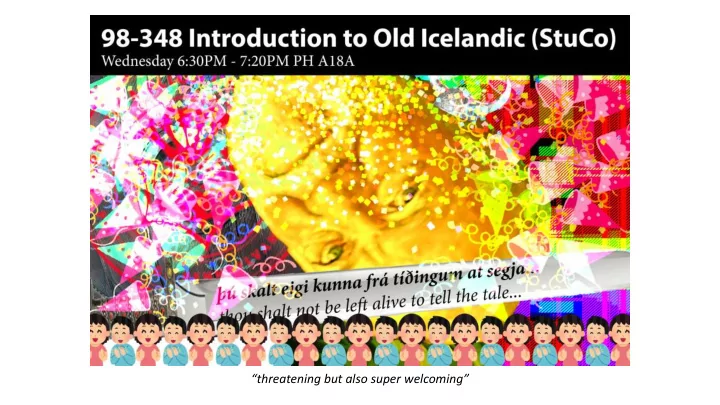
“threatening but also super welcoming”
slide-2
SLIDE 2

98-348: Lecture 0

slide-3
SLIDE 3

About me

  • Satoru Ozaki (sozaki)
  • Class of 2020, linguistics major
  • I love (generative) syntax!
  • I speak Mandarin Chinese and

Japanese

  • I am learning Swedish
slide-4
SLIDE 4

About you

  • Your name
  • What languages you speak/learn/learned
  • Anything else you’d like us to know
slide-5
SLIDE 5

What is OI (Old Icelandic)???

  • For now: an
  • ancient,
  • extinct language
  • spoken once in Norway and

Iceland

  • around 750-1350 AD
  • has a lot of descendants, among

which modern Icelandic preserves the most aspects of it Red areas on the map! →

slide-6
SLIDE 6

Why learn OI???

slide-7
SLIDE 7
slide-8
SLIDE 8
slide-9
SLIDE 9

About this class (also see syllabus)

  • 3 goals
  • Know linguistics
  • aka. how languages do things
  • Learn OI grammar
  • aka. how OI does things
  • Learn OI
  • aka. learning OI vocab, understanding/translating OI texts, confusing yourself

if you are already learning an OI descendant, i.e. a Scandinavian language

  • 50% language, 50% linguistics
slide-10
SLIDE 10

About this class

  • Rough semester schedule
  • 1/3: learning OI grammar
  • Then: reading and translating OI texts
  • All the time: talking about concepts in linguistics, talking about how languages

do things, learning OI vocab (also very important!)

  • Maybe: writing your own stories (sagas!), etc.
  • Guest lectures!
slide-11
SLIDE 11

What to do for the last 1-3 weeks?

  • Choose some favorite topic from the semester and focus on it?
  • Some options for now:
  • Just more readings and translations
  • Epics, like The Prose Edda and The Poetic Edda
  • More about Proto-Germanic > OI
slide-12
SLIDE 12

Sharing is a virtue

  • For the first few classes, we will talk a lot about
  • Linguistic concepts, and
  • Strategies employed by different languages
  • What do I mean by that? An example…
slide-13
SLIDE 13

Example: pro-drop

  • In English, you always need a subject:
  • I speak English. The students spoke up.
  • *Speak English. *Spoke up.
  • In Spanish, you never need the subject for the 1st and 2nd persons,

i.e. ”I”, ”you”, ”we”, ”y’all”; the information is encoded in the verb:

  • Hablo inglés. “I speak English.”
  • Hablas español. “You speak Spanish.”
  • If the subject is clear from context, you don’t need the subject for the

3rd person either, i.e. ”he/she/it/they”:

  • (some discussion about John)… Habla japonés. ”He (= John) speaks Japanese.”

The star (*) indicates that the sentence is ungrammatical, i.e. bad!

slide-14
SLIDE 14

Example: pro-drop

  • But in both English and Spanish, you can’t drop the object:
  • I ate the apple. vs. I ate.

Different ”eat”s

  • Who ate the apple? *I ate.

Even though the object is clear from context, this is still bad!

  • But in Japanese, you can:
  • Ringo

tabeta? Tabeta. apple ate ate ’Did you eat apple?’ ’Ate.’ ’Did you eat the apple?’ ’I did.’

  • No subject!

No subject or object! If anything can be inferred from context, you can drop it

slide-15
SLIDE 15

Here we have a table

Language Can we drop the subject? Can we drop the

  • bject?

English Never Never Spanish Yes, then it’s inferred from context and verb ending Never Japanese Yes, then it’s inferred from context Yes, then it’s inferred from context

  • Spanish and Japanese are called

pro-drop languages

  • There are fancy reasons behind

this name, but think of it as “languages where you can drop the pronoun”

  • What’s the strategy for encoding

subjects/objects in English?

  • For Spanish?
  • For Japanese?
slide-16
SLIDE 16

More fun with tables

  • In English:
  • A: Where’s the table?
  • B: The kids were eating.
  • A: (Oh, they took the table because they needed it for the kids)
  • In Japanese:
  • A:Teeburu wa

doko? Table is where ’Where’s the table?’

  • B:Kodomotachi

ga tabeteta. The.kids were eating. ’The kids were eating.’

  • A: (??????? The kids were eating the table???????)

The kids were eating.

slide-17
SLIDE 17

Sharing is a virtue

  • It’s fun to see how different languages encode information in

different ways!

  • When we are discussing a particular concept, feel free to share

examples from a language you speak/know!

  • In general, feel free to interrupt if you have any questions/thoughts to

share

slide-18
SLIDE 18

Introduction to glosses

In Swedish, in order to say ”I am reading (at this very moment of speech)”, you’d say jag sitter och läser. Wow, so in order to indicate that the action is currently ongoing, instead of changing the ending on the verb, you’d add in another verb! I don’t speak Swedish! What is the green guy even talking about???

slide-19
SLIDE 19

Glosses

  • Format in which data from language A is annotated using language B
  • Five-line gloss:
  • Jag sitter och läser.

Sentence Jag sitter och läser. Words I sit and read. Words translated ‘I sit and read.’ Sentence literally translated ‘I am reading.’ Sentence translated

  • Three-line gloss:
  • Jag

sitter

  • ch

läser. Words I sit and read. Words translated ‘I am reading.’ Sentence translated

Sitter ‘sit’ was the verb that green guy was talking about!

slide-20
SLIDE 20

Practice!

  • Choose a language you speak
  • Write down what you would say in your language to order a salad
  • Write a gloss for that!
  • Example: Swedish

Jag skulle vilja ha en sallad. I would want have a salad ‘I’d like a salad.’

slide-21
SLIDE 21

Assessment

  • Quiz (not graded)
  • Every class, 5 min
  • Homework (graded)
  • Released every class, collected next class
  • Should take <30 min
  • Midterm and final (graded)
  • May be in-class or out-of-class
  • Closed notes, open dictionary (online!)
slide-22
SLIDE 22

Assessment

  • Final grade =
  • Homeworks 30%
  • Midterm 30%
  • Final 40%
  • Pass/Fail boundary is 30%
  • Will be lowered if the exams are too difficult
  • The idea is that the content is hard but passing is easy
slide-23
SLIDE 23

StuCo logistics

  • 3 units, Pass/Fail
  • >2 unexcused absences guarantee Fail
  • If you need to miss class, just let me know beforehand or send me an email

before class (even at the last minute)

  • This is just a StuCo, it’s okay to miss class if you need time for your other

classes/projects/etc., if you feel sick, etc.

slide-24
SLIDE 24

StuCo logistics

  • It’s sad to have to drop this class (or any StuCo) because you’ve

accumulated >2 unexcused absences, please don’t

  • If you have to drop, drop before the drop deadline!
  • Don’t be this person
slide-25
SLIDE 25

Counting this StuCo towards your linguistics minor

  • This seems possible, according to Tom
  • If you are interested, please contact Tom (twerner)!
slide-26
SLIDE 26

Quick survey

  • Who’s doing/considering a linguistics major/minor?
  • Who’s taken 80-180: Ñature of Language?
  • Who’s learned a foreign language before?
  • Who’s studied Latin or Ancient Greek before?
slide-27
SLIDE 27

Course website

  • [Link here]
  • Syllabus, slides, homeworks, reading lists and links, etc.
slide-28
SLIDE 28

Textbook

  • New Introduction to Old Norse, Michael Barnes (2008).
  • http://www.vsnrweb-publications.org.uk/NION-1.pdf
  • Optional: An Introduction to Old Norse, E. V. Gordon (1926).
  • This seems to be available on the Internet Web Archive.
  • Ugly: Viking Language 1: Learn Old Norse, Runes,

and Icelandic Sagas, Jesse L. Byock (2013).

slide-29
SLIDE 29

Some advertisements

  • Try linguistics classes!
  • Try modern language classes! (Also offered at Pitt)
  • Join the linguistics club!
slide-30
SLIDE 30

Problems

  • Do people want a better classroom?
  • Do people want a Piazza?
slide-31
SLIDE 31

Next semester: Old Akkadian vs. Old Irish

slide-32
SLIDE 32

Also