This webinar is presented by Tonights panel Lauren Campbell - - PDF document

this webinar is presented by
SMART_READER_LITE
LIVE PREVIEW

This webinar is presented by Tonights panel Lauren Campbell - - PDF document

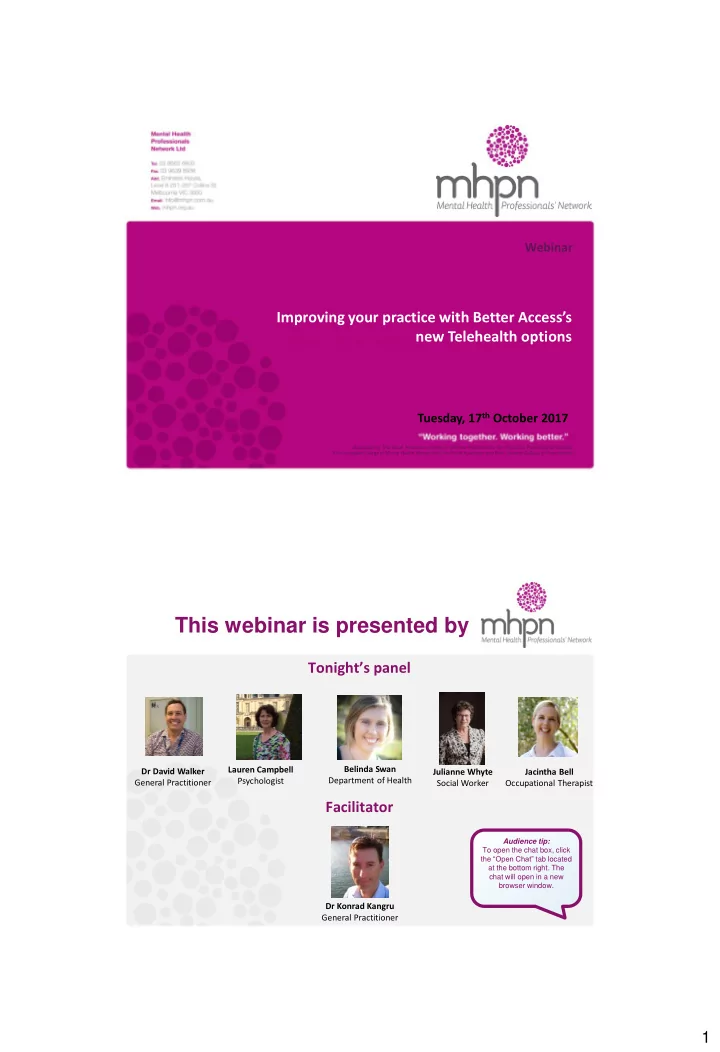
Webinar Improving your practice with Better Accesss DATE: November 12, 2008 new Telehealth options Tuesday, 17 th October 2017 Supported by The Royal Australian College of General Practitioners, the Australian Psychological Society, the


slide-1
SLIDE 1

1

Supported by The Royal Australian College of General Practitioners, the Australian Psychological Society, the Australian College of Mental Health Nurses and The Royal Australian and New Zealand College of Psychiatrists

DATE:

November 12, 2008 Webinar Tuesday, 17th October 2017

Improving your practice with Better Access’s new Telehealth options

This webinar is presented by

Tonight’s panel Facilitator

Lauren Campbell Psychologist Dr Konrad Kangru General Practitioner Jacintha Bell Occupational Therapist Julianne Whyte Social Worker Dr David Walker General Practitioner

Audience tip: To open the chat box, click the “Open Chat” tab located at the bottom right. The chat will open in a new browser window.

Belinda Swan Department of Health

slide-2
SLIDE 2

2

Department of Health

This webinar has been made possible through funding provided by the Australian Government Department of Health.

Ground Rules

To help ensure everyone has the opportunity to gain the most from the live webinar, we ask that all participants consider the following ground rules:

  • Be respectful of other participants and panellists. Behave as you would in a

face-to-face activity.

  • You may interact with each other and the panel by using the participant chat
  • box. As a courtesy to other participants and the panel, keep your comments
  • n topic. Please note that if you post your technical issues in the participant

chat box you may not be responded to.

  • For help with your technical issues, click the Technical Support FAQ tab at the

top of the screen. If you still require support, call the Redback Help Desk on 1800 291 863. If there is a significant issue affecting all participants, you will be alerted via an on screen announcement.

slide-3
SLIDE 3

3

Learning Outcomes

Through an exploration of telehealth for rural and remote patients, the webinar will provide participants with the opportunity to:

  • outline how new telehealth measures will provide improved access to

psychological services in rural and remote areas

  • recognise appropriate times to use new telehealth measures for rural

and remote clients

  • identify strategies to implement new systems within practice to

improve referrals for clients eligible for telehealth services.

Audience tip: The PowerPoint slideshow, Warren’s story and supporting resources can be found in the Resources Library tab at the bottom right.

DoH perspective

  • Improving access to mental health treatment for people in rural and remote

locations

  • Commences 1 November 2017

Belinda Swan

New Telehealth services available through the ‘Better Access to Psychiatrists, Psychologists and General Practitioners through the MBS’ (Better Access) initiative

slide-4
SLIDE 4

4

DoH perspective

  • Annual session limits, rebate amounts, session times and many eligibility

requirements remain the same

Belinda Swan

This is a new way for allied mental health professionals to deliver Better Access services

What is changing?

  • Eligible allied mental health practitioners can now offer Psychological

Therapy Services and Focussed Psychological Strategy services via video conferencing

  • New MBS item numbers for video conferencing consultations
  • A maximum of 7 consultations can be delivered through video

conferencing each calendar year

  • One of the first four sessions must be face to face

DoH perspective

slide-5
SLIDE 5

5

DoH perspective

MMM Locator: Detailed map and a search option to find an address: http://www.doctorconnect.gov.au/internet/otd/publishing.nsf/Content/MMM_locator

Who is eligible to receive telehealth Better Access services

Existing Better Access patient eligibility requirements apply

In addition:

  • The patient must be located in

a rural or remote location (Monash Modified Regions 4- 7)

  • The patient must be located at

least 15km by road from an eligible Better Access allied mental health provider

DoH perspective

  • Allied mental health practitioners eligible to deliver existing Better Access services
  • Practitioners will need to consider clinical appropriateness and the security and

reliability of the technology before offering telehealth consultations

  • The Australian Psychological Society has received funding to prepare further

guidance for mental health practitioners

  • General practitioners will continue to provide face-to-face Better Access services

Belinda Swan

Who can deliver the new telehealth Better Access services?

slide-6
SLIDE 6

6

DoH perspective

  • Guidelines and Frequently Asked Questions is available on the Department of

Health website at: http://www.health.gov.au/internet/main/publishing.nsf/Content/mental-ba- telehealth

Belinda Swan

Further information

General Practitioner perspective

Dr David Walker

Leveraging off likely pre-existing therapeutic relationship

  • Warning signs
  • Empathy for situation – understanding family and work context
  • Excluding organic causes for presentation
  • Seeing the “whole person” and chance for opportunistic care
slide-7
SLIDE 7

7

General Practitioner perspective

Dr David Walker

Diagnosis and referral:

  • Making a mental health diagnosis to ensure eligibility
  • Diagnosis – processing concerns about stigma
  • Medication – not necessarily jumping to this
  • Discussing non-pharmacological options

– Face to face options in neighbouring towns – “Digital” options – Telehealth Access to Allied Health practitioner

General Practitioner perspective

Dr David Walker

Telehealth

  • Doing up a MHTP
  • Seeking client understanding/permission to engage in telehealth method and
  • Referring to a psychologist.
slide-8
SLIDE 8

8

General Practitioner perspective

Note that…

  • GPs exempt from MHTP and providing FPS
  • Medicare rebates not available to GPs to attend telehealth consults
  • Patient travel subsidies might not cover travel to see Allied Health

(check local rules)

Dr David Walker

Occupational Therapist perspective

  • Meets the criteria for the Better Access program.
  • Living in a rural area where the closest psychological service is 50km away.
  • Concerned about stigma and time limited.
  • There does not appear to be any acute risk.
  • Is Warren willing to engage and to travel for at least one appointment face to face.
  • Does Warren have access to reliable and affordable technology suitable for teleconferencing?
  • As we are a mental health occupational therapy service, are we the best available MH provider

to meet Warren’s needs? Is the GP willing to refer to an occupational therapist who is endorsed to provide focussed psychological strategies?

Jacintha Bell

Is provision of FPS via Telehealth appropriate?

slide-9
SLIDE 9

9

Risk Management

  • Management of risk is essential.
  • What if Warren/client expressed suicidal ideation during the video consult, or left the

consult abruptly, or did not present for the consult?

  • Initial consult to be conducted through face to face consultation:

– Development of the therapeutic relationship – Conduct a thorough risk assessment – Develop a contingency/crisis plan if necessary – Agree to reasonable boundaries for the provision of services.

  • Example: If you do not respond to the videoconference, I will call your phone, if you

don’t answer the phone, I will call your wife’s phone.

  • Be aware of all of the relevant services available in Warren’s area, so we can build this

into the plan if necessary (eg: Mental health service, ambulance, GP, etc.).

  • I am based in the city – initial consult can often be co-ordinated with other specialist

medical appointments or reasons to travel to the city (eg: collecting supplies).

Occupational Therapist perspective

Provision of FPS via videoconference

  • Initial assessment face to face, and agreement on a treatment plan, crisis plan and
  • contingencies. Write back to the GP outlining the details.
  • Subsequent appointments via videoconference. Keep in mind privacy - end to end

encryption, etc.

  • Warren will need to have a quiet space where he is comfortable to sit for an hour, and

able to talk unencumbered.

  • It is best if the computer is hard wired to the modem, rather than on a wireless

connection.

  • Clinician will need to have the same sort of set-up.
  • Clinician will also need to be presented professionally, and the environment around

should be professional-looking (e.g. an office) with good light.

  • Test any technology before the first teleconference to make sure it works properly, and

also to have a plan of what to do if the internet connection is no good/drops out.

  • For example, we have turned the sound off, and just had the video via internet,

and spoken over the phone, when the connection is poor.

Jacintha Bell

Occupational Therapist perspective

slide-10
SLIDE 10

10

Provision of FPS via videoconference continued…

  • It is ideal if Warren has access to a secure platform for sending documents, printer and

scanner or fax, so that you can send through any worksheets, reading, questionnaires, that Warren can do and then send back to you. Post is too slow.

  • It is difficult to write on a whiteboard, or even show things on a piece of paper during
  • consultations. It is much better to send these through via a secure platform before or

after the appointment.

  • While engaging via videoconference, consider position of the webcam, and video of the

client, at eye level so it looks as though you are making eye contact and talking to

  • Warren. Use all of your usual active listening skills.
  • Remember, just as you do with your regular clients to be punctual, and to let Warren

know if you are running late, so he is not sitting at the computer, waiting. I prefer to be the person who initiates the teleconference, rather than the client.

  • At the completion of six sessions, write back to the GP re: progress and offer

recommendations.

Jacintha Bell

Occupational Therapist perspective

OT provision of FPS

  • What services might an OT offer to Warren via telehealth?
  • Focus would be on enabling occupational participation – e.g. Enabling Warren to do the

things he wants to do and needs to do in his life.

  • Psychoeducation
  • Motivational interviewing – possibly regarding alcohol use or any other area of

ambivalence.

  • Goal setting
  • Sleep hygiene
  • Activity scheduling – developing a realistic and manageable routine
  • Problem solving
  • Stress management

Jacintha Bell

Occupational Therapist perspective

slide-11
SLIDE 11

11

Psychologist perspective

  • Psychology practice in a small remote rural community in Victoria.
  • Client referral from local GP via Better Access Telehealth.
  • Initial consultation in office housing a multi-disciplinary team to increase

client perceived confidentiality.

  • Support person (wife) encouraged to attend initial consultation.

Lauren Campbell

Setting the scene

Psychologist perspective

  • Clarify advantages of using Telehealth technology
  • Seven subsequent consultations arranged by Telehealth (on agreed

technology platform with client consent)

  • reduce stress from cost of 100km round trip
  • reduce time away from work
  • increase client perceived confidentiality in a small community.

Lauren Campbell

Introduce Telehealth concept

slide-12
SLIDE 12

12

Psychologist perspective

Ground Rules

  • Establish ground rules for commitment to appointment time if client was in

consulting rooms.

  • Specify a particular location in the home/office where client will not be

interrupted.

  • Check that client has had experience with Skype or FaceTime.

Lauren Campbell

Psychologist perspective

More ground rules

  • Ask client to practice Skype/FaceTime with family or friends
  • Psychologist to ring client at agreed time
  • Length of appointment will be the same as usual e.g. 50 minutes
  • Use visual input to evaluate client progress

Lauren Campbell

slide-13
SLIDE 13

13

Psychologist perspective

  • Begin therapy with psychoeducation regarding depression/anxiety and its

effect on sleep.

  • Use acceptance and commitment therapy (ACT) to encourage acceptance of

situation.

  • Focus on positive anchors to divert negative thoughts
  • Consider: Finances, Relationships, Alcohol use, Loss of energy, Past Trauma.
  • Empower client to focus on an area that can be changed/improved
  • Provide feedback to GP & allied health team.

Lauren Campbell

Therapeutic process

Social Worker approach

Julianne Whyte

  • Person in environment approach - eco-mapping, genogram
  • Places the person as separate to the problem/s – the problem

is the problem not the person

  • Utilises bio-psycho-social assessment

– Biological – Physical & medical issues – fatigue, age, sleep knowledge and skills (hygiene) – Psychological – frustration, grief/loss, personal schema, values, coping mechanisms/styles – alcohol, worry – Social - expectations – personal and social, frustrations, finances, Warren’s perceptions of the “problem”, other’s perception of the problem – Difficulties accessing support/help

slide-14
SLIDE 14

14

Social Worker approach

Initial engagement with Warren

Possibility of using Mixed Modes in the delivery of therapy

  • Face to face and telehealth – clear explanation of benefits and expectations

– both from client and from clinician

  • Benefits, difficulties, safeguards, follow up (as per early slides)

Develop and build respectful therapeutic alliance: Structured approach

  • Clear identification of approach/s to be used or offered – Warren needs to

feel value in investing the time and energy. Telehealth requires focussed microskills – listening, paraphrasing, summarising, checking for meaning, watching facial expressions, affect.

Julianne Whyte

Social Worker approach

Initial engagement continued…

Problem identification

  • Hierarchy of problems from Warren’s perspective
  • Warren’s attempts to ‘fix’ the problem – what’s worked in the past –

strengths approach, schema

  • Inclusive of his wife/ trusted family member – systems

Goals – start with easy achievable goals

  • Short, medium term and achievable goals – based on values,

motivation, meaning

Julianne Whyte

slide-15
SLIDE 15

15

Social Worker perspective

  • Cognitive Grief approaches – the neurological, the biological and psychological

reaction to any significant change where the perception is one of loss. It can be primary, secondary or tertiary.

  • Grief is the response to loss, not simply an emotion. The

word "grief" is shorthand for a complex, multifaceted experience that changes over time and varies from loss to loss.

  • Grief is an automatic reaction, presumably guided by

brain circuitry activated in response to a world altered by the los of a strongly held belief (schema), value, relationship – not just related to death.

Approaches to offer Warren and Karen

Education is essential to understand the cause of the problem

Social worker approach

Approaches to offer Warren and Karen continued…

Understanding Schemas and how they may inform Warren’s attempt at solutions and inform his values A schema is a mental structure used to organise and simplify a person’s knowledge of the world around them. Schemas:

  • can be related to one another, sometimes in a hierarchy
  • can affect how we filter problems, how a problem is interpreted, and

can influence how solutions or coping mechanisms are enacted

  • act like filters, accentuating and downplaying various aspects of the

problem

  • also help us forecast, predicting what will happen. We even

remember and recall things via schemas, using them to ‘encode’ memories.

slide-16
SLIDE 16

16

Social Worker perspective

Schema Activation Formulation

Adapted from PsychologyTools.com Julianne Whyte

Social Worker perspective

Dual Processing Model of Grief Stroebe and Schut. 1999

Oscillation between attending to the loss or attending to/distracting behaviours.

slide-17
SLIDE 17

17

Questions and Answers

Lauren Campbell Psychologist Dr Konrad Kangru General Practitioner Jacintha Bell Occupational Therapist Julianne Whyte Social Worker Dr David Walker General Practitioner Belinda Swan Department of Health

Thank you for your participation

  • Please ensure you complete the feedback survey before you log out.
  • If the survey doesn’t appear, click the Feedback Survey tab at the bottom of the

screen

  • Certificates of Attendance for this webinar will be issued within four weeks
  • Each participant will be sent a link to the online resources associated with this

webinar within four weeks

  • Our next webinar, Internet Gaming Addiction will be held 22nd November

Sign up at www.mhpn.org.au/UpcomingWebinars

Audience tip: Your feedback is important – please click the Feedback Survey tab to open the survey

slide-18
SLIDE 18

18 Are you interested in joining an MHPN network in your local area? View a list of MHPN’s networks here. Join one today! For more information about MHPN networks and online activities, visit www.mhpn.org.au

Audience tip: Your feedback is important – please click the Feedback Survey tab to open the survey

Thank you for your contribution and participation Good evening

Audience tip: Your feedback is important – please click the Feedback Survey tab to open the survey