Thesis/dissertation presentation guidelines A. General formatting - - PDF document

thesis dissertation presentation guidelines
SMART_READER_LITE
LIVE PREVIEW

Thesis/dissertation presentation guidelines A. General formatting - - PDF document

AGST Alliance Thesis/dissertation presentation guidelines A. General formatting guidelines 1. Paper and page size : Print each copy of the thesis/dissertation on good quality white 70-80gsm A4 paper. Print on one side of the sheet only. 2.


slide-1
SLIDE 1

AGST Alliance

Thesis/dissertation presentation guidelines

  • A. General formatting guidelines

1. Paper and page size: Print each copy of the thesis/dissertation on good quality white 70-80gsm A4 paper. Print on one side of the sheet only. 2. Print quality: Final copy may be computer printed or photocopied. In either case clear, clean and sharp copies are required. Photocopied pages should be without gray background or black copy lines. 3. Page margins: Set the left margin at 4 cm. Margins on the remaining three sides should be not less than 2 cm each. Use a right ragged margin. 4. Font: Use Times New Roman 12 point font or a close equivalent for the main text. Figures, tables and appendices may use different fonts and font sizes, but ensure that they are readable. 5. Line spacing: Use 1.5 line space throughout the text. However, note the following exceptions:

  • Captions for figures/tables – single-spaced.
  • Block quotations – single-spaced.
  • Lists of Figures/Tables – single-spaced (with a line space between entries).
  • Footnotes – single-spaced.

6. Page numbering: Number all pages except the title page in the top right hand corner. Use numerals (1, 2, 3, etc.) for the main text. Use a separate sequence of numbering for the introductory pages preceding the main thesis/dissertation text, with Roman numerals (i, ii, iii, iv, etc.). 7. Figures/tables numbering: Figures and tables should be numbered consecutively through the thesis/dissertation. Don’t start renumbering for each chapter. Thus Figure 1, Figure 2, etc… Table 1, Table 2, etc… 8. Footnotes: Footnotes should appear at the bottom of the page to which they refer, in 10 point font size. 9. Paragraph Style: Please use the blocked paragraph style (no indent on first line).

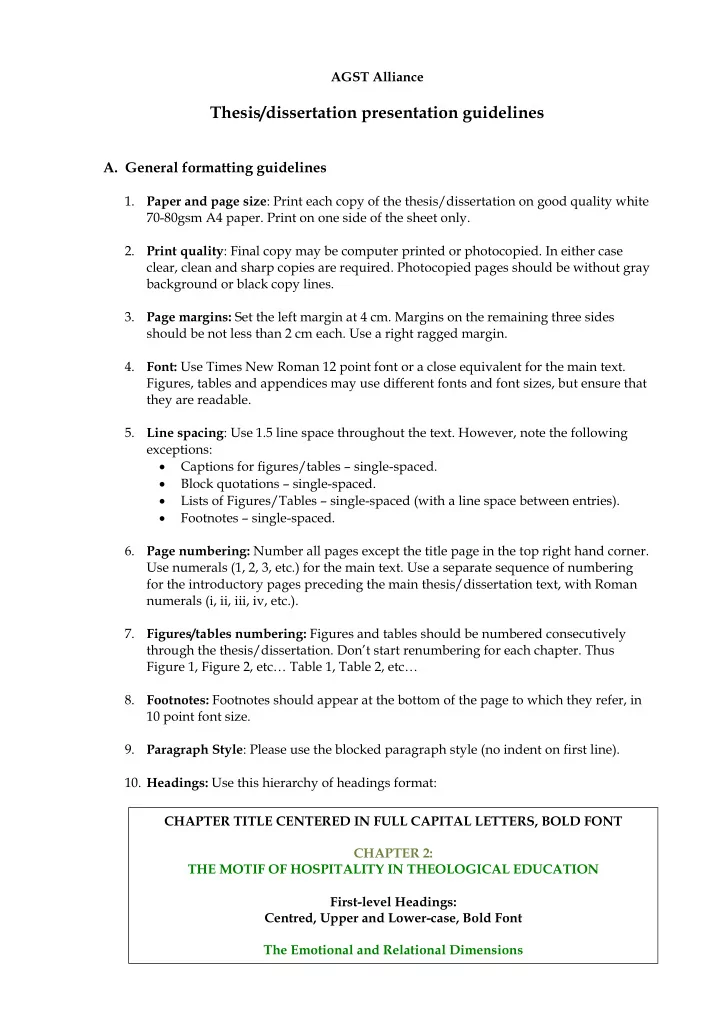
  • 10. Headings: Use this hierarchy of headings format:

CHAPTER TITLE CENTERED IN FULL CAPITAL LETTERS, BOLD FONT CHAPTER 2: THE MOTIF OF HOSPITALITY IN THEOLOGICAL EDUCATION First-level Headings: Centred, Upper and Lower-case, Bold Font The Emotional and Relational Dimensions

slide-2
SLIDE 2

Thesis/dissertation presentation guidelines | 2

May 2020

Second-level Headings: Centred, Upper and Lower-case, Not Bold Shifting Trends in Higher Education Third-level Headings: Against the Left Margin, in Bold Font, Upper and Lower Case From Teaching to Learning Fourth-level headings: Against the left margin, not bold, lower case Reality – then and now

  • 11. Outline numbering: Use this system of notation for numbered outlines:
  • A. [ A. … B. … C. … D. …]
  • 1. [ 1. … 2. ... 3. … 4. …]

a) [ a) … b) … c) … d) …] (1) [ (1) … (2) … (3) … (4) …)]

  • B. Sequence of contents

Present the contents of the thesis/dissertation in this order:

  • Title page
  • Declaration of originality
  • Abstract (maximum 300 words)
  • Acknowledgements
  • Table of contents
  • Lists of tables and figures
  • Notes and abbreviations
  • Main body of thesis/dissertation
  • References
  • Appendices
  • C. Title Page

The title page should contain the following information, using the same font as for your main text at maximum 16 point size:

  • Thesis/dissertation title in bold, and in sentence case (i.e. Capital letter only for the

first word and proper nouns).

  • Candidate’s name. Do not append qualifications.
  • The words: “This thesis/dissertation [select one] is presented for the degree of

<Name of degree> of AGST Alliance. <Year>.

slide-3
SLIDE 3

Thesis/dissertation presentation guidelines | 3

May 2020

Figure 1: Title Page – sample (a) (b) (c) (d) (e) (f) (g) (h) (i) (j) (k) (l) (m) (n)

  • D. Declaration of originality

The page following the title page of your thesis/dissertation should include this signed declaration: I declare that this thesis/dissertation [select one] is my own account of my research and contains as its main content work which has not previously been submitted for a qualification at any tertiary education institution. .......................................................................................... (Name and signature)

  • E. Thesis/dissertation physical presentation

1. Examination copies:

  • Softcopy: Submit an electronic copy of the thesis/dissertation version from

which the paper copies were printed. Medium-resolution .pdf format is

  • preferred. [This is now the common medium for thesis/dissertation examination

copies.]

  • Hardcopy: If printed (paper) copies of a thesis/dissertation are required for the

examination process, submit them to AGST Alliance in temporary but firm binding (‘soft-bound’, e.g. ringback or spiral binding). Use a clear plastic front

Into maturity: A study of models of teenage faith formation in Malaysian Anglican churches

Marie Poon This thesis is presented for the degree of Master of Theology (Education)

  • f AGST Alliance

2020

slide-4
SLIDE 4

Thesis/dissertation presentation guidelines | 4

May 2020

cover and light board back cover.

  • Attachments/non-written items

If the thesis/dissertation includes ‘non-written’ items, like a DVD, photographs

  • r portfolio of some form, attach these securely to the thesis/dissertation. For

example, use a flapped DVD envelope mounted with double-sided tape. When you are close to submitting your thesis/dissertation for examination, confirm with AGST Alliance how many, if any, printed copies will be required. 2. Approved, bound copies: When all the revisions have been made and a thesis/dissertation has been finally approved, two bound paper copies need to be submitted to AGST Alliance, along with an electronic copy of the thesis/dissertation version from which the paper copies were printed. Medium-resolution .pdf format is preferred. The student/candidate takes responsibility for producing the bound copies and the electronic copy. Student/candidates may print other copies for their own use. It is courteous to offer a copy to each supervisor (but check whether they would prefer hard- or soft-copy format). Examiners are normally permitted to keep their examination copy, but if they have returned it to the student with annotations, it is courteous for the student to offer the examiners another, unmarked copy, in either soft- or hard-copy format.

  • Binding requirements: Theses/dissertations need to be bound in cloth or

buckram, and sewn rather than stapled.

  • Thesis/dissertation colours: The colours to use for the bound copies are
  • For PhD dissertations: maroon, similar to Pantone colour 491.
  • For EdD dissertations: sky blue, similar to Pantone colour 283.
  • For MTh theses: dark green, similar to Pantone colour 3435.
  • Cover/spine text: This is printed in gold with the following text items:

a) On the spine of the bound copies (CAPITALS text running from top to bottom):

  • the title (abbreviated if necessary)
  • the name of the candidate
  • AGST ALLIANCE
  • the year in which the degree is conferred (not examined)

Figure 2: Spine – sample (o) (p) b) b) On the cover of the bound copies, with all text in CAPITALS

  • the full title
  • the name of the candidate
  • AGST ALLIANCE
  • the year in which the degree is conferred (not the year it was examined)

MODELS OF TEENAGE FAITH FORMATION MARIE POON AGST ALLIANCE 2020

slide-5
SLIDE 5

Thesis/dissertation presentation guidelines | 5

May 2020

Figure 3: Cover – sample

* * * * * * *

A STUDY OF MODELS OF TEENAGE FAITH FORMATION IN MALAYSIAN ANGLICAN CHURCHES

MARIE POON

AGST ALLIANCE

2020

slide-6
SLIDE 6

Thesis/dissertation presentation guidelines | 6

May 2020

Turabian Author-Date Reference Style Quick Tips

For further detail about thesis/dissertation formatting, follow the guidelines in K. Turabian, A Manual for Writers of Research Papers, Theses and Dissertations. 9th ed. Chicago, IL: University

  • f Chicago Press, 2018. Turabian has two styles and AGST Alliance uses the Author-Date

style.

  • A. Quotations

Quotations have a significant function in your thesis/dissertation. Although, remember it is primarily you the reader needs to hear from, not other writers!

  • All quotations must appear exactly as in the original. You must not change words,

punctuation, or grammar (except in a small number of special cases).

  • Length of quotations: Avoid long quotations unless they are quite necessary to your line
  • f argument. It may be better to paraphrase what a writer is saying than have a lengthy

quotation.

  • Presenting quotations in your thesis/dissertation:

Quotations of less than 40 words should be integrated into the flow of your text, between quotation marks (“…”), e.g. On this point, Robert Banks suggested that, “It is not merely the extent of Paul’s contribution that sets it apart from others in the first century, but its quality” (Banks 1998, 10). His views should be given adequate attention. Quotations longer than 40 words (about three lines) should start on a new line, be indented, and without quotation marks, e.g. This point has been developed further by Robert Banks, who wrote: It is not merely the extent of Paul’s contribution that sets it apart from

  • thers in the first century, but its quality. We find here the most clearly

developed and profound understanding of community in all the early Christian writings. (Banks 1998, 10) If you need to leave some words or lines of text out of a quotation, indicate this with ‘…’, e.g. (from the above quotation): “It is not merely the extent of Paul’s contribution … but its quality.”

  • B. Plagiarism

Plagiarism is the practice of borrowing from the work of another persons without acknowledging the source. Within the academic world, intentional plagiarism is treated very

  • seriously. At your level of study you need to pay extra special care with it.
  • C. Footnotes/endnotes

Footnotes (at the bottom of a page) and endnotes (at the end of an thesis/dissertation) may be used to provide the reader with information which is related to the main line of discussion in the text, but does not fit readily in the flow of the text.

slide-7
SLIDE 7

Thesis/dissertation presentation guidelines | 7

May 2020

  • In general, use footnotes sparingly. Work on the principle “if something is worth saying,

it is worth saying in the text.” Thus, instead of using a note, reorganise your text to include the material there. Note: Footnotes/endnotes are usually included in the total word count, so you don’t gain extra words by having lengthy notes.

  • Where footnotes/endnotes are used, number them consecutively (1... 2... 3... etc.) from

the beginning to the end of the thesis/dissertation. Ensure that footnotes appear at the bottom of the same page with the text to which they refer.

  • D. Appendices

When you have a detailed table or chart, a long quotation, or other data to which you refer in your thesis/dissertation, place this in an appendix at the end of your thesis/dissertation – and refer to it in the text with the phrase “See Appendix (A… B… etc. if there is more than

  • ne appendix)”.

However, use appendices with discretion. They are not intended to be an extension of the argument or discussion of your thesis/dissertation.

  • E. References

It is essential that you are careful to acknowledge the source of your data and information clearly and accurately. This is done in two areas of your thesis/dissertation: 1. In the text of your thesis/dissertation, acknowledge when you use material which is not original to you. 2. At the end of your thesis/dissertation, you give fuller bibliographical details of the references you have used in the text. There are conventions to use for both these areas. 1. In-text references A number of referencing styles are available. AGST Alliance uses the author-date style, which has been traditionally used in the physical and natural sciences, but is now gaining popularity in the humanities because of its simplicity. [See especially Turabian, chs 18-19.] [The main alternative style, often used by writers in theology, literature and the arts, is the ‘footnotes style’ (or ‘documentary-note’ style), which is used especially if there is a need for additional footnoted material.]

Author-date reference style

  • Sources are indicated in brackets in the text with the author’s name, the year of the

publication, and the page(s) cited – and then full details are given in the list of references at the end of the thesis/dissertation. Example: With the growth of Christianity came threats (Hill 1985, 32). Note: there is no comma between the author’s name and date; and no ‘p’ for the page number.

  • If the author’s name occurs naturally in the text, it does not need to be repeated in the
slide-8
SLIDE 8

Thesis/dissertation presentation guidelines | 8

May 2020

brackets, e.g. Hill (1985, 32) suggested that with the growth of Christianity came threats.

  • If you are citing more than one work written in the same year by a particular author, use

‘a’ and ‘b’ after the date, e.g. Astley (1992a) was concerned about Christian worship, while he also expressed concerns for Christian growth (1992b).

  • No abbreviations (e.g. ibid, op. cit. etc.) are used in this style.
  • If more than one author is cited in the parentheses, list in alphabetical order (by author’s

surname) – and all appear in the same set of parentheses, e.g. This theory was widely known (e.g. Boldy 1998, Hill 1985, Symons and Raus 1993). 2. Reference list A full list of all the references you have quoted from and/or referred to in your thesis/dissertation must be included at the end of your thesis/dissertation. [NB a reference list differs from a bibliography, which provides a comprehensive list of all the sources you have consulted for your thesis/dissertation. Most frequently you will use a reference list.] List your references in alphabetical order, using the following sample formats. (For more details and many more examples, see Turabian, chs. 18-19.) If your reference list or bibliography includes two or more works written, edited, or translated by the same individual, arrange the entries chronologically after the publication

  • date. For all entries after the first, replace the individual’s name with a 3-em dash.

Chong, Terence. 2015. ‘Megachurches in Singapore: The Faith of an Emergent Middle Class’. Pacific Affairs 88 (2). https://doi.org/10.5509/2015882215. ______. , ed. 2018. Pentecostal Megachurches in Southeast Asia: Negotiating Class, Consumption and the Nation. Singapore: ISEAS Publishing. https://bookshop.iseas.edu.sg/publication/2307. [Note where italics are used in these formats] * * * * * * *

slide-9
SLIDE 9

Thesis/dissertation presentation guidelines | 9

May 2020

Sample references and citations1

[Each example of a reference list entry is accompanied by an example of a corresponding parenthetical citation in the text] 1. Books [printed]

  • One author:

Hill, Brian V. 1985. The Greening of Christian Education. Sydney: Lancer Books. (Hill 1985, 32)

  • Two-three authors

Morey, Peter, and Amina Yaqin. 2011. Framing Muslims: Stereotyping and Representation after 9/11. Cambridge, MA: Harvard University Press. (Morey and Yaqin 2011, 52)

  • For four or more authors, list all of the authors in the reference list; in the text, list only

the first author, followed by “et al.” (“and others”): Bernstein, Jay M., Claudia Brodsky, Anthony J. Cascardi, Thierry de Duve, Aleš Erjavec, Robert Kaufman, and Fred Rush. 2010. Art and Aesthetics After Adorno. Berkeley: University of California Press. (Bernstein et al. 2010, 276)

  • Editor or translator instead of author

Lattimore, Richmond, trans. 1951. The Iliad of Homer. Chicago: University of Chicago Press. (Lattimore 1951, 91–92)

  • Editor or translator in addition to author

Austen, Jane. 2011. Persuasion: An Annotated Edition. Edited by Robert Morrison. Cambridge, MA: Belknap Press of Harvard University Press. (Austen 2011, 311–12)

  • Chapter in an edited book

Strommen, M. 1993. “Rethinking Family Ministry.” In Rethinking Christian Education, edited by D. Schuller, 57-72. St. Louis, MI: Chalice Press. (Strommen 1993, 62)

  • Preface, foreword, introduction, or similar part of a book

Cronon, William. 2012. Foreword to The Republic of Nature, by Mark Fiege, ix–xii. Seattle: University of Washington Press. (Cronon 2012, ix)

1 Material this section has been adapted from

http://www.press.uchicago.edu/books/turabian/turabian_citationguide.html/.

slide-10
SLIDE 10

Thesis/dissertation presentation guidelines | 10

May 2020

2. Books [published electronically] If a book is available in more than one format (print and e-version), give a reference for the version you consulted. Wilkerson, Isabel. 2010. The Warmth of Other Suns: The Epic Story of America’s great

  • migration. New York: Vintage. Kindle.

(Wilkerson 2010, 183–84) [Note: Use Kindle location #: e.g. 1862]

  • For books consulted online, include an access date and a URL.

Kurland, Philip B., and Ralph Lerner, eds. 1987. The Founders’ Constitution. Chicago: University of Chicago Press. Accessed October 15, 2011. http://press- pubs.uchicago.edu/founders/. (Kurland and Lerner 1987, chap. 10, doc. 19)

  • For books consulted in a database, you may give the name of the database instead of a
  • URL. If no fixed page numbers are available, you can include a section title or a chapter
  • r other number.

Quinlan, Joseph P. 2010. The Last Economic Superpower: The Retreat of Globalization, the End

  • f American Dominance, and What We Can Do about It. New York: McGraw-Hill.

Accessed December 8, 2012. ProQuest Library. (Quinlan 2010, 211) 3. Journal articles

  • Journal article in print

Andersen, William. 1999. “Self-esteem, Self and Sin.” Journal of Christian Education 42, no. 1: 25-36. (Anderson 1999, 31)

  • Article in an online journal consulted online, include an access date and a URL.

Brown, Campbell. 2011. “Consequentialize This.” Ethics 121, no. 4 (July): 749–71. Accessed December 1, 2012. http://dx.doi.org/10.1086/660696. (Brown 2011, 752)

  • Article in a database, you may give the name of the database instead.

Kurylo, Anastacia. 2012. “Linsanity: The Construction of (Asian) Identity in an Online New York Knicks Basketball Forum.” China Media Research 8, no. 4 (October): 15–28. Accessed March 9, 2013. Academic OneFile. (Kurylo 2012, 16)

  • References from internet sources

Wong, Albert. 2006. The Age of Transformation. NAE Online, 20 May. Accessed 18 March

  • 2015. http://www.better-learning.org.

(Wong 2006) 4. Magazine article Lepore, Jill. 2011. “Dickens in Eden.” New Yorker, August 29.

slide-11
SLIDE 11

Thesis/dissertation presentation guidelines | 11

May 2020

(Lepore 2011, 52) 5. Newspaper article Newspaper articles may be cited in running text (e.g. “As Elisabeth Bumiller and Thom Shanker noted in a New York Times article on January 23, 2013, …”) and they are commonly omitted from a reference list. A more formal version of a newspaper citation is: Bumiller, Elisabeth, and Thom Shanker. 2013. “Pentagon Lifts Ban on Women in Combat.” New York Times, January 23. Accessed January 24, 2013. http://www.nytimes.com/2013/01/24/us/ pentagon-says-it-is-lifting-ban-on- women-in-combat.html. (Bumiller and Shanker 2013) 6. Book review Mokyr, Joel. 2011. Review of Natural Experiments of History, edited by Jared Diamond and James A. Robinson. American Historical Review 116, no. 3 (June): 752–55. Accessed December 9, 2011. http://dx.doi.org/10.1086/ahr.116.3.752. (Mokyr 2011, 754) 7. Thesis or dissertation Soh, Davina. 2015. “The Motif Of Hospitality In Theological Education: A Critical Appraisal with Implications for Application in Theological Education.” PhD(Ed) diss., AGST Alliance. (Soh 2015, 101) 8. Paper presented at a meeting or conference Adelman, Rachel. 2009. “ ‘Such Stuff as Dreams Are Made On’: God’s Footstool in the Aramaic Targumim and Midrashic Tradition.” Paper presented at the annual meeting for the Society of Biblical Literature, New Orleans, Louisiana, November 21–24. (Adelman 2009) 9. Website A reference to website content can often be limited to a mention in the text (e.g. “As of August 28, 2015, AGST Alliance listed six strengths of its programs…”). A more formal version of a website citation is: AGST Alliance. 2015. “Our strengths.” Accessed August 28, 2015. http://agstalliance.

  • rg/index.php /about-us/our-strengths.

(AGST Alliance 2015)

  • 10. Blog entry or comment

Blog entries or comments may be cited in running text (e.g. “In a comment posted to The Becker-Posner Blog on February 16, 2012, …”), and they are commonly omitted from a reference list. A more formal version of a blog citation is:

slide-12
SLIDE 12

Thesis/dissertation presentation guidelines | 12

May 2020

Becker, Gary. 2012. “Is Capitalism in Crisis?” The Becker-Posner Blog, February 12. Accessed February 16, 2012. http://www.becker-posner-blog.com/2012/02/is- capitalism-in-crisis-becker.html. (Becker 2012)

  • 11. E-mail or text message

E-mail and text messages may be cited in running text (e.g. “In an email to the author on April 21, 2020, Sunny Tan suggested…”). They are rarely listed in a reference list. A more formal version of the in-text email or text message reference is: (Sunny Tan, e-mail message to author, April 21, 2020)

* * * * * * *

slide-13
SLIDE 13

Thesis/dissertation presentation guidelines | 13

May 2020

Abbreviations for Bible Books. The strongly preferred style is the first column: “Traditional”

Old Testament (OT) / Jewish Bible

Traditional: Shorter: Full Name: Amos Am Amos 1 Chron. 1 Chr 1 Chronicles 2 Chron. 2 Chr 2 Chronicles Dan. Dn Daniel Deut. Dt Deuteronomy Eccles. Eccl Ecclesiastes Esther Est Esther Exod. Ex Exodus Ezek. Ez Ezekiel Ezra Ezr Ezra Gen. Gn Genesis Hab. Hb Habakkuk Hag. Hg Haggai Hosea Hos Hosea Isa. Is Isaiah Jer. Jer Jeremiah Job Jb Job Joel Jl Joel Jon. Jon Jonah Josh. Jo Joshua Judg. Jgs Judges 1 Kings 1 Kgs 1 Kings 2 Kings 2 Kgs 2 Kings Lam. Lam Lamentations Lev. Lv Leviticus Mal. Mal Malachi Mic. Mi Micah Nah. Na Nahum Neh. Neh Nehemiah Num. Nm Numbers Obad. Ob Obadiah Prov. Prv Proverbs

  • Ps. (plural Pss.)

Ps (plural Pss) Psalms Ruth Ru Ruth 1 Sam. 1 Sm 1 Samuel 2 Sam. 2 Sm 2 Samuel Song of Sol. Sg Song of Solomon (Song of Songs) Zech. Zec Zechariah Zeph. Zep Zephaniah

slide-14
SLIDE 14

Thesis/dissertation presentation guidelines | 14

May 2020

New Testament (NT)

Traditional: Shorter: Full Name: Acts

  • Acts of the Apostles

Apoc.

  • Apocalypse (Revelation)

Col. Col Colossians 1 Cor. 1 Cor 1 Corinthians 2 Cor. 2 Cor 2 Corinthians Eph. Eph Ephesians Gal. Gal Galatians Heb. Heb Hebrews James Jas James John Jn John (Gospel) 1 John 1 Jn 1 John (Epistle) 2 John 2 Jn 2 John (Epistle) 3 John 3 Jn 3 John (Epistle) Jude

  • Jude

Luke Lk Luke Mark Mk Mark Matt. Mt Matthew 1 Pet. 1 Pt 1 Peter 2 pet. 2 Pt 2 Peter Philem. Phlm Philemon Phil. Phil Philippians Rev. Rv Revelation (Apocalypse) Rom. Rom Romans 1 Thess. 1 Thes 1 Thessalonians 2 Thess. 2 Thes 2 Thessalonians 1 Tim. 1 Tm 1 Timothy 2 Tim. 2 Tm 2 Timothy Titus Ti Titus