There are no large sets which can be translated away from every - - PowerPoint PPT Presentation

there are no large sets which can be translated away from
SMART_READER_LITE
LIVE PREVIEW

There are no large sets which can be translated away from every - - PowerPoint PPT Presentation

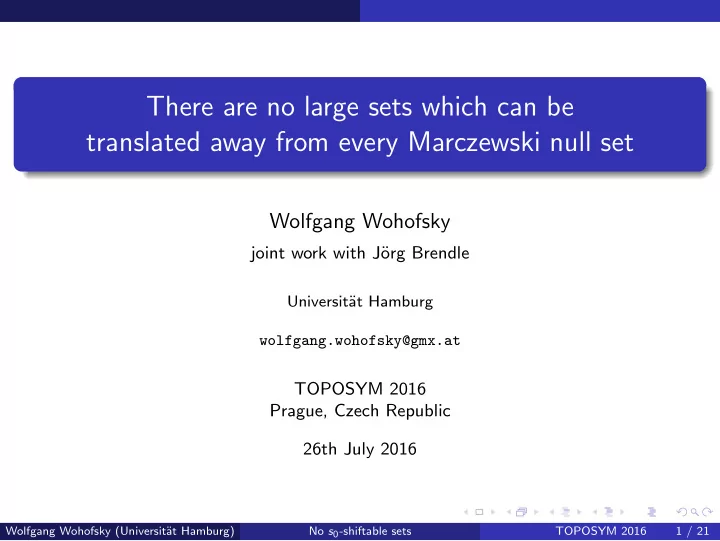
There are no large sets which can be translated away from every Marczewski null set Wolfgang Wohofsky joint work with J org Brendle Universit at Hamburg wolfgang.wohofsky@gmx.at TOPOSYM 2016 Prague, Czech Republic 26th July 2016


slide-1
SLIDE 1

There are no large sets which can be translated away from every Marczewski null set

Wolfgang Wohofsky

joint work with J¨

  • rg Brendle

Universit¨ at Hamburg wolfgang.wohofsky@gmx.at

TOPOSYM 2016 Prague, Czech Republic 26th July 2016

Wolfgang Wohofsky (Universit¨ at Hamburg) No s0-shiftable sets TOPOSYM 2016 1 / 21

slide-2
SLIDE 2

Theorem (Brendle-W., 2015)

(ZFC) No set of reals of size continuum is “s0-shiftable”.

Definition

A set Y ⊆ 2ω is Marczewski null (Y ∈ s0) :⇐ ⇒ for any perfect set P ⊆ 2ω there is a perfect set Q ⊆ P with Q ∩ Y = ∅. ⇐ ⇒ ∀p ∈ S ∃q ≤ p [q] ∩ Y = ∅

Definition

A set X ⊆ 2ω is s0-shiftable :⇐ ⇒ ∀Y ∈ s0 X + Y = 2ω ⇐ ⇒ ∀Y ∈ s0 ∃t ∈ 2ω (X + t) ∩ Y = ∅.

Theorem (Brendle-W., 2015, restated more explicitly)

(ZFC) Let X ⊆ 2ω with |X| = c. Then there is a Y ∈ s0 with X + Y = 2ω.

Wolfgang Wohofsky (Universit¨ at Hamburg) No s0-shiftable sets TOPOSYM 2016 2 / 21

slide-3
SLIDE 3

Theorem (Brendle-W., 2015)

(ZFC) No set of reals of size continuum is “s0-shiftable”.

Definition

A set Y ⊆ 2ω is Marczewski null (Y ∈ s0) :⇐ ⇒ for any perfect set P ⊆ 2ω there is a perfect set Q ⊆ P with Q ∩ Y = ∅. ⇐ ⇒ ∀p ∈ S ∃q ≤ p [q] ∩ Y = ∅

Definition

A set X ⊆ 2ω is s0-shiftable :⇐ ⇒ ∀Y ∈ s0 X + Y = 2ω ⇐ ⇒ ∀Y ∈ s0 ∃t ∈ 2ω (X + t) ∩ Y = ∅.

Theorem (Brendle-W., 2015, restated more explicitly)

(ZFC) Let X ⊆ 2ω with |X| = c. Then there is a Y ∈ s0 with X + Y = 2ω.

Wolfgang Wohofsky (Universit¨ at Hamburg) No s0-shiftable sets TOPOSYM 2016 2 / 21

slide-4
SLIDE 4

Theorem (Brendle-W., 2015)

(ZFC) No set of reals of size continuum is “s0-shiftable”.

Definition

A set Y ⊆ 2ω is Marczewski null (Y ∈ s0) :⇐ ⇒ for any perfect set P ⊆ 2ω there is a perfect set Q ⊆ P with Q ∩ Y = ∅. ⇐ ⇒ ∀p ∈ S ∃q ≤ p [q] ∩ Y = ∅

Definition

A set X ⊆ 2ω is s0-shiftable :⇐ ⇒ ∀Y ∈ s0 X + Y = 2ω ⇐ ⇒ ∀Y ∈ s0 ∃t ∈ 2ω (X + t) ∩ Y = ∅.

Theorem (Brendle-W., 2015, restated more explicitly)

(ZFC) Let X ⊆ 2ω with |X| = c. Then there is a Y ∈ s0 with X + Y = 2ω.

Wolfgang Wohofsky (Universit¨ at Hamburg) No s0-shiftable sets TOPOSYM 2016 2 / 21

slide-5
SLIDE 5

Theorem (Brendle-W., 2015)

(ZFC) No set of reals of size continuum is “s0-shiftable”.

Definition

A set Y ⊆ 2ω is Marczewski null (Y ∈ s0) :⇐ ⇒ for any perfect set P ⊆ 2ω there is a perfect set Q ⊆ P with Q ∩ Y = ∅. ⇐ ⇒ ∀p ∈ S ∃q ≤ p [q] ∩ Y = ∅

Definition

A set X ⊆ 2ω is s0-shiftable :⇐ ⇒ ∀Y ∈ s0 X + Y = 2ω ⇐ ⇒ ∀Y ∈ s0 ∃t ∈ 2ω (X + t) ∩ Y = ∅.

Theorem (Brendle-W., 2015, restated more explicitly)

(ZFC) Let X ⊆ 2ω with |X| = c. Then there is a Y ∈ s0 with X + Y = 2ω.

Wolfgang Wohofsky (Universit¨ at Hamburg) No s0-shiftable sets TOPOSYM 2016 2 / 21

slide-6
SLIDE 6

Theorem (Brendle-W., 2015)

(ZFC) No set of reals of size continuum is “s0-shiftable”.

Definition

A set Y ⊆ 2ω is Marczewski null (Y ∈ s0) :⇐ ⇒ for any perfect set P ⊆ 2ω there is a perfect set Q ⊆ P with Q ∩ Y = ∅. ⇐ ⇒ ∀p ∈ S ∃q ≤ p [q] ∩ Y = ∅

Definition

A set X ⊆ 2ω is s0-shiftable :⇐ ⇒ ∀Y ∈ s0 X + Y = 2ω ⇐ ⇒ ∀Y ∈ s0 ∃t ∈ 2ω (X + t) ∩ Y = ∅.

Theorem (Brendle-W., 2015, restated more explicitly)

(ZFC) Let X ⊆ 2ω with |X| = c. Then there is a Y ∈ s0 with X + Y = 2ω.

Wolfgang Wohofsky (Universit¨ at Hamburg) No s0-shiftable sets TOPOSYM 2016 2 / 21

slide-7
SLIDE 7

Theorem (Brendle-W., 2015)

(ZFC) No set of reals of size continuum is “s0-shiftable”.

Definition

A set Y ⊆ 2ω is Marczewski null (Y ∈ s0) :⇐ ⇒ for any perfect set P ⊆ 2ω there is a perfect set Q ⊆ P with Q ∩ Y = ∅. ⇐ ⇒ ∀p ∈ S ∃q ≤ p [q] ∩ Y = ∅

Definition

A set X ⊆ 2ω is s0-shiftable :⇐ ⇒ ∀Y ∈ s0 X + Y = 2ω ⇐ ⇒ ∀Y ∈ s0 ∃t ∈ 2ω (X + t) ∩ Y = ∅.

Theorem (Brendle-W., 2015, restated more explicitly)

(ZFC) Let X ⊆ 2ω with |X| = c. Then there is a Y ∈ s0 with X + Y = 2ω.

Wolfgang Wohofsky (Universit¨ at Hamburg) No s0-shiftable sets TOPOSYM 2016 2 / 21

slide-8
SLIDE 8

Strong measure zero

For an interval I ⊆ R, let λ(I) denote its length.

Definition (well-known)

A set X ⊆ R is (Lebesgue) measure zero if for each positive real number ε > 0 there is a sequence of intervals (In)n<ω of total length

n<ω λ(In) ≤ ε

such that X ⊆

n<ω In.

Definition (Borel; 1919)

A set X ⊆ R is strong measure zero if for each sequence of positive real numbers (εn)n<ω there is a sequence of intervals (In)n<ω with ∀n ∈ ω λ(In) ≤ εn such that X ⊆

n<ω In.

Wolfgang Wohofsky (Universit¨ at Hamburg) No s0-shiftable sets TOPOSYM 2016 3 / 21

slide-9
SLIDE 9

Strong measure zero

For an interval I ⊆ R, let λ(I) denote its length.

Definition (well-known)

A set X ⊆ R is (Lebesgue) measure zero if for each positive real number ε > 0 there is a sequence of intervals (In)n<ω of total length

n<ω λ(In) ≤ ε

such that X ⊆

n<ω In.

Definition (Borel; 1919)

A set X ⊆ R is strong measure zero if for each sequence of positive real numbers (εn)n<ω there is a sequence of intervals (In)n<ω with ∀n ∈ ω λ(In) ≤ εn such that X ⊆

n<ω In.

Wolfgang Wohofsky (Universit¨ at Hamburg) No s0-shiftable sets TOPOSYM 2016 3 / 21

slide-10
SLIDE 10

. . . -shiftables

M σ-ideal of meager sets N σ-ideal of Lebesgue measure zero (“null”) sets s0 σ-ideal of Marczewski null sets M-shiftable ⇐ ⇒ strong measure zero N-shiftable ⇐ ⇒: strongly meager s0-shiftable

  • nly the countable sets are M-shiftable

⇐ ⇒: BC

  • nly the countable sets are N-shiftable

⇐ ⇒: dBC

  • nly the countable sets are s0-shiftable

Thilo Weinert

⇐ ⇒: MBC

Wolfgang Wohofsky (Universit¨ at Hamburg) No s0-shiftable sets TOPOSYM 2016 4 / 21

slide-11
SLIDE 11

. . . -shiftables

M σ-ideal of meager sets N σ-ideal of Lebesgue measure zero (“null”) sets s0 σ-ideal of Marczewski null sets M-shiftable ⇐ ⇒ strong measure zero N-shiftable ⇐ ⇒: strongly meager s0-shiftable

  • nly the countable sets are M-shiftable

⇐ ⇒: BC

  • nly the countable sets are N-shiftable

⇐ ⇒: dBC

  • nly the countable sets are s0-shiftable

Thilo Weinert

⇐ ⇒: MBC

Wolfgang Wohofsky (Universit¨ at Hamburg) No s0-shiftable sets TOPOSYM 2016 4 / 21

slide-12
SLIDE 12

. . . -shiftables

M σ-ideal of meager sets N σ-ideal of Lebesgue measure zero (“null”) sets s0 σ-ideal of Marczewski null sets M-shiftable ⇐ ⇒ strong measure zero N-shiftable ⇐ ⇒: strongly meager s0-shiftable

  • nly the countable sets are M-shiftable

⇐ ⇒: BC

  • nly the countable sets are N-shiftable

⇐ ⇒: dBC

  • nly the countable sets are s0-shiftable

Thilo Weinert

⇐ ⇒: MBC

Wolfgang Wohofsky (Universit¨ at Hamburg) No s0-shiftable sets TOPOSYM 2016 4 / 21

slide-13
SLIDE 13

. . . -shiftables

M σ-ideal of meager sets N σ-ideal of Lebesgue measure zero (“null”) sets s0 σ-ideal of Marczewski null sets M-shiftable ⇐ ⇒ strong measure zero N-shiftable ⇐ ⇒: strongly meager s0-shiftable

  • nly the countable sets are M-shiftable

⇐ ⇒: BC

  • nly the countable sets are N-shiftable

⇐ ⇒: dBC

  • nly the countable sets are s0-shiftable

Thilo Weinert

⇐ ⇒: MBC

Wolfgang Wohofsky (Universit¨ at Hamburg) No s0-shiftable sets TOPOSYM 2016 4 / 21

slide-14
SLIDE 14

. . . -shiftables

M σ-ideal of meager sets N σ-ideal of Lebesgue measure zero (“null”) sets s0 σ-ideal of Marczewski null sets M-shiftable ⇐ ⇒ strong measure zero N-shiftable ⇐ ⇒: strongly meager s0-shiftable

  • nly the countable sets are M-shiftable

⇐ ⇒: BC

  • nly the countable sets are N-shiftable

⇐ ⇒: dBC

  • nly the countable sets are s0-shiftable

Thilo Weinert

⇐ ⇒: MBC

Wolfgang Wohofsky (Universit¨ at Hamburg) No s0-shiftable sets TOPOSYM 2016 4 / 21

slide-15
SLIDE 15

. . . -shiftables

M σ-ideal of meager sets N σ-ideal of Lebesgue measure zero (“null”) sets s0 σ-ideal of Marczewski null sets M-shiftable ⇐ ⇒ strong measure zero N-shiftable ⇐ ⇒: strongly meager s0-shiftable

  • nly the countable sets are M-shiftable

⇐ ⇒: BC

  • nly the countable sets are N-shiftable

⇐ ⇒: dBC

  • nly the countable sets are s0-shiftable

Thilo Weinert

⇐ ⇒: MBC

Wolfgang Wohofsky (Universit¨ at Hamburg) No s0-shiftable sets TOPOSYM 2016 4 / 21

slide-16
SLIDE 16

Wolfgang Wohofsky (Universit¨ at Hamburg) No s0-shiftable sets TOPOSYM 2016 5 / 21

slide-17
SLIDE 17

Consistency of MBC

Theorem (Brendle-W., 2015)

(ZFC) No set of reals of size continuum is “s0-shiftable”.

Corollary

CH implies MBC (i.e., s0-shiftables = [2ω]≤ℵ0). So what about larger continuum?

Theorem (Brendle-W., 2015)

In the Cohen model, MBC holds.

Wolfgang Wohofsky (Universit¨ at Hamburg) No s0-shiftable sets TOPOSYM 2016 6 / 21

slide-18
SLIDE 18

Consistency of MBC

Theorem (Brendle-W., 2015)

(ZFC) No set of reals of size continuum is “s0-shiftable”.

Corollary

CH implies MBC (i.e., s0-shiftables = [2ω]≤ℵ0). So what about larger continuum?

Theorem (Brendle-W., 2015)

In the Cohen model, MBC holds.

Wolfgang Wohofsky (Universit¨ at Hamburg) No s0-shiftable sets TOPOSYM 2016 6 / 21

slide-19
SLIDE 19

Consistency of MBC

Theorem (Brendle-W., 2015)

(ZFC) No set of reals of size continuum is “s0-shiftable”.

Corollary

CH implies MBC (i.e., s0-shiftables = [2ω]≤ℵ0). So what about larger continuum?

Theorem (Brendle-W., 2015)

In the Cohen model, MBC holds.

Wolfgang Wohofsky (Universit¨ at Hamburg) No s0-shiftable sets TOPOSYM 2016 6 / 21

slide-20
SLIDE 20

Properties of s0

Proposition

Let Y ⊆ 2ω with |Y | < c. Then Y ∈ s0. Why? Perfect sets can be split into “perfectly many” disjoint perfect sets.

Theorem

There is a set Y ∈ s0 with |Y | = c.

Sketch of proof.

Fix a maximal antichain {qα : α < c} ⊆ S in Sacks forcing. In particular, |[qα] ∩ [qβ]| ≤ ℵ0 for any α = β. So (for each α < c) we can pick yα ∈ [qα] \

β<α[qβ].

By maximality of the antichain, and the proposition above, Y := {yα : α < c} is as desired.

Wolfgang Wohofsky (Universit¨ at Hamburg) No s0-shiftable sets TOPOSYM 2016 7 / 21

slide-21
SLIDE 21

Properties of s0

Proposition

Let Y ⊆ 2ω with |Y | < c. Then Y ∈ s0. Why? Perfect sets can be split into “perfectly many” disjoint perfect sets.

Theorem

There is a set Y ∈ s0 with |Y | = c.

Sketch of proof.

Fix a maximal antichain {qα : α < c} ⊆ S in Sacks forcing. In particular, |[qα] ∩ [qβ]| ≤ ℵ0 for any α = β. So (for each α < c) we can pick yα ∈ [qα] \

β<α[qβ].

By maximality of the antichain, and the proposition above, Y := {yα : α < c} is as desired.

Wolfgang Wohofsky (Universit¨ at Hamburg) No s0-shiftable sets TOPOSYM 2016 7 / 21

slide-22
SLIDE 22

Properties of s0

Proposition

Let Y ⊆ 2ω with |Y | < c. Then Y ∈ s0. Why? Perfect sets can be split into “perfectly many” disjoint perfect sets.

Theorem

There is a set Y ∈ s0 with |Y | = c.

Sketch of proof.

Fix a maximal antichain {qα : α < c} ⊆ S in Sacks forcing. In particular, |[qα] ∩ [qβ]| ≤ ℵ0 for any α = β. So (for each α < c) we can pick yα ∈ [qα] \

β<α[qβ].

By maximality of the antichain, and the proposition above, Y := {yα : α < c} is as desired.

Wolfgang Wohofsky (Universit¨ at Hamburg) No s0-shiftable sets TOPOSYM 2016 7 / 21

slide-23
SLIDE 23

Properties of s0

Proposition

Let Y ⊆ 2ω with |Y | < c. Then Y ∈ s0. Why? Perfect sets can be split into “perfectly many” disjoint perfect sets.

Theorem

There is a set Y ∈ s0 with |Y | = c.

Sketch of proof.

Fix a maximal antichain {qα : α < c} ⊆ S in Sacks forcing. In particular, |[qα] ∩ [qβ]| ≤ ℵ0 for any α = β. So (for each α < c) we can pick yα ∈ [qα] \

β<α[qβ].

By maximality of the antichain, and the proposition above, Y := {yα : α < c} is as desired.

Wolfgang Wohofsky (Universit¨ at Hamburg) No s0-shiftable sets TOPOSYM 2016 7 / 21

slide-24
SLIDE 24

Properties of s0

Proposition

Let Y ⊆ 2ω with |Y | < c. Then Y ∈ s0. Why? Perfect sets can be split into “perfectly many” disjoint perfect sets.

Theorem

There is a set Y ∈ s0 with |Y | = c.

Sketch of proof.

Fix a maximal antichain {qα : α < c} ⊆ S in Sacks forcing. In particular, |[qα] ∩ [qβ]| ≤ ℵ0 for any α = β. So (for each α < c) we can pick yα ∈ [qα] \

β<α[qβ].

By maximality of the antichain, and the proposition above, Y := {yα : α < c} is as desired.

Wolfgang Wohofsky (Universit¨ at Hamburg) No s0-shiftable sets TOPOSYM 2016 7 / 21

slide-25
SLIDE 25

Properties of s0

Proposition

Let Y ⊆ 2ω with |Y | < c. Then Y ∈ s0. Why? Perfect sets can be split into “perfectly many” disjoint perfect sets.

Theorem

There is a set Y ∈ s0 with |Y | = c.

Sketch of proof.

Fix a maximal antichain {qα : α < c} ⊆ S in Sacks forcing. In particular, |[qα] ∩ [qβ]| ≤ ℵ0 for any α = β. So (for each α < c) we can pick yα ∈ [qα] \

β<α[qβ].

By maximality of the antichain, and the proposition above, Y := {yα : α < c} is as desired.

Wolfgang Wohofsky (Universit¨ at Hamburg) No s0-shiftable sets TOPOSYM 2016 7 / 21

slide-26
SLIDE 26

Lemma

Let X ⊆ 2ω, and let D ⊆ S be a dense and translation-invariant set of Sacks trees with the property that any less than c many (of its bodies) do not cover X. Then there is a Y ∈ s0 such that X + Y = 2ω (i.e., X is not s0-shiftable).

Sketch of proof.

Fix a maximal antichain {qα : α < c} ⊆ D (within the dense set D). Fix an enumeration 2ω = {zα : α < c}. By our assumptions, we can pick xα ∈ X \

β<α(zα + [qβ]).

Let yα := xα + zα. And let Y := {yα : α < c}. Then

◮ X + Y = 2ω, and ◮ Y ∈ s0. Wolfgang Wohofsky (Universit¨ at Hamburg) No s0-shiftable sets TOPOSYM 2016 8 / 21

slide-27
SLIDE 27

Lemma

Let X ⊆ 2ω, and let D ⊆ S be a dense and translation-invariant set of Sacks trees with the property that any less than c many (of its bodies) do not cover X. Then there is a Y ∈ s0 such that X + Y = 2ω (i.e., X is not s0-shiftable).

Sketch of proof.

Fix a maximal antichain {qα : α < c} ⊆ D (within the dense set D). Fix an enumeration 2ω = {zα : α < c}. By our assumptions, we can pick xα ∈ X \

β<α(zα + [qβ]).

Let yα := xα + zα. And let Y := {yα : α < c}. Then

◮ X + Y = 2ω, and ◮ Y ∈ s0. Wolfgang Wohofsky (Universit¨ at Hamburg) No s0-shiftable sets TOPOSYM 2016 8 / 21

slide-28
SLIDE 28

Lemma

Let X ⊆ 2ω, and let D ⊆ S be a dense and translation-invariant set of Sacks trees with the property that any less than c many (of its bodies) do not cover X. Then there is a Y ∈ s0 such that X + Y = 2ω (i.e., X is not s0-shiftable).

Sketch of proof.

Fix a maximal antichain {qα : α < c} ⊆ D (within the dense set D). Fix an enumeration 2ω = {zα : α < c}. By our assumptions, we can pick xα ∈ X \

β<α(zα + [qβ]).

Let yα := xα + zα. And let Y := {yα : α < c}. Then

◮ X + Y = 2ω, and ◮ Y ∈ s0. Wolfgang Wohofsky (Universit¨ at Hamburg) No s0-shiftable sets TOPOSYM 2016 8 / 21

slide-29
SLIDE 29

Lemma

Let X ⊆ 2ω, and let D ⊆ S be a dense and translation-invariant set of Sacks trees with the property that any less than c many (of its bodies) do not cover X. Then there is a Y ∈ s0 such that X + Y = 2ω (i.e., X is not s0-shiftable).

Sketch of proof.

Fix a maximal antichain {qα : α < c} ⊆ D (within the dense set D). Fix an enumeration 2ω = {zα : α < c}. By our assumptions, we can pick xα ∈ X \

β<α(zα + [qβ]).

Let yα := xα + zα. And let Y := {yα : α < c}. Then

◮ X + Y = 2ω, and ◮ Y ∈ s0. Wolfgang Wohofsky (Universit¨ at Hamburg) No s0-shiftable sets TOPOSYM 2016 8 / 21

slide-30
SLIDE 30

Transitive versions of s0

Y ∈ s0 ⇐ ⇒ ∀p ∈ S ∃q ≤ p [q] ∩ Y = ∅ ???? ⇐ ⇒ ∀p ∈ S ∃q ≤ p ∀t ∈ 2ω ([q] + t) ∩ Y = ∅

Wolfgang Wohofsky (Universit¨ at Hamburg) No s0-shiftable sets TOPOSYM 2016 9 / 21

slide-31
SLIDE 31

Transitive versions of s0

Y ∈ s0 ⇐ ⇒ ∀p ∈ S ∃q ≤ p [q] ∩ Y = ∅ ???? ⇐ ⇒ ∀p ∈ S ∃q ≤ p ∀t ∈ 2ω ([q] + t) ∩ Y = ∅

Wolfgang Wohofsky (Universit¨ at Hamburg) No s0-shiftable sets TOPOSYM 2016 9 / 21

slide-32
SLIDE 32

Transitive versions of s0

Y ∈ s0 ⇐ ⇒ ∀p ∈ S ∃q ≤ p [q] ∩ Y = ∅ Y = ∅ ⇐ ⇒ ∀p ∈ S ∃q ≤ p ∀t ∈ 2ω ([q] + t) ∩ Y = ∅

Wolfgang Wohofsky (Universit¨ at Hamburg) No s0-shiftable sets TOPOSYM 2016 10 / 21

slide-33
SLIDE 33

Transitive versions of s0

Y ∈ s0 ⇐ ⇒ ∀p ∈ S ∃q ≤ p [q] ∩ Y = ∅ Y = ∅ ⇐ ⇒ ∀p ∈ S ∃q ≤ p ∀t ∈ 2ω ([q] + t) ∩ Y = ∅ Y ∈ s0 ⇐ ⇒ ∀p ∈ S ∃q ≤ p |[q] ∩ Y | < c Y is . . . ⇐ ⇒ ∀p ∈ S ∃q ≤ p ∀t ∈ 2ω |([q] + t) ∩ Y | < c

Wolfgang Wohofsky (Universit¨ at Hamburg) No s0-shiftable sets TOPOSYM 2016 11 / 21

slide-34
SLIDE 34

Transitive versions of s0

Y ∈ s0 ⇐ ⇒ ∀p ∈ S ∃q ≤ p [q] ∩ Y = ∅ Y = ∅ ⇐ ⇒ ∀p ∈ S ∃q ≤ p ∀t ∈ 2ω ([q] + t) ∩ Y = ∅ Y ∈ s0 ⇐ ⇒ ∀p ∈ S ∃q ≤ p |[q] ∩ Y | < c Y is . . . ⇐ ⇒ ∀p ∈ S ∃q ≤ p ∀t ∈ 2ω |([q] + t) ∩ Y | < c

Wolfgang Wohofsky (Universit¨ at Hamburg) No s0-shiftable sets TOPOSYM 2016 11 / 21

slide-35
SLIDE 35

Transitive versions of s0

Y ∈ s0 ⇐ ⇒ ∀p ∈ S ∃q ≤ p [q] ∩ Y = ∅ Y = ∅ ⇐ ⇒ ∀p ∈ S ∃q ≤ p ∀t ∈ 2ω ([q] + t) ∩ Y = ∅ Y ∈ s0 ⇐ ⇒ ∀p ∈ S ∃q ≤ p |[q] ∩ Y | < c Y is . . . ⇐ ⇒ ∀p ∈ S ∃q ≤ p ∀t ∈ 2ω |([q] + t) ∩ Y | < c

Definition

A set Y ⊆ 2ω is <κ-transitively Marczewski null (<κ-trans-s0) ⇐ ⇒ ∀p ∈ S ∃q ≤ p ∀t ∈ 2ω |([q] + t) ∩ Y | < κ. A set Y ⊆ 2ω is ≤κ-transitively Marczewski null (≤κ-trans-s0) ⇐ ⇒ ∀p ∈ S ∃q ≤ p ∀t ∈ 2ω |([q] + t) ∩ Y | ≤ κ.

Wolfgang Wohofsky (Universit¨ at Hamburg) No s0-shiftable sets TOPOSYM 2016 12 / 21

slide-36
SLIDE 36

Transitive versions of s0

Y ∈ s0 ⇐ ⇒ ∀p ∈ S ∃q ≤ p [q] ∩ Y = ∅ Y = ∅ ⇐ ⇒ ∀p ∈ S ∃q ≤ p ∀t ∈ 2ω ([q] + t) ∩ Y = ∅ Y ∈ s0 ⇐ ⇒ ∀p ∈ S ∃q ≤ p |[q] ∩ Y | < c Y is . . . ⇐ ⇒ ∀p ∈ S ∃q ≤ p ∀t ∈ 2ω |([q] + t) ∩ Y | < c

Definition

A set Y ⊆ 2ω is <κ-transitively Marczewski null (<κ-trans-s0) ⇐ ⇒ ∀p ∈ S ∃q ≤ p ∀t ∈ 2ω |([q] + t) ∩ Y | < κ. A set Y ⊆ 2ω is ≤κ-transitively Marczewski null (≤κ-trans-s0) ⇐ ⇒ ∀p ∈ S ∃q ≤ p ∀t ∈ 2ω |([q] + t) ∩ Y | ≤ κ.

Wolfgang Wohofsky (Universit¨ at Hamburg) No s0-shiftable sets TOPOSYM 2016 12 / 21

slide-37
SLIDE 37

Lemma

Let X ⊆ 2ω with |X| = c. Then there exists an X ′ ⊆ X with |X ′| = c and X ′ ∈ s0. Recall the notion of Luzin set (we could say: M-Luzin set): X is (generalized) Luzin if (|X| = c and) its intersection with any meager set is of size less than c. So the above lemma says: There are no “s0-Luzin sets” (in ZFC).

Proof.

1st case: X ∈ s0, and we are finished :-) 2nd case: X / ∈ s0, then we can fix p ∈ S with: ∀q ≤ p |[q] ∩ X| = c. Construct a c-sized set X ′ ∈ s0 inside of [p] ∩ X: Fix a maximal antichain below p, . . . , . . . , and we are finished :-)

Wolfgang Wohofsky (Universit¨ at Hamburg) No s0-shiftable sets TOPOSYM 2016 13 / 21

slide-38
SLIDE 38

Lemma

Let X ⊆ 2ω with |X| = c. Then there exists an X ′ ⊆ X with |X ′| = c and X ′ ∈ s0. Recall the notion of Luzin set (we could say: M-Luzin set): X is (generalized) Luzin if (|X| = c and) its intersection with any meager set is of size less than c. So the above lemma says: There are no “s0-Luzin sets” (in ZFC).

Proof.

1st case: X ∈ s0, and we are finished :-) 2nd case: X / ∈ s0, then we can fix p ∈ S with: ∀q ≤ p |[q] ∩ X| = c. Construct a c-sized set X ′ ∈ s0 inside of [p] ∩ X: Fix a maximal antichain below p, . . . , . . . , and we are finished :-)

Wolfgang Wohofsky (Universit¨ at Hamburg) No s0-shiftable sets TOPOSYM 2016 13 / 21

slide-39
SLIDE 39

Lemma

Let X ⊆ 2ω with |X| = c. Then there exists an X ′ ⊆ X with |X ′| = c and X ′ ∈ s0. Recall the notion of Luzin set (we could say: M-Luzin set): X is (generalized) Luzin if (|X| = c and) its intersection with any meager set is of size less than c. So the above lemma says: There are no “s0-Luzin sets” (in ZFC).

Proof.

1st case: X ∈ s0, and we are finished :-) 2nd case: X / ∈ s0, then we can fix p ∈ S with: ∀q ≤ p |[q] ∩ X| = c. Construct a c-sized set X ′ ∈ s0 inside of [p] ∩ X: Fix a maximal antichain below p, . . . , . . . , and we are finished :-)

Wolfgang Wohofsky (Universit¨ at Hamburg) No s0-shiftable sets TOPOSYM 2016 13 / 21

slide-40
SLIDE 40

Lemma

Let X ⊆ 2ω with |X| = c. Then there exists an X ′ ⊆ X with |X ′| = c and X ′ ∈ s0. Recall the notion of Luzin set (we could say: M-Luzin set): X is (generalized) Luzin if (|X| = c and) its intersection with any meager set is of size less than c. So the above lemma says: There are no “s0-Luzin sets” (in ZFC).

Proof.

1st case: X ∈ s0, and we are finished :-) 2nd case: X / ∈ s0, then we can fix p ∈ S with: ∀q ≤ p |[q] ∩ X| = c. Construct a c-sized set X ′ ∈ s0 inside of [p] ∩ X: Fix a maximal antichain below p, . . . , . . . , and we are finished :-)

Wolfgang Wohofsky (Universit¨ at Hamburg) No s0-shiftable sets TOPOSYM 2016 13 / 21

slide-41
SLIDE 41

Lemma

Let X ⊆ 2ω with |X| = c. Then there exists an X ′ ⊆ X with |X ′| = c and X ′ ∈ s0. Recall the notion of Luzin set (we could say: M-Luzin set): X is (generalized) Luzin if (|X| = c and) its intersection with any meager set is of size less than c. So the above lemma says: There are no “s0-Luzin sets” (in ZFC).

Proof.

1st case: X ∈ s0, and we are finished :-) 2nd case: X / ∈ s0, then we can fix p ∈ S with: ∀q ≤ p |[q] ∩ X| = c. Construct a c-sized set X ′ ∈ s0 inside of [p] ∩ X: Fix a maximal antichain below p, . . . , . . . , and we are finished :-)

Wolfgang Wohofsky (Universit¨ at Hamburg) No s0-shiftable sets TOPOSYM 2016 13 / 21

slide-42
SLIDE 42

Lemma

Let X ⊆ 2ω with |X| = c. Then there exists an X ′ ⊆ X with |X ′| = c and X ′ ∈ s0. Recall the notion of Luzin set (we could say: M-Luzin set): X is (generalized) Luzin if (|X| = c and) its intersection with any meager set is of size less than c. So the above lemma says: There are no “s0-Luzin sets” (in ZFC).

Proof.

1st case: X ∈ s0, and we are finished :-) 2nd case: X / ∈ s0, then we can fix p ∈ S with: ∀q ≤ p |[q] ∩ X| = c. Construct a c-sized set X ′ ∈ s0 inside of [p] ∩ X: Fix a maximal antichain below p, . . . , . . . , and we are finished :-)

Wolfgang Wohofsky (Universit¨ at Hamburg) No s0-shiftable sets TOPOSYM 2016 13 / 21

slide-43
SLIDE 43

Lemma

Let X ⊆ 2ω with |X| = c. Then there exists an X ′ ⊆ X with |X ′| = c and X ′ ∈ s0. Recall the notion of Luzin set (we could say: M-Luzin set): X is (generalized) Luzin if (|X| = c and) its intersection with any meager set is of size less than c. So the above lemma says: There are no “s0-Luzin sets” (in ZFC).

Proof.

1st case: X ∈ s0, and we are finished :-) 2nd case: X / ∈ s0, then we can fix p ∈ S with: ∀q ≤ p |[q] ∩ X| = c. Construct a c-sized set X ′ ∈ s0 inside of [p] ∩ X: Fix a maximal antichain below p, . . . , . . . , and we are finished :-)

Wolfgang Wohofsky (Universit¨ at Hamburg) No s0-shiftable sets TOPOSYM 2016 13 / 21

slide-44
SLIDE 44

Lemma

Let X ⊆ 2ω with |X| = c. Then there exists an X ′ ⊆ X with |X ′| = c and X ′ ∈ s0. Recall the notion of Luzin set (we could say: M-Luzin set): X is (generalized) Luzin if (|X| = c and) its intersection with any meager set is of size less than c. So the above lemma says: There are no “s0-Luzin sets” (in ZFC).

Proof.

1st case: X ∈ s0, and we are finished :-) 2nd case: X / ∈ s0, then we can fix p ∈ S with: ∀q ≤ p |[q] ∩ X| = c. Construct a c-sized set X ′ ∈ s0 inside of [p] ∩ X: Fix a maximal antichain below p, . . . , . . . , and we are finished :-)

Wolfgang Wohofsky (Universit¨ at Hamburg) No s0-shiftable sets TOPOSYM 2016 13 / 21

slide-45
SLIDE 45

Lemma (from previous slide)

Let X ⊆ 2ω with |X| = c. Then there exists an X ′ ⊆ X with |X ′| = c and X ′ ∈ s0.

Main Lemma

Let X ⊆ 2ω with |X| = c. Then there exists an X ′ ⊆ X with |X ′| = c such that X ′ is <c-trans-s0. Outline of the proof: W.l.o.g. X ∈ s0 (by the lemma above).

Wolfgang Wohofsky (Universit¨ at Hamburg) No s0-shiftable sets TOPOSYM 2016 14 / 21

slide-46
SLIDE 46

Lemma (from previous slide)

Let X ⊆ 2ω with |X| = c. Then there exists an X ′ ⊆ X with |X ′| = c and X ′ ∈ s0.

Main Lemma

Let X ⊆ 2ω with |X| = c. Then there exists an X ′ ⊆ X with |X ′| = c such that X ′ is <c-trans-s0. Outline of the proof: W.l.o.g. X ∈ s0 (by the lemma above).

Wolfgang Wohofsky (Universit¨ at Hamburg) No s0-shiftable sets TOPOSYM 2016 14 / 21

slide-47
SLIDE 47

Lemma (from previous slide)

Let X ⊆ 2ω with |X| = c. Then there exists an X ′ ⊆ X with |X ′| = c and X ′ ∈ s0.

Main Lemma

Let X ⊆ 2ω with |X| = c. Then there exists an X ′ ⊆ X with |X ′| = c such that X ′ is <c-trans-s0. Outline of the proof: W.l.o.g. X ∈ s0 (by the lemma above).

Wolfgang Wohofsky (Universit¨ at Hamburg) No s0-shiftable sets TOPOSYM 2016 14 / 21

slide-48
SLIDE 48

Main Lemma

Let X ⊆ 2ω with |X| = c. Then there exists an X ′ ⊆ X with |X ′| = c such that X ′ is <c-trans-s0. W.l.o.g. X ∈ s0 (by the lemma above). p ∈ S is skew if there is at most one splitting node on each level. We distinguish two cases: 1st Case: For each skew p ∈ S: |[p] ∩ X| < c.

◮ The collection of skew trees is dense and translation-invariant. ◮ Hence, X is <c-trans-s0, i.e., ∀q ∈ S ∃r ≤ q ∀t ∈ 2ω |([r] + t) ∩ X| < c.

2nd Case: Fix a skew tree p ∈ S with |[p] ∩ X| = c.

◮ Define X ′ := [p] ∩ X. (So |X ′| = c.) ◮ Then X ′ is <c-trans-s0(actually even X ′ is ≤ℵ0-trans-s0). Why? ◮ Since p is skew, t = 0 ⇒ |[p] ∩ [p + t]| ≤ 2. ◮ Therefore, {p + t : t ∈ 2ω} is an antichain in S. ◮ Given q ∈ S, we now use X ′ ∈ s0 to find r ≤ q, and finish the proof :-)) Wolfgang Wohofsky (Universit¨ at Hamburg) No s0-shiftable sets TOPOSYM 2016 15 / 21
slide-49
SLIDE 49

Main Lemma

Let X ⊆ 2ω with |X| = c. Then there exists an X ′ ⊆ X with |X ′| = c such that X ′ is <c-trans-s0. W.l.o.g. X ∈ s0 (by the lemma above). p ∈ S is skew if there is at most one splitting node on each level. We distinguish two cases: 1st Case: For each skew p ∈ S: |[p] ∩ X| < c.

◮ The collection of skew trees is dense and translation-invariant. ◮ Hence, X is <c-trans-s0, i.e., ∀q ∈ S ∃r ≤ q ∀t ∈ 2ω |([r] + t) ∩ X| < c.

2nd Case: Fix a skew tree p ∈ S with |[p] ∩ X| = c.

◮ Define X ′ := [p] ∩ X. (So |X ′| = c.) ◮ Then X ′ is <c-trans-s0(actually even X ′ is ≤ℵ0-trans-s0). Why? ◮ Since p is skew, t = 0 ⇒ |[p] ∩ [p + t]| ≤ 2. ◮ Therefore, {p + t : t ∈ 2ω} is an antichain in S. ◮ Given q ∈ S, we now use X ′ ∈ s0 to find r ≤ q, and finish the proof :-)) Wolfgang Wohofsky (Universit¨ at Hamburg) No s0-shiftable sets TOPOSYM 2016 15 / 21

slide-50
SLIDE 50

Main Lemma

Let X ⊆ 2ω with |X| = c. Then there exists an X ′ ⊆ X with |X ′| = c such that X ′ is <c-trans-s0. W.l.o.g. X ∈ s0 (by the lemma above). p ∈ S is skew if there is at most one splitting node on each level. We distinguish two cases: 1st Case: For each skew p ∈ S: |[p] ∩ X| < c.

◮ The collection of skew trees is dense and translation-invariant. ◮ Hence, X is <c-trans-s0, i.e., ∀q ∈ S ∃r ≤ q ∀t ∈ 2ω |([r] + t) ∩ X| < c.

2nd Case: Fix a skew tree p ∈ S with |[p] ∩ X| = c.

◮ Define X ′ := [p] ∩ X. (So |X ′| = c.) ◮ Then X ′ is <c-trans-s0(actually even X ′ is ≤ℵ0-trans-s0). Why? ◮ Since p is skew, t = 0 ⇒ |[p] ∩ [p + t]| ≤ 2. ◮ Therefore, {p + t : t ∈ 2ω} is an antichain in S. ◮ Given q ∈ S, we now use X ′ ∈ s0 to find r ≤ q, and finish the proof :-)) Wolfgang Wohofsky (Universit¨ at Hamburg) No s0-shiftable sets TOPOSYM 2016 15 / 21

slide-51
SLIDE 51

Main Lemma

Let X ⊆ 2ω with |X| = c. Then there exists an X ′ ⊆ X with |X ′| = c such that X ′ is <c-trans-s0. W.l.o.g. X ∈ s0 (by the lemma above). p ∈ S is skew if there is at most one splitting node on each level. We distinguish two cases: 1st Case: For each skew p ∈ S: |[p] ∩ X| < c.

◮ The collection of skew trees is dense and translation-invariant. ◮ Hence, X is <c-trans-s0, i.e., ∀q ∈ S ∃r ≤ q ∀t ∈ 2ω |([r] + t) ∩ X| < c.

2nd Case: Fix a skew tree p ∈ S with |[p] ∩ X| = c.

◮ Define X ′ := [p] ∩ X. (So |X ′| = c.) ◮ Then X ′ is <c-trans-s0(actually even X ′ is ≤ℵ0-trans-s0). Why? ◮ Since p is skew, t = 0 ⇒ |[p] ∩ [p + t]| ≤ 2. ◮ Therefore, {p + t : t ∈ 2ω} is an antichain in S. ◮ Given q ∈ S, we now use X ′ ∈ s0 to find r ≤ q, and finish the proof :-)) Wolfgang Wohofsky (Universit¨ at Hamburg) No s0-shiftable sets TOPOSYM 2016 15 / 21

slide-52
SLIDE 52

Main Lemma

Let X ⊆ 2ω with |X| = c. Then there exists an X ′ ⊆ X with |X ′| = c such that X ′ is <c-trans-s0. W.l.o.g. X ∈ s0 (by the lemma above). p ∈ S is skew if there is at most one splitting node on each level. We distinguish two cases: 1st Case: For each skew p ∈ S: |[p] ∩ X| < c.

◮ The collection of skew trees is dense and translation-invariant. ◮ Hence, X is <c-trans-s0, i.e., ∀q ∈ S ∃r ≤ q ∀t ∈ 2ω |([r] + t) ∩ X| < c.

2nd Case: Fix a skew tree p ∈ S with |[p] ∩ X| = c.

◮ Define X ′ := [p] ∩ X. (So |X ′| = c.) ◮ Then X ′ is <c-trans-s0(actually even X ′ is ≤ℵ0-trans-s0). Why? ◮ Since p is skew, t = 0 ⇒ |[p] ∩ [p + t]| ≤ 2. ◮ Therefore, {p + t : t ∈ 2ω} is an antichain in S. ◮ Given q ∈ S, we now use X ′ ∈ s0 to find r ≤ q, and finish the proof :-)) Wolfgang Wohofsky (Universit¨ at Hamburg) No s0-shiftable sets TOPOSYM 2016 15 / 21

slide-53
SLIDE 53

Main Lemma

Let X ⊆ 2ω with |X| = c. Then there exists an X ′ ⊆ X with |X ′| = c such that X ′ is <c-trans-s0. W.l.o.g. X ∈ s0 (by the lemma above). p ∈ S is skew if there is at most one splitting node on each level. We distinguish two cases: 1st Case: For each skew p ∈ S: |[p] ∩ X| < c.

◮ The collection of skew trees is dense and translation-invariant. ◮ Hence, X is <c-trans-s0, i.e., ∀q ∈ S ∃r ≤ q ∀t ∈ 2ω |([r] + t) ∩ X| < c.

2nd Case: Fix a skew tree p ∈ S with |[p] ∩ X| = c.

◮ Define X ′ := [p] ∩ X. (So |X ′| = c.) ◮ Then X ′ is <c-trans-s0(actually even X ′ is ≤ℵ0-trans-s0). Why? ◮ Since p is skew, t = 0 ⇒ |[p] ∩ [p + t]| ≤ 2. ◮ Therefore, {p + t : t ∈ 2ω} is an antichain in S. ◮ Given q ∈ S, we now use X ′ ∈ s0 to find r ≤ q, and finish the proof :-)) Wolfgang Wohofsky (Universit¨ at Hamburg) No s0-shiftable sets TOPOSYM 2016 15 / 21

slide-54
SLIDE 54

Main Lemma

Let X ⊆ 2ω with |X| = c. Then there exists an X ′ ⊆ X with |X ′| = c such that X ′ is <c-trans-s0. W.l.o.g. X ∈ s0 (by the lemma above). p ∈ S is skew if there is at most one splitting node on each level. We distinguish two cases: 1st Case: For each skew p ∈ S: |[p] ∩ X| < c.

◮ The collection of skew trees is dense and translation-invariant. ◮ Hence, X is <c-trans-s0, i.e., ∀q ∈ S ∃r ≤ q ∀t ∈ 2ω |([r] + t) ∩ X| < c.

2nd Case: Fix a skew tree p ∈ S with |[p] ∩ X| = c.

◮ Define X ′ := [p] ∩ X. (So |X ′| = c.) ◮ Then X ′ is <c-trans-s0(actually even X ′ is ≤ℵ0-trans-s0). Why? ◮ Since p is skew, t = 0 ⇒ |[p] ∩ [p + t]| ≤ 2. ◮ Therefore, {p + t : t ∈ 2ω} is an antichain in S. ◮ Given q ∈ S, we now use X ′ ∈ s0 to find r ≤ q, and finish the proof :-)) Wolfgang Wohofsky (Universit¨ at Hamburg) No s0-shiftable sets TOPOSYM 2016 15 / 21

slide-55
SLIDE 55

Main Lemma

Let X ⊆ 2ω with |X| = c. Then there exists an X ′ ⊆ X with |X ′| = c such that X ′ is <c-trans-s0. W.l.o.g. X ∈ s0 (by the lemma above). p ∈ S is skew if there is at most one splitting node on each level. We distinguish two cases: 1st Case: For each skew p ∈ S: |[p] ∩ X| < c.

◮ The collection of skew trees is dense and translation-invariant. ◮ Hence, X is <c-trans-s0, i.e., ∀q ∈ S ∃r ≤ q ∀t ∈ 2ω |([r] + t) ∩ X| < c.

2nd Case: Fix a skew tree p ∈ S with |[p] ∩ X| = c.

◮ Define X ′ := [p] ∩ X. (So |X ′| = c.) ◮ Then X ′ is <c-trans-s0(actually even X ′ is ≤ℵ0-trans-s0). Why? ◮ Since p is skew, t = 0 ⇒ |[p] ∩ [p + t]| ≤ 2. ◮ Therefore, {p + t : t ∈ 2ω} is an antichain in S. ◮ Given q ∈ S, we now use X ′ ∈ s0 to find r ≤ q, and finish the proof :-)) Wolfgang Wohofsky (Universit¨ at Hamburg) No s0-shiftable sets TOPOSYM 2016 15 / 21

slide-56
SLIDE 56

Main Lemma

Let X ⊆ 2ω with |X| = c. Then there exists an X ′ ⊆ X with |X ′| = c such that X ′ is <c-trans-s0. W.l.o.g. X ∈ s0 (by the lemma above). p ∈ S is skew if there is at most one splitting node on each level. We distinguish two cases: 1st Case: For each skew p ∈ S: |[p] ∩ X| < c.

◮ The collection of skew trees is dense and translation-invariant. ◮ Hence, X is <c-trans-s0, i.e., ∀q ∈ S ∃r ≤ q ∀t ∈ 2ω |([r] + t) ∩ X| < c.

2nd Case: Fix a skew tree p ∈ S with |[p] ∩ X| = c.

◮ Define X ′ := [p] ∩ X. (So |X ′| = c.) ◮ Then X ′ is <c-trans-s0(actually even X ′ is ≤ℵ0-trans-s0). Why? ◮ Since p is skew, t = 0 ⇒ |[p] ∩ [p + t]| ≤ 2. ◮ Therefore, {p + t : t ∈ 2ω} is an antichain in S. ◮ Given q ∈ S, we now use X ′ ∈ s0 to find r ≤ q, and finish the proof :-)) Wolfgang Wohofsky (Universit¨ at Hamburg) No s0-shiftable sets TOPOSYM 2016 15 / 21

slide-57
SLIDE 57

Main Lemma

Let X ⊆ 2ω with |X| = c. Then there exists an X ′ ⊆ X with |X ′| = c such that X ′ is <c-trans-s0. W.l.o.g. X ∈ s0 (by the lemma above). p ∈ S is skew if there is at most one splitting node on each level. We distinguish two cases: 1st Case: For each skew p ∈ S: |[p] ∩ X| < c.

◮ The collection of skew trees is dense and translation-invariant. ◮ Hence, X is <c-trans-s0, i.e., ∀q ∈ S ∃r ≤ q ∀t ∈ 2ω |([r] + t) ∩ X| < c.

2nd Case: Fix a skew tree p ∈ S with |[p] ∩ X| = c.

◮ Define X ′ := [p] ∩ X. (So |X ′| = c.) ◮ Then X ′ is <c-trans-s0(actually even X ′ is ≤ℵ0-trans-s0). Why? ◮ Since p is skew, t = 0 ⇒ |[p] ∩ [p + t]| ≤ 2. ◮ Therefore, {p + t : t ∈ 2ω} is an antichain in S. ◮ Given q ∈ S, we now use X ′ ∈ s0 to find r ≤ q, and finish the proof :-)) Wolfgang Wohofsky (Universit¨ at Hamburg) No s0-shiftable sets TOPOSYM 2016 15 / 21

slide-58
SLIDE 58

Main Lemma

Let X ⊆ 2ω with |X| = c. Then there exists an X ′ ⊆ X with |X ′| = c such that X ′ is <c-trans-s0. W.l.o.g. X ∈ s0 (by the lemma above). p ∈ S is skew if there is at most one splitting node on each level. We distinguish two cases: 1st Case: For each skew p ∈ S: |[p] ∩ X| < c.

◮ The collection of skew trees is dense and translation-invariant. ◮ Hence, X is <c-trans-s0, i.e., ∀q ∈ S ∃r ≤ q ∀t ∈ 2ω |([r] + t) ∩ X| < c.

2nd Case: Fix a skew tree p ∈ S with |[p] ∩ X| = c.

◮ Define X ′ := [p] ∩ X. (So |X ′| = c.) ◮ Then X ′ is <c-trans-s0(actually even X ′ is ≤ℵ0-trans-s0). Why? ◮ Since p is skew, t = 0 ⇒ |[p] ∩ [p + t]| ≤ 2. ◮ Therefore, {p + t : t ∈ 2ω} is an antichain in S. ◮ Given q ∈ S, we now use X ′ ∈ s0 to find r ≤ q, and finish the proof :-)) Wolfgang Wohofsky (Universit¨ at Hamburg) No s0-shiftable sets TOPOSYM 2016 15 / 21

slide-59
SLIDE 59

Main Lemma

Let X ⊆ 2ω with |X| = c. Then there exists an X ′ ⊆ X with |X ′| = c such that X ′ is <c-trans-s0. W.l.o.g. X ∈ s0 (by the lemma above). p ∈ S is skew if there is at most one splitting node on each level. We distinguish two cases: 1st Case: For each skew p ∈ S: |[p] ∩ X| < c.

◮ The collection of skew trees is dense and translation-invariant. ◮ Hence, X is <c-trans-s0, i.e., ∀q ∈ S ∃r ≤ q ∀t ∈ 2ω |([r] + t) ∩ X| < c.

2nd Case: Fix a skew tree p ∈ S with |[p] ∩ X| = c.

◮ Define X ′ := [p] ∩ X. (So |X ′| = c.) ◮ Then X ′ is <c-trans-s0(actually even X ′ is ≤ℵ0-trans-s0). Why? ◮ Since p is skew, t = 0 ⇒ |[p] ∩ [p + t]| ≤ 2. ◮ Therefore, {p + t : t ∈ 2ω} is an antichain in S. ◮ Given q ∈ S, we now use X ′ ∈ s0 to find r ≤ q, and finish the proof :-)) Wolfgang Wohofsky (Universit¨ at Hamburg) No s0-shiftable sets TOPOSYM 2016 15 / 21

slide-60
SLIDE 60

Main Lemma

Let X ⊆ 2ω with |X| = c. Then there exists an X ′ ⊆ X with |X ′| = c such that X ′ is <c-trans-s0. W.l.o.g. X ∈ s0 (by the lemma above). p ∈ S is skew if there is at most one splitting node on each level. We distinguish two cases: 1st Case: For each skew p ∈ S: |[p] ∩ X| < c.

◮ The collection of skew trees is dense and translation-invariant. ◮ Hence, X is <c-trans-s0, i.e., ∀q ∈ S ∃r ≤ q ∀t ∈ 2ω |([r] + t) ∩ X| < c.

2nd Case: Fix a skew tree p ∈ S with |[p] ∩ X| = c.

◮ Define X ′ := [p] ∩ X. (So |X ′| = c.) ◮ Then X ′ is <c-trans-s0(actually even X ′ is ≤ℵ0-trans-s0). Why? ◮ Since p is skew, t = 0 ⇒ |[p] ∩ [p + t]| ≤ 2. ◮ Therefore, {p + t : t ∈ 2ω} is an antichain in S. ◮ Given q ∈ S, we now use X ′ ∈ s0 to find r ≤ q, and finish the proof :-)) Wolfgang Wohofsky (Universit¨ at Hamburg) No s0-shiftable sets TOPOSYM 2016 15 / 21

slide-61
SLIDE 61

Main Lemma

Let X ⊆ 2ω with |X| = c. Then there exists an X ′ ⊆ X with |X ′| = c such that X ′ is <c-trans-s0. ∀q ∈ S ∃r ≤ q ∀t ∈ 2ω |([r] + t) ∩ X ′| < c.

Lemma

Let X ⊆ 2ω, and let D ⊆ S be a dense and translation-invariant set of Sacks trees with the property that any less than c many (of its bodies) do not cover X. Then there is a Y ∈ s0 such that X + Y = 2ω (i.e., X is not s0-shiftable). (ZFC) Let X ⊆ 2ω with |X| = c. Then there is a Y ∈ s0 with X + Y = 2ω.

Main Lemma (more complicated, but not stronger!)

Assume c is singular. Let X ⊆ 2ω with |X| = c. Then there is X ′ ⊆ X with |X ′| = c and µ < c such that X ′ is ≤µ-trans-s0.

Wolfgang Wohofsky (Universit¨ at Hamburg) No s0-shiftable sets TOPOSYM 2016 16 / 21

slide-62
SLIDE 62

Main Lemma

Let X ⊆ 2ω with |X| = c. Then there exists an X ′ ⊆ X with |X ′| = c such that X ′ is <c-trans-s0. ∀q ∈ S ∃r ≤ q ∀t ∈ 2ω |([r] + t) ∩ X ′| < c.

Lemma

Let X ⊆ 2ω, and let D ⊆ S be a dense and translation-invariant set of Sacks trees with the property that any less than c many (of its bodies) do not cover X. Then there is a Y ∈ s0 such that X + Y = 2ω (i.e., X is not s0-shiftable). (ZFC) Let X ⊆ 2ω with |X| = c. Then there is a Y ∈ s0 with X + Y = 2ω.

Main Lemma (more complicated, but not stronger!)

Assume c is singular. Let X ⊆ 2ω with |X| = c. Then there is X ′ ⊆ X with |X ′| = c and µ < c such that X ′ is ≤µ-trans-s0.

Wolfgang Wohofsky (Universit¨ at Hamburg) No s0-shiftable sets TOPOSYM 2016 16 / 21

slide-63
SLIDE 63

Main Lemma

Let X ⊆ 2ω with |X| = c. Then there exists an X ′ ⊆ X with |X ′| = c such that X ′ is <c-trans-s0. ∀q ∈ S ∃r ≤ q ∀t ∈ 2ω |([r] + t) ∩ X ′| < c.

Lemma

Let X ⊆ 2ω, and let D ⊆ S be a dense and translation-invariant set of Sacks trees with the property that any less than c many (of its bodies) do not cover X. Then there is a Y ∈ s0 such that X + Y = 2ω (i.e., X is not s0-shiftable). (ZFC) Let X ⊆ 2ω with |X| = c. Then there is a Y ∈ s0 with X + Y = 2ω.

Main Lemma (more complicated, but not stronger!)

Assume c is singular. Let X ⊆ 2ω with |X| = c. Then there is X ′ ⊆ X with |X ′| = c and µ < c such that X ′ is ≤µ-trans-s0.

Wolfgang Wohofsky (Universit¨ at Hamburg) No s0-shiftable sets TOPOSYM 2016 16 / 21

slide-64
SLIDE 64

Main Lemma

Let X ⊆ 2ω with |X| = c. Then there exists an X ′ ⊆ X with |X ′| = c such that X ′ is <c-trans-s0. ∀q ∈ S ∃r ≤ q ∀t ∈ 2ω |([r] + t) ∩ X ′| < c.

Lemma

Let X ⊆ 2ω, and let D ⊆ S be a dense and translation-invariant set of Sacks trees with the property that any less than c many (of its bodies) do not cover X. Then there is a Y ∈ s0 such that X + Y = 2ω (i.e., X is not s0-shiftable). (ZFC) Let X ⊆ 2ω with |X| = c. Then there is a Y ∈ s0 with X + Y = 2ω.

Main Lemma (more complicated, but not stronger!)

Assume c is singular. Let X ⊆ 2ω with |X| = c. Then there is X ′ ⊆ X with |X ′| = c and µ < c such that X ′ is ≤µ-trans-s0.

Wolfgang Wohofsky (Universit¨ at Hamburg) No s0-shiftable sets TOPOSYM 2016 16 / 21

slide-65
SLIDE 65

Skew perfect sets in an arbitrary (?) Polish group G

Definition

Z ⊆ G is skew if for all x, y, z, w ∈ Z with x = y, z = w, and {x, y} = {z, w}, we have x − y = z − w.

Proposition

Assume Z ⊆ G is skew and t ∈ G with t = 0. Then |Z ∩ (Z + t)| ≤ 2.

Proposition

Being skew is translation-invariant.

Lemma

The skew perfect sets are dense in the perfect sets, i.e., for each perfect set P ⊆ G there is a skew perfect set Q ⊆ P.

Wolfgang Wohofsky (Universit¨ at Hamburg) No s0-shiftable sets TOPOSYM 2016 17 / 21

slide-66
SLIDE 66

Skew perfect sets in an arbitrary (?) Polish group G

Definition

Z ⊆ G is skew if for all x, y, z, w ∈ Z with x = y, z = w, and {x, y} = {z, w}, we have x − y = z − w.

Proposition

Assume Z ⊆ G is skew and t ∈ G with t = 0. Then |Z ∩ (Z + t)| ≤ 2.

Proposition

Being skew is translation-invariant.

Lemma

The skew perfect sets are dense in the perfect sets, i.e., for each perfect set P ⊆ G there is a skew perfect set Q ⊆ P.

Wolfgang Wohofsky (Universit¨ at Hamburg) No s0-shiftable sets TOPOSYM 2016 17 / 21

slide-67
SLIDE 67

Skew perfect sets in an arbitrary (?) Polish group G

Definition

Z ⊆ G is skew if for all x, y, z, w ∈ Z with x = y, z = w, and {x, y} = {z, w}, we have x − y = z − w.

Proposition

Assume Z ⊆ G is skew and t ∈ G with t = 0. Then |Z ∩ (Z + t)| ≤ 2.

Proposition

Being skew is translation-invariant.

Lemma

The skew perfect sets are dense in the perfect sets, i.e., for each perfect set P ⊆ G there is a skew perfect set Q ⊆ P.

Wolfgang Wohofsky (Universit¨ at Hamburg) No s0-shiftable sets TOPOSYM 2016 17 / 21

slide-68
SLIDE 68

Skew perfect sets in an arbitrary (?) Polish group G

Definition

Z ⊆ G is skew if for all x, y, z, w ∈ Z with x = y, z = w, and {x, y} = {z, w}, we have x − y = z − w.

Proposition

Assume Z ⊆ G is skew and t ∈ G with t = 0. Then |Z ∩ (Z + t)| ≤ 2.

Proposition

Being skew is translation-invariant.

Lemma

The skew perfect sets are dense in the perfect sets, i.e., for each perfect set P ⊆ G there is a skew perfect set Q ⊆ P.

Wolfgang Wohofsky (Universit¨ at Hamburg) No s0-shiftable sets TOPOSYM 2016 17 / 21

slide-69
SLIDE 69

Thank you

Thank you for your attention and enjoy TOPOSYM and Prague!

shortly before previous TOPOSYM: 2011 Winter School in Hejnice

Wolfgang Wohofsky (Universit¨ at Hamburg) No s0-shiftable sets TOPOSYM 2016 18 / 21

slide-70
SLIDE 70

Thank you

Thank you for your attention and enjoy TOPOSYM and Prague!

shortly before previous TOPOSYM: 2011 Winter School in Hejnice

Wolfgang Wohofsky (Universit¨ at Hamburg) No s0-shiftable sets TOPOSYM 2016 19 / 21

slide-71
SLIDE 71

Thank you

Thank you for your attention and enjoy TOPOSYM and Prague!

shortly before previous TOPOSYM: 2011 Winter School in Hejnice

Wolfgang Wohofsky (Universit¨ at Hamburg) No s0-shiftable sets TOPOSYM 2016 20 / 21

slide-72
SLIDE 72

Thank you

Thank you for your attention and enjoy TOPOSYM and Prague!

shortly before previous TOPOSYM: 2011 Winter School in Hejnice

Wolfgang Wohofsky (Universit¨ at Hamburg) No s0-shiftable sets TOPOSYM 2016 21 / 21