The We The Westside Ar Area ea Con Concep ept Plan Plan 2 On - - PDF document

the we the westside ar area ea con concep ept plan plan
SMART_READER_LITE
LIVE PREVIEW

The We The Westside Ar Area ea Con Concep ept Plan Plan 2 On - - PDF document

7/5/2017 Process to Date Technical Advisory and Project Advisory Committees Meetings in October, November, February, April, June 2 Open houses November and February The We The Westside Ar Area ea Con Concep ept Plan Plan 2 On line


slide-1
SLIDE 1

7/5/2017 1

The The We Westside Ar Area ea Con Concep ept Plan Plan

Or Oreg egon

  • n Planne

nners Ne Network Mee Meeting ing

June 29, 2017

Process to Date

Technical Advisory and Project Advisory Committees

  • Meetings in October, November,

February, April, June

2 Open houses

  • November and February

2 On‐line open houses

  • December – 375+ respondents
  • March – 650+ respondents

On‐going information and

  • utreach
  • Project web site, newspaper

notices of open houses, area‐ wide mailing in March

  • Many individual contacts with

participants

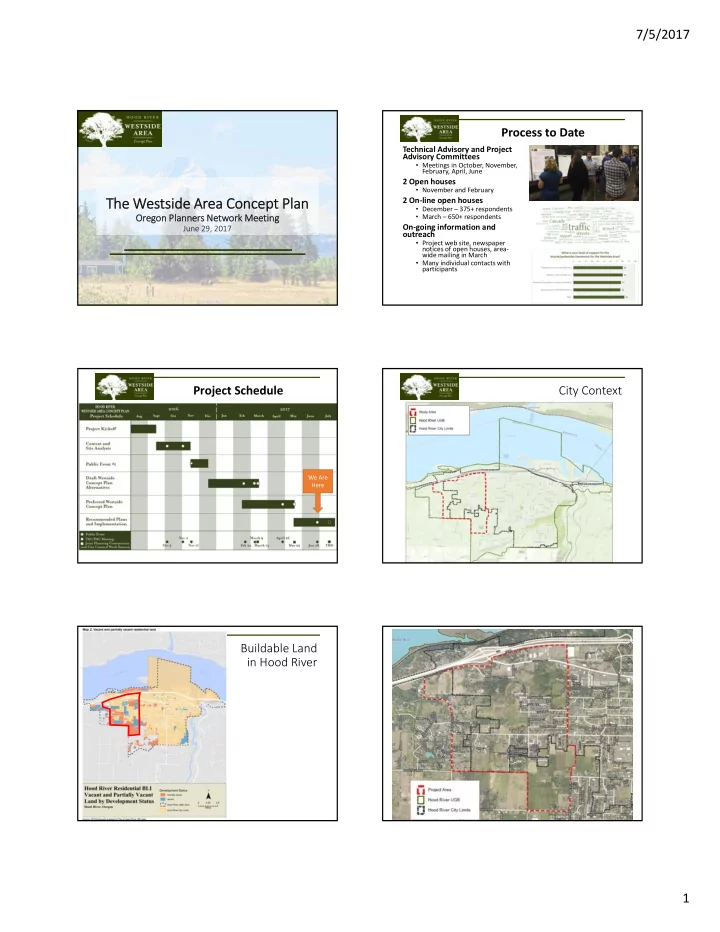
Project Schedule

We Are Here

City Context Buildable Land in Hood River Transportation System Plan

slide-2
SLIDE 2

7/5/2017 2

Transportation System Plan Physical Conditions Transportation System Plan Draft Preferred Alternative Studying a New Connection

JD7

Land Use

535 535 535 535 1133 1642 2318 1831 BASE CASE MODERATE ALTERNATIVE STRONG ALTERNATIVE PREFERRED ALTERNATIVE

EXPECTED DEVELOPMENT CAPACITY

Existing Housing Units New Housing Units

slide-3
SLIDE 3

Slide 11 JD7 left box is WM site study, right box is DEA plan (the meets-radii one that goes through the school property

Joe Dills, 5/21/2017

slide-4
SLIDE 4

7/5/2017 3

Preferred Alternative – Housing Mix

31 531 8 271 160 200 630 200 400 600 800 1000 1200 R‐1 R‐2A R‐3

Estimated Housing Mix of New Housing Units

Single‐Family Detached Single‐Family Attached Multifamily

Housing estimates based on data in Table 5 of the adopted Housing Needs Analysis

Land Use – Key Issues

  • Strategies to deliver

workforce and affordable housing

  • Level of change for

the Westside

  • Zoning updates
  • Whether to apply

zoning updates just in Westside or citywide

Housing Needs

  • Housing Needs Analysis
  • Deficit of land for multifamily housing
  • Need for a wider range of housing

“Missing Middle” housing types

  • Evaluate allowing smaller lot sizes
  • Identify opportunities for government‐subsidized

affordable housing

Housing – Zoning Strategies

  • Increase housing capacity
  • Existing zoning (Base Case) – 1133 new dwellings
  • Draft Preferred Concept Plan – 1831 new dwellings (increase of 60%)
  • Increase the amount of “missing middle” housing
  • Base Case – 14% Multifamily; 9% Attached Single‐Family; 77% Detached Single‐Family
  • Preferred Concept Plan – 45% Multifamily; 24% Attached Single‐Family; 31% Detached

Single‐Family

  • Diversify the mix of housing in each neighborhoods
  • Include Neighborhood Commercial sites to help reduce reliance on auto travel.
  • Create walkable and connected neighborhoods to reduce reliance on auto

travel.

  • Integration of land use with planned transit
  • Reduction in cost per unit for infrastructure
  • Support development of the County‐owned 2‐acre parcel for affordable

housing

  • Potential code changes (e.g. affordable housing bonus, minimum density

requirements)

Housing – Additional Strategies

  • Construction Excise Tax for affordable housing development
  • Community land trust for affordable, owner‐occupied housing
  • Advocacy for government (federal, state, local) subsidies for

affordable housing

  • System Development Charge waivers or significant reductions

(example: 75% reduction)

  • System Development Charges deferral to date of occupancy
  • Property tax exemption for low‐income housing, non‐profit

corporation, multi‐unit housing, housing in distressed areas

  • Property tax freezes on rehabilitated housing
  • Affirmatively further fair housing

Source: Mid‐Columbia Housing Authority and Columbia Cascade Housing Corporation, edited.

Streets Framework
slide-5
SLIDE 5

7/5/2017 4

Streets Framework – Key Issues

  • Alignment D funding
  • Alignment D phasing

and implementation

  • n smaller properties
  • Transportation

Planning Rule Compliance – meeting the “reasonably likely to be funded” criterion

  • Signal or roundabout

at Cascade/Mt Adams

Park and Open Space Framework

Thank you!

Resource slides

slide-6
SLIDE 6

7/5/2017 5

Current Zoning Moderate Alternative Strong Alternative City Context Overview Housing Definitions

Housing Affordable to Low‐ Income Households

Income below 60% of Median Family Income ($38,400)

Housing Affordable to Moderate‐Income Households

Income between 60% to 120% of Median Family Income ($38,400 ‐ $76,800)