The Vietnam War in Vietnamese History An Online Professional - - PowerPoint PPT Presentation

the vietnam war in vietnamese history
SMART_READER_LITE
LIVE PREVIEW

The Vietnam War in Vietnamese History An Online Professional - - PowerPoint PPT Presentation

The Vietnam War in Vietnamese History An Online Professional Development Seminar Haydon Cherry Assistant Professor of History NC State University We will begin promptly on the hour. The silence you hear is normal. If you do not hear anything


slide-1
SLIDE 1

We will begin promptly on the hour. The silence you hear is normal. If you do not hear anything when the images change, e-mail Caryn Koplik ckoplik@nationalhumanitiescenter.org for assistance.
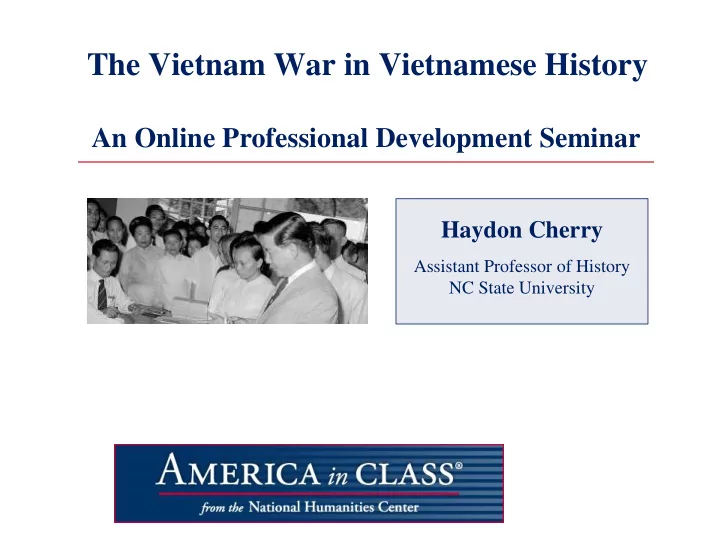
The Vietnam War in Vietnamese History

An Online Professional Development Seminar

Haydon Cherry

Assistant Professor of History NC State University

slide-2
SLIDE 2

americainclass.org 2

FROM THE FORUM

  • How important was Vietnam to the French?
  • For the Vietnamese, north and south, to what extent was the war an aspect
  • f the Cold War?
  • Was the Vietnam War a “proxy war” that somehow pitted the US against

China and the Soviet Union?

  • Was the domino theory in any way valid?

The Vietnam War in Vietnamese History

slide-3
SLIDE 3

americainclass.org 3

Haydon Cherry

Assistant Professor NC State University Fellow, Mahindra Humanities Center Harvard University (2011-2012) Currently writing "Down and Out in Saigon: Stories of the Urban Poor in Colonial Vietnam"

The Vietnam War in Vietnamese History

slide-4
SLIDE 4

americainclass.org 4

Introduction

For the United States, the Vietnam War was one of the defining events

  • f the era after World War II. The war profoundly shaped the domestic

politics, diplomatic relations, popular culture, and lives of thousands of

  • Americans. At its height in 1968, the US had 536,000 troops in
  • Vietnam. In comparison, during the recent occupation of Iraq, the

number of coalition forces peaked at 176,000. The Vietnam Veterans Memorial in Washington DC, records the names

  • f the 58,272 Americans who lost their lives in Vietnam, etched on two

black granite walls. Since the occupation of Iraq began on March 19, 2003, there have been 4,489 American military deaths.

slide-5
SLIDE 5

americainclass.org 5

Introduction

No such comprehensive list of Vietnamese war dead exists for the

  • war. The best estimates of modern demographers puts the number

at 1 million – or nearly 17 Vietnamese dead for every American. The Vietnamese government puts the number at closer to 1.5

  • million. The best estimates of the number of Iraqis who have died

since the occupation began place the number at over 1 million.

slide-6
SLIDE 6

americainclass.org 6

Introduction

If the Vietnam War was ONE of the defining events of the era after World War II for the United States, it was THE defining event for Vietnam in that period. For Vietnamese in both the North and the South, the Vietnam War was a Total War: it was a war that led to the mobilization of every available social and material resource. The war profoundly transformed the lives of tens of millions of Vietnamese people for more than a decade while it lasted and has done so for decades since.

slide-7
SLIDE 7

americainclass.org 7

The War’s Roots in Vietnamese History

Timeline 1858 France attacks Vietnam. 1862- 1867 Southern Vietnam becomes a French territory. 1884- 1885 France gains control over northern Vietnam. 1887 French Indochina formed (out of territories that are modern Vietnam and Cambodia). 1893 Laos becomes part of French Indochina. 1941 Japanese invade French Indochina. 1945 Vietnamese declare independence. 1946- 1954 First Indochina War. 1954 Vietnam divided at 17th parallel. 1955 Formation of the Republic of Vietnam (South Vietnam) 1963 Assassination of President Ngo Dinh Diem. 1965 Escalation of American troop numbers. American War begins. 1973 US troops withdraw. 1975 Fall of Saigon.

slide-8
SLIDE 8

americainclass.org 8

The French Colonial Empire in Southeast Asia

slide-9
SLIDE 9

americainclass.org 9

Dividing Vietnam

slide-10
SLIDE 10

americainclass.org 10

Introduction

But, as David Chanoff and Doan Van Toai declare in the introduction to the reading for this seminar, “Revolutionary Vietnam was not a monolith.” Vietnamese in the northern Democratic Republic of Vietnam (DRV) and in the southern Republic of Vietnam (RV) were divided by social status, religion, ethnicity, family, and place of origin as much as they were by political differences. There were cross-cutting fractures in Vietnamese society beyond those of political and ideological difference.

slide-11
SLIDE 11

americainclass.org 11

Introduction

Some differences between northern and southern Vietnam: North Vietnam Vietnamese homeland Densely populated Predominantly Vietnamese Strong Confucian influences Rice poor Little foreign trade South Vietnam More recently settled Population less dense Large Chinese population Heterodox religious practices Rice rich Substantial foreign trade

slide-12
SLIDE 12

americainclass.org 12

Introduction

Today we will look at the Vietnamese experience of the Vietnam War by focusing on events in the lives of three individuals: XUAN VU was a combat reporter and propaganda chief. His revolutionary activity lasted from 1945 to 1969. NGUYEN CONG HOAN was a South Vietnamese student militant who was elected to the National Assembly from his home province of Phu Yen in 1971. TRINH DUC was born on the Chinese island of Hainan where he joined the communist resistance during World War II. He spent ten years in prison before fighting Americans and their Saigon army allies.

slide-13
SLIDE 13

americainclass.org 13

Xuan Vu, combat reporter and propaganda chief:

You not only had to prove yourself by fighting the outside enemy, you also had to overcome the inside enemy. You had to be able to struggle against

  • yourself. You had to prove that you were loyal to the revolution with your

whole heart, and that you could renounce all your other loyalties – to your family especially. You had to cut your roots to your parents and grandparents and to any property you might have – renounce anything that separated you from the poor peasants and workers.

(pp. 77-78)

Discussion Questions

  • What does this passage suggest about the nature of social revolution in

the DRV?

  • And what is Xuan Vu’s view of it?
slide-14
SLIDE 14

americainclass.org 14

Xuan Vu, combat reporter and propaganda chief:

Each person had to write a detailed autobiography which highlighted everything he had ever done that was against the revolution. If you were educated in a French school you had to describe how your thoughts had been formed by colonialists. If your parents were business people or owned land you had to tell about how they had acted against the interests of the people – and how you had made any mistakes of your own, you had to include those in your confession. For example, if at some point you had put your own self- interest before the interests of the revolution. ... What they wanted was for you to deny yourself and accept the consciousness of the Party. You had to root out everything that was part of you that didn’t conform to the correct way

  • f thinking.

(p. 79)

Discussion Questions

  • Why did the government of the DRV want people to deny themselves and “accept the

consciousness of the Party?”

  • What kind of effect did this have on people?
slide-15
SLIDE 15

americainclass.org 15

Han Vi, musicologist, cultural cadre in North Vietnam:

During the “Hundred Flowers” campaign, when they asked cultural cadres to freely criticize the government, I kept quiet. At one of the meetings I drew a little cartoon for my friend sitting next to me – a man’s face in profile, with a padlock through his lips. I was saying that we had better shut up. After the campaign was over, a lot of people suffered for the criticisms they had made when things were supposedly open. Even nationally known figures, party members. The atmosphere then was terrible. Many artists went to jail for what they had said. Other people humbled themselves or denounced friends to keep their positions. But I hadn’t said a thing. So I just kept working at my job, up until 1960.

(p. 118)

Discussion Question

  • Why was the DRV government so concerned to produce ideological conformity?
slide-16
SLIDE 16

americainclass.org 16

Xuan Vu, combat reporter and propaganda chief:

I don’t know whether land reform accomplished what they wanted it to. It was traumatic enough for me. But there was a lot of quiet talk about the murders that happened in the countryside. … Of course there was no official information on any

  • f this. None of it was ever reported in the newspapers. But the troubles were

confirmed indirectly by Vo Nguyen Giap in a big speech he gave in Hanoi’s central

  • square. ... He said that the land reform had some successes but that there were also

some mistakes. The Party’s policy was right, but in certain localities it had been carried out incorrectly. He didn’t seem terribly repentant about it. There was a rumor, though, that Uncle Ho had cried in a Central Committee meeting when he heard about the executions. But I don’t know. He was an awfully foxy guy.

(p. 80)

Discussion Questions

  • What does this passage suggest about people’s knowledge of land reform in the

DRV?

  • What views might they have had of their leadership?
slide-17
SLIDE 17

americainclass.org 17

Xuan Vu, combat reporter and propaganda chief:

In the first years there was a lot of excitement and commitment, the same as there had been in the French war. But before I finally went South myself, an uneasy feeling began to creep into the atmosphere. By that time the villages were emptying out. The young people were all going to fight in the South, and they weren’t coming back. Here and there I would hear snatches of information or gossip that many of the youngsters were unhappy about having to go. A friend at work would say something about his son, or more likely, his son’s friends. More often it would be some general remark about how somebody had heard that they were having problems with some of the young men. People were just worried. Especially the ones with children. But this wasn’t the kind of thing that anybody spoke about openly. There wasn’t any public discussion.

(p. 82)

Discussion Questions

  • Why was gossip and rumor so important in the DRV?
  • Why had people become worried?
slide-18
SLIDE 18

americainclass.org 18

Huynh Liem, a Chinese-Vietnamese artist in the north:

From what I could see, there was enthusiasm for the war at first. But by 1965 or so the situation had changed. In the city anyway, people wanted to stay out. In the countryside, you know, they weren’t able to get out of it. But for a lot of the city boys it was a different story. There were different methods of avoiding the draft. You could take a job far away from your home and stay out of the hands of your local officials. Of course then you’d have to be careful about visiting home. Sometimes they could be

  • bribed. Tobacco leaves were another favorite method. Chewing raw tobacco leaves

sends your blood pressure straight up. If you did it before your induction physical you were a sure bet to fail.

(p. 124)

Discussion Question

  • What does this passage suggest about the different experiences of people in the

city and the countryside in the DRV?

slide-19
SLIDE 19

americainclass.org 19

Xuan Vu, combat reporter and propaganda chief:

The older writers had all been in the resistance and they were happy to be back in Hanoi after living in the jungle. … But as time passed, I could see each of them becoming more and more depressed. They just couldn’t produce like they had before. The problem was that were all being given such terrible projects to write about. The culture and propaganda people wanted works of art about all the good things, about factory life or collective labor in the countryside. But only the good things. What you wrote about had to be round like a ball, perfect. But a good writer has to pick something complicated, something he can analyze from the inside and the outside.

(p. 83)

Discussion Question

  • What effects might the war have had on cultural production in the DRV?
slide-20
SLIDE 20

americainclass.org 20

Nguyen Cong Hoan, a South Vietnamese student militant:

From 1965 on I also became more aware of the war, and more worried about it. That was the year the Americans arrived in force. As more of them came to Vietnam, I could see what kind of effect they were having. Each time I went home to Phu Yen I’d take a

  • bus. One of the stops was Cam Ranh, which had been such a beautiful place. But now

it was choked up with night clubs. Prostitutes and pornography stores were all over the

  • place. It had turned into a pornography city. The same kind of thing was happening in

Saigon, where there were more and more prostitutes and beggars. The Americans I saw looked strange and different. I didn’t hate them, but I was certainly disturbed by what their presence was doing to the country.

(p. 86)

Discussion Questions

  • What does this passage suggest about some Vietnamese views of the American

presence in the RV?

slide-21
SLIDE 21

americainclass.org 21

Nguyen Cong Hoan, a South Vietnamese student militant:

[I]n Phu Yen it was especially bad. Korean troops were operating there and they didn’t have any scruples at all about killing all the men in a village if they thought the village was being used by the Vietcong. So the peasants were scared to death and there were crowds of refugees. My parents became refugees too, along with most of the others from my village. It just wasn’t safe to live there anymore.

(p. 87)

Discussion Question

  • What does this passage suggest about whom some Vietnamese saw as their

main threat?

slide-22
SLIDE 22

americainclass.org 22

Nguyen Cong Hoan, a South Vietnamese student militant:

As far as I was concerned, I didn’t think much about the Front – the Vietcong. But some of my friends from the Buddhist movement joined them, people who were sincere and warmhearted, people I liked. But I never considered joining

  • myself. I knew they didn’t have the mass of the people with them, and I didn’t

like the violence of their methods. So I was quite opposed to fighting for them. It wasn’t so much that I was exactly a pacifist. … But I believed that we could change things in a relatively peaceful way, through political methods. And the way to do that was to struggle, to demonstrate, to keep the pressure on. That’s what appealed to me, to face the government directly as proponents of peace and democracy.

(p. 87)

Discussion Questions

  • What does this passage suggest about the nature of opposition to the

government in Saigon?

slide-23
SLIDE 23

americainclass.org 23

Nguyen Cong Hoan, a South Vietnamese student militant:

A lot of my friends in the Buddhist youth movement thought I should run for an Assembly seat from Phu Yen. … So I ran. … But even though I was only a student and didn’t have any money or experience, I had certain advantages. … The main advantage was that most of the other candidates were afraid to speak

  • ut against the government – and there was a lot of anti-government sentiment

among the voters. I ran on three issues: (1) Peace, (2) For the Poor, (3) Against the Government. By “against the government” I meant that I was against social injustice and economic inequities. I was against illegal arrests and imprisonment, and I was against the suppression of free speech.

Discussion Questions

  • Why was there opposition to the government in Saigon?
slide-24
SLIDE 24

americainclass.org 24

Trinh Duc, a Chinese-Vietnamese resistance fighter in the south:

Con Son [Prison] changed me. At least it changed me finally. When I was young, I witnessed a great deal of injustice, and I hated the people who I saw doing such terrible things. But that hatred wasn’t ingrained in me. Later I saw how people I loved were brutally tortured, and I had more hatred. Since I had been in prison that kind of thing had been happening to me personally for many, many years. Con Son was the culmination of it. I felt as if I had become like hardened steel. My human feelings were leaving me, I knew that. I was more than capable of doing the same things to my enemies that they were doing to me – no question. Without a moment’s hesitation. The same and worse.

Discussion Question

  • What effects did incarceration and war have on Trinh Duc and others?
slide-25
SLIDE 25

americainclass.org 25

Trinh Duc, a Chinese-Vietnamese resistance fighter in the south:

When I was finished with the training, they assigned me to the Hoa Van Comittee (the Chinese department). All the headquarters areas including Hoa Van were stretched out away from COSVN along the Cambodian border. … Rice had to be brought in, and there were very few vegetables to go along with it. … There was just never enough food. … I propose that they put me in charge of improving the life of the department. For a while on Con Son I had been chief of the prisoners who worked raising vegetables and I knew I could do it well. So I planted vegetables. Before long I was raising enough for the Hoa Van Committee, for Radio Liberation, which was next to us, and even enough to send up to COSVN (Central Office for South Vietnam).

(p. 102-103)

Discussion Questions

  • Was war and opposition to the southern government always the main

preoccupation of combatants in the south?

  • What might there other main concerns have been?
slide-26
SLIDE 26

americainclass.org 26

[T]he Saigon government was making an attempt to keep rice and medicine out of the hands of the Vietcong by restricting the supplies available to hamlets in disputed areas. Local people were put on a strict ration that was calculated according to how many individuals they had in their household. The idea was that if they didn’t have anything extra, they wouldn’t be able to smuggle anything to the guerrillas. In this kind of hamlet the people always suffered terribly. They weren’t able to keep more than a week’s worth of any kind of supplies on hand. Their food intake was severely limited, and they were under constant government pressure. Under those circumstances, it was natural that they sympathized with us and hated the government.

(p. 104)

Discussion Question

  • What does this and other similar passages suggest about the experiences of many

southern Vietnamese?

Trinh Duc, a Chinese-Vietnamese resistance fighter in the south:

slide-27
SLIDE 27

americainclass.org 27

Worse than the Americans were the Australians. The Americans’ style was to hit us, then call for planes and artillery. Our response was to break contact and disappear if we could, but if we couldn’t we’d move up right next to them so the planes couldn’t get us. The Australians were more patient than the Americans, better guerrilla fighters, better at ambushes. They liked to stay with us instead of calling in the planes. We were more afraid of their style.

(p. 108)

Discussion Question

  • What does this passage suggest about southern resistance fighters’ views of

their enemies?

Trinh Duc, a Chinese-Vietnamese resistance fighter in the south:

slide-28
SLIDE 28

americainclass.org 28

Le Thi Dau, Trinh Duc’s wife, a nurse:

When I got to Bao Binh I opened up a little infirmary, myself and two assistants from the village. One of the problems at first was that the people were illiterate. They weren’t used to Western medicine at all. They relied mostly on prayers and superstitions, so we had to educate them. I took care of minor health problems, taught basic hygiene, baby care, things like that.

(p. 112)

Discussion Questions

  • What other challenges might people in the countryside have faced?
  • What does this passage suggest about the principle preoccupations of

Vietnamese in the countryside?

slide-29
SLIDE 29

americainclass.org 29

Han Vi, musicologist, cultural cadre in North Vietnam:

As far as I was concerned, the South Vietnamese regime really was just a continuation of colonialism. But I felt a lot of ambivalence about the Americans, and so did many of my friends. I hated their invasion of the South. But I had a lot of admiration for their standard of living, and for their history. There wasn’t any colonialism in their history. As far as China went, I wasn’t thrilled by what I had seen of it under Mao. And I couldn’t see much to like about the Russians

  • either. So as the war progressed I found myself in a confused state of mind about

a lot of things.

(p. 121)

Discussion Questions

  • What does this passage suggest about some northern Vietnamese views of the

United States during the war?

slide-30
SLIDE 30

americainclass.org 30

My real disillusionment with the war began to grow because of the conflict between China and the USSR. That wasn’t possible for me to ignore. It brought too many problems. … I knew that Hoang Van Hoan [the leading pro-China voice in North Vietnam’s politburo] had lost his power. He was no longer an effective counterbalance to the pro-Soviet faction in the politburo – Le Duan, Le Duc Tho, and Nguyen Co Thac. As I saw it, the pro-Soviet group was submerging the pro-Chinese and also people like Vo Nguyen Giap [minister of defense] and Truong Chinh [the leading politburo theoretician] who wanted to steer a middle course between China and the USSR, as Ho Chi Minh had done. By 1975, they were eliminating pro-Chinese elements from the Central Committee, using the pretext that room had to be made for Southerners.

(p. 121)

Discussion Questions

  • Was the United States always at the forefront of the minds of northern

Vietnamese? Or were other players often at least as important?

Han Vi, musicologist, cultural cadre in North Vietnam:

slide-31
SLIDE 31

americainclass.org 31

Final Slide Thank you