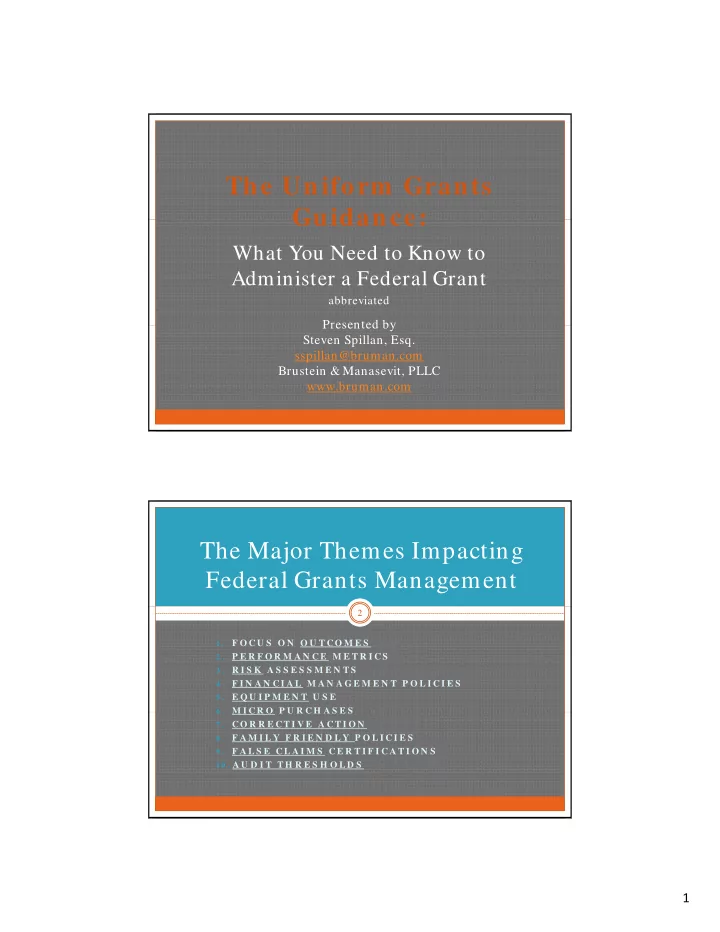
The Uniform Grants Guidance: Guidance: What You Need to Know to - - PDF document

the uniform grants guidance guidance
SMART_READER_LITE
LIVE PREVIEW

The Uniform Grants Guidance: Guidance: What You Need to Know to - - PDF document

The Uniform Grants Guidance: Guidance: What You Need to Know to Administer a Federal Grant abbreviated Presented by Presented by Steven Spillan, Esq. sspillan@bruman.com Brustein & Manasevit, PLLC www.bruman.com The Major Themes


slide-1
SLIDE 1

1

The Uniform Grants Guidance:

What You Need to Know to Administer a Federal Grant

abbreviated

Guidance:

Presented by Presented by Steven Spillan, Esq. sspillan@bruman.com Brustein & Manasevit, PLLC www.bruman.com

The Major Themes Impacting Federal Grants Management

1 .

F O C U S O N O U T C O M E S

2 . P E R F O R M A N C E M E T R I C S 3 . R I S K A S S E S S M E N T S 4 . F I N A N C I A L M A N A G E M E N T P O L I C I E S 5 .

E Q U I P M E N T U S E

6 . M I CR O P U R C H A S E S

2

6 . M I CR O P U R C H A S E S 7 .

C O R R E C T I V E A C T I O N

8 . F A M I L Y F R I E N D L Y P O L I CI E S 9 . F A L S E C L A I M S C E R T I F I C A T I O N S 1 0 . A U D I T T H R E S H O L D S

slide-2
SLIDE 2

2

Date of Applicability of Revised Rules

3

 OMB stated on 12/ 20/ 13

All Drawdowns, after December 26, 2014

? ? ? ? ? ?

What is covered?

 A-102 – Administrative Rules State / Local

4

– Part 80 – EDGAR

 A-110 – Administrative Rules

Postsecondary – Part 74 – EDGAR

 A-87 – Cost Rules – State / Local  A-21 – Cost Rules – Rules – Postsecondary  A-122 – Cost Rules – Nonprofit  A-133 – Audit Rules (>$750,000)

slide-3
SLIDE 3

3

Who is covered?

ll “ f d l i i ” di

5

All “nonfederal entities” expending

federal awards – that means districts and charters

Structure of Omni-Circular (p. 78608)

2 CF R P AR T 2 0 0 2 CF R P AR T 3 4 74

6

slide-4
SLIDE 4

4

(p. 78608)

7

 Subpart A – Definitions

S b B G l P i i

 Subpart B – General Provisions  Subpart C – Pre Award Requirements  Subpart D – Post Award Requirements  Subpart E – Cost Principles  Subpart F – Audit Requirements

Key Definitions

8

 Cognizant Agency for Audit 200.18 (78611)  Cognizant Agency for Indirect 200.19 (78611)

Cognizant Agency for Indirect 200.19 (78611)

 Computing Devices 200.20 (78612)  Cooperative Audit Resolution 200.25 (78612)  Cost Objective 200.28 (78612)  Internal Control Over Compliance 200.62 (78615)  Major Program 200.65 (78615)

Major Program 200.65 (78615)

 Micro Purchase 200.67 (78615)  Modified Total Direct Cost 200.68 (78615)  Non-Federal Entity 200.69 (78615)  Conflict of Interest 200.112 (78621)

slide-5
SLIDE 5

5

Quick Overview of New Financial Management Requirements:

  • 1. Performance Metrics

Ri k M

9

  • 2. Risk Management
  • 3. Augmented Pass-Through Responsibilities
  • 4. Emphasis on Immediate Corrective Action
  • 5. Cooperative Audit Resolution

WHY??

All oversight will examine financial management

10

All oversight will examine financial management controls:

1)

OIG Audit

2) Single Audit 3) Federal Program Monitoring ) “P

Th h” M it i

4) “Pass Through” Monitoring

slide-6
SLIDE 6

6

Crosswork Between 34 CFR 80.20 (b) and CFR 200.302(b)

34 CFR 8 0 .20 (b) 34 CFR 8 0 .20 (b) 2 CFR 20 0 .30 2 (b) 2 CFR 20 0 .30 2 (b)

11

  • 1. Financial Reporting
  • 2. Accounting Records
  • 3. Internal Control
  • 4. Budget Control
  • 5. Allowable Cost
  • 6. Source Documentation

C h M t

  • 1. Identification of

Awards

  • 2. Financial Reporting
  • 3. Accounting Records

(Source Docs)

  • 4. Internal Control
  • 5. Budget Control
  • 7. Cash Management
  • 6. Written Cash

Management Procedures

  • 7. Written Allowability

Procedures

2) Financial Reporting

New shift to OMB approved

f t i

12

performance metrics

slide-7
SLIDE 7

7

2) Financial Reporting (cont.)

 Performance Metrics:

C t l li h t

13

  • 1. Compare actual accomplishments

to objectives. (quantify to extent possible)

  • 2. Reasons goals were not met if

appropriate pp p

  • 3. Additional pertinent information

(e.g. analysis and explanation of cost overruns, high unit costs) 2) Financial Reporting (cont.)

  • 4. Significant developments

14

  • a. Problems, delays. Adverse conditions

that would impair ability to meet

  • bjective of the award
  • b. Favorable developments. Finishing

sooner or at less cost sooner or at less cost

slide-8
SLIDE 8

8

2) Financial Reporting (Cont.)

 OMB Allows ED to waive “performance metrics” not

required.

15

required.

 How will ED reconcile performance metrics with

accountability / performance indicators of ESEA, IDEA CTE AEFLA IDEA, CTE, AEFLA

4) Internal Control

 Essentially same as 80.20 (b) (3)  Effective control over and accountability for:

16

 Effective control over and accountability for:

1.

All funds

  • 2. Property
  • 3. Other assets

 Must adequately safeguard all assets  Use assets solely for authorized purpose

slide-9
SLIDE 9

9

4) Internal Control 200.303 (cont.)

 Comply with federal statutes, regs, terms of the

award

17

award

 Evaluate and monitor compliance  Take prompt action when instances of

noncompliance are identified

 Safeguard protected personally identifiable

information information

6) Written Cash Management Procedures (New)

 Written Procedures to implement the

requirements of 200 305

18

requirements of 200.305

slide-10
SLIDE 10

10

7) Written Allowability Procedures (New) Written procedures for determining

19

allowability of costs in accord with Subpart E – Cost Principles (see p. 78639 – 78662)

20

Equipment

200.313 (78629) Significant changes on use and

disposition

slide-11
SLIDE 11

11

21

Supplies

200.314 (78630) Covers computers

Procurement “Bear Claw”

22

slide-12
SLIDE 12

12

 Pass-through (TEA) must evaluate each

subrecipient’s risk of non compliance

23

subrecipient s risk of non compliance (federal statute / regulations / terms of award) for purpose of monitoring 200.331

 Risk Factors:

S b i i ’ i i i h h

24

  • 1. Subrecipient’s prior experience with the

grant program

  • 2. Results of previous audits
  • 3. New personnel or substantially changed

systems systems

  • 4. Results of federal monitoring
slide-13
SLIDE 13

13

200.331

 Pass-through may impose conditions on subgrant

based on risk assessment:

25

1.

Shift to reimbursement

2.

Withhold payments until evidence of acceptable performance

3.

Require more reporting

4.

Require additional monitoring

5.

Require additional technical or management assistance

6.

Establish additional prior approvals

200.331

Pass-through (TEA) must monitor its

b i i t t li d

26

subrecipients to assure compliance and performance goals are achieved

slide-14
SLIDE 14

14

Record Retention (78636)

27

Retention 200.333 (5 years)

Subpart E – Cost Principles (78639)

28

slide-15
SLIDE 15

15

Basic Considerations (78640)

29

Composition of Costs 200.402 Allowability 200.403 Reasonable Costs 200.404 Allocability 200.405 Applicable Credits 200 406 Applicable Credits 200.406 Prior Written Approval 200.407

30

Promotional Costs 200.421 (78645) Conferences 200.432 (78650) Employee Morale 200.437 (78652) Memberships 200.454 (78657) Travel Costs 200.474 (78661)

slide-16
SLIDE 16

16

Disclaim er This presentation is intended solely to provide general information and does not constitute legal g g

  • advice. Attendance at the presentation or later

review of these printed materials does not create an attorney-client relationship with Brustein & Manasevit, PLLC. You should not take any action based upon any information in this presentation i h fi l i l l l f ili i h without first consulting legal counsel familiar with your particular circumstances.

31