SLIDE 1
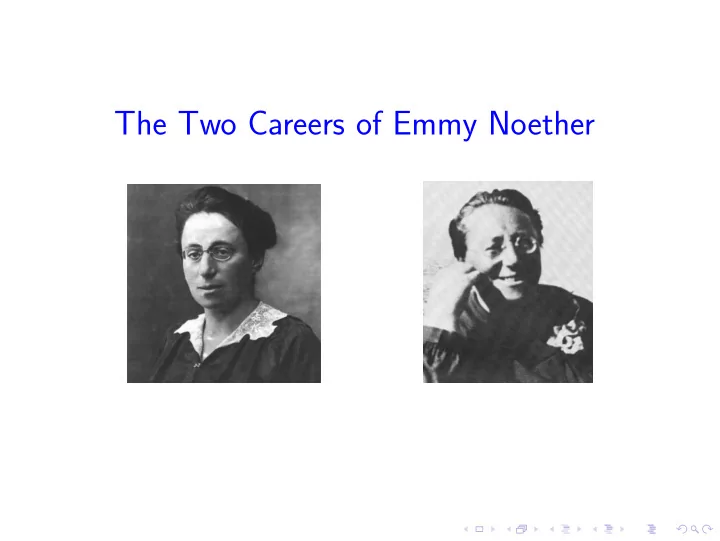
The Two Careers of Emmy Noether
SLIDE 2
A notable career in Nineteenth Century Erlangen. 1905 1916 The long Nineteenth Century.
SLIDE 3
EN would be remembered today as a woman in mathematics if she had never done any of the things we remember today.
SLIDE 4
EN would be remembered today as a woman in mathematics if she had never done any of the things we remember today. An unfortunate parallel case:
SLIDE 5 EN would be remembered today as a woman in mathematics if she had never done any of the things we remember today. An unfortunate parallel case: Mildred Sanderson, 1889–1914.
◮ Master’s and Ph.D. with L.E. Dickson, Chicago. ◮ Thesis ”Formal Modular Invariants with Applications to
Binary Modular Covariants.”
SLIDE 6 Noether:
◮ Dissertation 1908 with Gordan. ◮ Circolo Matematico di Palermo 1908. ◮ Deutsche Mathematiker-Vereinigung 1909. ◮ Supervised Hans Falckenberg dissertation 1911 (with E.
Schmidt).
SLIDE 7 Noether:
◮ Dissertation 1908 with Gordan. ◮ Circolo Matematico di Palermo 1908. ◮ Deutsche Mathematiker-Vereinigung 1909. ◮ Supervised Hans Falckenberg dissertation 1911 (with E.
Schmidt). Then a different career: different place, different life, and a different century in world history and in mathematics.
SLIDE 8
Life in Erlangen
Weyl: “There was nothing rebellious in her nature; she was willing to accept conditions as they were.” Weyl probably heard this from her brother Fritz, and it is probably true.
SLIDE 9
However, she may have irritated Friedrich Nietzsche when she was 5 years old.
SLIDE 10
However, she may have irritated Friedrich Nietzsche when she was 5 years old. Nietzsche, 1887, took meals in the Hotel Alpenrose, Sils Maria, enjoying ”occasional conversations with a Mathematics Professor from Erlangen, [Max] Noether, an intelligent Jew.”
SLIDE 11
However, she may have irritated Friedrich Nietzsche when she was 5 years old. Nietzsche, 1887, took meals in the Hotel Alpenrose, Sils Maria, enjoying ”occasional conversations with a Mathematics Professor from Erlangen, [Max] Noether, an intelligent Jew.” He avoided the normal dinner hour: ”the room is hot, too crowded (ca. 100 people, many children), noisy.”
SLIDE 12
However, she may have irritated Friedrich Nietzsche when she was 5 years old. Nietzsche, 1887, took meals in the Hotel Alpenrose, Sils Maria, enjoying ”occasional conversations with a Mathematics Professor from Erlangen, [Max] Noether, an intelligent Jew.” He avoided the normal dinner hour: ”the room is hot, too crowded (ca. 100 people, many children), noisy.” Her lowest grade was “satisfactory,” for practical classroom conduct.
SLIDE 13
Noether considered her career in Erlangen a success.
SLIDE 14
Noether considered her career in Erlangen a success. She was not a feminist.
SLIDE 15
Noether considered her career in Erlangen a success. She was not a feminist. A student and friend was, Olga Taussky-Todd:
SLIDE 16
Noether considered her career in Erlangen a success. She was not a feminist. A student and friend was, Olga Taussky-Todd:
SLIDE 17
Even by 1930, Taussky-Todd tells us
SLIDE 18 Even by 1930, Taussky-Todd tells us
◮ “She said women should not try to work as hard as men.
SLIDE 19 Even by 1930, Taussky-Todd tells us
◮ “She said women should not try to work as hard as men. ◮ She remarked that she, on the whole, only helped young men
to obtain positions so they could marry and start families.
SLIDE 20 Even by 1930, Taussky-Todd tells us
◮ “She said women should not try to work as hard as men. ◮ She remarked that she, on the whole, only helped young men
to obtain positions so they could marry and start families.
◮ She somehow imagined that all women were supported.”
SLIDE 21
The Turn of the Century in Mathematics.
SLIDE 22
The Turn of the Century in Mathematics. I define these two mathematical centuries in relation to foundations.
SLIDE 23
The Turn of the Century in Mathematics. I define these two mathematical centuries in relation to foundations. Not (necessarily) formal foundations.
SLIDE 24 A broad consensus as to:
◮ What mathematics deals with: numbers?
SLIDE 25 A broad consensus as to:
◮ What mathematics deals with: numbers? symbols?
SLIDE 26 A broad consensus as to:
◮ What mathematics deals with: numbers? symbols?
quantities?
SLIDE 27 A broad consensus as to:
◮ What mathematics deals with: numbers? symbols?
quantities? sets?
SLIDE 28 A broad consensus as to:
◮ What mathematics deals with: numbers? symbols?
quantities? sets?
◮ What do we assume about them at base?
SLIDE 29 A broad consensus as to:
◮ What mathematics deals with: numbers? symbols?
quantities? sets?
◮ What do we assume about them at base? ◮ What questions may legitimately be asked about such entities?
SLIDE 30 A broad consensus as to:
◮ What mathematics deals with: numbers? symbols?
quantities? sets?
◮ What do we assume about them at base? ◮ What questions may legitimately be asked about such entities? ◮ What counts as a solution?
SLIDE 31 A broad consensus as to:
◮ What mathematics deals with: numbers? symbols?
quantities? sets?
◮ What do we assume about them at base? ◮ What questions may legitimately be asked about such entities? ◮ What counts as a solution? Non-constructive proofs?
SLIDE 32 Hel Braun’s student-eye view. Number theory at Frankfurt University 1933. Student of Carl Ludwig Siegel. Habilitated G¨
SLIDE 33 Saw the spread of G¨
◮ “This largely goes back to the algebraists.
SLIDE 34 Saw the spread of G¨
◮ “This largely goes back to the algebraists. ◮ University mathematics became, so to say, more ‘logical.’
SLIDE 35 Saw the spread of G¨
◮ “This largely goes back to the algebraists. ◮ University mathematics became, so to say, more ‘logical.’ ◮ One learns methods and everything is put into a theory.
SLIDE 36 Saw the spread of G¨
◮ “This largely goes back to the algebraists. ◮ University mathematics became, so to say, more ‘logical.’ ◮ One learns methods and everything is put into a theory. ◮ Talent is no longer so extremely important.”
SLIDE 37 Saw the spread of G¨
◮ “This largely goes back to the algebraists. ◮ University mathematics became, so to say, more ‘logical.’ ◮ One learns methods and everything is put into a theory. ◮ Talent is no longer so extremely important.”
“Perhaps I exaggerate but this is the impression I have when I compare the lectures of that time to later ones.”
SLIDE 38
Or again:
SLIDE 39 Or again:
◮ “Still in my student days university mathematics rested
strongly on mathematical talent.
SLIDE 40 Or again:
◮ “Still in my student days university mathematics rested
strongly on mathematical talent.
◮ Logic and notation were not so well established.
SLIDE 41 Or again:
◮ “Still in my student days university mathematics rested
strongly on mathematical talent.
◮ Logic and notation were not so well established.
“The days are gone when one affectionately described one’s professor with ‘He said A, wrote B, meant C, and D is correct’...”
SLIDE 42
Compare Max and Emmy Noether on Paul Gordan:
SLIDE 43 Compare Max and Emmy Noether on Paul Gordan:
◮ His lectures rested less on deep knowledge of other’s works –
since he read them very little –
SLIDE 44 Compare Max and Emmy Noether on Paul Gordan:
◮ His lectures rested less on deep knowledge of other’s works –
since he read them very little –
◮ than on an instinctive feel for the ways and goals of
mathematical efforts. . . .
SLIDE 45 Compare Max and Emmy Noether on Paul Gordan:
◮ His lectures rested less on deep knowledge of other’s works –
since he read them very little –
◮ than on an instinctive feel for the ways and goals of
mathematical efforts. . . .
◮ He never did justice to developing concepts from the
fundamentals (Grundlagen gehenden Begriffsentwicklungen).
SLIDE 46 Compare Max and Emmy Noether on Paul Gordan:
◮ His lectures rested less on deep knowledge of other’s works –
since he read them very little –
◮ than on an instinctive feel for the ways and goals of
mathematical efforts. . . .
◮ He never did justice to developing concepts from the
fundamentals (Grundlagen gehenden Begriffsentwicklungen).
◮ His lectures entirely avoided fundamental conceptual
definitions, even such as limit.
SLIDE 47 Compare Max and Emmy Noether on Paul Gordan:
◮ His lectures rested less on deep knowledge of other’s works –
since he read them very little –
◮ than on an instinctive feel for the ways and goals of
mathematical efforts. . . .
◮ He never did justice to developing concepts from the
fundamentals (Grundlagen gehenden Begriffsentwicklungen).
◮ His lectures entirely avoided fundamental conceptual
definitions, even such as limit.
◮ His lectures rested on lively expression and the power gained
from his own studies, rather than on logic and rigor (Systematik und Strenge).
SLIDE 48
SLIDE 49
Does Emmy Noether use limits in “formale Variationsrechnung,” in her famous paper on conservation theorems?
SLIDE 50
Does Emmy Noether use limits in “formale Variationsrechnung,” in her famous paper on conservation theorems? Not obvious.
SLIDE 51
The extreme difficulty of reading her dissertation.
SLIDE 52
The extreme difficulty of reading her dissertation. Computational algebraists Rebecca and Luis Garcia, Sam Houston State University.
SLIDE 53 The eulogy of Gordan
◮ “He compiled volumes of formulas, very well ordered but
providing a minimum of text.
◮ His mathematical friends undertook to prepare the text for
◮ They could not always produce a fully correct conception.”
“Only a few of his publications, and especially the earliest, express Gordan’s specific style: bare, brief, direct, uninterrupted theorems
SLIDE 54
Noether was comfortable with this.
SLIDE 55
Noether was comfortable with this. She would call a claim well known if someone she knew, knew it.
SLIDE 56
Noether 1916 uses a “well known” fact on polarized symmetric polynomials.
SLIDE 57
Noether 1916 uses a “well known” fact on polarized symmetric polynomials. She gives two footnotes to this well known fact on one page.
SLIDE 58
Noether 1916 uses a “well known” fact on polarized symmetric polynomials. She gives two footnotes to this well known fact on one page. Neither footnote cites a proof.
SLIDE 59
Noether 1916 uses a “well known” fact on polarized symmetric polynomials. She gives two footnotes to this well known fact on one page. Neither footnote cites a proof. One footnote refers to the other.
SLIDE 61 Life in G¨
No need to linger on WW I.
SLIDE 62 Life in G¨
No need to linger on WW I. Pro-soviet socialism.
SLIDE 63
Weyl has her “period of relative dependence” extend to 1919 – first on Gordan, then on Hilbert.
SLIDE 64
This is fair in the sense that she let Gordan, Fischer, and Klein-Hilbert set her problems.
SLIDE 65
This is fair in the sense that she let Gordan, Fischer, and Klein-Hilbert set her problems. But not her methods.
SLIDE 66
Her “method” circa 1915–1918:
SLIDE 67
Her “method” circa 1915–1918: state each probem as simply as possible, it will solve itself.
SLIDE 68
Her “method” circa 1915–1918: state each probem as simply as possible, it will solve itself. And Noether never claimed independence:
SLIDE 69
Her “method” circa 1915–1918: state each probem as simply as possible, it will solve itself. And Noether never claimed independence: “It is all already in Dedekind.”
SLIDE 70
Her “method” circa 1915–1918: state each probem as simply as possible, it will solve itself. And Noether never claimed independence: “It is all already in Dedekind.” What she saw in Dedekind – as she saw conservation laws in Lie.
SLIDE 71
Twentieth Century Mathematics according to Noether
SLIDE 72
Twentieth Century Mathematics according to Noether Build a community around Dedekind’s achievements.
SLIDE 73 ◮ What does mathematics deal with?
SLIDE 74 ◮ What does mathematics deal with?
◮ Dedekind: integers, real and complex numbers, sets.
SLIDE 75 ◮ What does mathematics deal with?
◮ Dedekind: integers, real and complex numbers, sets. ◮ Noether defers to her friend Zermelo.
SLIDE 76 ◮ What does mathematics deal with?
◮ Dedekind: integers, real and complex numbers, sets. ◮ Noether defers to her friend Zermelo.
◮ What do we assume about them at base?
SLIDE 77 ◮ What does mathematics deal with?
◮ Dedekind: integers, real and complex numbers, sets. ◮ Noether defers to her friend Zermelo.
◮ What do we assume about them at base?
◮ Dedekind in print: standard analysis.
SLIDE 78 ◮ What does mathematics deal with?
◮ Dedekind: integers, real and complex numbers, sets. ◮ Noether defers to her friend Zermelo.
◮ What do we assume about them at base?
◮ Dedekind in print: standard analysis. ◮ Noether(and Dedekind in notes) stated algebraic axioms.
SLIDE 79 ◮ What does mathematics deal with?
◮ Dedekind: integers, real and complex numbers, sets. ◮ Noether defers to her friend Zermelo.
◮ What do we assume about them at base?
◮ Dedekind in print: standard analysis. ◮ Noether(and Dedekind in notes) stated algebraic axioms.
◮ What questions may legitimately be asked about such
entities?
SLIDE 80 ◮ What does mathematics deal with?
◮ Dedekind: integers, real and complex numbers, sets. ◮ Noether defers to her friend Zermelo.
◮ What do we assume about them at base?
◮ Dedekind in print: standard analysis. ◮ Noether(and Dedekind in notes) stated algebraic axioms.
◮ What questions may legitimately be asked about such
entities? Structural relations.
SLIDE 81 ◮ What does mathematics deal with?
◮ Dedekind: integers, real and complex numbers, sets. ◮ Noether defers to her friend Zermelo.
◮ What do we assume about them at base?
◮ Dedekind in print: standard analysis. ◮ Noether(and Dedekind in notes) stated algebraic axioms.
◮ What questions may legitimately be asked about such
entities? Structural relations.
◮ What counts as a solution?
SLIDE 82 ◮ What does mathematics deal with?
◮ Dedekind: integers, real and complex numbers, sets. ◮ Noether defers to her friend Zermelo.
◮ What do we assume about them at base?
◮ Dedekind in print: standard analysis. ◮ Noether(and Dedekind in notes) stated algebraic axioms.
◮ What questions may legitimately be asked about such
entities? Structural relations.
◮ What counts as a solution? Homomorphism and isomorphism
theorems.
SLIDE 83 ◮ What does mathematics deal with?
◮ Dedekind: integers, real and complex numbers, sets. ◮ Noether defers to her friend Zermelo.
◮ What do we assume about them at base?
◮ Dedekind in print: standard analysis. ◮ Noether(and Dedekind in notes) stated algebraic axioms.
◮ What questions may legitimately be asked about such
entities? Structural relations.
◮ What counts as a solution? Homomorphism and isomorphism
theorems. Those are not the only solutons allowed in principle, of course. They are the preferred means of solution for Dedekind and Noether.
SLIDE 84
The growth of mathemtics, and the rise of more uniform standards, both required and permitted profusion ot textbooks.
SLIDE 85
The growth of mathemtics, and the rise of more uniform standards, both required and permitted profusion ot textbooks. Hel Braun: “Springer books freed students from the Lesezimmer.”
SLIDE 86
The growth of mathemtics, and the rise of more uniform standards, both required and permitted profusion ot textbooks. Hel Braun: “Springer books freed students from the Lesezimmer.” Precursor: Weber Lehrbuch der Algebra: kleine Ausgabe in einem Bande 1912.
SLIDE 87 The growth of mathemtics, and the rise of more uniform standards, both required and permitted profusion ot textbooks. Hel Braun: “Springer books freed students from the Lesezimmer.” Precursor: Weber Lehrbuch der Algebra: kleine Ausgabe in einem Bande 1912. A symptom of Noether’s closeness to this: It is easy today to get a rather close replica of her MA articles in L
AT
EX, as it has fonts closely based on Springer-Verlag of the time.
SLIDE 88
Bourbaki
SLIDE 89
Bourbaki “It is true that there were already excellent monographs at the time and, in fact, the Bourbaki treatise was modeled in the beginning on the excellent algebra treatise of Van der Waerden.
SLIDE 90
Bourbaki “It is true that there were already excellent monographs at the time and, in fact, the Bourbaki treatise was modeled in the beginning on the excellent algebra treatise of Van der Waerden. I have no wish to detract from his merit, but as you know, he himself says in his preface that really his treatise had several authors, including E. Noether and E. Artin,
SLIDE 91
Bourbaki “It is true that there were already excellent monographs at the time and, in fact, the Bourbaki treatise was modeled in the beginning on the excellent algebra treatise of Van der Waerden. I have no wish to detract from his merit, but as you know, he himself says in his preface that really his treatise had several authors, including E. Noether and E. Artin, so that it was a bit of an early Bourbaki.”
SLIDE 92
Norbert Schappacher objects strongly that all my sources are unreliable and have their own agendas. He and I agree the same is true of Weyl. We both like Alexandroff on Noether, but you can hardly avoid saying the same of him.
SLIDE 93 However:
◮ What I quote from Braun is clearly true. She just puts it well. ◮ Indeed Gordan is an extreme case, but so was Poincar´
e, and I could as well cite Lie or Klein as examples that I know. I doubt many less known professors were very much more like Weierstrass than these were.
◮ Norbert tells me Cordula Tollmien has found that Max
Noether resented Gordan for making him do a lot of work in Gordan’s name.
◮ Far from disqualifying him as a source, this makes it more
likely than I had thought before, that Max was one of those who wrote proofs for Gordan without understanding them.
SLIDE 94 ◮ What personal agenda would lead Taussky-Todd to say
Noether would not recommend women for jobs?
◮ Most likely, that Noether said exactly this to her, in declining
to recommend her.
◮ No one says Noether did attend the women’s group meeting
at the ICM 1932. Noether talked at that ICM. Taussky-odd says she told Noether about the meeting and Noether endorsed it in principle without attending.
◮ Why would Taussky-Todd make up that Noether said women
should not try to work as hard as men?
◮ Can we believe it was resentment over Noether’s methods in
number theory? Or should we rather believe Taussky-Todd resented Noether saying things just like this?
SLIDE 95
Saunders Mac Lane did not call himself a friend, but a student. He says he did not understand her lectures. Should we dismiss this as a late reconstructed memory? Or should we rather say he – whose later work would in fact utterly reorganize the material that he heard her lecture on – had a more demanding sense of “understanding” the material than most people would?