The Time Has Come: Integrating Traumainformed Prevention within - - PDF document

the time has come integrating trauma informed prevention
SMART_READER_LITE
LIVE PREVIEW

The Time Has Come: Integrating Traumainformed Prevention within - - PDF document

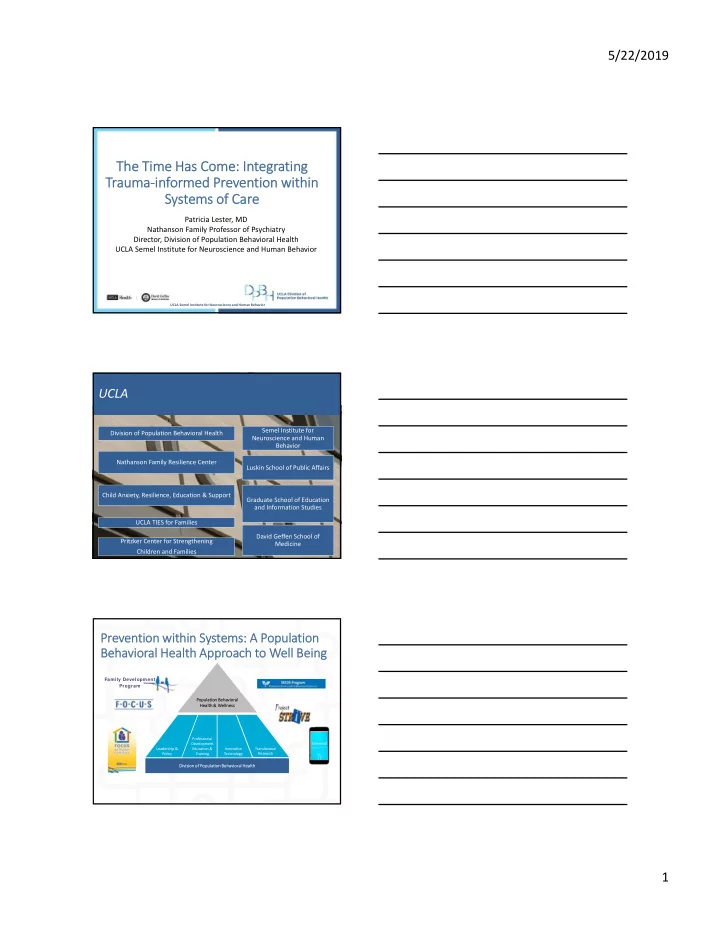
5/22/2019 The Time Has Come: Integrating Traumainformed Prevention within Systems of Care Patricia Lester, MD Nathanson Family Professor of Psychiatry Director, Division of Population Behavioral Health UCLA Semel Institute for Neuroscience


slide-1
SLIDE 1

5/22/2019 1

UCLA Semel Institute for Neuroscience and Human Behavior

The Time Has Come: Integrating Trauma‐informed Prevention within Systems of Care

Patricia Lester, MD Nathanson Family Professor of Psychiatry Director, Division of Population Behavioral Health UCLA Semel Institute for Neuroscience and Human Behavior

UCLA Semel Institute for Neuroscience and Human Behavior

UCLA

Division of Population Behavioral Health Pritzker Center for Strengthening Children and Families Nathanson Family Resilience Center UCLA TIES for Families Child Anxiety, Resilience, Education & Support Semel Institute for Neuroscience and Human Behavior Luskin School of Public Affairs David Geffen School of Medicine Graduate School of Education and Information Studies

Leadership & Policy Professional Development Education & Training Innovative Technology Translational Research

Division of Population Behavioral Health Population Behavioral Health & Wellness Family Development Program

Prevention within Systems: A Population Behavioral Health Approach to Well Being

slide-2
SLIDE 2

5/22/2019 2

RECREATION CHILD WELFARE HEALTH CARE MENTAL HEALTH EDUCATION COMMUNITY SPIRITUALITY FAMILY INDIVIDUAL

Ecological Framework for Prevention: Engaging with System of Support

RECREATION CHILD WELFARE HEALTH CARE MENTAL HEALTH EDUCATION COMMUNITY SPIRITUALITY FAMILY INDIVIDUAL

Prevention Across a Continuum of Care: Opportunities to Support & Optimize Life Trajectories

Adapted from National Academy of Sciences, 2016

  • Billions of dollars and decades of research have been invested in the

development of practices, programs, guidelines, and interventions to affect individual‐level health‐related behavior and outcomes

  • Benefits of preventive interventions to support positive developmental

and well‐being outcomes in children and families has a strong research base, the translation of this evidence into practice has lagged far behind.

  • Dissemination of existing EBP is low across most community and clinical

settings, with research identifying a range of barriers to successful implementation.

(IOM 2009, Glasgow & Chambers, 2012; Kazdin & Blase, 2011; Rotheram‐ Borus et al, 2012).

Translation Gap from Research to Practice: Preventive Intervention

slide-3
SLIDE 3

5/22/2019 3 Common Elements Framework

Prevention researchers have increasingly proposed a paradigm shift is needed in how we apply, expand, and diffuse the evidence based of interventions. “Common elements framework” is used to identify, coordinate and monitor the delivery of components from established EBP

  • Focuses on professional training and development,
  • Supports a flexible approach to evidence informed delivery across

different settings and populations

  • Encourages tailoring informed by empirical evidence about

treatment efficacy and effectiveness, AND local evidence through the

delivery process (Chorpita & Daleiden, 2009; Becker et a, 2013, Mohr et al 2016)

Learning Community System: Using the “Adaptome” Model

Adaptome, a proposed set of approaches, processes, and infrastructure needed to advance the science of intervention adaptation and implementation

  • Service Setting
  • Target Audience
  • Core Components
  • Mode of Delivery
  • Cultural Relevance

Chambers and Norton / Am J Prev Med 2016 PREVENTION PRACTICE LEARNING COMMUNITY

ADAPTOME DATA PLATFORM INTERVENTION a

Adaptation Core Components

INTERVENTION b

Adaptation Core Components

INTERVENTION d

Adaptation Core Components

INTERVENTION c

Adaptation Core Components Adaptome Data Commons

  • Taxonomy of Adaptations
  • Core Components
  • Outcomes Data Capture
  • Contextual Factors
  • Analytic Strategies

Knowledge Development

  • Science of Adaptation
  • Science of Implementation
  • Intervention Development
  • Designing for Evolution

EVIDENCE INFLUENCE Improved Practice

Delivery System

Chambers and Norton / Am J Prev Med 2016;51(4S2):S124–S131

slide-4
SLIDE 4

5/22/2019 4 Trauma‐informed Service Systems

Adapted from National Child Traumatic Stress Network

  • Recognize and respond to the impact of traumatic stress on those who have contact

with the system

  • Infuse and sustain trauma awareness, knowledge, and skills into organizational

cultures, practices, and policies:

  • Routinely screen for trauma exposure and related symptoms.
  • Use evidence‐based, culturally responsive assessment and treatment for

traumatic stress and associated mental health symptoms.

  • Make resources available to clients and providers on trauma exposure, its

impact, and treatment.

  • Engage in efforts to strengthen resilience and protective processes
  • Address parent and caregiver trauma and its impact on the family system.
  • Emphasize continuity of care and collaboration across systems.
  • Maintain an environment of care for staff that addresses secondary traumatic

stress, and that increases staff wellness.

  • Address the intersections of trauma with culture, history, race, gender, location,

and language, acknowledge the compounding impact of structural inequity, and are responsive to the unique needs of diverse communities.

https://www.nctsn.org/resources/what‐trauma‐informed‐child‐and‐family‐service‐system

Informed by Resilience Processes to Elevate Life Course Trajectories

A shift from deficit to adapti adaptive str strength Soc Social J Justice Focus on the wi wins ns Honoring and building conne nnecti ctions an and d be belon longin ing Not just stabilizing or catching up ….fl flourishing

Applying the Adaptome Framework:

Trauma‐ & Resilience‐Informed Approach to Prevention

Education Health Care Community Military Families

  • Service Setting
  • Audience
  • Core Components
  • Cultural Relevance
  • Mode of Delivery
  • Workforce Well‐being

Requires

  • Mapping & Monitoring Infrastructure for CQI
  • Learning System: Training & Technical Support
slide-5
SLIDE 5

5/22/2019 5

RECREATION CHILD WELFARE HEALTH CARE MENTAL HEALTH EDUCATION COMMUNITY SPIRITUALITY FAMILY INDIVIDUAL

Ecological Framework for Prevention: Engaging with System of Support

RECREATION CHILD WELFARE HEALTH CARE MENTAL HEALTH EDUCATION SPIRITUALITY FAMILY COMMUNITY INDIVIDUAL 14 FOCUS is a trauma‐informed resilience‐building intervention adapted from this team’s evidence based preventive interventions for families facing adversity. It has been tailored for military families through a community participatory process. FOCUS is delivered as a continuum of prevention services within military communities, including group, individual, family models, and through virtual and mobile platforms FOCUS provides core resilience education and skills to help families, parents, youth, and couples:

  • Understand the impact of transitions and challenges on families,

including those facing physical or behavioral health injuries

  • Identify, manage, and discuss emotions
  • Develop problem‐solving and goal‐setting skills to enhance self‐

efficacy

  • Communicate effectively about the impact of transitions,

deployments, trauma, and loss

  • Strengthen couple/family relationships and functioning
  • Enhance parenting and co‐parenting skills

FOCUS Resilience Model: Public Health Approach to Supporting Military Families in Transition

Implementation Science: Public Health Prevention

Translating Research to Practice

Family Based Prevention Science Family Resilience Framework Traumatic Stress and Developmental Systems Research FOCUS Resilience Enhancing Intervention

slide-6
SLIDE 6

5/22/2019 6

  • Changes in social support and

resources

  • Community level stress
  • Changes in family roles and

routines

  • Impact on children, parenting, and

co‐parenting

  • Concerns about safety and danger
  • Anxiety and depression
  • Geographic mobility
  • Financial concerns
  • Possible parental mental health

problems, physical injury, or loss: caregiving burden for spouse

Audience: Starting with Military/Veteran Family Experiences, Voice & Research

  • Well‐being of children and their families are inextricably linked
  • Family members can play a significant role in enhancing or

impeding the recovery of youth affected by trauma or adversity

  • Families prefer family approaches over individual approaches

for mental health care

  • Cultural relevance of family readiness

MacDermid, Lester et al, 2013

Cultural Relevance of Family‐Centered Prevention for Military Families

  • Family real time check‐up
  • Customizes services to family needs
  • Family level education
  • PTSD, TBI, Injury education
  • Child Stress Reactions
  • Developmental guidance
  • Individual and Family CBT Skill Building
  • Emotional Regulation, Communication, Goal Setting,

Problem Solving, Managing Trauma, Loss & Stress Reminders

  • Family narrative timeline
  • Link skills to family (and child) experience
  • Develop shared family meaning
  • Bridge estrangements
  • Co‐parenting

FOCUS Core Elements

(Lester et al, 2011; 2016; Saltzman, et al, 2011; Beardslee et al 2013)

slide-7
SLIDE 7

5/22/2019 7

  • Custom care delivery

system for providers

  • Assessment and clinical

decision making tool from iPad

  • Real‐time data analytics

ensure programs are working

Embedded Screening Drives Personalized Delivery, Risk Screening & Stepped Care, & Continuous Quality Improvement

70%

Program Completion

Mobile Platforms Group‐level Briefings Psychoeducation Workshops Trauma‐informed Consultation Skill‐building Groups FOCUS Family Resilience Training

Mode of Delivery: FOCUS Core Elements as a Prevention Suite of Services

Lester et al, 2016; Beardslee et al 2011

FOCUS Impact on Family Psychological Health

  • Children reported increased use of positive coping strategies in dealing with stressful

events, including significant increases in problem solving (p = .0001) and emotional regulation on KidCope (p = .005).

  • Children ages 6‐18 reported decreased anxiety symptom on MASC (p<0.01)
  • Parents reported reductions in child conduct problems (p<.0001), Reductions in

emotional symptoms (p=.001), such as anxiety and depressive symptoms, and improvements in child prosocial behaviors on SDQ (p=.01).

  • Parents reported decreased levels of their own PTSD (PCL), depression (p<.01) and

anxiety symptoms (BSI) (p=.002).

  • Family functioning improved (problem solving, communication, roles, affective

responsiveness, behavior control) on FAD (p < .0001).

Lester, Saltzman et al., “Evaluation of a Family Centered Prevention Intervention for Military Children and Families Facing Wartime Deployments.” Am J of Public Health, 2012.

slide-8
SLIDE 8

5/22/2019 8

Families with Children: Child Adjustment over Time 3,810 children ages 3‐18; 54% were boys –1,426 (40.8%) Service Members and 2,073 (59.2%) Civilian Parents

Journal of the American Academy of Child & Adolescent Psychiatry 2016 55, 14‐ 24DOI: (10.1016/j.jaac.2015.10.009)

Parent Anxiety and Depression Symptoms Over Time Couples Psychological Health (OSD)

Both service members and civilian spouse/partners showed statistically significant reductions in the prevalence of at‐risk levels of anxiety and depressive symptoms from Intake to Post Intervention.

slide-9
SLIDE 9

5/22/2019 9 2019 FOCUS Site Locations

Arizona Marine Corps Air Station Yuma California Marine Corps Air Ground Combat Center Twentynine Palms Marine Corps Base Camp Pendleton Naval Base Ventura County Naval Base San Diego Marine Corps Recruit Depot, San Diego Naval Base Coronado Marine Corps Logistics Base Barstow Marine Corps Air Station Miramar Florida MacDill Air Force Base Hawaii Joint Base Pearl Harbor‐Hickam Marine Corps Base Hawaii Mississippi Keesler Air Force Base Naval Construction Battalion Center Gulfport Stennis Space Center New Mexico Cannon Air Force Base North Carolina Marine Corps Base Camp Lejeune Marine Corps Air Station Cherry Point Marine Corps Air Station New River South Carolina Marine Corps Air Station Beaufort / Parris Island Marine Corps Recruit Training Depot Virginia Marine Corps Base Quantico Naval Station Norfolk Joint Expeditionary Base Little Creek and Fort Story Washington Joint Base Lewis‐McChord Naval Air Station Whidbey Island Japan Kadena Air Base Marine Corps Base Okinawa U.S. Army Garrison Torii Station Marine Corps Air Station Iwakuni

  • VTC Virtual Home visiting

FOCUS early childhood‐ 6 session parenting coaching and dyadic model

  • NICHD RO1 Randomized

trial for Military Connected Families with young children – Virtual Home Visiting

(Mogil et al, 2014)

In Home Tele‐Behavioral Health Reaching Families Where They Live

FOCUS Early Childhood Tele‐Health

Preliminary Outcomes from a Randomized Trial

  • Population Recruited:

199 children ages 3‐6 194 mothers and 155 fathers

Primary caregivers in the FOCUS‐EC intervention reported relative to those in the control condition:

  • Significantly greater improvements in self‐reported parent‐

child relationships at 3, 6 and 12 months

  • Significantly greater reductions in total parenting stress at

12 months

  • Reductions in Parent PTSD symptoms from baseline to 6

months

  • Mother‐child dyads in the intervention group were observed to

have significantly greater improvements in parenting and parent‐child interactions among participants in the FOCUS‐EC intervention group relative to the control group.

slide-10
SLIDE 10

5/22/2019 10

  • Personalized delivery of high quality care

management, scale and reach of care.

  • Family‐centered care and prevention

beyond traditional clinical settings.

  • Research challenges in context of rapid

innovations.

Leveraging Mobile Technology for Behavioral Health Continuum of Care Setting and Audience: UCLA/VA Veteran Family Wellness Center

  • Translating family and

relationship‐centered care to the VA system

  • Utilizing a wellness approach

to engage Veterans and families

  • Continuum of in person and

tele‐wellness services and connection

  • Academic‐VA‐Community

Partnerships

Family Centered Resilience & Prevention

Screening Relationship Enhancement Caregivers Couples Children Family

Health & Wellness

Mindfulness Yoga Meditation Arts Programs

In‐Home Virtual Resources Community Resources

UCLA/VA Veteran Family Wellness Center

Life‐Skills

Parenting Classes School Readiness

Recreation

Sports Programs to support family and community connections

Family Peer Navigation Community & VA Care

mHealth & Wellness

Mobile Apps Web‐based Platforms

slide-11
SLIDE 11

5/22/2019 11

RECREATION CHILD WELFARE HEALTH CARE MENTAL HEALTH EDUCATION COMMUNITY SPIRITUALITY FAMILY INDIVIDUAL

Ecological Framework for Prevention: Engaging with School Mental Health to Children & Families

RECREATION CHILD WELFARE HEALTH CARE MENTAL HEALTH COMMUNITY SPIRITUALITY FAMILY INDIVIDUAL EDUCATION 32

Research on Setting & Population: Traumatic experiences take a measurable toll on academic achievement

Decreased IQ and reading ability More suspensions, expulsions Lower GPA Decreased high‐school graduation rates More days absent from school

SOURCES (left to right): Delany‐Black et al., 2003; LAUSD survey, 2006; Hurt et al., 2001; Hurt et al., 2001; Grogger, 1997.

618,970 Students

80% Living in poverty 94 Languages spoken 157,619 English language learners 7,000+ Students in foster care 18,000 Students homeless

Adaptation for Los Angeles Unified School District

slide-12
SLIDE 12

5/22/2019 12

Universal screen of risk and protective factors Universal prevention curriculum Targeted mental health screening Tier 2 and Tier 3 evidence‐ based intervention

Resilience Check‐In FOCUS Resilience Curriculum Wellness Check‐Up Groups (CBITS)

A Population Health Approach Developed in Partnership with LAUSD

Trauma‐ & Resilience‐Informed School Community

School Classroom Family Student

  • Professional Development for

teachers/staff (trauma & self‐care)

  • FOCUS Resilience Curriculum, a

skill‐building classroom curriculum

  • FOCUS on Parenting groups
  • Cognitive Behavioral Intervention

for Trauma in Schools (CBITS)

  • Individual counseling
  • Data collection & management

tool replaced paper screening

  • School Mental Health Staff records

interviews, assessments, and scores electronically

  • Link to academic data and

reporting Interpretation, scoring, and management done in Real time‐ managed by school team

Tracking student wellness across the District

Continuous Quality Improvement Requires Data Monitoring Infrastructure

slide-13
SLIDE 13

5/22/2019 13

Brief universal survey of risk and resilience factors that assesses:

  • Social skills
  • Empathy
  • Problem‐solving
  • Self‐efficacy & Self‐awareness
  • School safety
  • Traumatic stress risk
  • Help‐seeking behaviors
  • School support

Resilience Check‐In 48% of Students were Found to be at Moderate/High Risk for PTSD

(n=9196)

High risk for PTSD significantly associated with low GPA High Risk for PTSD significantly associated with low attendance

Adapting Core Components with LAUSD Partners: FOCUS Resilience Curriculum

(Ijadi‐Maghsoodi et al, 2016)

slide-14
SLIDE 14

5/22/2019 14

RECREATION CHILD WELFARE HEALTH CARE MENTAL HEALTH EDUCATION COMMUNITY SPIRITUALITY FAMILY INDIVIDUAL

Ecological Framework for Prevention: Engaging with Health Systems

RECREATION CHILD WELFARE MENTAL HEALTH EDUCATION COMMUNITY SPIRITUALITY FAMILY INDIVIDUAL HEALTH CARE

Trauma‐Informed Health Systems: Integrating Workforce Well‐Being within Training & Practice

Addressing secondary trauma Enhancing Wellness & Resilience Attention to Moral Distress/Injury

slide-15
SLIDE 15

5/22/2019 15

Mental Health Treatment

2 ‐ Resilience Training 3 ‐ Trained Peer Support

General Wellness Initiatives

1 ‐ Wellness App

Connectd – A Self Care Tool Amount of effort targeting individuals at risk General Education & Outreach: Preventative before an event Evidence‐based Skilled Peer Support: Preventative Professional Mental Health Services: Interventional after symptoms Evidence‐based Education & Self Help: Preventative & Interventional UCLA Professional Resilience Package Brenda Bursch, PhD

Workforce Well‐Being: Trauma‐Informed Prevention Across the Health System

Self Assessment

  • Anonymous screens for

anxiety, depression, trauma, burnout, alcohol use, and health behaviors

  • Track scores over time

Evidence‐based Education and Tools Local Resources

“Connectd” – Adapted as UCLA Professional Wellness App

Scalable evidence‐based resilience skills training to mitigate against exposure to high stress and trauma:

 Reflective Narrative Timeline  Emotion Regulation  Communication with Angry Individuals  Effective Boundary Management  Depression, Anxiety, Trauma, Personal Toolbox

Adapted from FOCUS program, found to be effective with military personnel and their families. Addresses stigma with use of actual events.

Selective Prevention UCLA Resilience Training

slide-16
SLIDE 16

5/22/2019 16

RECREATION CHILD WELFARE HEALTH CARE MENTAL HEALTH EDUCATION COMMUNITY SPIRITUALITY FAMILY INDIVIDUAL

Ecological Framework for Prevention: Training Center of Excellence with Los Angeles County

RECREATION CHILD WELFARE HEALTH CARE EDUCATION COMMUNITY SPIRITUALITY FAMILY INDIVIDUAL MENTAL HEALTH Creating Learning Communities Practice‐Based Adaptation & Cultural Customization Consultation & Coaching Partnership & Collaboration Continuous Quality Monitoring Interactive Online Learning Platforms

Prevention Training Center of Excellence

DHS DPH School Districts Libraries Parks and Recreation DCFS Juvenile Justice DPSS Child Care Providers DMH Resource Centers Early Education Centers

Prevention Training Center Of Excellence Trauma/Resilience Informed Care Training Core Principles of Trauma /Resilience‐Informed Care

  • Safety
  • Trust and transparency
  • Peer support
  • Collaboration and

mutuality

  • Voice, choice, and self

agency

  • Culturally, historically,

sexual identity, gender‐ identity appropriate

  • Dissemination of best

practices

  • Understanding the

many systems that impact individuals & families

  • Intra‐agency referrals

Creating a “Learning” Community System

slide-17
SLIDE 17

5/22/2019 17

  • Adapting EBI Core Components
  • Community Partnered Participatory Processes
  • Continuous Data Monitoring: Leverage Cloud Computing Technology

and Real Time Screening

  • A “Learning” Training Institute/On Line Hub: to support and

sustain community practice

  • Flexible Platforms: Utilization of Suite of Services along Public Health

Continuum‐ Multiple Delivery Platforms

  • Workforce Well‐being: Integrating professional development and

management tools that address secondary stress & burnout.

  • Engagement Strategies: Materials Development, Partnered Marketing,

Community Training; Mobile Tools, Continuous feedback through implementation monitoring/partnered practices

Healthcare Professional Wellness Program School‐Based Resilience Curriculum FOCUS for Military Families

Lessons Learned from Integrating Prevention into Systems of Care

Patricia Lester, MD plester@mednet.ucla.edu

http://dpbh.ucla.edu

Foundational & Outcome Research for FOCUS Program

Lester P, Peterson K, Reeves J, et al. The long war and parental combat deployment: Effects on military children and at‐home spouses. Journal of the American Academy of Child and Adolescent Psychiatry. 2010;49(4): 310‐320. Mogil C, Paley B, Doud B, …. Lester P. Families OverComing Under Stress (FOCUS) for early childhood: Building resilience for young children in high stress families. Journal of Zero to Three. 2010;31(1):10‐16. Lester P, Mogil C, Saltzman W, et al. FOCUS (Families OverComing Under Stress): Implementing family‐centered prevention for military families facing wartime deployments and combat operational stress. Military Medicine. 2011; 176(1):19‐25. Beardslee W, Lester P, Klosinski L, Saltzman W, Woodward K, Nash W, Mogil C, Koffman R, & Leskin G. Family‐ centered preventive intervention for military families: Implications for implementation science. Prev Sci. 2011 Dec;12(4):339‐48. Lester P, & Bursch B. The long war comes home: Mitigating risk and promoting resilience in military children and

  • families. Psychiatric Times. 2011; 28(7).

Saltzman WR, Lester P, Beardslee WR, Layne C M, Nash WP. Mechanisms of risk and resilience in military families: Theoretical and empirical basis of a family‐focused resilience enhancement program. Clin Child Fam Psychol Rev. 2011 Sep; 14(3):213‐30.

slide-18
SLIDE 18

5/22/2019 18 Foundational & Outcome Research for FOCUS Program

Lester P, Saltzman W, Woodward K, et al. Evaluation of a family‐centered prevention intervention for military children and families facing wartime deployments. Am J Public Health. 2012 Mar;102 Suppl 1:S48‐

  • 54. Epub 2011 Nov 28.

Lester P. War and military children and families: Translating prevention science into practice. J Am Acad Child Adolesc Psychiatry. 2012; 51(1):3‐5. Green S, Nurius PS, Lester P. Spouse Psychological Well‐Being: A Keystone to Military Family Health. Journal of Human Behavior in the Social Environment. 2013; 23, (6): 753‐768. MacDermid SW, Lester P, Marini C, Cozza S, Sornborger J, Strouse T, Beardslee W. Approaching Family‐ Focused Systems of Care for Military and Veteran Families. Military Behavioral Health. 2013; 1, 1‐10. Lester P, Stein J A, Saltzman W, Woodward K, MacDermid SW et al. Psychological health of military children: Longitudinal evaluation of a family‐centered prevention program to enhance family resilience. Military Medicine. 2013; 178 (8), 838‐845.

Foundational & Outcome Research for FOCUS Program

Lester P, Paley B, & Saltzman W. Military Service, War, and Families: Considerations for Child Development, Prevention and Intervention, and Public Health Policy. Clinical child and family psychology review.2013; 16(3), 229‐232. Saltzman WR, Pynoos RS, Lester P, Layne CM, & Beardslee WR. Enhancing family resilience through family narrative co‐construction. Clinical Child and Family Psychology Review.2013; 16, (3), 294‐310. Paley B, Lester P, & Mogil C. Family Systems and Ecological Perspectives on the Impact of Deployment on Military Families. Clinical Child and Family Psychology Review. 2013; 16 (3), 245‐265. Lester P, Flake E. How Wartime Military Service Affects Children and Families. The Future of Children: Military Children and Families. 2013; 23(2), 121‐142. Beardslee WR, Klosinski LE, Saltzman W, Mogil C, Pangelinan S, McKnight CP, & Lester P. Dissemination of Family‐Centered Prevention for Military and Veteran Families: Adaptations and Adoption within Community and Military Systems of Care. Clinical Child and Family Psychology Review. 2013;16 (4), 394‐409. Garcia E, De Pedro K, Astor RA, Lester P, & Benbenishty R. FOCUS School‐Based Skill‐Building Groups: Training and Implementation. Journal of Social Work Education.2015: 51:sup1, S102‐S116.

Foundational & Outcome Research for FOCUS Program

Mogil C, Hajal N, Garcia E, Kiff C, Paley B, Milburn N, & Lester P. FOCUS for Early Childhood: A virtual home visiting program for military families with young children. Journal of Contemporary Family Therapy. 2015; 37(3), 199‐208. Flittner O’Grady AE, MacDermid Wadsworth S, Willerton E, Cardin JF, Topp D, Mustillo S, & Lester P. (2015). Help seeking by parents in military families on behalf of their young children. Psychological services, 2015;12(3), 231. Wadsworth SM, Cardin JF, Christ S, Willerton E, O'Grady AF, Topp D, ... & Mustillo S. Accumulation of Risk and Promotive Factors among Young Children in US Military Families. American journal of community psychology, 2016; 57(1‐2), 190‐202. Lester P, Liang LJ, Milburn N, Mogil C, Woodward K, Nash W, ... & Beardslee W. Evaluation of a family‐centered preventive intervention for military families: Parent and child longitudinal outcomes. Journal of the American Academy of Child & Adolescent Psychiatry, 2016; 55(1), 14‐24. Saltzman WR, Lester P, Milburn N, Woodward K, & Stein J. Pathways of Risk and Resilience: Impact of a Family Resilience Program on Active‐Duty Military Parents. Family Process. 2016; Dec 1;55(4):633‐46.