The Temperature Side Channel and Heating Fault Attacks Michael - - PowerPoint PPT Presentation

the temperature side channel and heating fault attacks
SMART_READER_LITE
LIVE PREVIEW

The Temperature Side Channel and Heating Fault Attacks Michael - - PowerPoint PPT Presentation

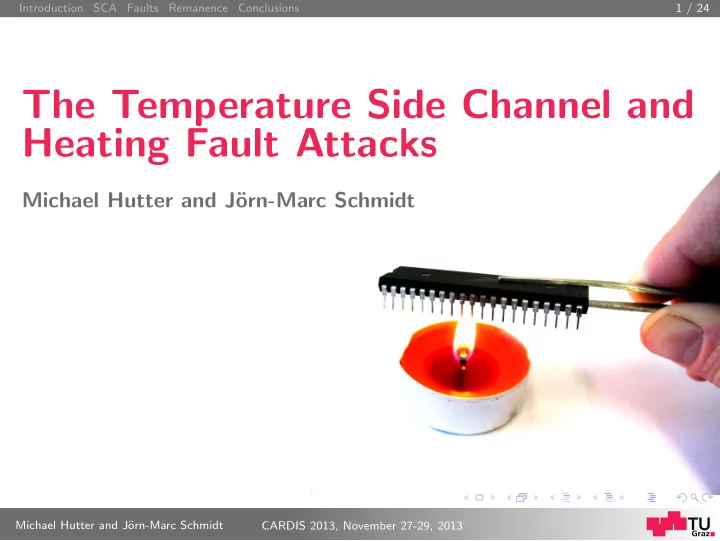
Introduction SCA Faults Remanence Conclusions 1 / 24 The Temperature Side Channel and Heating Fault Attacks Michael Hutter and J orn-Marc Schmidt Michael Hutter and J orn-Marc Schmidt CARDIS 2013, November 27-29, 2013 Introduction


slide-1
SLIDE 1

Introduction SCA Faults Remanence Conclusions 1 / 24

The Temperature Side Channel and Heating Fault Attacks

Michael Hutter and J¨

  • rn-Marc Schmidt

Michael Hutter and J¨

  • rn-Marc Schmidt

CARDIS 2013, November 27-29, 2013

slide-2
SLIDE 2

Introduction SCA Faults Remanence Conclusions 2 / 24

Related Work

  • A. Shamir and E. Tromer - “Acoustic cryptanalysis” (2004) [12]

◮ Heat causes mechanical stress expressed as low-level acoustic noise ◮ Exploit the acoustic emissions to get information about processed data

Several low-temperature attacks

◮ S. Skorobogatov [13] and D. Samyde et al. [11] ◮ Cooling down SRAM (−50 ◦C) will freeze the data ◮ Allows reading out of data even after seconds after power down ◮ Similar to cold-boot attacks [10]

  • J. Brouchier et al. - “Thermocommunication” (2009) [3, 4]

◮ Cooling fan can carry information about the processed data Michael Hutter and J¨

  • rn-Marc Schmidt

CARDIS 2013, November 27-29, 2013

slide-3
SLIDE 3

Introduction SCA Faults Remanence Conclusions 3 / 24

Outline

1 Introduction 2 Temperature Side Channel 3 High-Temperature Fault Attacks 4 Exploiting Data-Remanence Effects 5 Conclusions

Michael Hutter and J¨

  • rn-Marc Schmidt

CARDIS 2013, November 27-29, 2013

slide-4
SLIDE 4

Introduction SCA Faults Remanence Conclusions 4 / 24

The Temperature Side Channel

Electrical current causes heat Heat is proportional to the power consumption Temperature of the ATmega162 is measured using a Resistance Temperature Detector (PT100 RTD sensor) AD693 is an analog conditioning circuit to amplify the sensor signals (voltage to current converter, 4...20 mA to 0...104 ◦C)

Digital- storage

  • scilloscope

Oscilloscope control Power Supply

DC

PC

390 Ω

AD693 Amplifier PT100 ATmega162 26V

Michael Hutter and J¨

  • rn-Marc Schmidt

CARDIS 2013, November 27-29, 2013

slide-5
SLIDE 5

Introduction SCA Faults Remanence Conclusions 5 / 24

The Measurement Setup

Rear-side de-capsulated chip The silicon substrate offers a good thermal conductivity for the RTD sensor (about 150 W /m · K)

Michael Hutter and J¨

  • rn-Marc Schmidt

CARDIS 2013, November 27-29, 2013

slide-6
SLIDE 6

Introduction SCA Faults Remanence Conclusions 6 / 24

Temperature Leakage Characterization

We measured the temperature dissipation of various instructions, e.g. MOV, ADD, EOR, and MUL Evaluated the impact of thermal conductivity and capacitance

◮ Targeted one byte that is processed and stored in 24 internal registers

(and cleared before writing)

◮ Executed the instructions in a loop

Long acquisition window of 20 seconds

◮ First 10 seconds: process zero values ◮ Second 10 seconds: process all possible byte values (28) ◮ We averaged 100 traces per value to reduce noise Michael Hutter and J¨

  • rn-Marc Schmidt

CARDIS 2013, November 27-29, 2013

slide-7
SLIDE 7

Introduction SCA Faults Remanence Conclusions 7 / 24

AVR Results

4 6 8 10 12 26.5 26.6 26.7 26.8 26.9 27 Time [s] Mean temperature [°C]

HW=0 HW=1 HW=2 HW=3 HW=4 HW=5 HW=6 HW=7 HW=8

50 100 150 200 250 26.66 26.68 26.7 26.72 26.74 26.76 26.78 26.8 26.82 Possible values of the intermediate byte Temperature [°C]

The temperature side-channel obviously leaks the Hamming weight of the processed data Data caused an averaged DC increase/decrease (0.3 ◦C)

Michael Hutter and J¨

  • rn-Marc Schmidt

CARDIS 2013, November 27-29, 2013

slide-8
SLIDE 8

Introduction SCA Faults Remanence Conclusions 8 / 24

PIC16F84 Results

5 10 15 20 25.6 25.62 25.64 25.66 25.68 25.7 Time [s] Mean temperature [C°] 5 10 15 20 25.6 25.62 25.64 25.66 25.68 25.7 Time [s] Mean temperature [C°]

Leakage of 0x00 → 0xFF (left plot) and 0xFF → 0x00 (right plot) No chip decapsulation RTD placed on top of package

Michael Hutter and J¨

  • rn-Marc Schmidt

CARDIS 2013, November 27-29, 2013

slide-9
SLIDE 9

Introduction SCA Faults Remanence Conclusions 9 / 24

Observed Characteristics

Temperature variation is limited by the physical property of thermal conductivity Heat flow can be seen as a (low-pass) RC network with cut-off frequency of some kHz

Transistor Ambient temperature Junction Case (Heat sink)

Higher frequency leakages are filtered Temperature sensor has limitations in response time and acquisition resolution (100 ms and 0.01 ◦C)

Michael Hutter and J¨

  • rn-Marc Schmidt

CARDIS 2013, November 27-29, 2013

slide-10
SLIDE 10

Introduction SCA Faults Remanence Conclusions 10 / 24

Attack Scenarios and Ideas

1 Loops and continuous leakages

◮ Implementation repeatedly checks a password (as similarly argued by

Brouchier et al. [3, 4])

◮ Password is written continuously from memory into registers ◮ The dissipated temperature can then be exploited to reveal the

password

2 Exploiting static leakage

◮ Assuming a device is leaking information in the static power

consumption (already shown by, e.g., Giogetti et al. [7] or Lin et al. [9])

◮ The clock signal can then be stopped, e.g., after the first AES S-box

  • peration

◮ Intermediates can be extracted from the temperature side channel ◮ Advantage: plenty of time available to measure the temperature leak Michael Hutter and J¨

  • rn-Marc Schmidt

CARDIS 2013, November 27-29, 2013

slide-11
SLIDE 11

Introduction SCA Faults Remanence Conclusions 11 / 24

Exploiting Heating Faults

Well known attack, but less details available in literature The device is exposed to extensive heating (> 150 ◦C)

◮ ATmega162 operated beyond the maximum ratings ◮ Target implementation was CRT-RSA

Bellcore attack [2]

◮ CRT allows computing two exponentiations in smaller sub-groups

(faster)

◮ Signature S ≡ CRT ((md mod p), (md mod q)) mod n ◮ Injection of a random fault ∆ causes the device to output a faulty

signature ˜ S ≡ CRT ((m mod p)d, (m mod q)d + ∆) mod n

◮ Now p = gcd(˜

S − S, n) can be calculated to factorize p and to reveal the RSA primes p and q

Michael Hutter and J¨

  • rn-Marc Schmidt

CARDIS 2013, November 27-29, 2013

slide-12
SLIDE 12

Introduction SCA Faults Remanence Conclusions 12 / 24

The Used Setup

Laboratory heating plate from Schott instruments (SLK 1)

◮ ATmega162 placed directly on top of the hot-plate surface ◮ Temperature measured with two PT100s

“Flying” connections

◮ Exposed wires to avoid any contact to the hot plate: serial connection,

power supply, clock signal, and reset

Controller

◮ Spartan-3 FPGA-based board ◮ Allows turning off/on signals Michael Hutter and J¨

  • rn-Marc Schmidt

CARDIS 2013, November 27-29, 2013

slide-13
SLIDE 13

Introduction SCA Faults Remanence Conclusions 13 / 24

Results

ATmega162 does not respond after 160 ◦C Faults occurred between 152 and 158 ◦C

◮ Within 70 minutes, we got 100 faults ◮ 31 revealed one of the prime modulus: 15 revealed p, 16 revealed q ◮ 7 faults produced the same RSA output

Same result also for other ATmega162 devices

◮ E.g., 182 faults within 30

minutes

◮ Mean and fault temperature

varies per device

150 152 154 156 158 160 2 4 6 8 10 Temperature [°C] Frequency of fault occurrence Michael Hutter and J¨

  • rn-Marc Schmidt

CARDIS 2013, November 27-29, 2013

slide-14
SLIDE 14

Introduction SCA Faults Remanence Conclusions 14 / 24

Exploiting Data-Remanence Effects

Data stored in SRAM for a long period of time leaves a permanent mark, cf. P. Gutmann [8] Can be recovered by reading out the preferred power-up values

◮ Practically exploited by R. Anderson and M. Kuhn [1] in 1997, recovered

  • ver 90 % of a DES key of a late 1980s bank card

◮ Harder on newer SRAM structures, 18 % recoverable (cf. Cakir [5])

Effect is due to aging where transistor parameters change (speed, current drive, noise margin) Extensive heating accelerates aging

◮ Negative Bias Temperature Instability (NBTI) ◮ SRAM cells get “weaker” and tend to a certain bit value

Two NBTI degradation components: permanent and transient damage [6]

Michael Hutter and J¨

  • rn-Marc Schmidt

CARDIS 2013, November 27-29, 2013

slide-15
SLIDE 15

Introduction SCA Faults Remanence Conclusions 15 / 24

Permanent Data Remanence Effect

1 Tests performed on new ATmega162; preferred power-up values are

around 50 %

2 We wrote randomly distributed data to SRAM (3 072 bits to “1” and

3 072 bits to “0”, 6 144 out of 8 192 bits total)

3 Exposed the device to extensive burn-in stress

◮ 100 ◦C for 36 hours at 5.5 volts ◮ SRAM cells got biased:

52.24 % → 1, 47.75 % → 0

◮ 919 bits (15 %) changed their

state, i.e., 30 % are unstable

◮ > 95 % of the bits tended to the

correct value

◮ In total, we can predict 63 %

correctly

5 10 15 20 25 30 35 45 50 55 60 65 70 Burn−in stress time [h] Success rate [%] Predicting a "1" Predicting a "0" Michael Hutter and J¨

  • rn-Marc Schmidt

CARDIS 2013, November 27-29, 2013

slide-16
SLIDE 16

Introduction SCA Faults Remanence Conclusions 16 / 24

Transient Data Remanence Effect

1 Read out the SRAM content every 4 seconds during burn-in stress 2 Heated up to 170 ◦C and turned off heating afterwards

◮ “Weak” SRAM cells tend to “0”

during heating

◮ They move back to preferred

state after cooling

◮ Can be used to identify

“unstable” bits

◮ Around 30 % have been

identified to be unstable

100 200 300 400 20 30 40 50 60 70 80 Burn−in stress time [seconds] Bit value probability [%] heating cooling "1" values "0" values Michael Hutter and J¨

  • rn-Marc Schmidt

CARDIS 2013, November 27-29, 2013

slide-17
SLIDE 17

Introduction SCA Faults Remanence Conclusions 17 / 24

How to Exploit NBTI Degradation?

1 Combine revealed SRAM content of several devices

◮ Assume all devices share the same secret ◮ Reveal parts of the data of many devices and combine the information ◮ Identify constant data, i.e., related to the key with high probability

2 Apply partially key exposure attacks

◮ Apply burn-in stress for several hours ◮ Read out the memory ◮ Exploit transient NBTI effect to identify “unstable” bit locations ◮ Now use previously revealed bits at these locations to obtain correct

SRAM content with high probability

◮ Apply cryptanalytic attacks to reveal the entire secret Michael Hutter and J¨

  • rn-Marc Schmidt

CARDIS 2013, November 27-29, 2013

slide-18
SLIDE 18

Introduction SCA Faults Remanence Conclusions 18 / 24

Further Research Suggestions

More NBTI tests

◮ Accelerate aging while device is performing crypto operations (realistic

scenario)

◮ Are SRAM cells that stored constant data (key) “unstable” during

transient NBTI?

Heat penetrates through different materials (through shielding?) Heating or cooling will change the characteristics not only for memory but also for logic...

◮ Increase/decrease threshold voltages, e.g., of watchdog circuits

Exploit static power/temperature leakages on newer CMOS processes

Michael Hutter and J¨

  • rn-Marc Schmidt

CARDIS 2013, November 27-29, 2013

slide-19
SLIDE 19

Introduction SCA Faults Remanence Conclusions 19 / 24

References I

  • R. J. Anderson and M. G. Kuhn.

Low Cost Attacks on Tamper Resistant Devices. In B. Christianson, B. Crispo, M. Lomas, and M. Roe, editors, Security Protocols, 5th International Workshop, volume 1361 of LNCS, pages 125–136. Springer, 1997.

  • D. Boneh, R. A. DeMillo, and R. J. Lipton.

On the Importance of Checking Cryptographic Protocols for Faults (Extended Abstract). In W. Fumy, editor, Advances in Cryptology - EUROCRYPT ’97, International Conference on the Theory and Application of Cryptographic Techniques, Konstanz, Germany, May 11-15, 1997, Proceedings, volume 1233 of LNCS, pages 37–51. Springer, 1997.

  • J. Brouchier, N. Dabbous, T. Kean, C. Marsh, and D. Naccache.

Thermocommunication. eprint, 2009.

Michael Hutter and J¨

  • rn-Marc Schmidt

CARDIS 2013, November 27-29, 2013

slide-20
SLIDE 20

Introduction SCA Faults Remanence Conclusions 20 / 24

References II

  • J. Brouchier, T. Kean, C. Marsh, and D. Naccache.

Temperature Attacks. Security Privacy, IEEE, 7(2):79 –82, 2009.

  • C. Cakir, M. Bhargava, and K. Mai.

6T SRAM and 3T DRAM Data Retention and Remanence Characterization in 65nm bulk CMOS. In Custom Integrated Circuits Conference – CICC 2012, USA, San Jose, 9-12 September, 2012, pages 1–4, 2012.

  • M. Ershov, S. Saxena, H. Karbasi, S. Winters, S. Minehane, J. Babcock,
  • R. Lindley, P. Clifton, M. Redford, and A. Shibkov.

Dynamic Recovery of Negative Bias Temperature Instability in P-type MetalOxideSemiconductor Field-Effect Transistors. Applied Physics Letters, 83(8):1647–1649, 2003.

Michael Hutter and J¨

  • rn-Marc Schmidt

CARDIS 2013, November 27-29, 2013

slide-21
SLIDE 21

Introduction SCA Faults Remanence Conclusions 21 / 24

References III

  • J. Giogetti, G. Scotti, A. Simonetti, and A. Trifiletti.

Analysis of Data Dependance of Leakage Current in CMOS Cryptographic Hardware. In Proceedings of the 17th ACM Great Lakes Symposium on VLSI, Stresa-Lago Maggiore, Italy, March 11-13, 2007, pages 78–83. ACM, 2007.

  • P. Gutmann.

Data Remanence in Semiconductor Devices. In USENIX 2001 – Proceedings of the 10th Conference on USENIX Security Symposium, USA, Washington, D.C., August 1317, 2001, Berkeley, CA, USA,

  • 2001. USENIX Association.
  • L. Lin and W. Burleson.

Leakage-Based Differential Power Analysis (LDPA) on Sub-90nm CMOS Cryptosystems. In ISCAS 2008 – IEEE International Symposium on Circuits and Systems, USA, Seattle, 18-21 May, 2008, pages 252–255, 2008.

Michael Hutter and J¨

  • rn-Marc Schmidt

CARDIS 2013, November 27-29, 2013

slide-22
SLIDE 22

Introduction SCA Faults Remanence Conclusions 22 / 24

References IV

  • T. M¨

uller and M. Spreitzenbarth. FROST - Forensic Recovery of Scrambled Telephones. In M. Jacobson, M. Locasto, P. Mohassel, and R. Safavi-Naini, editors, Applied Cryptography and Network Security–ACNS 2013, 11th International Conference, Banff, AB, Canada, June 25-28, 2013. Proceedings, volume 7954, pages 373–388, 2011.

  • D. Samyde, S. P. Skorobogatov, R. J. Anderson, and J.-J. Quisquater.

On a New Way to Read Data from Memory. In IEEE Security in Storage Workshop (SISW02), pages 65–69. IEEE Computer Society, 2002.

  • A. Shamir and E. Tromer.

Acoustic cryptanalysis - On nosy people and noisy machines. http://www.wisdom.weizmann.ac.il/~tromer/acoustic/.

Michael Hutter and J¨

  • rn-Marc Schmidt

CARDIS 2013, November 27-29, 2013

slide-23
SLIDE 23

Introduction SCA Faults Remanence Conclusions 23 / 24

References V

  • S. Skorobogatov.

Low temperature data remanence in static RAM. Technical report, University of Cambridge Computer Laboratory, June 2002.

Michael Hutter and J¨

  • rn-Marc Schmidt

CARDIS 2013, November 27-29, 2013

slide-24
SLIDE 24

Introduction SCA Faults Remanence Conclusions 24 / 24

Thanks for attention! Questions?

Michael Hutter michael.hutter@iaik.tugraz.at Graz University of Technology

Michael Hutter and J¨

  • rn-Marc Schmidt

CARDIS 2013, November 27-29, 2013