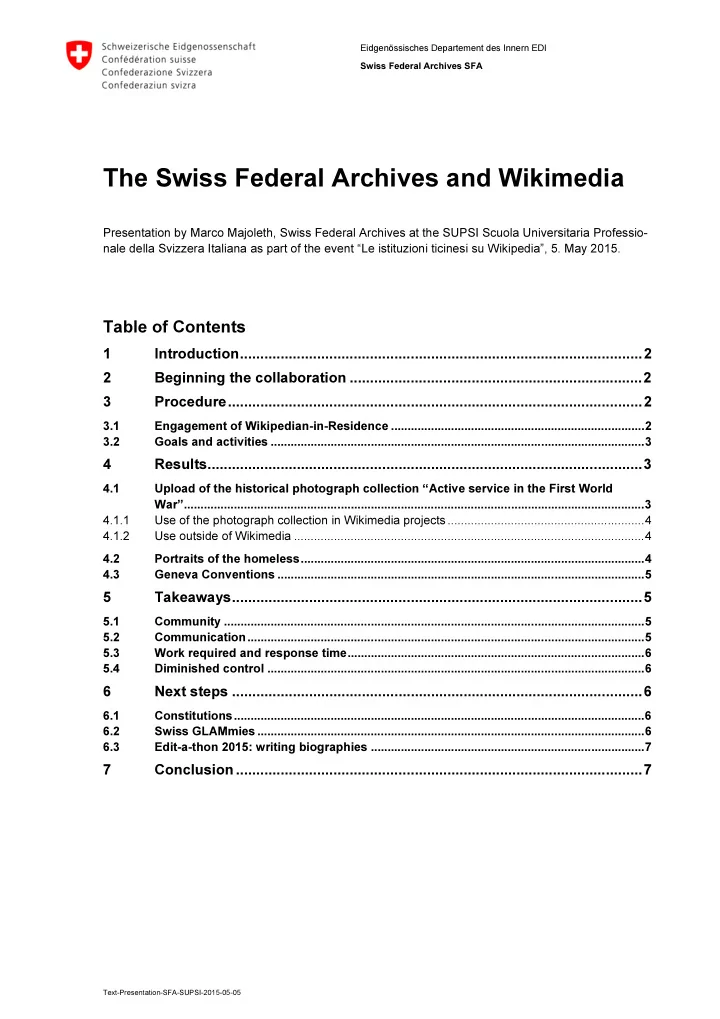
The Swiss Federal Archives and Wikimedia Presentation by Marco - - PDF document

the swiss federal archives and wikimedia
SMART_READER_LITE
LIVE PREVIEW

The Swiss Federal Archives and Wikimedia Presentation by Marco - - PDF document

Eidgenssisches Departement des Innern EDI Swiss Federal Archives SFA The Swiss Federal Archives and Wikimedia Presentation by Marco Majoleth, Swiss Federal Archives at the SUPSI Scuola Universitaria Professio- nale della Svizzera Italiana as


slide-1
SLIDE 1

Eidgenössisches Departement des Innern EDI Swiss Federal Archives SFA

Text-Presentation-SFA-SUPSI-2015-05-05

The Swiss Federal Archives and Wikimedia

Presentation by Marco Majoleth, Swiss Federal Archives at the SUPSI Scuola Universitaria Professio- nale della Svizzera Italiana as part of the event “Le istituzioni ticinesi su Wikipedia”, 5. May 2015.

Table of Contents

1 Introduction ................................................................................................... 2 2 Beginning the collaboration ........................................................................ 2 3 Procedure ...................................................................................................... 2

3.1 Engagement of Wikipedian-in-Residence ............................................................................ 2 3.2 Goals and activities ................................................................................................................ 3

4 Results ........................................................................................................... 3

4.1 Upload of the historical photograph collection “Active service in the First World War” .......................................................................................................................................... 3 4.1.1 Use of the photograph collection in Wikimedia projects ........................................................... 4 4.1.2 Use outside of Wikimedia ......................................................................................................... 4 4.2 Portraits of the homeless ....................................................................................................... 4 4.3 Geneva Conventions .............................................................................................................. 5

5 Takeaways ..................................................................................................... 5

5.1 Community .............................................................................................................................. 5 5.2 Communication ....................................................................................................................... 5 5.3 Work required and response time ......................................................................................... 6 5.4 Diminished control ................................................................................................................. 6

6 Next steps ..................................................................................................... 6

6.1 Constitutions ........................................................................................................................... 6 6.2 Swiss GLAMmies .................................................................................................................... 6 6.3 Edit-a-thon 2015: writing biographies .................................................................................. 7

7 Conclusion .................................................................................................... 7

slide-2
SLIDE 2

2/7

Text-Presentation-SFA-SUPSI-2015-05-05

1 Introduction

The past 15 months have seen Wikipedia articles containing digitised holdings of the Federal Archives viewed 3.3 million1 times. Compared to the approximately 12,000 hits we get per month on our online archival database, this suggests that our archives may possibly enjoy significantly better visibility on Wikipedia than on our own platforms.

  • Possibly. Because what we don’t know is whether people who consult these digitised holdings realise

that we are the information provider. This diminished control goes hand in hand with the opening of the archives. Simultaneously, we are becoming more visible to users who would otherwise never have learned about us. The three million views are the result of a fruitful collaboration with Wikimedia CH, the organisation op- erating Wikipedia, and the Wikipedia community. I will spend the next few minutes telling you about this collaboration: how it came about (2), the steps we took (3), the results so far (4), what we have learned (5) and our plans for this year (6).

2 Beginning the collaboration

Our collaboration with Wikimedia CH began in 2012. We set down the terms of our collaboration in our cooperation agreement. Among other things, we es- tablished rules for the financing of a Wikipedian-in-Residence and for joint coordination of media work. Although there are clear institutional and organisational differences among Wikimedia CH, the Wikipe- dia community and a federal body, a basic common feature was obvious from the start: the aim of making knowledge and information accessible.

3 Procedure

3.1 Engagement of Wikipedian-in-Residence

A Wikipedian-in-Residence liaises between the institution and the Wikipedia community, raises aware- ness of various methodologies, supports the enhancement of content by the community, and should lay the foundation for a lasting partnership between the institution and the community.2 We had nine applicants in response to our advertising the position, a limited engagement until the end

  • f 2013. Three of the applicants matched the profile (well connected within the Wikipedia community).

One was a German-language native speaker, one French-language, and one Italian-language. We soon realised, however, that by opting for one particular native language for our Wikipedian we were also opting for a particular community. After all, there is a separate Wikipedia for each language. With the engagement of Micha Rieser we opted for the German-speaking community, but since Micha is also connected with other communities and with Wikimedia CH, our commitment has been noted beyond linguistic borders.

1 3,302,607; http://tools.wmflabs.org/glamtools/baglama2 (4.5.2015) 2 In English see https://outreach.wikimedia.org/wiki/Wikipedian_in_Residence (28.4.2015).

slide-3
SLIDE 3

3/7

Text-Presentation-SFA-SUPSI-2015-05-05

3.2 Goals and activities

We kept our goals for the Wikipedian open, wanting first to find out where his strengths and interests lay, and to tailor his remit accordingly. Initially the Wikipedian-in-Residence was a basic liaison between us and a community which, in the beginning, didn’t know us very well. Micha’s assignment was mutual development aid: he explained to us the goals pursued by Wikipedia projects, how the community is made up, what it expects from an archive and how writing for Wikipedia works, among other things; and he set out to the community the Federal Archives’ interests and opportunities. Over time, this communication began to take place directly between the Archives and the community.

4 Results

4.1 Upload of the historical photograph collection “Active service in the First World War”

A further milestone in our collaboration was reached in November 2013: with the help of committed Wikipedians we were able to upload our photograph collection dedicated to “Active service in the First World War” to Wikimedia Commons, the media archive of the various Wikimedia projects (among them Wikipedia itself). Why this particular photograph collection? For one thing, 2014 marked the centennial of the start of the First World War, so we expected an increased demand for these photos. For another, the photos were no longer subject to a closure period, rights to them lay with the Federal Government, and there were no other personal rights preventing publication. In addition, and this is of particular importance in the eyes of the Archives, is the fact that versioning guarantees the authenticity of digitised holdings and metadata. In other words, even though digitised holdings and metadata can in principle be altered, the first version uploaded by the institution in each case also always remains visible.3 For these reasons in particular we were already able to make the collection accessible online some years ago, for instance on Memobase and as a preview image in our Swiss-Archives archival data- base. What was new here was the high quality of the digitised holdings and the choice of publication plat- form: via Wikimedia – which is the very symbol of freely accessible knowledge – a much larger reader- ship had now become aware of the photos.

3 See for example http://commons.wikimedia.org/wiki/File:Das_Motorrad_mit_den_Skiern_von_der_Seite_-_CH-BAR_-

_3241064.tif (28.4.2015)

slide-4
SLIDE 4

4/7

Text-Presentation-SFA-SUPSI-2015-05-05

4.1.1 Use of the photograph collection in Wikimedia projects

4.1.1.1 Incorporation of photos

Scarcely had the photos become available on Wikimedia Commons the community began taking ad- vantage of them.4 To date, there have been 114 photos from the collection used directly in articles for the German-language Wikipedia, 21 for the French-language, and 19 for the English-language. The Italian-language Wikipedia has had four photos used so far – maybe we’ll see a bump following this event?

4.1.1.2 Errata reports and metadata supplements

The community has not simply used the photos for its articles, but has also reported to us on errata in the metadata. We review such reports and then make corrections as necessary: https://de.wikipe- dia.org/wiki/Benutzer_Diskussion:Swiss_Federal_Archives In addition – and this, too, constitutes a bonus for us – the digitised holdings are continuously supple- mented with metadata: for instance, with more precise geographical indicators and the assignment of categories, as on https://commons.wikimedia.org/wiki/Category_talk:Switzerland_in_World_War_I. This work is still in progress – and thus this location view has not yet been precisely categorised: https://commons.wikimedia.org/wiki/File:Dorf_im_Tessin_-_CH-BAR_-_3238869.tif.

4.1.1.3 Edit-a-thon 2014

In order to use the potential of these images to better advantage, we joined the National Library in holding an edit-a-thon in June 2014, with the support of Wikimedia CH. The aim of the event was to include photos in existing articles or, better yet, to have new articles written on the basis of the im-

  • ages. And of course – as befits an edit-a-thon – to acquire new Wikipedia authors.

4.1.2 Use outside of Wikimedia

From our point of view, it was of course not only the visibility of the collection within the Wikimedia cos- mos that was important, but also the photos’ use by researchers and the media. And in fact the images were used intensively: e.g. for print publications (on book covers),5 in online picture series, as for instance by Swissinfo6 or to illustrate a piece on RSI, the Italian-language Swiss radio and television network.7 Or again for touristic purposes, to provide background information on an “Adventure trail through Swiss history”.8

4.2 Portraits of the homeless

Shortly before Christmas in 2014 we were able to make a further collection available on Wikimedia Commons: the portraits of homeless people by pioneering photographer Carl Durheim from the mid-

4 See also Top 24 most used files in Wikimedia projects: http://commons.wikimedia.org/wiki/Commons:Swiss_Federal_Ar-

chives/reports/wikimedia_usage.

5 Kreis: http://www.nzz-libro.ch/insel-der-unsicheren-geborgenheit.html (22.4.2015) and Buomberger et al.: http://www.erster-

weltkrieg.ch (22.4.2015).

6 “Waiting for a conflict in a neutral land”: http://www.swissinfo.ch/eng/first-world-war_waiting-for-a-conflict-in-a-neutral-

land/38755934 (22.4.2015).

7 Article on the exhibition “14/18” in Zurich by RSI (Rete uno): http://www.rsi.ch/rete-uno/programmi/intrattenimento/ginevra-

sciaffusa-chiasso/La-Prima-guerra-mondiale-e-la-Svizzera-2416336.html (22.4.2015).

8 http://reiseziele.ch/erlebnispfad-durch-die-schweizer-geschichte-die-sbrinz-route (22.4.2015).

slide-5
SLIDE 5

5/7

Text-Presentation-SFA-SUPSI-2015-05-05

19th century. Current scholarship holds this to be the world’s earliest known store of police photo- graphs. Although they are less widely distributed within Wikimedia projects, almost 10% of the 222 photos have to date been used for articles in Wikipedia.9

4.3 Geneva Conventions

On the occasion of the 150th anniversary of the Geneva Convention we published its text in Wiki- media Commons in the summer of 2014. For the sake of completeness we also published the conven- tions agreed in 1949 and valid to this day.10 This digitised material, by the way, has had a considerable effect on the high hit rates on English-lan- guage Wikipedia: over ¾ of the visits are to the English-language article on the Geneva Conventions.

5 Takeaways

We have learned quite a lot about Wikipedia projects, about the community and its expectations. And we have been able to show the community in turn what an archive can do for Wikipedia, as well as, to some extent, what it cannot do. In what follows I would like to highlight four takeaways.

5.1 Community

The Wikipedia community in Switzerland is not exactly a multitude: those actively collaborating with GLAMs constitute a very manageable group. Nevertheless, or perhaps for this very reason, these peo- ple take their commitment - their voluntary commitment, it must be noted – very seriously. Whenever we have required their support, it has been readily granted. The same goes for our contacts with Wikimedia CH.

5.2 Communication

The Wikipedia community communicates in Wikipedia. So as to enter into a conversation with it, and to remain in that conversation, we are advised to use this as an additional communication channel, for example with our own user page or proprietary project sites. This assumes, however, a certain famili- arity with writing in MediaWiki, the software behind Wikipedia. Naturally this does not rule out the use of established channels such as websites, newsletters, press releases and social media, but rather supplements them.

9 Assessment of the category: Durheim portraits contributed by CH-BAR with http://tools.wmflabs.org/glamtools/glamor-

  • us.php (22.4.2015).

10 Category:Geneva Conventions contributed by CH-BAR (22.4.2015).

slide-6
SLIDE 6

6/7

Text-Presentation-SFA-SUPSI-2015-05-05

5.3 Work required and response time

Initially we were afraid that the immediate publication of a request via Wikimedia/pedia would require us to respond immediately, and thus place us under time pressure. We were also a little nervous about the fact that our answer would also be immediately published on the internet. My impression is that the community understands that the research required can mean longer pro- cessing times. And although requests often get posted at night or at the weekend, we have never been expected to respond immediately.

5.4 Diminished control

As a GLAM, however, one must in fact accept considerably diminished control over data in Wikimedia Commons. But as mentioned at the outset, this diminished control is part of opening up an archive. We are no longer able to say who uses what and for what purpose, and where they have got it from. On the other hand, people learn about us who would otherwise never have found their way here. When it comes to changes to metadata in the Commons, the community is extremely careful, with members mutually policing themselves. Thus digitised material supplied by us is not as a rule altered directly – which would not be a problem. It is established practice to record relevant errata reports or supplements on our discussion page. If there is any problem at all, it is the use of material outside of Wikimedia projects. With the photo- graph collection, for example, users were actually required to mention the SFA (licence CC-BY-SA). This is very often done, but of course not always meticulously. It was recently neglected, in fact, in the educational documents accompanying the “14/18” travelling exhibition, in which neither the SFA nor the photographs’ call numbers, for instance, were indicated, and no index of illustrations was pro- vided.11 In many cases, however, users supply the correct references, as for instance on the blog for the Basel station of the exhibition mentioned.12

6 Next steps

In closing, a quick look at our plans for this year. We intend to offer individual digitised holdings.

6.1 Constitutions

On the occasion of Bern’s Night of the Museums in March and the bicentennial of the Swiss Federal Treaty we made a digitised version of the Constitution available on Wikimedia Commons. The “Acte de médiation” of 1803 and the 1848 Federal Constitution are to follow.

6.2 Swiss GLAMmies

In order to make digitised material already uploaded, and the story behind it, better known, we will be taking part in the “Swiss GLAMmies” project. The idea is that a Swiss GLAM institution will present a

11 http://www.ersterweltkrieg.ch/fileadmin/user_upload/14-18_Sek2_web.pdf (22.4.2015). 12 http://baselersterweltkrieg.com/2014/09/05/grenzschliessung (22.4.2015).

slide-7
SLIDE 7

7/7

Text-Presentation-SFA-SUPSI-2015-05-05

“GLAMmie” each week with a few lines of explanation – on Wikimedia Commons and in social me- dia.13 This offering is not only all about trustworthy content, but reliable frequency as well. The more GLAMs are involved, the more varied, and thus interesting, it will become. And the work required will be ac- cordingly spread over more institutions.

6.3 Edit-a-thon 2015: writing biographies

We are also planning another edit-a-thon. Together with experienced Wikipedians, we would like to get our archive users to become writers for Wikipedia: The Federal Archives include 671 private archives of people who have shaped the history of the Con-

  • federation. Many of them do not yet have a Wikipedia article to their name. We have published an
  • verview in Wikipedia (see Liste der Privatbestände im Schweizerischen Bundesarchiv).

On the other hand, over 30% of the encyclopaedia articles in the German-language Wikipedia are bio-

  • graphical. Archive users also frequently research biographical topics.

Plenty of good reasons, then, to offer an edit-a-thon on biography writing. That is what we are plan- ning for Saturday, 5 September in Bern – and you are naturally invited to take part.

7 Conclusion

Reading a Wikipedia article is not the same thing as recognising the information provider. This is true for the author of the article as well as for the GLAM that has contributed media data to Wikimedia Commons. If, however, anyone is interested in a particular photograph, painting or map, they will find not only the digitised material where they have gone for information in the first place, they will also find us at the very same location. Let’s remember that Wikipedia is among the most popular websites14 in the world – so it’s certainly worth the effort!

13 Example of an SFA GLAMmy: https://commons.wikimedia.org/wiki/Commons:Swiss_GLAMmies/2014-03-31_Das_Motor-

rad_mit_den_Skiern (22.4.2015).

14 Sixth place according to https://en.wikipedia.org/wiki/List_of_most_popular_websites (28.4.2015), fifth place in CH according

to http://www.alexa.com/topsites/countries/CH (28.4.2015).