The Sagittarius Impact as an Architect of Spirality and Outer Rings - - PowerPoint PPT Presentation

the sagittarius impact as an architect of spirality and
SMART_READER_LITE
LIVE PREVIEW

The Sagittarius Impact as an Architect of Spirality and Outer Rings - - PowerPoint PPT Presentation

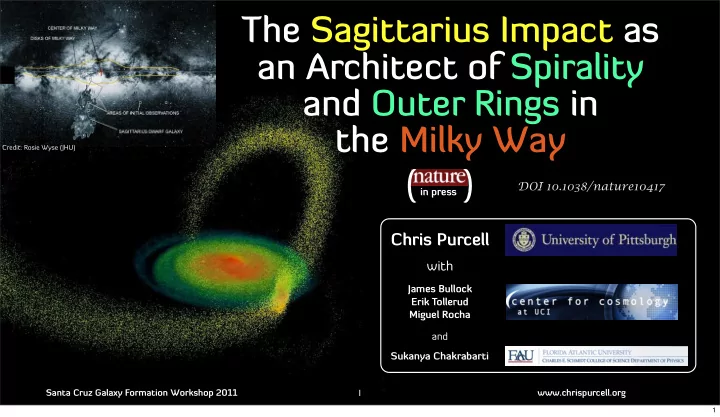
The Sagittarius Impact as an Architect of Spirality and Outer Rings in the Milky Way Credit: Rosie Wyse (JHU) ( in press ) DOI 10.1038/nature10417 Chris Purcell with James Bullock Erik Tollerud Miguel Rocha and Sukanya Chakrabarti 1


slide-1
SLIDE 1

The Sagittarius Impact as an Architect of Spirality and Outer Rings in the Milky Way

Chris Purcell

with

James Bullock Erik Tollerud Miguel Rocha and Sukanya Chakrabarti

Santa Cruz Galaxy Formation Workshop 2011 1 www.chrispurcell.org

( in press )

Credit: Rosie Wyse (JHU)

DOI 10.1038/nature10417

1

slide-2
SLIDE 2

particle mass ≃ 104 Msun, parsec-scale force softening

  • ur collisionless experiment simulates a

globally stable Milky Way at very high resolution:

Credit: Steve Majewski, David Law, et al. 2005, 2010

real 2MASS M-giants fake MW

  • bservation

simulation

stream modeling has always used static Milky Way potential, DM-less dwarf to test halo triaxiality/shape, etc.

two bracketing cases for a cosmologically-realistic infalling Sagittarius dwarf galaxy with dark matter: Light Sgr ≃ 1010.5 Msun, Heavy Sgr ≃ 1011 Msun

2 www.chrispurcell.org Santa Cruz Galaxy Formation Workshop 2011

2

slide-3
SLIDE 3

  • ur collisionless experiment simulates a

globally stable Milky Way at very high resolution:

Light Sgr ≃ 1010.5 Msun, Heavy Sgr ≃ 1011 Msun

2 www.chrispurcell.org

Purcell et al. 2011 Figure 1

!

Figure S8a

stable to long-wavelength perturbations,

  • nly susceptible to short-wavelength modes
  • n small scales (at radius of Sgr impact)

Q > 2

Santa Cruz Galaxy Formation Workshop 2011

2

slide-4
SLIDE 4

3 www.chrispurcell.org

tightly-bound stars are stripped preferentially later, but mass loss does occur at all radii throughout Sgr dwarf has lost more than 99% of dark mass, and ~80-90% of stellar mass by the present-day simulated stream/orbit in good agreement with a variety of observational data sets

high low

Purcell et al. 2011 Figure 3 Figure S2

  • rbital

path

Santa Cruz Galaxy Formation Workshop 2011

3

slide-5
SLIDE 5

4 www.chrispurcell.org

impact on the Galactic disk

Santa Cruz Galaxy Formation Workshop 2011

4

slide-6
SLIDE 6

5 www.chrispurcell.org

Levine et al. 2006, neutral hydrogen map

  • f spiral arms

swing-amplified spirality

Purcell et al. 2011 Figure 2

Credit: NASA/JPL-Caltech

Santa Cruz Galaxy Formation Workshop 2011

5

slide-7
SLIDE 7

5 www.chrispurcell.org

✦ gravitational perturbations augment

unstable modes latent in the stellar disk

✦ excess non-circularity combined

with differential rotation shear intermediate-scale spiral structure! Levine et al. 2006, neutral hydrogen map

  • f spiral arms

swing-amplified spirality

epicycle

  • rbit

disk rotation

Purcell et al. 2011 Figure 2

Santa Cruz Galaxy Formation Workshop 2011

5

slide-8
SLIDE 8

radial wavenumber k = dϕ / dR strong swing mechanics are greatly amplifying spiral wave-modes!

!

swing-amplified spirality

Figure S8b

6 www.chrispurcell.org

strength of swing amplification

(increasing downwards)

stability of disk 1st pericenter at R ~ 17 kpc 2nd pericenter at R ~ 12 kpc

stability parameters of disk

Santa Cruz Galaxy Formation Workshop 2011

6

slide-9
SLIDE 9

!

7 www.chrispurcell.org

metallicity tracers may be a red herring: radial mixing can obscure the relation of abundance to position

(modulo selection effects, large azimuthal variance)

ring-like features in the outer disk

✦ overdense spiral-arm wrappings

exist above and below the plane

Monoceros and Tri-And stream features are nearby wrappings of known spiral arms (Scutum-Centaurus and Perseus?)

Rocha-Pinto et al. 2006 ✦ future observations at Galactic longitudes

30O < l < 180O will fully map these arms and fill out the picture a little more...

“multiple tributaries”

+ +

MRi today: high latitude MRi stars: 2.65 Gyr ago

⊙ ⊙

Purcell et al. 2011 Figures 4 and S7 Figure S6

Santa Cruz Galaxy Formation Workshop 2011

7
slide-10
SLIDE 10

1:100 perturber with pericenter ~15 kpc (Chakrabarti & Blitz 2009)

future work: hydrodynamical treatment

gas density more flaring/warping in disk outskirts, enhanced/extended spiral-arm production are the likely outcomes of Sgr+hydro sims

✦ gas disk reinforces swing amplification since the stellar disk is ✦

fresh star formation replenishes circularity, extending transient lifetimes

✦ steeper (and more realistic) vertical density

profiles very near mid-plane = self-gravity weaker and disk response more severe

probable effects:

stellar gas+stellar

distortion -->

Pranav & Jog 2010

8 www.chrispurcell.org Santa Cruz Galaxy Formation Workshop 2011

8

slide-11
SLIDE 11

conclusions

The Sgr impact has been a major force in the emergence of Galactic structure. Observable ring-like features in the outer Milky Way are nearby extensions of the known spiral arms in the inner disk. Current- and next-generation surveys (SEGUE-2, APOGEE, LSST, GAIA) will connect the dots and empirically implicate the Sgr dwarf as an architect

  • f Milky Way spirality and the outer Galactic rings.

9 www.chrispurcell.org Image credit: Erik Tollerud Santa Cruz Galaxy Formation Workshop 2011

9