SLIDE 1 Gian Michele Cirulli – Agronomist, Urban Tree Manager – Department of Parks and Green Spaces City of Turin
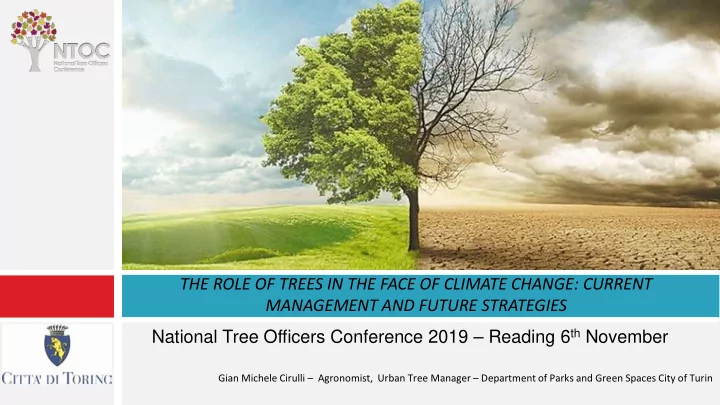
THE ROLE OF TREES IN THE FACE OF CLIMATE CHANGE: CURRENT MANAGEMENT AND FUTURE STRATEGIES National Tree Officers Conference 2019 – Reading 6th November
SLIDE 2
Turin’s Green and Open Space System
URBAN SURFACE : 130.17 km2 INHABITANTS: 898.714 GREEN SPACE/INHABITANT : 52.56 m2 TOTAL PUBLIC GREEN AREAS: 21.429.000 m2 (23,84 m2/in. – 16,46% urban surface) HILLSIDE FOREST: 7.925.186 m2
SLIDE 3 Turin’s Trees Historic Heritage More than 160.000 public trees:
trees in parks, gardens, riverbanks, boulevards (60.000), school gardens and sporting facilities
- more than 50.000 trees in hill
forests
1817: the first tree-lined boulevard estabilished A system
tree-lined boulevards over km 450 long An heritage with an incredible value in environmental and economic terms
SLIDE 4 Urban trees area: Organization & Activities ACTIVITIES
- Tree-maintenance planning
- Issuing public tenders: planting, pruning, risk
assessment, etc.
- Daily works managements and territorial
control ORGANIZATION
- 1 tree manager (coordinator):
general and technical codes, relationships w/all stakeholders (politicians, associations, citizens..)
SLIDE 5
The Alpine Arch and the Po River plain Turin is in a unique natural location: surrounded by the Alps, with hills to the east and is crossed by four rivers
SLIDE 6
Unfavourable Natural Conditions Negative effects of poor air circulation in a densely populated and highly agricoltural landscape
SLIDE 7 Climate Change
change may exacerbate regional and local air quality problems
- Summer heat waves can impact the
production of ozone
- Longer dry spells and less frequent
winter precipitation mean more stagnant air
- Impacts of climate change may be
cumulative and indirect
- Heat and drought can cause forest
fires that exacerbate air quality
SLIDE 8
Climate Vulnerabilities in Turin
Source: Regional Agency for the Protection of the Environment
SLIDE 9 Climate Vulnerabilities in Turin – Heat Waves
Data from EU Life DERRIS Project
Increase in temperatures of + 3 ° C to m 50 from industrial areas, + 1°C between m 50 and m 100 from industrial areas
Effect of industrial buildings on heat waves Distribution of the three hazard classes related to heat waves
SLIDE 10
Climate Vulnerabilities in Turin - Flooding River flooding and localized flooding
SLIDE 11 A Climate Strategy for Turin Mitigation: towards an energy transition 2009 Turin signs the Covenant of Mayors for Energy - 7481 signatory cities agree to implement EU energy policy 2010 Turin adopts an Action Plan for Energy (TAPE) to reduce greenhouse gas emissions by 30% below 1991 levels by 2020 Planning for adaptation
- Mayors Adapt – the Covenant of Mayors Initiative on Climate
Change Adaptation, set up by the European Commission to engage cities in taking action to adapt to climate change
- Adapting to climate change is a way of making the city a safer,
healthier, greener, and more liveable place for its citizens and
- visitors. Turin adheres in 2015.
SLIDE 12
A Climate Strategy for Turin Implement a climate risk management plan with an integrated approach that fosters coordination between PA and SMEs for the definition of a series of measures to prevent economic, environmental and human health damage caused by climate change. Planning for adaptation – EU Life DERRIS Project Partnership between public administration and SMEs to reduce the risks from extreme weather in industrial districts
SLIDE 13 A Climate Strategy for Turin Planning for adaptation Formalizing the process
- Municipal resolution launching interdepartmental working
group across the administration
- Comprehensive vulnerability analysis including all risk factors:
wind, heat, air quality, soil stability, food security, flooding, pollen outbreaks, etc
- Epidemiological assessment of climatic events on local and
regional populations
a Climate Action Strategy with Local Administrations, Regional Environmental Agency, Local Universities and Strategic partners
SLIDE 14 Development of a Climate Action Strategy
- Survey adaptation actions already being implemented
- Assess the planning and regulatory frameworks that require
revision
stakeholders across the board to develop a comprehensive climate strategy
- Continue exchanging and sharing best practices
- Periodic monitoring and evaluation of the implementation of
climate actions, and correct the strategy as necessary
- Develop and implement ongoing communication strategies to
raise awareness in the general public
SLIDE 15 Development of a Climate Action Strategy THE TIMING IS RIGHT An enormous opportunity to integrate the Climate Strategy into existing and new plan
- Update of the Urban Master Plan in process
- Update of the Sustainable Urban Mobility Plan to begin
- Civil Protection Plan will be updated
- Turin Action Plan for Energy to be reviewed
- Strategic Green Infrastructure Plan (new plan)
- Air quality plan (new plan)
- Zero waste strategy (new plan)
SLIDE 16 Integrating the strategy Updating the City Masterplan by 2021
conservation
mobility
surface permeability
conservation/development
SLIDE 17 Integrating the strategy Green Infrastructure Plan
- Quantitative and qualitative analysis
- f recreational green infrastructure
- Ecological assessment: Biodiversity
and habitat connectivity
- Ecosystem services: Risk mitigation
and management assessment: land stabilization, soil conservation, shading/cooling and ventilation, CO2 capture, stormwater management
- Urban agriculture and food security
Target: 25 square meters per resident
SLIDE 18
Awareness of the Multiple Benefits of Urban Trees Planting trees in cities is particularly effective both for direct CO2 sequestration and for microclimate improvement Urban trees have a direct impact on human healt New N.U. «Urban Agenda to 2030» considers green spaces one of key points for sustanaible cities According to the European Commission Green Infrastructures themes will be strategic The cities of the future should have more trees
SLIDE 19
Trees & Complex Urban Environments Our tree stock is ageing and feeling the effects of a complicated coexistence with human activities History full of mistakes, wrong choices also from arborists and municipal ones and the result is…. Reduction of life expectancy and structural stability factors
SLIDE 20
Problems related to tree stability in cities Extreme weather events are more frequents and show structural instability of our public and private tree stock
SLIDE 21 Tree failures: Causes and Frequency
TREE FAILURES & REMOVAL 2013 (WIND > 100 km/h) 2014 2015 2016 2017 2018 GLOBAL 253 43 65
70 100 103
TRUNK 30 9 13
7 38 5
COLLAR 25 4
1 2 6
ROOT PLATE 83 18 36
30 24 60
CANOPY 115 10 16
32 36 32
- Importance of analysing data and trends over the years
- Failures could help us better understand tree history and
vulnerability to improve our management
- It’s key to point out critical issues and analyse causes and errors
SLIDE 22 Trees normally fail ….. in Turin as well
TREE FAILURES & REMOVAL 2013 (venti > 100 km/h) 2014 2015 2016 2017 2018 (30/10/18) GLOBAL 253 43 65
70 100 103
WITH ORDINARY WEATHER CONDITIONS 3 2 5
1 9 3
- Despite risk assessment activities trees fall down, also ones with
lower failure risk
- 43-100 trees x year on 160.000 represents 0,02%-0,06% of the total,
it’s neither a lot nor a little… it depends on how many are avodaible failures and the extent of the damages…..
- Avoid alibi of extreme weather conditions and focus on climate
change as the new normal
SLIDE 23
ALBERA.TO web-GIS Platform for Tree Management Web application to plan and manage public tree stock Open to the tree-technicians and consultants Easy to use and web interface (pc, laptop, smartphone) Privileges are set according to different users (municipal technicians and arborists, consultants, citizens…) Flexibility: system admnistrators can customize data sheets
SLIDE 24
ALBERA.TO web-GIS Platform for Tree Management Web-gis to ensure an easy and sure access to all users Preserve historical info, know-how and experience Decision-making based on historical data Planning maintenance activities Reporting and statistical analysis Support quality process activities (ISO 9001 standards)
SLIDE 25
ALBERA.TO & Tree Assessment All data related to tree inventory and assessments is available for all stakeholders Useful in case of accidents with damages and injuries Indispensable tools to improve management: safety for trees and citizens > 70.000 assessment reports loaded
SLIDE 26
Possibility to store and analize accidents and damages related to tree failures After an event once the emergencies have been resolved, it’s normal to go back to routine management, with a risk of losing valuable info Need to analize data to evaluate critical issues in a sort of troubleshooting process ALBERA.TO & Tree Assessment
SLIDE 27
Tree Risk Assessment & International Context In Italy V.T.A. has been used for more 20 years The professional landscape is very sophisticated There’s a national protocol processed/drawned by ISA Italy Chapter with different interpretations and approaches In Italy the first TRAQ and QTRA certifications were estabilished in 2016
SLIDE 28 Risk Assessment T.R.A. FORMS Risk Assessment is a process based
matrix that consider
- hazard
- target
- consequences
With a qualitative (T.R.A.Q.)
quantitative (Q.T.R.A.) approach
SLIDE 29 Hazard vs Risk Clarify difference between hazard and risk, in Italy there’s still too much confusion Hazard is the possibility of a negative event (failure)
- ccurring. It is in a sense
related to the nature of the
HAZARD TARGET TARGET Risk is the potential impact of the hazard based on the vulnerability
- f the site. It is related to the nature and extent of the damage that a
failure can cause on the surrounding environment
SLIDE 30 Risk Assessment RISK
CONSEQUENCES TARGET HAZARD
Likelyhood of impact related to occupancy rate Likelyhood
failure according as per V.T.A. Growing accuracy depending
zoning and exposure Damages to infrastructures
depending on gravity
SLIDE 31 Risk Assessment and Risk Management Transition from likelyhood
tree failure to potential risk pose by considering context (history, characteristics, occupancy rate) and consequences Likelyhood of tree failure is a part of risk assessment Zero risk doesn’t exist! Risk mitigation depending on target, risk level, site restriction Defining acceptable risk level
SLIDE 32
Risk Assessment and Risk Management Risk assessment/management are connected to acceptable risk level which is influenced by different factors (political, technical, economical, insurance and emotional) According to Italian criminal law acceptable risk threeshold must be determinated by the tree owner/manager, not the consultant An acceptable risk level evaluation is about balancing citizens safety with tree stewardship In the face of a failure event a Judge generally weighs safety over tree stewardship
SLIDE 33 Risk Assessment in Italy Clear up the mandate
- Tree inventory
- Tree stability assessment
- Tree risk assessment
When a tree analysis is commissioned the real question is «Is that tree healty?» «Could it fall?»… Clear up the roles
- Arborists
- Analyst
- Tree risk assessor
- Tree risk manager
Need to clarify roles and responsabilities in the Italian context
SLIDE 34
Activities entrusted to external consultants selected with call for tenders Consultants decide if visual or instrumenctal inspection, tree failure categorization and how to mitigate it…City arborists evaluate risk! Tree Inspections in Turin
SLIDE 35 Risk Assessment in Turin In Turin tree stability controls are focused on evaluating the likelyhood of failure. It’s not necessary to evaluate every trees in the same way: it’s technically uncorrect and not sustenaible We’re in a transition phase, risk assessment will be a mixed process:
- territory zoning decided by manager to determinate time frame
and tipology of control
- likelyhood of tree failure determinated by consultants
- risk mitigation through a shared decision
SLIDE 36 Management Plan of Public Tree Heritage
ISO 9001 PROCEDURES MANAGEMENT PROTOCOLS CALL FOR TENDERS GREEN PLAN GREEN REGULATIONS
Importance of having a multi- year tree stock management plan based on census and monitoring information and that connects different aspects
SLIDE 37 What is the future of our Public Tree Stock Are our existing urban trees able to face this challenge?
- With a different approach based on life expetancy that
introduces planned tree renowal but not forgetting tree risk assessment on existing trees
- Tree risk assessment is a part in tree management process
- Maximum effort to reduce and minimize risk, but since a zero
risk scenario doesn’t exist and we need to accept a certain amount of risk as the price for the multiple benefits of trees
SLIDE 38 Tree Planting campaign to Mitigate Climate Change Trees are considered as one of the most effective and affordable solutions to mitigate climate change effects How do we mantain the exisisting tree stock and grow it in numbers?
- reforestation of former industrial sites
- micro-interventions of NBS within the exisisting urban fabric
- extending the benefits of tree to areas where it is not possible to
create new green space
SLIDE 39
What Are We Doing Already?
Green roof
Strategies to reduce heat island effect and better manage stormwater runoff Use pilot projects to demonstrate best practices for public and private projects
SLIDE 40 Project to create multi-functional micro green areas at the block and street level (heat islands and stormwater runoff) repurposing areas dedicated to streetside rubbish collection which are currently being
- eliminated. Micro areas could provide co-benefits by supporting more
equitable and sustainable lifestyles
What Are We Doing Already?
SLIDE 41 What Are We Doing Already? Urban tree planting campaigns with residents, community groups, local organizations and political representatives
annual initiatives to plant trees with citizens
2000 trees planted since 2016
planted by end 2019, 10.000 by 21/11 our National Arbor Day
SLIDE 42
What Are We Doing Already? Urban reforestation with private sponsors and institutional partners First experiences with private enteprises investment Collaboration protocols with no profit org. expertise in urban forestry activities to engage private partners Forestry certifications process of public hillside forest (more than 250 ha.) according to ecosystem services benefits
SLIDE 43 Final thoughts
- Engage this challenge to save our historical tree stocks from
climate change effects and both demonstrate how trees can mitigate climate change effects
- The future of trees in our cities requires a paradigm shift from
trees as on ornamental feature of the urban landscape to trees as an integral part of the urban ecosystem providing multiple ecosystem services and benefits to contrast climate change
- Approach tree management not forgetting our roots and
introducing a new vision, new solutions
- Zero risk scenario doesn’t exist we need to accept a certain
amount of risk as the price for the multiple benefits of trees
- Engage all stakeholders because trees is a public good
SLIDE 44
THANKS FOR YOUR PATIENCE AND ATTENTION
www.comune.torino.it verdepubblico@comune.torino.it gianmichele.cirulli@comune.torino.it
make the world a better place, one tree at time!