The Role of Credits and Advanced Technologies in EPAs Light Duty GHG - - PDF document

the role of credits and advanced technologies in epa s
SMART_READER_LITE
LIVE PREVIEW

The Role of Credits and Advanced Technologies in EPAs Light Duty GHG - - PDF document

6/10/20 The Role of Credits and Advanced Technologies in EPAs Light Duty GHG Standards Aaron Hula National Vehicle and Fuel Emissions Laboratory Office of Transportation and Air Quality U.S. Environmental Protection Agency 1 What Does


slide-1
SLIDE 1

6/10/20 1

The Role of Credits and Advanced Technologies in EPA’s Light Duty GHG Standards

Aaron Hula National Vehicle and Fuel Emissions Laboratory Office of Transportation and Air Quality U.S. Environmental Protection Agency 1

2

Certify and Regulate Fuels

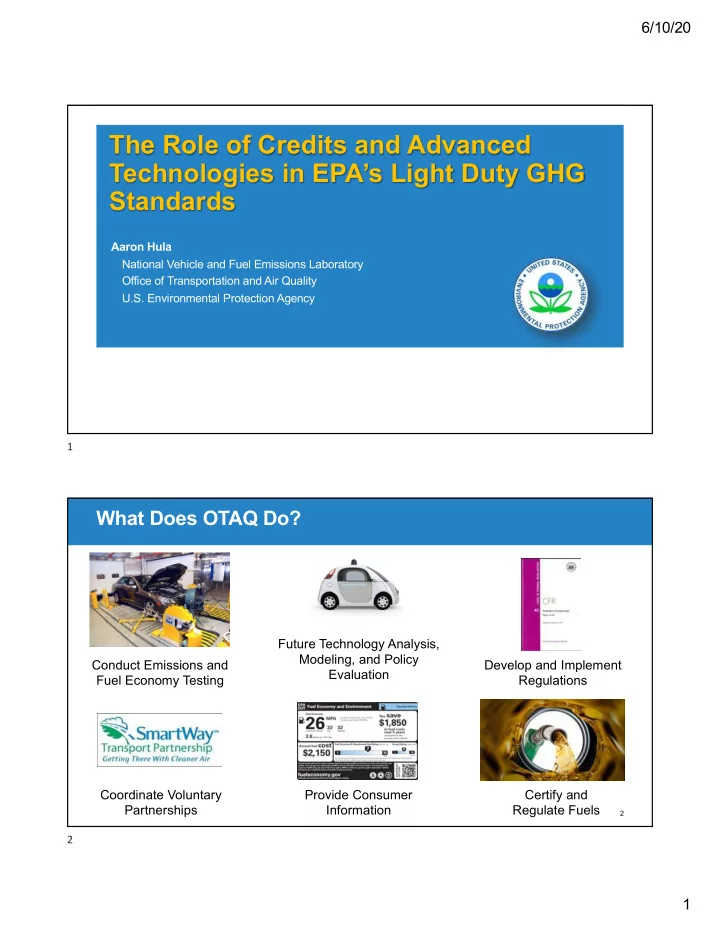
What Does OTAQ Do?

Coordinate Voluntary Partnerships Provide Consumer Information Conduct Emissions and Fuel Economy Testing Future Technology Analysis, Modeling, and Policy Evaluation Develop and Implement Regulations

2

slide-2
SLIDE 2

6/10/20 2

Existing light-duty GHG emission and fuel economy standards have been established through model year 2026. Two questions for today:

  • How can advanced technologies be credited under the existing

regulations?

  • How can EPA encourage and promote technologies that reduce

emissions and protect the environment, beyond model year 2026?

Regulating GHG Emissions: Today and Tomorrow

3

3

  • EPA’s GHG standards are a credit

based Averaging, Banking, and Trading (ABT) program

  • Manufacturers are in compliance with

the current (and all previous) model years if they have a positive credit balance at the end of the model year

EPA’s Light Duty Greenhouse Gas Program

4

Source: EPA Automotive Trends Report 4

slide-3
SLIDE 3

6/10/20 3

Off-Cycle credits reward technologies that achieve real-world GHG reductions, but are not fully captured on 2-cycle city/highway tests

Manufacturers may generate credits for CO2 reducing technologies where the CO2 reduction benefit of the technology is not adequately captured on the Federal Test Procedure and/or the Highway Fuel Economy Test. These technologies must have a measurable, demonstrable, and verifiable real-world CO2 reduction that occurs outside the conditions of the Federal Test Procedure and the Highway Fuel Economy Test. These optional credits are referred to as “off-cycle” credits. (40 CFR 86.1869-12)

Eligible Technologies must NOT be:

  • Integral to basic vehicle design (FR 62836, October 2012)
  • Required by Federal law (FR 62836, October 2012)
  • Attributable to crash avoidance-systems (FR 62733, October 2012)

What are Off-Cycle Credits?

5

5

1) Menu Based Verify that the vehicle has a technology on EPAs list of approved credits for specific technologies

  • Stop/Start
  • High efficiency lighting
  • Active aerodynamics
  • Solar/thermal control
  • Active engine warmup

How do you generate Off-Cycle Credits?

6

2) 5-cycle Testing Perform additional testing using EPA 5-cycle method (including high speed, rapid accelerations, cold starts) to demonstrate and justify credits. 3) Alternative method Petition EPA using an Alternative method if option 1 and 2 are not applicable (40 CFR 86.1869-12)

There are 3 pathways for off-cycle credits:

MY 2018: 92% of credits MY 2018: <1% of credits MY 2018: 8% of credits 6
slide-4
SLIDE 4

6/10/20 4

7

2018 Off-Cycle Menu Technology Implementation

Manufacturers are using a variety of menu credits

7

  • The methodologies described in the applications must meet the following

criteria:

  • Use modeling, on-road testing, on-road data collection, or other approved

analytical or engineering methods

  • Be robust, verifiable, and capable of demonstrating the real-world emissions

benefit with strong statistical significance

  • Result in a demonstration of baseline and controlled emissions over a wide range
  • f driving conditions and number of vehicles such that issues of data uncertainty

are minimized

  • Result in data on a model type basis unless the manufacturer demonstrates that

another basis is appropriate and adequate

  • EPA must seek public comment and publish each application

Alternative Methodology Criteria

8

8

slide-5
SLIDE 5

6/10/20 5

9

Alternative Methodology Criteria - Mercedes Example

  • Mercedes requested credits for their stop start system, based on the effectiveness of

their technology and real world use for Mercedes vehicles.

  • EPA published the request for public comment and received 8 public comments.
  • Mercedes instrumented 29 consumer vehicles and acquired data on 1.4 million vehicles

through Progressive Insurance to estimate Mercedes idle time, and system effectiveness.

  • EPA approved the credit methodology, but applied a more conservative approach.

Small Car Mid Car Large Car Light Truck EPA “menu” credits 2.5 2.5 2.5 4.4 Mercedes application 11 9.1 19 17.1 Mercedes rebuttal 8.72 6.92 8.46 7.56 Approved methodology 4.3 3.7 3.7 3.6

9

  • No manufacturers have requested credits for automated vehicle operation
  • Including adaptive cruise, etc.
  • Most requests have been related to technologies on the menu
  • Credits above the menu credit amount
  • Retroactive menu credits
  • Majority of current credits due to two technologies
  • A/C compressor with variable crankcase suction valve
  • High efficiency alternator
  • Approved applications available online:

https://www.epa.gov/vehicle-and-engine-certification/compliance-information-light-duty- greenhouse-gas-ghg-standards

Credits Approved through the Alternative Methodology

10

10

slide-6
SLIDE 6

6/10/20 6

11

2018 Off-Cycle Total Credits Awarded

Industry performance for model year 2018 was 253 g/mi, including 6.5 g/mi of

  • ff-cycle credits

11

Model Year 2018 Performance vs Standards

12

Manufacturer performance = Tailpipe emissions adjusted for A/C credits, off-cycle credits, advanced technology credits, etc. This does NOT determine compliance! Each manufacturer has unique car and truck standards based on average vehicle footprint

12

slide-7
SLIDE 7

6/10/20 7

13

Credit Balances at the end of Model Year 2018

All large manufacturers achieved compliance with the GHG standards through the 2018 model year.

13

Impacts of the SAFE Rule

14

  • Expands the program one model year, from 2025 to 2026
  • Lowers the standards for 2021-2026
  • From 4-5% annual change to about 1.5%
  • Adds high efficiency alternators to the preapproved off-cycle

credit menu

  • Commits EPA to create a process to begin “allowing technology

suppliers to begin the petition process”

14

slide-8
SLIDE 8

6/10/20 8

  • Can connected and autonomous technologies create off-cycle

credits under the existing regulations?

  • Maybe… if you start collecting emissions data TODAY!
  • Off-menu applications are data and time intensive

Looking Forward

15

EPA’s National Vehicle and Fuel Emissions Laboratory Ann Arbor, MI

  • Is there a better way?
  • How can EPA encourage and promote

advanced technologies that reduce emissions and protect the environment?

  • How do we account for system-wide

impacts?

– VMT, traffic, vehicle design, utilization, etc. 15

Appendix

16

16

slide-9
SLIDE 9

6/10/20 9

17

Credit Transfers through Model Year 2018

Several manufacturers are buying, and selling, credits. Credits from model year 2017 and later last 5 years.

17

GHG Program Credit Summary

18

The industry generated almost as many credits as it used in 2018, maintaining a large bank of credits for future model years.

18

slide-10
SLIDE 10

6/10/20 10

Converting from g/mi to Tg

19

19