
SLIDE 1
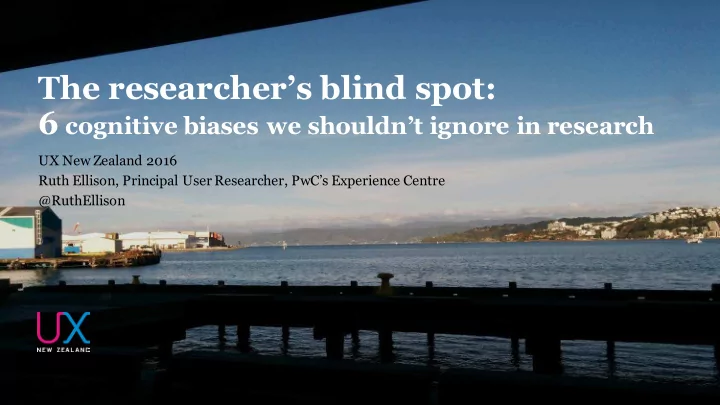
The researcher’s blind spot: 6 cognitive biases we shouldn’t ignore in research
UX New Zealand 2016 Ruth Ellison, Principal User Researcher, PwC’s Experience Centre @RuthEllison
The researchers blind spot: 6 cognitive biases we shouldnt ignore in - - PowerPoint PPT Presentation
The researchers blind spot: 6 cognitive biases we shouldnt ignore in research UX New Zealand 2016 Ruth Ellison, Principal User Researcher, PwCs Experience Centre @RuthEllison Hi :) 2 @RuthEllison $10 $20 Free! $7 @RuthEllison
UX New Zealand 2016 Ruth Ellison, Principal User Researcher, PwC’s Experience Centre @RuthEllison
@RuthEllison
2
@RuthEllison
@RuthEllison
@RuthEllison
@RuthEllison
@RuthEllison You can buy a copy of this poster from: https://www.designhacks.co/products/cognitive-bias- codex-poster
@RuthEllison
8
Photo available under a CC by 2.0 licence https://www.flickr.com/photos/yellowbookltd/14907364551/
@RuthEllison
Image source: http://www.businessinsider.com.au/w hat-new-coke-looked-like-in-1985-2013- 3
@RuthEllison
Preparing Running Analysing
@RuthEllison
@RuthEllison
@RuthEllison
@RuthEllison
Multiple channels - mix of recruitment companies, social media, trusted networks Avoid professional respondents Careful screeners Behavioural based recruitment
@RuthEllison
Photo available under a CC by 2.0 licence: https://www.flickr.com/photos/gdsteam/20649386153
@RuthEllison
@RuthEllison
17
Source: https://medium.com/@userfocus/the-7-deadly-sins-of-user-r esearch-22857c5a971b#.xb38ukdtr
@RuthEllison
@RuthEllison
Loftus, E. F., & Palmer, J. C. Reconstruction of automobile destruction: An example of the interaction between language and memory. Journal of Verbal Learning and Verbal Behavior, 1974, 13, 585-589. McLeod, S. A. (2014). Loftus and Palmer. Retrieved from www.simplypsychology.org/loftus-palmer.html
@RuthEllison
About how fast were the cars going when they collided into each other? About how fast were the cars going when they bumped into each other? About how fast were the cars going when they contacted into each other? About how fast were the cars going when they smashed into each other?
@RuthEllison
Triangulate research Use observational methods Keeping positive-neutral body language, watch the tone of your voice Avoid leading questions
@RuthEllison
22
23
@RuthEllison
@RuthEllison
26
27
Take the opposing view
28
Don’t just confirm your hypothesis, see if you can prove it wrong
Analysis of Competing Hypotheses (ACH)
@RuthEllison
List assumptions Be skeptical, especially if everyone agrees with you Remain open Consider all evidence equally Multiple user researchers Leave your ego by the door.
@RuthEllison from PwC’s Digital Services
@RuthEllison
@RuthEllison
31
@RuthEllison
Triangulate with other research methods (e.g. observational) Use a mixture of individual and group exercises Avoid stating preferences and expectations at start Give someone the devil’s advocate role to question assumptions
@RuthEllison
@RuthEllison
34
35 https://www.flickr.com/photos/naotakem/17105160150/
@RuthEllison
Consider the order of questions and designs carefully Open ended questions Alternate order in which participants are shown concept or design versions
Show version A first 1 3 5 2 4 6 Show version B first
@RuthEllison
@RuthEllison
38
@RuthEllison
Apophenia
39
Source: https://au.pinterest.com/pin/249738741807276910/
@RuthEllison
@RuthEllison
Sample sizes – it’s about the WHY Consider evidence equally – not just the ones that confirm your belief/assumption Collaborative analysis sessions Strive for objectivity
@RuthEllison
42
@RuthEllison
@RuthEllison
@RuthEllison
@RuthEllison
Listen with an open mind Become more rational, but less rationalising Continuous learning
46
Always assess your method, your analysis and yourself for bias
@RuthEllison
47
@RuthEllison Image source: https://en.wikipedia.org/wiki/Twenty_Questions#/media/File:20_questions _1954.JPG
Say hello @RuthEllison
@RuthEllison
Further reading List of cognitive biases You are not so smart: a celebration
9 Biases In Usability Testing
50