The Relationship Lives On Narra/ve therapy creates a different way - - PDF document

the relationship lives on
SMART_READER_LITE
LIVE PREVIEW

The Relationship Lives On Narra/ve therapy creates a different way - - PDF document

4/19/16 Still Alive Construc/ng iden//es & legacies following the death of a baby Helene Grau Kristensen Andrea Lorraine Hedtke Agenda Introducing Re-membering Challenges in Re-membering S/llbirth How to Make the


slide-1
SLIDE 1

4/19/16 1

Still Alive

Construc/ng iden//es & legacies following the death of a baby

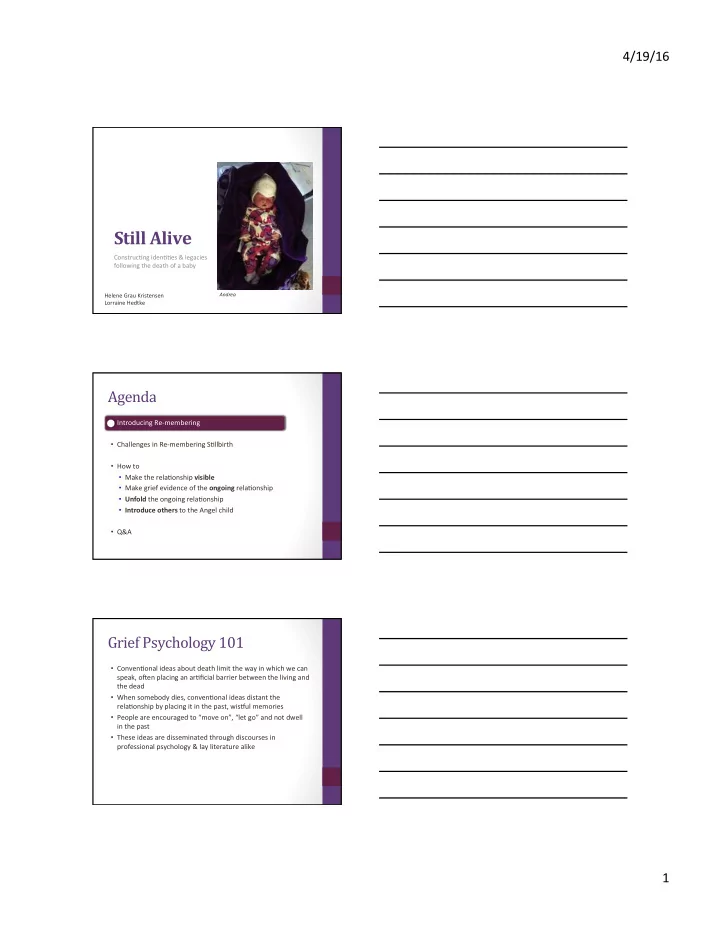
Andrea

Helene Grau Kristensen Lorraine Hedtke

Agenda

  • Introducing Re-membering
  • Challenges in Re-membering S/llbirth
  • How to
  • Make the rela/onship visible
  • Make grief evidence of the ongoing rela/onship
  • Unfold the ongoing rela/onship
  • Introduce others to the Angel child
  • Q&A

Grief Psychology 101

  • Conven/onal ideas about death limit the way in which we can

speak, oLen placing an ar/ficial barrier between the living and the dead

  • When somebody dies, conven/onal ideas distant the

rela/onship by placing it in the past, wisOul memories

  • People are encouraged to “move on”, “let go” and not dwell

in the past

  • These ideas are disseminated through discourses in

professional psychology & lay literature alike

slide-2
SLIDE 2

4/19/16 2

The Relationship Lives On

  • Narra/ve therapy creates a different way to access stories and

shape meaning that transcends conven/onal construc/ons.

  • People, and babies, are born into a connec/on of

rela/onships that hold spaces for the deceased.

  • When babies dies, their influence does not stop simply

because they are not here physically.

  • Their influence con/nues to impact on those who love them

and can change over /me.

Their Life Continues to Matter

  • Making space for the untold & ignored stories
  • Exploring the personal and oLen very private meanings of

where & how the rela/onship is present

  • Knowing a child’s life is not inconsequen/al, influences how

we think and speak about a child that has died before or aLer a birth

  • People want to know that their child will not be forgo]en.
  • We need to listen for the invita/ons to breathe life into a

deceased child’s memories & stories

  • Death does not diminish stories, wishes or dreams
  • Death does not cancel love

The Hyphen

§ Re-membering is ac/ve, not passive § It is more than reminiscing, but the “re” establishment of connec/ons § It is not only solitary § It impacts on an individual, but on others who have been touched by the life and the death § It means ac/vely including someone aLer death

Myerhoff, 1982

slide-3
SLIDE 3

4/19/16 3

Re-membering differently when it is a child that has died.

  • Re-membering oLen picks up on themes, stories, or values of

the deceased person.

  • Re-membering can be informed by a wealth of lived

experiences.

  • Re-membering a baby that dies before or aLer a birth can be

limited by lived memories.

  • A child keeps influencing in ways that ma]ers in life & how the

rela/onship to the child is expressed in newly acquired skills,

  • rienta/ons and values.

”It makes me feel be;er when our two other sons talk about their brother. They tell me about how he [their brother] is in heaven and someday they will get to see him

  • too. That give me peace.”

A mother whose baby died at 24 weeks

Stories Continue to Live On

  • Stories of babies come into life long before concep/on
  • We can invite stories of subjunc/ve dreams & language
  • Children are placed into rela/onal ways of being with parents,

grandparents, siblings & larger communi/es

  • Become a point of connec/on for future rela/onships (like

with not yet born siblings)

Lorraine: What might your daughter appreciate about how you have con/nued to include her in the family? Dad: She would like that we speak about her and have her picture from the hospital up with our other kids.

Agenda

  • Introducing Re-membering
  • Challenges in Re-membering S/llbirth
  • How to
  • Make the rela/onship visible
  • Make grief evidence of the ongoing rela/onship
  • Unfold the ongoing rela/onship
  • Introduce others to the Angel child
  • Q&A
slide-4
SLIDE 4

4/19/16 4

Make the relationship visible

The dominant discourse defining a fetus as not being a person makes the child- parent rela/onship invisible. As a result the child’s influences during pregnancy hardly get explored and recognized

”I think it is harder to loose Ellie in such a young age because we don’t have any experiences with her. If she was three years old then we would have had the memories to hold on to” (Ellie died in week 42).

In our work we see the unborn child as a li]le person being marginalized. We unfold the many experiences in the light of the child’s influences that we would otherwise see as naturalis/c effects of pregnancy ”I haven’t thought about how much

my li;le daughter made me into a

  • mother. All these experieces with

her during pregnancy . It is so nice to know she has made me see the value in mothercaring. And to know that even though the grief has been hard on me – I want to experience being pregnant again”

The fetus is not a person A fetus is a marginalized person

VS

Make grief evidence of the

  • ngoing relationship

Parents keep rela/ng to their Angel childen despite the age of the child. However this rela/ng gets constructed as abnormal due to the discourse of grief

”When I am at the graveyard I think about how Anna-Rose might be freezing - I know it is stupid - but I don’t want her Rl be cold or alone” (her daughter died in week 42)

In our work we see the unborn children as having the human right to be con/nuesly loved, talked about and

  • missed. We unfold grief as evidence of

the ongoing rela/onship to the Angelchild and the fact that parenthood never stops

”It is like when we talk about Molly in this way it becomes possible not

  • nly to talk about all the things we

have lost and feel so sad about. Now we can connect her with something posiRve” (her daughter died in week 38)

Ongoing grief is abnormal Unborn children have ”human rights”

VS

Unfold the ongoing relationship

The discourses of death oLen makes the con/nua/on of the rela/onship invisible for the parents and other.

Mother: If someone asked if I had a child I would say No Therapist: Why is it that we only count the living children? Father: Because you don’t have a relaRonship to the dead child

In our work we unfold how the child con/nue to influence the family and how that creates a rela/onship that is not limited to the to pregnancy, but is

  • ngoing

”We oXen ask ourselves what would Merle say. She is wise, she gets to have the role of supporRng us in doing what we feel is the right thing to do. She is our li;le helper. It is nice to know she can be part of

  • ur life”

Father (lost a girl in week 22)

There is no life aLer death The rela/onship keeps living

VS
slide-5
SLIDE 5

4/19/16 5

Introduce others to the Angel Child

The discourse of death and grief silence parents in talking about their ongoing rela/onship, and other people worry about asking about the child fearing it may make the parents sad. As a consequence the child become taboo

”My mother-in-law said to me that it is like a tumour, you be;er forget about it and get over it”

In our conversa/ons we see the Angelchildren as children who can influence other people in significant ways - not only their parents -but the people they get introduced to. As a consequence the child make it possible to bring change to society

”AXer we have started to talk about Augusta and how we sRll relate to her, my parents-in-law have started to talk about the li;le girl they lost 30 years ago, and my father-in-law for the first Rme has been able to talk about the feelings he sRll has for his li;le girl”

It is best not to talk too much about loss The child did not die in vain

VS

Change of discourse necessary to re-member stillbirth

A fetus is not a person

Dominant Discourse

Ongoing grief is abnormal There is no life aLer death It is best not to talk too much about loss

The child become taboo in rela/on to other people The child no longer exists The rela/onship to the child is pathologized No memories available for construc/ng the iden/ty of the child

Alterna/ve Discourse

A fetus is a marginalized person Unborn children have ”human rights” The rela/onship keeps living The child did not die in vain

The child makes it possible to bring change to society The child can con/nue to influence the life of the family The parents grief can be seen as signs of an

  • ngoing rela/onship

Experiences during pregnancy can be ascribed to agency

  • f the child

Agenda

  • Introducing Re-membering
  • Challenges in Re-membering S/llbirth
  • How to
  • Make the rela/onship visible
  • Make grief evidence of the ongoing rela/onship
  • Unfold the ongoing rela/onship
  • Introduce others to the Angel child
  • Q&A
slide-6
SLIDE 6

4/19/16 6

Rendering Visibility to Life

We need to be curious about:

  • How is the parent/person refusing sugges/ons from others/

discourse to let go or move on.

  • How is the parent/person being a witness to the rela/onship

with the child?

  • How does this experience & expression reflect on what is

valued?

  • What does this experience & expression of caring for a

deceased child’s legacy suggest?

  • What do these prac/ces say to the parent & others about how

the child con/nues to ma]er? “Mom: I have had a couple of events recently where I am mee/ng people and they say, ‘you have the 2 boys’. That’s hard cause I want to say, ‘I have 3 boys and I would love to tell you about him’ But it is like if I tell them I have a 3rd child but he died, then I get this total sympathy that doesn’t feel right. When I am with people who knew Teddy, I’m good. Everyone knows about him and everyone talks about him. The pain is really when I am in a situa/on where he is just not known. Or that even if he is known, he is not acknowledged. That’s really hard cause he is s/ll here for me. I am not actually holding his hand, but he is s/ll here. There’s joy when others know too that we are holding his hand.” 3 months aLer her son died at birth

Deconstructing the discourse

  • f fetus
  • The many experiences or interac/ons during pregnancy are tradi/onal seen and

described as naturalis/c effects of pregnancy.

  • This is due to the fact that a unborn child is not described as one that has agency or
  • ne that can ac/vely influence their parents in those moments.
  • In his work Michael White was keen to ascribe and make visible the agency or iden/ty
  • f the marginalized. Groups of people where their iden/ty and voices had been

robed.

  • We can define agency as being able to influence others – as being able to do

something to another person.

  • We are poli/cal in the sense that we see these small unborn children as being
  • marginalized. Their agency and iden/ty is being robed.
  • The many possible experiences with a unborn child expand when we see and explore

the many moments where the interac/on or rela/ng has taken place and the child is being described as being ac/ve and doing something to others in those moments.

  • These influences becomes stories of the child’s agency and significant influences on

their parents.

slide-7
SLIDE 7

4/19/16 7

Experiences during pregnancy

  • Moments of discovering the

pregnancy

  • Moments of scanning
  • Moments of talking about the unborn

child

  • Moments of the unborn child kicking
  • Moments of giving birth
  • Moments of silng with the dead

child Andrea, Scanning

Questions that unfolds experiences

  • How has the unborn child influenced

the parents in those exact moments

  • What did the li;le unborn child do to

the parents in that moment?

  • What did the li;le unborn child make

possible for the parents to experience, to noRce and to talk about?

  • What feeling did the li;le unborn

child implant in the parents in that moment? Andrea, Scanning

The child’s agency during pregnancy

How did Andrea come into your life? Did you fight for her or did she come easily? I fought a lot. I went into fer/lity treatment. I tried for 1 year to get pregnant and I almost lost hope. And then suddenly I got pregnant Wow so you fought a lot for her. What did Andrea do to you, when you discovered that you were pregnant with her, did she create certain feelings in you or? ( Smiles) yes she made me so happy. Wow so she made you so happy, was it a kind of happiness you have experienced before or was the happiness she created different? It was very different. It was a strong feeling of meaningfulness. Can you tell me more about that meaningfulness that Andrea so strongly connected you to - that she made you experience? It was a meaning about how much sense it makes for me to become a mother. What did she make you experience in the moments with her in the pregnancy about being a mother? The experience of wan/ng to take care and protect … How was that feeling - did you like it - how is that feeling for you? yeah it was so nice. It makes so much sense. It makes much more meaning to my life then anything else.

  • Wow. Is it ok so say it is a big or a liKle thing - do you recon - to open a mum’s eyes to?

It is huge thing. How is that for you that Andrea has done that? It makes me proud

slide-8
SLIDE 8

4/19/16 8

The child´s agency during birth

  • The event of giving birth to a dead child or a

child who only lived for a very short moments is very oLen described in the light of the horrific effects of death.

  • It becomes a moment that is described in the

grammar of loss and it all about saying goodbye.

  • This moments of interac/on can be explored

as a one of the greatest moments of saying

  • hallo. This is actually the first /me that these

parents see their li]le child.

  • This is a moment were the rela/onship to the

li]le child develops tremendously.

  • We can make the child’s influence in those

moments visible and it has the effect on making stories not only about loss but also of being influenced in this rela/onship by your

  • child. Your child has done something

significant to you. Andrea and her mother

An example of “Saying hullo”

Sif Ane only lived 2 minutes (cries) I had her on my chest while she died Is it ok to ask a liKle about how it was to experience Sif Ane. I know it was the first Mme you actually saw her? Yeah When you saw Sif Ane and she was put on you chest - what did she do to you when you saw her? did she make you have certain feelings? Yeah she was so beau/ful Wow she was so beauMful. What did you noMce was so beauMful about her? Her fine li]le nose and fingers Ahhh her fine liKle nose and fingers - wow when you saw her liKle nose and how beauMful she was, did Sif Ane make you experience something you haven’t felt before? I felt so proud of her … So she really made her mum experience being proud, and you had her on own you chest? Yeah … While you had her own your chest can you say more about what she did to you, what she made you experience, did she made you experience warmness or? She made me experience a strong warmness and love yeah a connec/on What was that love and connecMon like? It was so unique. It was the best Was it a love between a mum and her daughter or how would you describe it? Yes - she made me a mum How is that for you that she made you experience this proudness, connecMon, and love for the first Mme as a mum? It makes me so proud to know she did it

Making the child inQluential by being a witness

  • In honoring this moments of birth and

interac/on, we can bring the li]le Angelchild to the center of the rela/onship.

  • The child can be made influen/al not
  • nly in how it has influenced the

parents in that moment but also by giving it agency as a witness to the interac/on and the responses of the parents to it.

  • The parents sees themselves through

the eye of their unborn child.

  • This has the effect of transpor/ng the

parent’s in the experience of themselves as a parent and the child becomes influen/al in where they get transported to. Sif Ane and her mother

slide-9
SLIDE 9

4/19/16 9

An example of making the child an inQluential witness

Wow can you tell me what did you do to Sif Ane, how did you response to her while she was on your chest? I caress her and I kissed her So you caressed and kissed her. What did you want Sif Ane to experience from these kisses, what did you intended to tell her? That she was loved That she was loved. What differences do you think it made for Sif Ane that she felt all this love? (cries) a lot …the whole world … If Sif Ane could have a voice what would she say the love that she experienced tell her about her mum? That her mum did everything she could for her … If your daughter could have a wish for you how do you think she wants this knowledge to influence you? That I don’t feel bad or … feel guilty about what happened What would her voice be like it could have words to it? Mum you did you best How is that for you think about her voice in this way? It is nice .. I can feel her …

Agenda

  • Introducing Re-membering
  • Challenges in Re-membering S/llbirth
  • How to
  • Make the rela/onship visible
  • Make grief evidence of the ongoing rela/onship
  • Unfold the ongoing rela/onship
  • Introduce others to the Angel child
  • Q&A

Membership

  • “A life, then, is not envisioned as belonging to the individual

who has lived it but it is regarded as belonging to the world, to progeny who are heirs to the embodied tradi/ons, or to

  • God. Such re-membered lives are moral documents and their

func/on is salvific, inevitably implying, ‘All this has not been for nothing’.”

Myerhoff

slide-10
SLIDE 10

4/19/16 10 Standing against invisibilizing

  • Suppor/ng people to make visible the effects of the

rela/onship

  • Introducing the deceased child to the rest of the world
  • Others may need to be coached as to how to respond
  • Suppor/ng parents to know how to respond to

condolences

  • To find places where the life is shared and not only the

way in which a child died

  • Finding places that can become an apprecia/ve

audience for the deceased child

Double listening

  • Listening at the same /me to the problem story and the

counter story

  • Double listening hears both
  • the pain of the problem story & the story of hope
  • We need to be alert for both the other stories
  • For example, where there is pain, it is also tes/mony to love

Mom: We typically don’t name our kids un/l they are born, but when we learned there was a problem we felt like we needed to name him immediately. Naming him meant he was something that wouldn’t be taken away and can’t be taken away from us. Lorraine: In naming him before he was born, in what way did this make a commitment to your son? Dad: It helped us put a name to the face. And really get to know him. Even though he wasn’t born yet, we really got to know him. Lorraine: How has his name guided your connec/on to your son over the past weeks since his birth? Lorraine

Dead children have ”human rights”

  • In making visible the ongoing rela/onship we become poli/cal. We are giving back the

rights of these marginalized children and their parents.

  • Living children have the right to be con/nuously loved by their parents through the

parent’s whole life and the parents have the right to do so.

  • Living children have the right to be con/nuously talked about by their parent’s

through the parent’s whole life and the parents have the right to do so.

  • Living children have the right to be con/nuously felt and thought of by their parent’s

through the parent’s whole life and the parents have the right to do so.

  • All this gets named as skills in parenthood but when a parent to an Angelchild does the

same it gets labeled as grief.

slide-11
SLIDE 11

4/19/16 11 Deconstructing Grief as evidence of

  • ngoing relationship/parenting
  • The parent who con/nues to :
  • experience emo/onal pain or incidences of sadness
  • act in regard to the child
  • think about and miss the child
  • hugging Angelchild’s stuffed animals
  • are seen as grieving and not as a parent who are experiencing or finding ways to

con/nue the parenthood of an Angelchild.

  • Making these experiences visible as skills in keep rela/ng and being a parent for

an Angelchild makes them changes them from something that needs to be stopped to something that can con/nue or being honored.

  • In unfolding the present but invisible rela/onship or the parental skills in rela/ng

to the Angelchild we ask ourselves:

  • How is what the parent is experiencing or expressing or doing a witness to

conMnuously relaMng to the child?

  • How does this experience or expression or doing of the parent reflect

parenthood?

  • What does the parent intend in relaMon to their Angelchild?
  • What does this experience or expression or doing of the parent tell the

Angelchild about how it keep maKering?

Making grief/guilt into sign of

  • ngoing reationship/parenting

M: I feel guilty that I was not able to look aLer Magnus, that my body failed T: does the guilt that you experience as a mum to Magnus say something about what you so strongly intended or wished for him? M: yeah to look aLer him, to protect him and to make him live T: does that say something about what is so presence in your relaMonship to Magnus? M: yeah love .. that he is my son T: is the guilt connected to this being a mum that loves, a mum that wants to protect? M: yeah if I didn’t love him I wouldn’t feel guilty T: does this experience of guilt fit with being a mum, do mothers more easily experience guilt in regard to their children? M: yeah I think so, yeah it is a mum-thing, T: what would it tell Magnus about what he means for you that you are sMll thinking about how you could have protected him against something you didn’t know how to protect him against? M: that he is my son and that I would do anything to protect him, T: what do you think Magnus would hope this would do to you, him knowing this about you? M: that I can forgive myself .. T: what do think it would sound like if you could imagine he could speak or voice this hope? M: mum I know you did what you could …I love you (cries)

Agenda

  • Introducing Re-membering
  • Challenges in Re-membering S/llbirth
  • How to
  • Make the rela/onship visible
  • Make grief evidence of the ongoing rela/onship
  • Unfold the ongoing rela/onship
  • Introduce others to the Angel child
  • Q&A
slide-12
SLIDE 12

4/19/16 12

The Angelchild keeps inQluencing after his or her physical death

  • In making the Angelchild’s influences

visible, we can construct and unfold the influences from the child aLer it’s death. Its influences on values, skills, how to do life and how to understand life

  • Some of these influences on parents are

tradi/onally ascribed to effects of loosing

  • r the effects of the trauma.
  • OLen we can asked about how the

Angelchild has changed the person contributed to new understandings of life, skills, or doing of life. We can connect some of the effects of what they went through to the child’s influences.

Andrea´s hand

An example of Posthumous Agency

Has Andrea somehow influenced, effected or changed how you are as person? Has she for instance influenced how you talk with other people or? She has made me less cold before I was very hard on the outside. Today I can speak more openly about my feelings So she has influenced you to speak more about you feelings. What would be a recent example of that? Hmm well when I visited my work this week I talked about Andrea and how I feel about her to some of my colleagues What did you experience it did to more openly share these feelings, what did it do? M: I think I got more close to my colleagues, they get to know how much my daughter ma]ers for me So sharing feelings openly can make you closer to other people and make it more visible for others what maKers for you? yes Does it make sense to ask what else has Andrea made possible for you to discover that is important for you when you speak more openly about your feelings? That I can trust other people . Usually I thought other people would turn their backs to me What do think about this influence from Andrea? M: it makes me proud

The Angelchild’s inQluences can live on

  • If we make the child’s influences and

agency visible in regard to values, skills, understandings of life we can unfold:

  • how these influences from the child on

the parents can live on in the future – how can the parents keep making use

  • f the new values, skills,

understandings of life

  • what role can the child play in

supporMng the influences to live on – how can the parents make us of the Angelchild

  • This has the effect on expanding the

richness of the influences, making the

  • ngoing rela/onsship visible, making

the parents available for those influences. Majse and her mother

slide-13
SLIDE 13

4/19/16 13 Example of making the inQluences keep living

This skill or inspiraMon from Majse to not judge other people but to contain and listen to them is that something you want her to keep inspiring you to do? Is that a skill you like to hold on to? Yes indeed Why do you want to hold on to it? Because it makes me feel more connected to other people, not to distance myself to them.. It helps me to understand other people Are there situaMons where you can imagine yourself in the future to make use of this skill in not judging other people but listen to them? Yes when I start work again I know it will be hard to hold on to it but I like to What will it do to your relaMonship to Majse to hold on to this skill? It will make me feel connected to her How can she support you in holding on to this influence of hers to not judge but listen first to other people? I have thought about gelng a necklace with the le]er M Wow a leKer M that stands for mother and Majse .. two in one (smiles) I haven’t thought the two in one, but that is nice to think about Wow so could it be like every Mme you see or touches the necklace Majse can remind you of that, to not judge but to listen first? Yes that would be nice What will it do to know that touching the M can always make you connected to Majse’s influence

  • f not judging other people but first listen to them ..

(smiles) it makes me think she can always be my li]le helper

Agenda

  • Introducing Re-membering
  • Challenges in Re-membering S/llbirth
  • How to
  • Make the rela/onship visible
  • Make grief evidence of the ongoing rela/onship
  • Unfold the ongoing rela/onship
  • Introduce others to the Angel child
  • Q&A

The Angelchild becomes taboo

The con/nua/on of the rela/onship to an Angelchild is something that is hardly known in our society. The known and familiar responses are:

  • Condolence
  • Silence
  • How are you

The grammar of con/nuing the rela/onship is so undeveloped and not widespread that people unfamiliar with it don’t know how to talk about the child in ways that support the ongoing rela/onsship. Rather people are influenced by discourses of death and grief that makes them worry about how the parents are s/ll rela/ng to the dead child. This effect the parents to become invisible as parents, to not share their the Angelchilden with others and their li]le childen becomes silenced or tabooed

slide-14
SLIDE 14

4/19/16 14

Making the Angelchild inQluential in changing society

  • In our conversa/ons we see the Angelchildren as children who can

influence other people in significant ways - not only their parents - but the people they get introduced to.

  • We try to find ways to save the Angelchild for being silenced.
  • The parents can be posi/oned as missionaries, educators and

ac/vist. It is society who needs to be educated about how the Angelchild keeps ma]ering, the con/nua/on of the Angelchild’s significant influences and the con/nua/on of being a parent for the Angelchild

  • In these conversa/on we speculate and develop ideas to how to

introduce others to this different grammar of con/nuing the rela/onship

  • We unfold the parents knowledge about what other people need to

know in order for these people not to respond in accordance to the discourses of grief and death but to be changed or informed by them and their Angelchild

Example preparation of parents to be missionaries

I am not sure people out there know about this relaMonship that you have to your Esther. I am thinking about this area is so undeveloped that people don’t know what to ask about in regard to Esther, did you know about this before you experienced these things with Esther? F: no not at all, M: no I didn’t .. I think I wouldn’t have had an understanding of how it is to have an Angelchild .. So in a way this is what Esther has brought into you life .. She has change what you know about this F: yes she has .. I think you have a knowledge that only few people have .. And that you need to share this knowledge with other people in order for them to know about this and to be able to listen and make room for talks about Esther M: yeah I think you are right You said you parents response to your tears when you talk about Esther with changing the subject .. What do they need to know about the tears for them to response in a different way . F: I think they need to know that they don’t have to fix the tears that I want the tears to be there because they are connected to the feelings I have for Esther … I like to talk about how I relate to Esther .. And what do they need to know about this so they don’t worry about this as grief? M: I think we need to tell them that Esther is our Angelchild ..that we will always connect with her and we don’t want to change that

Example of the Angelchild being an activist

These talks you have had where you experience it becomes possible to talk about Esther is it a kind of missionary work? M: (laughs) yes it is. And my father in Law actually suggested to me that I should make contact to my work and educate them on what to do when you experience grief. We have no policy on this. My boss didn’t response to what happened he was silent. I have thought about making contact to my work and make them know the importance of talking about the dead children, I want to develop a policy of how to response If Esther knew she is influencing her mother to stand up for this and make this knowledge more visible what would it do her? What would it do to her understanding for herself knowing she is in this work of making it more visible and change things for future bereaved people? M: (smiles) She would be proud … I think she would like to change things for the be]er

slide-15
SLIDE 15

4/19/16 15

A motherly heart doesn’t just stop – it keeps beating

Can you describe what you feel or experience when you see other small babies? M: then I feel sad … I wish it was me who experienced that with Esther and then I don’t feel happy about their babies.. But it is not that I am not happy about them Do you think the best descripMon is jealousy or… what do you think you experience so strongly in those moments in regard to your Esther? M: Pain. It is painful that I can’t experience those things with her. I wanted to hug and cutle her and sit with her That you can experience this pain in regard to Esther in those moments and you can experience the strong wish to hug her, can it tell us something about you as a mum? M: that I love her .. This ability of yours to love Esther - what does that say about you as a mum? M: that I have a motherly heart Would you say that Esther acMvated your motherly heart or made you have a motherly heart M: she made me have a motherly heart and a heart does not just stop to pound No it is a heart. So it doesn’t stop pounding. Your motherly heart keeps pounding. When you experience the pain - when you see other parents with their small babies - what is your motherly heart then pounding for in regard to Esther? M: that I could have experienced that with Esther.. When you keep talking about Esther is that also your motherly heart that is pounding? M: Yes it is And what does it pound for in those moments M: That Esther should be talked about and experienced by others as our daughter. I want her to keep influencing us

Agenda

  • Introducing Re-membering
  • Challenges in Re-membering S/llbirth
  • How to
  • make the rela/onship visible
  • make the ongoing rela/onship visible
  • unfold what happens aUer death
  • introduce others to the Angel child
  • Q&A