The RAAF F/A-18A Hornet - Extend or Replace? Carlo Kopp, - - PowerPoint PPT Presentation

the raaf f a 18a hornet
SMART_READER_LITE
LIVE PREVIEW

The RAAF F/A-18A Hornet - Extend or Replace? Carlo Kopp, - - PowerPoint PPT Presentation

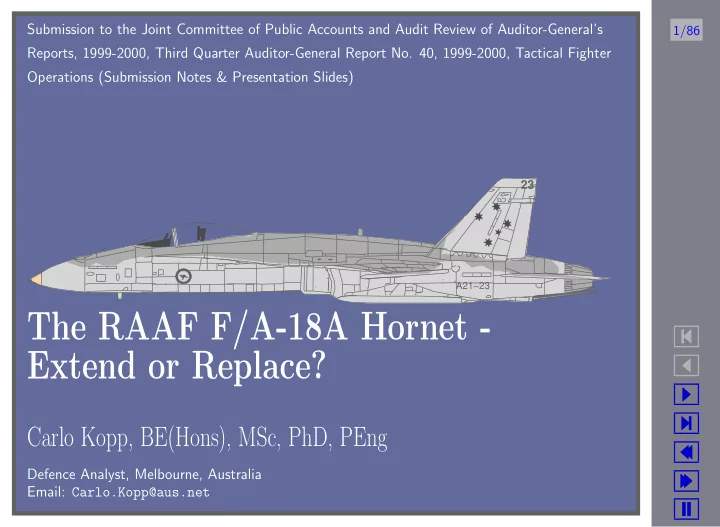
Submission to the Joint Committee of Public Accounts and Audit Review of Auditor-Generals 1/86 Reports, 1999-2000, Third Quarter Auditor-General Report No. 40, 1999-2000, Tactical Fighter Operations (Submission Notes & Presentation Slides)


slide-1
SLIDE 1

1/86

  • Submission to the Joint Committee of Public Accounts and Audit Review of Auditor-General’s

Reports, 1999-2000, Third Quarter Auditor-General Report No. 40, 1999-2000, Tactical Fighter Operations (Submission Notes & Presentation Slides)

A21−23

23

The RAAF F/A-18A Hornet - Extend or Replace?

Carlo Kopp, BE(Hons), MSc, PhD, PEng

Defence Analyst, Melbourne, Australia Email: Carlo.Kopp@aus.net

slide-2
SLIDE 2

2/86

  • Summary

Audit Report No.40 1999-2000, Tactical Fighter Operations, Section 5.22 states that Defence decided to upgrade the F/A-18A as an interim measure until a suitable new technology fighter becomes available. This submission will show that ongoing trends and recent developments in regional air and missile capability growth support the case made by

  • Defence. Therefore:
  • 1. The replacement of the F/A-18A with a new technology fighter

post-2010 will be necessary, should current trends persist.

  • 2. A larger type of fighter aircraft would be better suited as a replace-

ment for the F/A-18A, should current trends persist.

  • 3. Substantially improved aerial refuelling capabilities and Airborne Early

Warning & Control aircraft will be required to support the F/A-18A, should current trends persist.

slide-3
SLIDE 3

3/86

  • Why Air Superiority?
slide-4
SLIDE 4

4/86

  • What is Air Superiority?

3.46 DI(AF) AAP 1000 The Air Power Manual (2nd Ed): “Control of the Air is the campaign in which operations are conducted for the purpose of gaining freedom of action in the air. Once con- trol has been established, other air, land and sea campaigns may be conducted when and where desired, without prejudice from enemy air

  • power. Achieving control of the air means defeating or nullifying the

effects of enemy air power, both in the air and on the ground.” “Air superiority is domination in the air restricted by either time or space,

  • r both.”

The primary role of the F/A-18A Hornet is the attain- ment of air superiority over the air sea gap, Australian territories, or any other area of ADF operations.

slide-5
SLIDE 5

5/86

  • What Happens Without

Air Superiority?

  • 1. ADF combat aircraft can be attacked in the air and on the ground.
  • 2. ADF transport, tanker and maritime patrol aircraft can be attacked

in the air and on the ground. Commercial aircraft could also be attacked.

  • 3. ADF land forces can be attacked by bombers and cruise missiles.
  • 4. ADF naval surface fleet warships and transports can be attacked

with cruise missiles and bombs.

  • 5. Australian shipping lanes and air routes can be interdicted, costing

export revenue.

  • 6. Australian economic assets, ports, airports and population centres

can be attacked with cruise missiles and bombs.

slide-6
SLIDE 6

6/86

  • How is Air Superiority

Achieved and Maintained?

  • Superior fighter aircraft, radar and missiles.
  • Superior surveillance, radar early warning, command and control.
  • Superior electronic combat capabilities.
  • Superior fighter persistence through aerial refuelling.
  • Superior capability to attack an opponent’s airfields.
  • Superior pilots, tactics, strategy and doctrine.
  • Adequate numbers of pilots, fighters, Airborne Early Warning &

Control aircraft and aerial refuelling tankers.

slide-7
SLIDE 7

7/86

  • COUNTER−AIR

AERIAL REFUELLING SUPERIOR ELECTRONIC COMBAT SUPERIOR FIGHTERS SUPERIOR RADAR SUPERIOR MISSILES LONG RANGE SURVEILLANCE (JORN) AIRBORNE EARLY WARNING & CONTROL

ACHIEVING AND MAINTAINING AIR SUPERIORITY

AIRFIELD STRIKE SUPERIOR PILOTS SUPERIOR TACTICS SUPERIOR DOCTRINE

slide-8
SLIDE 8

8/86

  • Developing Regional Capabilities
slide-9
SLIDE 9

9/86

  • Indian Air Power (Current & Projected)
  • By 2010-2015 the Indian Air Force will deploy around 200 Sukhoi

Su-30MKI long range strike fighters.

  • The Indian Navy is currently negotiating the lease of 4 Tupolev Tu-

22M-3 Backfire strategic bombers. These may be operational as early as 2002. More may be purchased.

  • The Indian Air Force is evaluating the Russian A-50 AWACS and

negotiating for the Israeli A-50I AWACS system. India is likely to field an AWACS between 2005 and 2010.

  • The Indian Air Force is negotiating a buy of former Soviet Il-78 Midas

aerial refuelling tankers from Uzbekistan. These may be operational as early as 2001-2002. US sources claim India has at this time 2 Il-78 Midas.

slide-10
SLIDE 10

10/86

  • Indian Air Power (Current & Projected)
  • The Indian Navy is upgrading and expanding its fleet of 8 Tupolev

Tu-142M Bear F maritime aircraft. The upgraded fleet will become

  • perational by 2005-2010.
  • The Indian Navy is deploying the 3M-54E1 (SS-N-27) anti-ship

cruise missile on the Kilo class diesel-electric submarine. An op- erational capability is likely by 2001-2003.

  • It is likely that the 3M-54E1 cruise missile will be fitted to the Bear

and Backfire aircraft.

  • The Indian Navy has purchased a 40,000 tonne Russian aircraft car-

rier and intends to deploy an air wing of around 46 MiG-29K fighters. It will become operational at some point between 2005 and 2010.

slide-11
SLIDE 11

11/86

  • Indian Air Power (Current & Projected)

Indian Air Force/Naval Air Arm Striking Radius (FOB Andaman Is.)

20S 20S

Learmonth Curtin Darwin Tindal Halim Surabaya Iswahyudi Palembang Pekanbaru Singapore Butterworth Kuala Lumpur

100 120 120 100 Su−30MKI assumed 1 or 2 aerial refuellings at 700 NMI radius.

Combat Radius Tu−22M3 Backfire

Sunda Straits Straits

  • f Malacca

Christmas Island Cocos Islands Islands Andaman

Combat Radius 1 x AAR Su−30MKI Flanker Combat Radius 2 x AAR Su−30MKI Flanker Combat Radius Su−30MKI Flanker Tu−22M3 Backfire AS−4 Kitchen

slide-12
SLIDE 12

12/86

  • Indian Air Power (Tupolev Bear F)

Andaman Islands Islands Cocos Island Christmas

  • f Malacca

Straits Straits Sunda

Tu−142M Bear F 3M−82, 3M−54 Kh−22M, Kh−35, Indian Naval Air Arm Bear F Striking Radius (INS Rajali, Arakkonam)

Tu−142M assumed 4,000 NMI radius, no AAR performed. 20S 20S

Learmonth Curtin Darwin Tindal Halim Surabaya Iswahyudi Palembang Pekanbaru Singapore Butterworth Kuala Lumpur

100 120 120 100

slide-13
SLIDE 13

13/86

  • PRC Air Power (Current & Projected)
  • By 2015 the PRC’s Air Force will deploy around 250-300 Sukhoi

Su-27SK/J-11 long range fighters.

  • By 2010 the PRC’s Air Force will deploy around 60 Sukhoi Su-

30MKK long range strike fighters.

  • The PRC’s Air Force was recently denied the Israeli A-50I AWACS.

It is reported to be evaluating the upgraded Russian A-50E instead. If acquired, the A-50E could be operational by 2005.

  • The PRC’s Air Force has a stated intent to acquire aerial refuelling

tankers, probably the Il-78 Midas. Several H-6 Badger tankers are

  • perational.
slide-14
SLIDE 14

14/86

  • PRC Air Power (Current & Projected)

Singapore

Combat Radius − No AAR Tu−22M3 (hypothetical) Su−27SK/30MKK Flanker Combat Radius 2 x AAR

Sunda Straits Straits

  • f Malacca

Cocos Islands Islands Andaman

Su−27SK/30MKK Flanker Combat Radius 1 x AAR Xian H−6 Badger Combat Radius

Christmas Island

PLA−AF (PRC) Striking Radius (FOB Hainan Dao)

Assumed 1 or 2 aerial refuellings at 800 NMI radius. 20S 20S

Learmonth Darwin Tindal Halim Surabaya Iswahyudi Palembang Pekanbaru Butterworth Kuala Lumpur

100 120 120 100

Curtin

Su−27SK/30MKK Flanker

slide-15
SLIDE 15

15/86

  • PRC Air Power (Current & Projected)

Cumulative Total 358 Airframes

Russian Built Su−27SK (1) Russian Built Su−30MK (3) Russian Built Su−27SK (2)

(1) 48 aircraft currently in service comprising mix of Su−27SK and Su−27UBK (ITAR−TASS) (2) Reported follow on order of 55 Su−27SK and Su−27UBK (ITAR−TASS 1997) (3) Currently under negotiation, reported to be 55 examples of single seat Su−30MK variant

Projected PLA−AF Flanker Variant Deployments

Follow On PRC Manufacture (4)

(4) Speculative 22 130 70 55 55 26

PRC Kit Built Su−27SK PRC Manufactured Su−27SK/AL−31F 1990 2035 2040 1995 400 200 100 300 Quantity [−] 2025 2020 2015 2010 2005 2000 2030

slide-16
SLIDE 16

16/86

  • Indonesian Basing for Su-27/30
  • Indonesia ordered 12 Su-30K long range strike fighters before the

economic collapse. These aircraft have since been resold to India. Should Indonesia recover over the coming decade, this order may be revived.

  • Malaysia may acquire the Su-30MK long range strike fighter.

It

  • perates a modest number of the less capable MiG-29 fighter.
slide-17
SLIDE 17

17/86

  • Indonesian Basing for Su-27/30

100

Su−27/30

Sunda Straits Straits

  • f Malacca

Christmas Island Cocos Islands

Combat Radius Su−27/30 Combat Radius Indonesian Penetration Scenario − Air Power

20S 20S

Learmonth Curtin Darwin Tindal Halim Surabaya Iswahyudi Palembang Pekanbaru Singapore Butterworth Kuala Lumpur

100 120 120

slide-18
SLIDE 18

18/86

  • Regional Capability - Chronology

The last decade has seen unprecedented growth in the capabilities of the air power operated by the PRC and India. 1991-1992 The PRC orders 26, and later 22 more Russian long range Sukhoi Su-27SK air superiority fighters. 1996-1997 The PRC negotiates the licence manufacture of 200 Su- 27SK fighters in the PRC. Russian claims suggest another 55 Su- 27SK have been ordered. 1996-1997 India responds by ordering 40 improved Su-30MKI long range fighter bombers. Negotiations begin for a local build of further Su-30MKI by Hindustan Aircraft Ltd. 1997-1998 Indonesia orders 12 Su-30K, following the economic col- lapse these are sold by the Russians to India.

slide-19
SLIDE 19

19/86

  • Regional Capability - Chronology

1999-2000 The PRC negotiates a buy of about 60 improved Su-30MKK, similar to the Indian aircraft. Late 1999 Indian Navy orders upgrade and expansion of Tu-142M Bear F Long Range Maritime Patrol (LRMP) aircraft fleet. The 3M-54 (SS-N-27) cruise missile ordered for Kilo submarines and sur- face ships, deployment on Bear aircraft discussed in public. 1998-2000 The PRC orders several A-50I AWACS aircraft, equipped with the Israeli Elta EL-2075 radar on the Russian A-50 airframe. Order cancelled this July under US pressure. 2000 India responds by evaluating a pair of Russian A-50 AWACS. Ne- gotiations begin with Israel for A-50I purchase.

slide-20
SLIDE 20

20/86

  • Regional Capability - Chronology

Early 2000 Indian Navy negotiates lease of 4 Russian Tu-22M-3 Back- fire C supersonic strategic bombers. Status unknown at this time. July 2000 A report in the Russian press suggests that the Backfire bomber, and the 949A Oscar II cruise missile carrier and 971 Akula attack submarine classes may be sold to the PRC. September 2000 Russia announces massive defence budget cuts fol- lowing the accidental loss of the Kursk submarine. October 2000 India closes a deal for the licence building of 150 Su- 30MKI fighters. The 40,000 tonne aircraft carrier Gorshkov is sold for the cost of a refit alone, with negotiations under way for an air wing of MiG-29K fighters. A ‘military-technical cooperation’ ar- rangement is agreed to facilitate the transfer of Russian technology.

slide-21
SLIDE 21

21/86

  • Likely Future Developments
  • India converts Backfire lease to purchase and expands fleet beyond

4 aircraft.

  • The PRC acquires the Backfire to counter the Indian purchase.
  • Both India and the PRC acquire Russian A-50 AWACS.
  • The PRC and India acquire further advanced missiles for the Su-

27/30 fighter. India buys Uzbek Il-78 aerial refuelling tankers.

  • India acquires the 3M-54 cruise missile for the Bear and Backfire

bombers, including the Tomahawk-like 3M-14E land attack missile.

  • Russia transfers 949A Oscar II cruise missile carrier submarines to

China, India or both to save costs.

slide-22
SLIDE 22

22/86

  • Uncertainties
  • When will the PRC and India acquire Russian A-50 AWACS aircraft?
  • When will the PRC and India acquire Russian Il-78 tanker aircraft

in operationally useful numbers?

  • What cruise missile types will India choose to arm the Backfire and

Bear bombers with?

  • Will Russia supply the Backfire bomber to the PRC, having opted

to supply India? Russia refused to export the Backfire to China in 1993.

  • Will Russia choose to export the Oscar II cruise missile submarine

to India, the PRC, or both?

slide-23
SLIDE 23

23/86

  • Observations
  • The tit-for-tat purchases of advanced aircraft and weapons by China

and India shows a well established pattern which fits the definition

  • f an ‘arms race’.
  • The timing of purchases and types of weapons well exceed the scope
  • f a ‘modernisation program’, as many Western observers would

assert.

  • Russia’s bankruptcy is likely to result in former Soviet strategic air-

craft, cruise missiles, nuclear powered submarines and warships being supplied without restrictions to the PRC and India.

  • Because large stocks of former Soviet equipment are available from

the Russian inventory, the time to deploy such into Asia may be as short as months.

slide-24
SLIDE 24

24/86

  • Sukhoi Su-27 & Su-30 Fighter Capabilities
slide-25
SLIDE 25

25/86

  • Su-27P Flanker
  • The Su-27P Flanker was developed by the Soviets to defeat the

leading US air superiority fighter of the period, the Boeing F-15.

  • Variants carry between 9,400 and 10,000 kg of internal fuel, giving

it the greatest combat radius of any fighter in its class.

  • With a large radar, good supersonic persistence and the ability to

carry 10 to 14 missiles, it is a formidable opponent in Beyond Visual Range (BVR) missile combat.

  • With excellent manoeuvrability, powerful engines, advanced R-73

family dogfight missiles and a Helmet Mounted Sight, it is excep- tionally potent in close-in air combat.

  • Numerous variants are available, incorporating land and maritime

strike capabilities.

slide-26
SLIDE 26

26/86

  • Su-27SK Flanker

Sukhoi Su−27SK/J−11 PLA−AF

(C) 1997, Carlo Kopp

  • The Su-27SK Flanker is the baseline export model, supplied to the

PRC and Vietnam, and the basis of the PRC’s build of 200 ‘J-11’ Flankers.

  • It is similar to the Soviet Su-27S model, and is a single seat long

range air superiority fighter and fighter-bomber.

  • The nearest Western equivalent is the US F-15A/C with conformal

fuel tanks. The PRC intends to deploy 250-300 aircraft.

slide-27
SLIDE 27

27/86

  • Su-30MKI Flanker

Sukhoi Su−30K/MK/MKI IAF 24SQN

SB 007

AWK

  • The Su-30MKI Flanker is an advanced strike fighter, developed for

the Indian Air Force.

  • It incorporates increased fuel capacity, thrust vectoring engines, ca-

nard foreplanes, improved radar and French avionic components.

  • The nearest Western equivalent is the US F-15E Strike Eagle. Like

the F-15E, the Su-30MKI retains the full air-air capabilities of the single seat models. India intends to deploy 200 aircraft.

slide-28
SLIDE 28

28/86

  • NIIP N-011M Phased Array (Su-27P)
  • NIIP’s phased array has a 1 metre diameter and was designed for

the Su-35 and Indian Su-30MKI (NIIP Photo).

slide-29
SLIDE 29

29/86

  • Su-30MKK Flanker

Sukhoi Su−30MKK PLA−AF

(C) 1997, Carlo Kopp

  • The Su-30MKK Flanker is similar to the Su-30MKI, but developed

for the PLA-AF.

  • It has canard foreplanes, improved radar and may be fitted with

thrust vectoring engines, but retains Russian avionics.

  • The nearest Western equivalent is the US F-15E Strike Eagle. Like

the Su-30MKI it retains the full air-air capabilities of the single seat

  • models. The PRC intends to deploy around 60 aircraft.
slide-30
SLIDE 30

30/86

  • Su-35 & Su-37MR Flanker
  • Advanced technology demonstrators incorporating thrust vectoring

engines, digital avionics, phased array radar and a glass cockpit.

slide-31
SLIDE 31

31/86

  • Vympel R-73 Archer & R-77 Adder

Vympel R−77M RVV−AE−PD (AA−12 Adder) Vympel R−73/R−73M/R−74 (AA−11 Archer) Vympel R−77 RVV−AE (AA−12 Adder)

(c) 2000, Carlo Kopp

slide-32
SLIDE 32

32/86

  • Vympel R-73 Archer & R-77 Adder
  • The active radar guided R-77 (AA-12 Adder) missile is the Russian

equivalent to the US AIM-120 AMRAAM which was selected for the RAAF F/A-18. Deliveries to the PRC have been recently reported.

  • The R-77M, a long range ramjet variant equivalent to the UK FM-

RAAM planned for the Eurofighter Typhoon, is in development.

  • The thrust vectoring R-73 and R-73M (AA-11 Archer) missile is the

Russian equivalent to the Israeli Python 4 or US AIM-9X dogfight missiles.

  • A digital upgrade, the R-74, is in advanced development. It provides

an improved capability to reject Western countermeasures.

  • The AIM-132 ASRAAM, selected for the RAAF F/A-18, is consid-

ered superior to the R-73 series.

slide-33
SLIDE 33

33/86

  • Flanker Technological Growth

AFT FIRE CONTROL RADAR (IN TEST) AL−41F 35,000 LB (PROTOTYPE) 2D TVC (IN PRODUCTION) 3D TVC (IN TEST) RCS REDUCTION AAR PROBE (PRODUCTION OPTION) SUPERSCALAR CPUS (DSP & DP) 3RD GENERATION HMD / NVG (IN TEST) Kh−31R & R−37 "AWACS KILLER" AAMS PHASED ARRAY (IN TEST) LPI PHASED ARRAY AL−35F 31,000 LB (PRODUCTION) RAMJET R−77M ADDER VARIANTS (IN TEST) AL−37F/FU 32,000 LB + (IN TEST) DIGITAL FLY−BY−WIRE (IN TEST) ANTI−RADIATION R−77 ADDER VARIANTS ADVANCED R−77 ADDER VARIANTS

FLANKER CAPABILITY GROWTH

GLASS COCKPIT (IN TEST) IRS&T/FLIR (IN TEST) LONG−WAVE IRS&T/FLIR EXTENDED RANGE R−73M VARIANT (PRODUCTION) AFT FIRING R−73R ARCHER VARIANT DIGITAL K−73 ARCHER VARIANTS (IN TEST)

slide-34
SLIDE 34

34/86

  • Tupolev Tu-22M-3 Strategic Bomber

Capabilities

slide-35
SLIDE 35

35/86

  • Tu-22M-3 Backfire C
  • The Tu-22M Backfire was developed during the Cold War as a Soviet

counter to the US B-58, F-111 and then planned B-1A bombers.

  • The simplest comparison is that the Backfire is a 130 tonne equiv-

alent to the F-111, with about 2.5 times greater range.

  • The Backfire can carry up to 24 tonnes of weapons, including super-

sonic cruise missiles. The Backfire has provisions for aerial refuelling.

  • Because the Backfire uses a ‘swing wing’ like the F-111, it can take
  • ff from any runway suitable for a heavier model of the 767 airliner.
  • The Tu-22M-3 Backfire C was introduced in 1986 and incorporated

several improvements over earlier models, Russian sources claim up to 300 were built.

slide-36
SLIDE 36

36/86

  • Tu-22M-3 Backfire C

Kh−31R (AS−17) Anti−Radiation Missile (TBD) 3M−54E1 Alfa Anti−Ship Cruise Missile (TBD) 3M−54E Alfa Mach 2.9 Anti−Ship Cruise Missile (TBD) Kh−22/Kh−22M Burya (AS−4) Anti−Ship Cruise Missile (1 x C/L, 2 x Pylon) 3M−14E Alfa Land Attack Cruise Missile (TBD) Kh−22/Kh−22M Burya (AS−4) Land Attack Cruise Missile (1 x C/L, 2 x Pylon)

Tupolev Tu−22M−3 Backfire C Strategic Bomber

(c) 2000, Carlo Kopp.

NAVY

  • In Soviet service the Backfire was used for strategic, theatre and

maritime strike, using conventional or nuclear weapons.

slide-37
SLIDE 37

37/86

  • Tupolev Tu-142M LRMP Aircraft Capabilities
slide-38
SLIDE 38

38/86

  • Tu-142M Bear F
  • The Tu-142M Bear F is a Long Range Maritime Patrol derivative of

the Soviet Tu-95M/Tu-95K/Tu-95MS strategic bomber and cruise missile carrier.

  • The simplest comparison is that the Tu-95 Bear is a turboprop equiv-

alent to the US B-52 bomber. It was designed during the 1950s using technology stolen from the US Boeing B-29 bomber.

  • The Tu-142M Bear F is equivalent to a larger and faster P-3C Orion,

and carries depth charges and torpedoes in an internal bomb bay.

  • The Bear remained in production well into the 1990s.
  • The operating radius of the Bear is exceptional, without aerial refu-

elling it can reach targets up to 8,300 km from its operating base.

slide-39
SLIDE 39

39/86

  • Bear Cruise Missile Capabilities
  • The Soviet Tu-95K-22 Bear G carried two Mach 3 Kh-22 cruise

missiles, one under each wing.

  • The Tu-95MS Bear H carries six Kh-55 cruise missiles on a rotary

launcher in its bomb bay, and some carry up to ten additional cruise missiles on pylons under each wing.

  • The Indian Navy is upgrading and expanding its fleet of Bear F
  • aircraft. Reports indicate that it is likely these will be armed with

the 3M-54 anti-ship cruise missile. If so, Indian Bears will be capable

  • f also launching the 3M-14E land attack cruise missile.
  • Conversion of the Bear F to deliver cruise missiles can be performed

quickly and cheaply, since Russia has large stocks of suitable hard- ware and spares for its fleet of Tu-95K and Tu-95MS Bears.

slide-40
SLIDE 40

40/86

  • Russian Air-Surface Missiles
slide-41
SLIDE 41

41/86

  • Raduga Kh-22/Kh-22M Burya (AS-4)

Kh−22/Kh−22M Burya (AS−4) Land Attack Cruise Missile (220−270 NMI Range Mach 3) Kh−22/Kh−22M Burya (AS−4) Anti−Ship Cruise Missile (220−270 NMI Range Mach 3)

Kh−22/Kh−22M carried by Tu−22M−2/Tu−22M−3 Backfire B/C, Tu−95K−22 Bear G

(c) 2000, Carlo Kopp.

  • The Kh-22 missile is a Soviet equivalent to the UK Blue Steel stand-
  • ff missile carried by the V-bomber force.
slide-42
SLIDE 42

42/86

  • Raduga Kh-22/Kh-22M Burya (AS-4)
  • This missile was the principal anti-shipping and defence suppression

missile used by the Soviets.

  • The Kh-22 weighs almost six tonnes and cruises at speeds between

Mach 2 and 3. A high explosive or shaped charge 1 tonne warhead is carried. Nuclear versions exist.

  • Variants of this weapon employ radar seekers, anti-radiation seekers
  • r inertial guidance.
  • This missile was the primary incentive for the development of the

US Navy Aegis system. Its high speed makes it a challenging target to intercept.

  • The Tu-95K-22 Bear G carried two rounds.
  • The Tu-22M-3 Backfire C carries up to three rounds.
slide-43
SLIDE 43

43/86

  • Novator 3M-54 Klub/Alfa (SS-N-27)

BGM−109C/D Tomahawk Land Attack Missile (~600 NMI Range Subsonic) 3M−14E Alfa Land Attack Cruise Missile (~160 NMI Range Subsonic) 3M−54E1 Alfa Anti−Ship Cruise Missile (~160 NMI Range Subsonic)

Air Launched Version for Su−30MK, Su−32FN, Tu−142M (TBD) 3M−54/3M−14 0.533 Tube Launched From Kilo SSK (or FFG/DDG VLS)

(c) 2000, Carlo Kopp.

3M−54E Alfa Mach 2.9 Anti−Ship Cruise Missile (~120 NMI Range Subsonic Cruise)

  • The 3M-54 is a Russian cruise missile similar to the US Tomahawk.
slide-44
SLIDE 44

44/86

  • Novator 3M-54 Klub/Alfa (SS-N-27)
  • This missile was designed for launch from submarine torpedo tubes,

ship or submarine vertical launch tubes and air launch from fighters and maritime aircraft.

  • The basic 3M-54E1 model sold to India resembles a shortened Tom-

ahawk anti-ship missile.

  • The 3M-54E model planned for use by India carries a Mach 2.9

supersonic sea skimming rocket propelled terminal stage.

  • The 3M-14E model is a land attack missile, resembling a shortened

Tomahawk land attack missile. Indian reports suggest it may be acquired.

  • Any platform equipped for the basic 3M-54E1 can fire any version.
slide-45
SLIDE 45

45/86

  • Novator 3M-54 Klub/Alfa (SS-N-27)

ASM Loadout Growth Options

2 x Kh−22M (AS−4 Kitchen) 2 x KSR−5 (AS−6 Kingfish) 2 x Kh−41 (SS−N−22 Sunburn) 4 x Kh−35 (AS−20) 4 x 3M−54E (SS−N−27 Alfa) 4 x 3M−54E1 (SS−N−27 Alfa) 2 x 3K−55 (SS−N−26 Yakhont) External: 2 x Kh−22M (AS−4 Kitchen) 2 x KSR−5 (AS−6 Kingfish) External: 6 x 3K−55 (SS−N−26 Yakhont) 6 x Kh−41 (SS−N−22 Sunburn) 10 x Kh−35 (AS−20) 10 x 3M−54E (SS−N−27 Alfa) 10 x 3M−54E1 (SS−N−27 Alfa)

Bear H−16 Pylon Configuration Bear G Pylon Configuration

6 x Kh−35 (AS−20) 4−6 x 3M−54E (SS−N−27 Alfa) 6 x 3M−54E1 (SS−N−27 Alfa) Internal: Bomb Bay Launcher MKU−5−6 4−6 x ASM

Tu−142M Bear F

  • Indian reports suggest these missiles are being considered for use
  • n the Bear (up to 16 rounds) and Backfire aircraft, as this would

provide commonality with submarines and surface warships. It has also been actively marketed for use on the Su-30MK fighter.

slide-46
SLIDE 46

46/86

  • Zvezda Kh-31R (AS-17)

Counter AWACS/AEW&C Role (2 x Kh−31R)

Sukhoi Su−30MKK PLA−AF

(C) 1997, Carlo Kopp

  • The Kh-31R is an supersonic ramjet anti-radiation missile equivalent

in role to the US AGM-88 HARM, but larger and heavier.

  • This missile has been reported in the Indian press as an option for

the Backfire. It is compatible with the Su-30 and MiG-29 fighters.

slide-47
SLIDE 47

47/86

  • Beriev A-50/A-50E/A-50I AWACS
slide-48
SLIDE 48

48/86

  • Beriev A-50/A-50E/A-50I (Mainstay)
  • The A-50 is the second generation Soviet Airborne Early Warning

& Control system, designed as an equivalent to the US Boeing E-3 AWACS, which is flown by the USAF, RAF, NATO, France, Saudi Arabia and Japan (E-767). The baseline radar system on the A-50 is considered similar to Western 1970s and 1980s technology.

  • The A-50I incorporates the Israeli Elta EL-2075 phased array radar
  • n the Russian A-50 airframe. The Elta EL-2075 is similar to the

radar bid by Elta for the ADF Wedgetail project. The A-50E is a third generation Russian design with a new NIIP antenna.

  • China’s planned buy of the A-50I was cancelled in July, a buy of

Russian A-50E is likely. India started evaluating the A-50 this year and is reported to be negotiating with Israel for the A-50I.

slide-49
SLIDE 49

49/86

  • The Project 1143 Aircraft Carrier
slide-50
SLIDE 50

50/86

  • Project 1143 (Kiev) STOBAR Carrier
  • The Gorshkov (formerly Baku) was the last of the Soviet Kiev class

40,000 tonne carriers. It was commissioned in 1987.

  • After protracted negotiations, the Indian Navy purchased this vessel

in October 2000 for the cost of a refit.

  • The refit will include a ski-jump to allow the deployment of an air

wing of around 46 MiG-29K Fulcrum fighters, with Kamov Ka-29 Helix AEW&C and anti-submarine helicopters.

slide-51
SLIDE 51

51/86

  • Mikoyan MiG-29K Fulcrum
  • The MiG-29K is the navalised variant of the MiG-29, with an en-

larged folding wing and tailhook. It is similar in size and weight to the F/A-18A, but with higher thrust engines it is more agile.

  • The MiG-29 is flown by India (76) and Malaysia (18).
slide-52
SLIDE 52

52/86

  • The Project 949A Submarine
slide-53
SLIDE 53

53/86

  • Project 949A Cruise Missile Submarine
  • The 18,000 tonne 949A Antey (Oscar II) submarine was designed to

attack surface shipping with up to 24 supersonic P-700 (SS-N-19) 550 km range cruise missiles. Russia retains 10 boats in service.

  • Russian reports suggest this submarine class may be sold to China.
slide-54
SLIDE 54

54/86

  • Australia’s Strategic Position
slide-55
SLIDE 55

55/86

  • Strategic Issues for Australia
  • By 2005 both China and India are likely to have the capability to

directly project strategic air power and submarine launched cruise missiles into South East Asian and Australian air space.

  • By 2010-2015 both China and India are likely to have the capability

to deploy a genuine air expeditionary force of Su-27/30 fighters and A-50 AWACS.

  • Former Soviet weapons such as the Backfire bomber, the Su-27

fighter and the A-50 AWACS are of the same or later generations of technology as Australia’s F/A-18A and F-111 aircraft.

  • Ongoing growth in the Pilbara and Timor Sea gas industry places a

vital Australian economic asset within the direct reach of strategic air power likely to be soon operated by both the PRC and India.

slide-56
SLIDE 56

56/86

  • Regional Power Projection Radii

Tu−22M3 Combat Radius 2 x AAR Su−27SK/30MKK Flanker Su−30MKI Flanker Combat Radius Su−30MKI Flanker Combat Radius 2 x AAR

Andaman Islands Islands Cocos Island Christmas

  • f Malacca

Straits Straits Sunda

Combat Radius − No AAR

20S 20S

Learmonth Curtin Darwin Tindal Halim Surabaya Iswahyudi Palembang Pekanbaru Singapore Butterworth Kuala Lumpur

100 120 120 100

Regional Striking Radii (FOB Andaman Islands, Hainan Dao, Java) Tu−142M Bear F Tu−22M3 Backfire Kh−22M ASM

Combat Radius − Hainan−Dao FOB Combat Radius − Port Blair FOB Combat Radius − Iswahjudi/Halim FOB

Su−27SK/30MKK Flanker (Hainan−Dao)

slide-57
SLIDE 57

57/86

  • Vulnerability of Pilbara/Timor Sea

Lloyd

18° 16° 14° 12° 20° 22° 118° 120° 122° 22° 20° 18° 16° 114° 116° 14°

126° 128°

OCEAN INDIAN

N O R T H W E S T S H E L F Roti Sumba

BROOME DAMPIER KARRATHA PORT HEDLAND Gwydion Brewster Scott Reef Brecknock Blina West Terrace Cossack Wanaea

Sawu

Lambert/Hermes

Zone of Cooperation

Cornea Laminaria Buffalo Petrel Tern

Cartier Islands (N.T.) Territory of Ashmore and

Timor

200 NMI 300 NMI 400 NMI

EXMOUTH PLATEAU

NORTH WEST CAPE North Rankin West North Rankin Goodwyn Wandoo Stag Campbell Harriet Tanami Barrow Island Sinbad Rosette Alkimos East Spar BARROW ISLAND South Pepper North Herald Chervil Saladin Cowle Skate Crest Yammaderry Roller Tubridgi Griffin Chinook Scindian Macedon Gorgon Scarborough WYNDHAM NEWMAN RAAF LEARMONTH DERBY Boundary Sundown RAAF CURTIN

500 NMI 200 NMI RANGE CRUISE MISSILE LAUNCH FOOTPRINT 300 NMI RANGE CRUISE MISSILE LAUNCH FOOTPRINT

AWH8

RAAF FIGHTER OPERATING RADIUS 3M−54E/3M−14E (SUB) LAUNCH FOOTPRINT

NORTH WEST SHELF AND TIMOR SEA AIR DEFENCE ENVIRONMENT

200 km GAS DISCOVERIES OIL DISCOVERIES

Tahbilk Montara Puffin Talbot Skua Challis Jabiru Oliver Tenacious Maple Swan Krill Jahal Elang/Kakatua Kelp Chuditch Hingkip Bayu−Undan Greater Sunrise Bluff Laminaria Buffalo Buller Cornea Sparkle Tern Petrel Evans Shoal Barnett
slide-58
SLIDE 58

58/86

  • Vulnerability of Pilbara/Timor Sea
  • Current investment in the gas and oil production infrastructure in the

Pilbara and Timor Sea amounts to well in excess of $13B. Potential future investment could well exceed this number.

  • Current export revenue from Pilbara gas and condensate is around

$2B annually. Future revenue is likely to be much greater.

  • Western Australia is substantially dependent upon the flow of gas

from the Pilbara.

  • If the North Australia Gas Venture proceeds, QLD, SA, VIC and

NSW could become dependent upon the supply of Timor Sea gas.

slide-59
SLIDE 59

59/86

  • Vulnerability of Pilbara/Timor Sea
  • Oil and gas infrastructure is vulnerable to attack by anti-ship and

land attack cruise missiles, guided bombs, dumb bombs and torpe- does.

  • A successful strike on the Pilbara and Timor Sea gas infrastructure

in 2010-2020 could produce a similar effect to the Victorian gas shutdown, but on a national scale.

  • Should the damage be severe, or the risk of attack persist, such a

shutdown could last two years or longer.

  • The red, yellow and orange contours on the map represent the dis-

tance to which an aircraft or submarine need approach to deliver a cruise missile strike. The distance is determined by the type of cruise missile.

slide-60
SLIDE 60

60/86

  • A21−23

23

F/A-18A - Extend or Replace?

slide-61
SLIDE 61

61/86

  • Su-27/30 Flanker vs F/A-18A Hornet

Size Comparison− Su−30MK, F/A−18A and F−111C

slide-62
SLIDE 62

62/86

  • Su-27/30 Flanker vs F/A-18A Hornet

Spec Su-30MKK F/A-18A F/A-18A (AL-35F/FU) (clean) (2x480 USG) Empty Weight [kg] 17,700 10,455 10,455 Internal Fuel [kg] 9,400 4,926 4,926 External Fuel [kg]

  • 2,780

Combat Weight [kg] 24,620 14,340 15,730 Wing Area [m2] 62.04 37.16 37.16 Dry Thrust SL [kN] 83.36 48.9 48.9 A/B Thrust SL [kN] 142.0 71.2 71.2 Dry T/W [-] 0.69:1 0.7:1 0.63:1 A/B T/W [-] 1.2:1 1:1 0.92:1 WG LDG [kg/m2] 396.8 385.9 423.3 Table 1: Assumptions: 6x BVR AAM, 2x WVR AAM.

slide-63
SLIDE 63

63/86

  • Su-27/30 Flanker vs F/A-18A Hornet

Stealth Conventional

Target Radar Cross Section [dBSM] +10 −10 −20 −40

AGAT 9B−1103M/9B−1348E (R−77) Seeker Track

−30

for Flanker/Adder Weapon System vs Target RCS

Phazotron Zhuk Ph Air Intercept Radar Search NIIP N011M Air Intercept Radar Search AGAT 9B−1103M/9B−1348E (R−77) Seeker Lock NIIP N012 Tail Warning Radar Search

Detection Range [NMI] 60 140 120 100 80 40 20 10 1 0.1 0.01 0.001 0.0001 Target Radar Cross Section [Square Metres]

Detection/Engagement Ranges

Detection range performance for N011, N012, 9B−1103, 9B−1348 based on Russian data RCS figures for fighters are very approximate for I/J bands VLO Reduced or Low RCS

slide-64
SLIDE 64

64/86

  • Su-27/30 Flanker vs F/A-18A Hornet

The Su-27/30 is almost a decade newer by design than the F/A-18A/C in addition to being much larger. This confers several basic advantages:

  • With a higher thrust/weight, the Su-27/30 outclimbs and outaccel-

erates the F/A-18A.

  • With a larger fuel fraction and better aerodynamics, the Su-27/30

has better combat persistence than the F/A-18A at transonic and supersonic speeds.

  • With a higher thrust/weight and better aerodynamics, the Su-27/30

has better sustained turning performance, and similar or better in- stantaneous turning performance.

  • The larger radar antenna size provides the Su-27/30 with an advan-

tage should similar technology radars be carried.

slide-65
SLIDE 65

65/86

  • Su-27/30 Flanker vs F/A-18A Hornet

Thrust/Weight Aperture Radar Combat (Clean in Reheat)

Comparison of Su−27/30 vs F/A−18A

Combat Radius (Clean)

  • These three parameters are vital to competitive air combat capabil-
  • ity. None can be significantly changed by upgrades.
slide-66
SLIDE 66

66/86

  • What Does HUG / AIR 5400 Provide ?
  • The ability to shoot the AIM-120 AMRAAM which equalises the

Su-27/30’s previous advantage in the Beyond Visual Range R-77 missile.

  • The ability to shoot the AIM-132 ASRAAM which equalises or bet-

ters the Su-27/30’s previous advantage in the R-73/74 missile.

  • It provides a current technology and maintainable radar, radar warn-

ing and defensive jamming equipment.

  • It provides the capability to effectively operate with an AEW&C

aircraft using datalinks.

  • It provides maintainable software, avionics and cockpit displays.
slide-67
SLIDE 67

67/86

  • What Does HUG / AIR 5400 Provide ?

AAM Cued by Radar AAM Cued by HMD

2002 1999

AAM Cued by HMS

Comparison of Close−in Combat Capabilities Pre and Post HUG / AIR 5400

180 Degrees Off Boresight >25 NMI Range ASRAAM AIM−132 R−73M 20 NMI Range 16.2 NMI Range R−73 > 45 Degrees Off Boresight > 60 Degrees Off Boresight 6.5 NMI Range Sidewinder AIM−9M 25 Degrees Off Boresight

slide-68
SLIDE 68

68/86

  • What Does HUG / AIR 5400 Provide ?

N−011 Radar Planar Antenna N−011M Radar Phased Array APG−65 Radar Planar Antenna Planar Antenna APG−73 Radar AA−12 Adder R−77 Active Radar Semi−Active Radar AIM−7M Sparrow ~24 NMI Range Active Radar AIM−120B AMRAAM >30 NMI Range R−77M Active Radar Ramjet Adder ~48.6 NMI Range

1999 2005

~86.5 NMI Range

2003−2005 Comparison of Beyond Visual Range Combat Capabilities Pre and Post HUG / AIR 5400

slide-69
SLIDE 69

69/86

  • What Does HUG / AIR 5400

Not Provide ?

  • Any improvements in aerodynamic performance to match or exceed

the performance of the Su-27SK or Su-30MK.

  • Any improvements in operating radius to match or exceed the ad-

vantages held by the Su-27SK or Su-30MK.

  • A substantial improvement in Beyond Visual Range radar perfor-

mance to match or exceed the performance of new generation Rus- sian radars on the Su-27SK or Su-30MK.

  • The endurance and diversion ranges needed to carry large missile

loads, required for defence against cruise missile attacks.

  • The radar performance to detect and engage low altitude cruise

missiles without substantial support from AEW&C aircraft.

slide-70
SLIDE 70

70/86

  • Key Long Term Limitations of the

F/A-18

  • The aircraft’s small size and resulting limitations in operating radius

and endurance are not compatible with long endurance operations

  • ver the Indian Ocean and Timor Sea.
  • The aircraft will become increasingly less competitive in aerodynamic

performance as advanced variants of the Su-27/30 proliferate.

  • The small radar antenna bay sets hard limits on improvement in

radar performance and capability, necessary for the targeting of next generation long range ramjet air-air missiles and air defence against cruise missiles.

  • For air defence operations against cruise missiles the F/A-18 has an

inadequate missile payload, should external fuel be carried.

slide-71
SLIDE 71

71/86

  • The Limitations of Aerial Refuelling
  • Aerial refuelling from tanker aircraft can significantly increase the

distance to which combat aircraft may fly, or significantly increase the time on station during a Combat Air Patrol (CAP).

  • Current operational practice is to always ensure that a fighter carries

enough fuel in its tanks to safely divert to a friendly runway, should an aerial refuelling fail. While failures are infrequent, they could cause the loss of an expensive aircraft and pilot.

  • The diversion range from a CAP station to a runway is determined

by the internal and external fuel capacity of a fighter, and what fraction of the total fuel load remains.

  • If external fuel tanks on a small fighter are replaced with more mis-

siles, the CAP station must be closer to the runway.

slide-72
SLIDE 72

72/86

  • Life Extension Programs
  • A number of very successful life extension programs have been per-

formed on military aircraft over the last three decades.

  • The Boeing B-52 Stratofortress strategic bomber, built during

the early sixties, received a major rebuild of its wings and a series

  • f ongoing avionic upgrades. The aircraft is planned to remain in

service until 2030.

  • The Boeing KC-135 Stratotanker aerial refuelling aircraft,
  • f which 820 were built during between 1957 and 1965, received a

major rebuild of its wings, structural component replacements, new CFM-56 engines and the Pacer Crag avionic upgrade. The aircraft is planned to remain in service possibly until 2040.

slide-73
SLIDE 73

73/86

  • Life Extension - KC-135 & B-52
  • An early KC-135A refuelling an early model B-52 bomber.
slide-74
SLIDE 74

74/86

  • Life Extension Programs
  • In principle, structural rebuilds and avionic replacements can keep

an aircraft operational for many decades.

  • The more important issue is whether the aircraft will remain opera-

tionally useful and effective in combat. Both the B-52 and KC-135 rely upon fighter aircraft to maintain air superiority.

  • Aircraft which by basic aerodynamic design can continue to effec-

tively compete in an evolving military environment are good candi- dates for life extension.

  • If an aircraft can no longer compete due to limitations in its aero-

dynamic design or size it is not a good candidate for life extension.

slide-75
SLIDE 75

75/86

  • Life Extension Programs
  • Because the basic limitations of the F/A-18 in the developing re-

gional environment result from its aerodynamic design and small size, it is not a good candidate for airframe life extension.

  • Older air superiority fighters are frequently used as strike aircraft,
  • nce their aerodynamic design is no longer competitive.
  • The F-111, supported by a good air superiority fighter and equipped

with modern weapons, avionics and engines has the aerodynamic performance and size to remain effective in combat until 2020 or

  • beyond. It would be used for maritime strike, land strike and with a

new radar, interception of long range maritime patrol aircraft.

  • The F/A-18 has less than one half of the payload radius performance
  • f the F-111 and thus yields a lower return as a dedicated bomber.
slide-76
SLIDE 76

76/86

  • Force Structure Responses

AIR 5077, AIR 5402, AIR 6000

slide-77
SLIDE 77

77/86

  • Wedgetail AEW&C Aircraft - AIR 5077

Wedgetail: The Wedgetail AEW&C aircraft uses the Boeing 737-700 airframe, a MESA early warning radar, and a comprehensive package

  • f supporting communications and surveillance equipment.

Numbers: Between 6 and 9 aircraft are required for proper coverage

  • f the Pilbara, Timor Sea and Darwin.
slide-78
SLIDE 78

78/86

  • Tanker Fleet Expansion Issues

The RAAF’s fleet of four 707-338C tankers is inadequate in numbers and aircraft performance. The latter can be addressed by suitable upgrades. However, much larger numbers of tankers will be needed. Unit cost for tankers is similar to a new fighter. Options for AIR 5402 are: KC-135R: The KC-135R is a dedicated tanker, with poor freight car- rying ability. It has excellent fuel consumption and its size allows flexible use in refuelling. Since two squadrons would be required, the cost of air and ground crews would be high. KC-25/KC-747: The KC-25/KC-747 is a dual role tanker/transport. It burns more fuel than a KC-135R and is less flexible in use as a tanker, but performs well as a heavy transport lifting 4-5 times more than a C-130J. It can load C-130 sized items. Only one squadron would be needed, which almost halves personnel needs.

slide-79
SLIDE 79

79/86

  • Alternative Tanker Aircraft - AIR 5402

KC-135R: A medium sized tanker, widely used by the USAF, available

  • refurbished. Between 25 and 30 required.
slide-80
SLIDE 80

80/86

  • Alternative Tanker Aircraft - AIR 5402

KC-25/KC-747: A heavy strategic tanker/transport, rebuilt from used commercial 747 airliners. Provides 80 tonne class airlift ca- pability for C-130 sized payloads. Between 12 and 15 required.

slide-81
SLIDE 81

81/86

  • F/A-18 Replacement - Key Capabilities

Range/Endurance: The need to engage hostile combat aircraft be- fore they reach cruise missile launch ranges dictates the need for sufficient internal fuel to perform credibly in air combat at distances in excess of 400 nautical miles from a runway. This requirement is consistent with the needs of defending against submarine cruise missile attack, where external stores carriage must be committed to a large load of air-air missiles, at the expense of external fuel tanks. Radar Performance: The need to prevail in Beyond Visual Range missile combat demands a large high performance radar. This re- quirement is also consistent with the need to reliably engage small cruise missiles flying at low altitudes. The necessary conclusion is that AIR 6000 will need to be focussed upon fighters with 10 tonne class internal fuel capacity and large radars.

slide-82
SLIDE 82

82/86

  • Alternative Fighter Aircraft - AIR 6000
  • Only three large fighters will be in production over the next decade.

These are the Su-27/30, the F-15E series and the F-22A.

  • As a conflict of interest would arise for the supplier, the Su-27/30

is not a viable proposition.

  • An F-15E variant would combine 1970s aerodynamics, 1980s struc-

tural design and 1990s avionics. It would match the Su-27/30, the advantage going to the fighter with the better pilot, tactics, radar and missiles at the time.

  • An F-22A variant is new technology, incorporating stealth, super-

sonic cruise engines, an active phased array and integrated avionics. No upgrades to the Su-27/30 would match an F-22A variant, and a smaller number would suffice to replace the F/A-18 fleet.

slide-83
SLIDE 83

83/86

  • Alternative Fighter Aircraft - AIR 6000

F-15C/E: The F-15C/E is the leading US air superiority fighter in

  • perational service, flown also by Israel, Japan and Saudi Arabia.
slide-84
SLIDE 84

84/86

  • Alternative Fighter Aircraft - AIR 6000

F-22A: The F-22A is the planned replacement for the F-15 series.

slide-85
SLIDE 85

85/86

  • Electronic Combat - Support Jammers

A8−301

(c) 1999, Carlo Kopp

Proposed RAAF (NG/GD) EF−111A Raven

Support Jammer aircraft can be used to blind an opposing AWACS,

  • pposing fighters and to disrupt opposing communications. Such

aircraft were heavily used over Iraq in 1991, and Serbia in 1999. EF-111A: The EF-111A was recently retired by the USAF and a num- ber of aircraft remain in storage. Several such aircraft could be refurbished and introduced into service beside the RAAF’s F-111C.

slide-86
SLIDE 86

86/86

  • Conclusions
  • 1. The replacement of the F/A-18A with a new technology fighter

post-2010 will be necessary, should current trends persist.

  • 2. A larger type of fighter aircraft would be better suited as a replace-

ment for the F/A-18A, should current trends persist.

  • 3. Substantially improved aerial refuelling capabilities and Airborne Early

Warning & Control aircraft will be required to support the F/A-18A, should current trends persist.