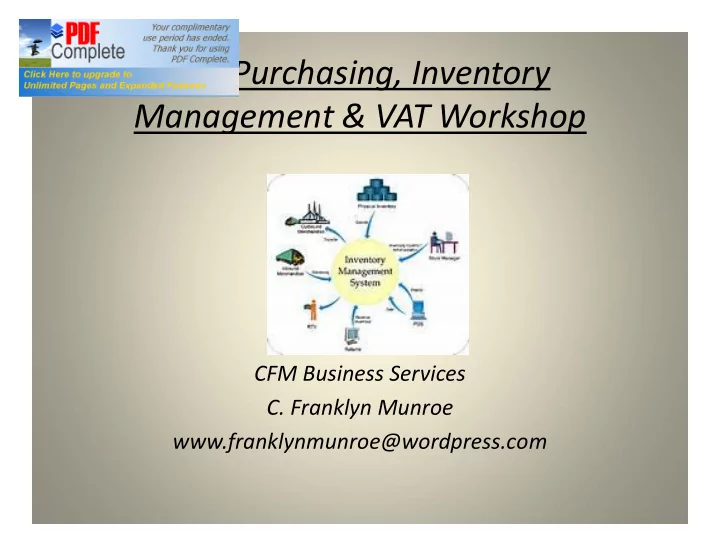
SLIDE 1 The Purchasing, Inventory Management & VAT Workshop
CFM Business Services
www.franklynmunroe@wordpress.com
SLIDE 2
The Purchasing, Inventory Management & VAT Workshop
DELIVERABLES Inventory Management & Control Techniques Fundamentals of Purchasing Managing and Improving Warehouse Operations VAT impact on Purchasing & Inventory Cost
SLIDE 3
The Purchasing, Inventory Management & VAT Workshop
Effective Inventory Management ? Effective Inventory Management enables a company to meet or exceed customer expectations of product availability with the amount of each item that will maximize net profits or minimize your inventory investment.
SLIDE 4
The Purchasing, Inventory Management & VAT Workshop
Inventory Management & Control Techniques Reduce Inventory without reducing service Forecasting Inventory Needs Understanding Inventory Costs Attain higher level of inventory accuracy Classification of inventory items Establish Key Performance Indicators (KPIs) to appraise inventory performance
SLIDE 5
The Purchasing, Inventory Management & VAT Workshop
Inventory Management & Control Techniques Determine what needs to be stored in each store, Branch or warehouse Liquidating unwanted material Analyzing and improving the accuracy of your forecasts of future demand of products Maintaining reserve or safety stock quantities that will ensure you meet or exceed customer expectations of product availability at lowest possible cost
SLIDE 6 The Purchasing, Inventory Management & VAT Workshop
Inventory Management & Control Techniques Stocking – Merchandise you intend to stock Stuff – Everything else Categorize items in warehouse:
- List of high value items
- List of slow moving items
- List of complimentary items
SLIDE 7 The Purchasing, Inventory Management & VAT Workshop
Categories of Inventory Good (A) – Stock provides acceptable return
Bad (B) – Contributes to other profitable sales; No acceptable return Ugly (C) – Does not provide acceptable return and does not contribute to other profitable sales
SLIDE 8 The Purchasing, Inventory Management & VAT Workshop
Inventory Carrying Costs Costs of putting away stock receipts and moving material Insurance & other charges on inventory Rent & utilities for portion of your facility used to store materials Physical inventory & cycle counting – No Buy, no count Shrinkage & Obsolescence – Dead , slow moving,
Opportunity Cost of the money invested in inventory (Interest expense or interest earned in safe investment)
SLIDE 9 The Purchasing, Inventory Management & VAT Workshop
Inventory Profitability – Key Performance Indicator (KPI)
- Gross Margin = Sales – Cost of Goods Sold
Sales
- Adjusted Margin = Annual Profit – (Avg. Inventory x Carrying cost %)
Annual Sales
- Inventory Turnover = Sales
- Avg. Inventory Value
- Other Indicators – www.r3now.com/about/scor-key-performance-indicators/
- Forecast accuracy
- Inventory Carrying Costs
- Shrinkage
- Distribution costs
SLIDE 10 The Purchasing, Inventory Management & VAT Workshop
Inventory Profitability – Key Performance Indicator (KPI)
- Gross Margin is not a good indication of profitability
because gross margin dollars do not vary as amount of inventory increases.
- Carrying cost such as insurance, rent & Utilities, inventory
shrinkage & obsolescence etc. affects product profitability
- Look at adjusted margin for a specific customer. Total sales
and profitability for the customer and avg. inventory for inventory maintained for each customer.
SLIDE 11 The Purchasing, Inventory Management & VAT Workshop
Liquidating Stuff and Excess Inventory
- Create report in descending order based on value of what is eligible to be liquidated
- Inventory is sunk expense; only worth what someone will pay
- Don’t get emotional
- Transfer to another location where needed
- Reduce price
- Provide sales person incentive to sell
- Advertise – place on internet, List with excess supply companies
- Substitute Products
- Return Material to vendor
- Donate material to non-profit organizations
- Throw it away
SLIDE 12 The Purchasing, Inventory Management & VAT Workshop
Maintenance of Inventory Records
- Stocktaking days – inefficient
- Implement Cycle Counting – updated on a periodic basis
- Cycle counting used with ABC analysis to determine cycle
- Elimination of shutdowns and interruption
- Elimination of annual Inventory adjustment
- Trained personnel and inventory accuracy
- Errors identified and corrected more timely
SLIDE 13 The Purchasing, Inventory Management & VAT Workshop
Level of Inventory Accuracy
- Accurate records are a critical ingredient in
production and inventory system
- Allows organization to focus on what is needed
- Necessary to make precise decisions about
- rdering, scheduling and shipping
- Incoming and outgoing record keeping must be
accurate
- Stockrooms should be secure
SLIDE 14 The Purchasing, Inventory Management & VAT Workshop
Evaluate & Maintain Safety Stock
Safety stock is reserved Inventory maintained to protect customer service in case of unused demand or delays in receiving stock receipt during the time it takes to replenish inventory. Safety Stock Items
- Products with erratic usage
- Products with erratic lead times
- High profit items
- Stock required for a specific customer
- Painful Backorders
SLIDE 15 The Purchasing, Inventory Management & VAT Workshop
Inventory Forecasting
A Demand forecast is a prediction of the quantity of a product that will be sold, transfer, or used during a time period. Demand Forecast based on five (5) elements: 1. Past Usage of product – Increases, decreases and seasonality 2. External Trends – economic or environmental factors 3. Events – promotions, holidays etc 4. Collaborative information from customers / sales persons 5. Appropriate forecast horizon or time period Better your forecast, the less you need to stock to maintain your desired level
SLIDE 16 The Purchasing, Inventory Management & VAT Workshop
Inventory Forecasting – Common Problems
- The if its on paper , it must be true syndrome
- Most systems base demand solely on some average of
past usage
- Usually one formula is used to calculate demand for all
products
- Usually no verification to see if quantity forecast for a
certain month was actually sold or shipped in that month
- No system for reliably obtaining future prediction of
customer demand
SLIDE 17 The Purchasing, Inventory Management & VAT Workshop
Inventory Forecasting – Stock Questionnaire
- Who will buy product or product line
- Estimates of usage for six (6) months
- Anticipated Gross Margin for sales
- Usage of product have on existing stock
- How many month’s supply. What inventory necessary
- Where will inventory be stored
- How can unsold stock be liquidated. Can items be returned
SLIDE 18 The Purchasing, Inventory Management & VAT Workshop
New Stock – Sales & Marketing Focus
Provide salesperson with weekly report of sale of new products:
- Items/description
- Sales & gross margin projection
- Actual sales and gross profits
- Available quantity
- Value of quantity
- Budget for new items
- Person requesting item to be stocked
SLIDE 19
The Purchasing, Inventory Management & VAT Workshop
Fundamentals of Purchasing How to become savvy negotiator Legalities of purchasing decision Keep information accessible and up to date Basic principles of successful purchasing Choose suppliers with lowest overall cost for best value
SLIDE 20
The Purchasing, Inventory Management & VAT Workshop
What is Procurement / Purchasing ? Procurement is the acquisition of goods, services or works from an external source. It is favorable that the goods, services or works are appropriate and that they are procured at the best possible cost to meet the needs of the purchaser in terms of quality, quantity, time and location.
SLIDE 21
The Purchasing, Inventory Management & VAT Workshop
Fundamentals of Purchasing Buying material at right QUALITY In the right QUANTITY From the right SOURCE At the right PRICE Delivered at the right PLACE At the right TIME With the right mode of TRANSPORT
SLIDE 22 The Purchasing, Inventory Management & VAT Workshop
Lowest Cost, Best value Choice
There are four (4) elements of purchase cost:
- Quality – rejection %, shelf life, reliability
- Service – Response Time, technical ability
- Delivery – Transport, storage, stocking, on time %
- Price – Payment terms, discounts, bulk purchases
Total costs of ownership is the sum of cost elements in Quality, Service, Delivery & Price
SLIDE 23 The Purchasing, Inventory Management & VAT Workshop
Legality in Purchasing Decisions
- The procurement department should have polices and procedures, which
would include legal rights in purchasing.
- All purchase contracts / agreements should be pre-approved by
compliance and/or legal department
- Terms of contract – quantity, quality, price, credit terms, delivery terms
etc.
- Know legal impact of Information age – electronic contracts and signatures
SLIDE 24 The Purchasing, Inventory Management & VAT Workshop
Legality in Purchasing Decisions
Purchasing Officer should know the key elements of Purchasing contracts:
- Offer and acceptance
- Consideration
- Intention to create legal relation
Purchasing Officer represents the principal in development and negotiation
- f contract with third parties:
- Expressed Authority
- Implied Authority
- Emergency Authority
SLIDE 25 The Purchasing, Inventory Management & VAT Workshop
Purchasing Records Management
There are two systems of recording purchases:
- 1. Periodic Inventory System – Easy to implement ; less robust
- 2. Perpetual Inventory System – Real Time tracking
Periodic Inventory system only updates during closing process . There is no adjustment to inventory concurrent with actual purchases and sales transactions. No real time data on levels of inventory or gross profit.
SLIDE 26
The Purchasing, Inventory Management & VAT Workshop
Purchasing Records Management
Perpetual Inventory System allows for the purchases and sales transactions to update inventory and costs of sales data into the accounting system on a real time basis. The Inventory account and cost of goods sold are adjusted on a real time basis. Bar code scanners facilitate speedy transactions linked to Accounting Information System. The Perpetual system uses computer systems to implement the Perpetual Inventory Management system.
SLIDE 27
The Purchasing, Inventory Management & VAT Workshop
Purchasing Records Management
Scan Invoices , Credit, debit memos into and supporting detail directly into the accounting system. Use computer systems to access Inventory or purchasing information as opposed to utilizing paper files Routinely compare Purchase orders with actual invoices received
SLIDE 28
The Purchasing, Inventory Management & VAT Workshop
Fundamentals of Negotiation Step 1: Know what you want Step 2: Know what they want Step 3: Propose action in a way they accept Tools of Savvy Negotiator: Plan for negotiation Conduct negotiation Concessions Win/Win negotiations
SLIDE 29
The Purchasing, Inventory Management & VAT Workshop
Plan for Negotiation
Identify Participants Develop Objectives Analyze strengths & weaknesses Gather information Recognize other party’s needs Identify facts and issues Establish positions Develop strategies & tactics Brief Personnel Practice the negotiation
SLIDE 30
The Purchasing, Inventory Management & VAT Workshop
Conduct Negotiation
Perform fact finding Recess or caucus as necessary Work to narrow differences Manage time pressure Maintain informal atmosphere Summarize results periodically Employ tactics Keep relationships positive
SLIDE 31
The Purchasing, Inventory Management & VAT Workshop
Provide Concessions
Give & Take process Concede on minor issues earlier. Make it seem valuable Occasionally say “No” Make them work for every concession Make enough room for concessions
SLIDE 32
The Purchasing, Inventory Management & VAT Workshop
WIN / Win Negotiations
International – Added complexity Culture Shock Be aware of Barriers and obstacles Assess need for Translator
SLIDE 33
The Purchasing, Inventory Management & VAT Workshop
Managing & Improving Warehouse Operations Improve Equipment Selection Assess and improve warehouse layouts Improve procedures for put away, packing, loading, picking and receiving
SLIDE 34
The Purchasing, Inventory Management & VAT Workshop
Managing & Improving Warehouse Operations Barcodes, Scanners, Radio Frequency Identification (RFID) systems, Automatic ID and wireless Lans are all part of warehouse and inventory management systems that focus on monitoring flow of products and enhancing accuracy and efficiency.
SLIDE 35 The Purchasing, Inventory Management & VAT Workshop
Improving Warehouse performance & Inventory Control Ten (10) Tips: 1. Start with good upkeep / organization – Inspect your operation regularly and review warehouse organization. Daily checklist for the manager to hold accountable 2. Know your inventory classification – high, medium, low. Keep high volume closer to shipping area. Easily accessible. Reduce labor costs 3. Utilize Cycle Counts
- perform regular cycle counts rather than annual physical Inv. count
- Analyze discrepancies to perfect time taken
- Monthly or quarterly cycle counts by inventory type
SLIDE 36 The Purchasing, Inventory Management & VAT Workshop
Improving Warehouse performance & Inventory Control, Cont 4. Minimize unauthorized traffic
- Eliminate risk of unauthorized people around our valuable inventory
- Give personnel special access
5. Make room for receiving
- Provide sufficient room for receiving goods
- Receiving errors can result in issues in selling cycle, losing money, time ,
credibility
- 6. Label Everything
- Labels on everything to make easier for pickers to choose right inventory
SLIDE 37 The Purchasing, Inventory Management & VAT Workshop
Improving Warehouse performance & Inventory Control, Cont
- 7. Quality Control
- Avoid mistakes by double checking your orders
- Get a veteran to check; save your business money
- 8. Priority Picking
- Color code orders for your most valuable customers or pick list
- 9. Finish Right, Start Tight
- Finish order processing; clean up before clock out
- Warehouse will be organized for next day
10. Don’t let your warehouse become a maze
- Neatly categorize and labeled
SLIDE 38 The Purchasing, Inventory Management & VAT Workshop
Improve Equipment selection Two issues of Equipment Selection:
- 1. Identify equipment alternatives that are reasonable
for a given storage / Retrieval requirement – Piece, Case or Pallet picking
- 2. Select reasonable alternatives; Develop method for
characterizing requirements by assessing warehouse layout.
SLIDE 39 The Purchasing, Inventory Management & VAT Workshop
Improve Equipment selection
- Automate picking, sorting and retrieval equipment as necessary
- Piece Picking – small quantities. Short cycle times
- Batch Picking – Multiple orders. Grouped into small
batches
- Zone Picking – Assign zones. Pick items within zones
- Wave Picking – quickest method. Pick in zone, batch and sort
- Engage a professional consultant in the equipment selection
process.
- Attend seminars and tradeshows
SLIDE 40
The Purchasing, Inventory Management & VAT Workshop
Impact of Value Added Tax (VAT) Impact on Hawksbill Creek Agreement Impact on Inventory Costs Sample VAT Transaction Standard VAT Invoices Sample VAT accounting procedure
SLIDE 41 The Purchasing, Inventory Management & VAT Workshop
VAT impact on Hawksbill Creek Agreement ?
Hawksbill Creek Agreement residents or licences in port area are free from personal income taxes, corporate profit tax, capital gain, death or property taxes until August 2015.
- “Bonded Sales” – Sales between Grand Bahama Port Authority
(“GBPA”) licensees would be VAT Exempt. These are already exempt from customs duty and will be Zero Rated for VAT purposes. VAT will not be levied on their exports, but they would claim credits for taxes paid on their inputs. However Goods brought in duty free by GBPA licensees, which are subsequently sold to individuals or households currently attract customs duties on a post paid basis. These sales will attract the 15% VAT.
SLIDE 42 The Purchasing, Inventory Management & VAT Workshop
VAT impact on Hawksbill Creek Agreement ?
GBPA would distinguish between what they sell to licensees and non-licensees Government currently in discussions with GBPA to deal with VAT under Hawksbill Creek Agreement GBPA has been operating a sales / consumption tax for
- decades. Lower costs results in increased inventory,
boosting local expenditures by business and individual. Increased local sales: expansion of business and staff
SLIDE 43
The Purchasing, Inventory Management & VAT Workshop
Impact of VAT on Inventory Cost
Value Added Tax (VAT) has a direct impact on Inventory Costs. The more inventory purchased impacts company’s cash flow VAT cost carried as a receivable until goods are sold to customer. VAT does not impact Company’s Cost of Goods sold. It is a pass through tax , ultimately borne by the consumer. Develop procedures to deal with VAT for loss, theft or damage to inventory Segregate Inventory for those items already in existence prior to VAT implementation
SLIDE 44 The Purchasing, Inventory Management & VAT Workshop
Impact of VAT on Company’s Operations
- All VAT Receipts are accounts payable (“Output VAT”),
while VAT payments are accounts receivable (“Input VAT”)
- At the end of the month, ledger balance should
indicate the position, whether to refund or carry the balance forward. Where the balance is on credit (Payable),it means payment should be paid to the VAT authority, with necessary VAT remittance forms. Even with a debit balance (Receivable), there must be return to the VAT authority.
SLIDE 45 The Purchasing, Inventory Management & VAT Workshop
Value Added Tax (VAT) Invoice Specifics
- The date the invoice was issued
- A sequential number uniquely identifying the invoice
- The supplier Vat ID number
- The recipient VAT ID
- Full name and address of the vendor and recipient
company
- Full description of goods or services and quantity
- Dates goods or services received or date payment received
- The VAT rate
- The VAT amount payable
SLIDE 46 The Purchasing, Inventory Management & VAT Workshop
Example of VAT on Inventory operation
- Business buys a bed for $100 + VAT 15% = $115
($15 = Input Tax) – Accounts Receivable
- Business sells a bed for $200 + VAT 15% = $230
($30 = Output Tax) - Accounts Payable
- Business Remits the $15 to the VAT Authority
(Output tax less input tax)
SLIDE 47 The Purchasing, Inventory Management & VAT Workshop
Value Added Tax (VAT) Accounts Set-up
- Create VAT G/L account – Making or Receiving VAT Payments
- Under “Taxes Payable”, open up subsidiary “VAT Payable ”
- Under “VAT Payable”, open up the following subsidiary accounts:
1. “Input Tax” 2. “Taxes Paid” 3. “Output Tax” 4. “Tax Refund on Export” 5. “Input Tax – Transfer Out”
SLIDE 48 The Purchasing, Inventory Management & VAT Workshop
Value Added Tax (VAT) Account Definitions
- “Input Tax” – Records the VAT that has been paid for
purchasing goods or services that can be credited against “Output Tax”.
- “Taxes Paid” – Records amount of VAT already paid
- “Output Tax ” – Records the VAT that shall be or is collected
for selling goods or providing services.
SLIDE 49 The Purchasing, Inventory Management & VAT Workshop
Value Added Tax (VAT) Account Definitions
- “Tax refund on Export” – Records the amount refunded for
exported goods which the zero tax rate is applicable, after going through export declaration procedures with customs, have applied for tax refund by presenting export declaration
- “Input Tax transfer out” – Records the amount of input tax
which shall not be credited with the output tax because of abnormal loss of goods purchased, goods in process and finish goods
SLIDE 50 The Purchasing, Inventory Management & VAT Workshop Conclusion
CFM Business Services
www.franklynmunroe.wordpress.com