
SLIDE 1
- !"
#$
- !"% !!&'!"% !(&%)
#* '+%)$ ,*- . !! . !(
- /$*012,
3#$ $
- 1
- 2
- 3
- 4
- 5
1 2 3 4 5
4)% '454)% 64 $/)% '7' $/)% 67) 4)% 64&4%)4&)&88%)&%9%):
The Procedural Approach (PA) lecture slides - - PDF document
The Procedural Approach (PA) lecture slides
#$
#* '+%)$ ,*- . !! . !(
3#$ $
1 2 3 4 5
4)% '454)% 64 $/)% '7' $/)% 67) 4)% 64&4%)4&)&88%)&%9%):
2;$/$< 7<<+=; 7%<<5= $>;4=4&= *$*;*
4<4& <<= %<<5=
;$///? 8/> <8) $<4<% )454<@)4
388*$/ $;8*<8// $/
#<8 <8' /<844%A@!4%4')B)%644
44%)4%4)=44 &4)% )=4 &4%'(4 &'( <8) <8
44%A@!4%4')B)%644&
<8)% 38*<8 4<% '454<@)4 $*$<7* 3*$7* .*<&! 4!% '454!@)4 65A
#$<&%C- 4%C%'454%C@)4 4%6454%'4 65'
<8)% **$;8$$< 7*4<% '454<@)4D$* 3**$ # $; $<% '&=;$'? $<@)&=;$%) E/9% *;%):;F%);'G9';@*: /;;;8<% ' <% '+=<+';//9%*;%):F%);'G 2;<@)/ <@)+=<+%);/*/9%*;%): = ' %) <
< < < <% % % % ' ' ' ' <@) <@) <@) <@)
= ' %) <
< < < <% % % % ' ' ' ' <@) <@) <@) <@)
E2 E22 E222
3/ E2 <5%) E22 %) < ' E222 <+' 7*4<% '454<@)4$ %9<% ':5%9<@): %9<% ':5@9<@): @9<% ':5@9<@): 38*7 %<@'5%<% ) %<@'5<@) <% '5<@) 3> E2 <5%)'5%) E22 %) < '%'5)< E222 <+'%'5) E2;D E227/%'H)5< ' E2227/<+' ;;7*4<% '454<@)47/<+%'H)
1 2 3 4 5
%'H)
< 'E 44'"%)64% 4A%!"44 2<)% ";//7*
#!$ %&'" ($$ )!$ % &'* &&+&'* &,+* (-%.*)#" /-!0 1$%&& 1$%&, !#!!! $2$ )$-345/ " 6$$( ) ) "
1 2 3 4 5
7* 787* 97 )$2$ * :$"
)$2$ * 9:$"
)$2$ ) )$2$ ) )$2$ ) )$2$ ) ) > ; !2$2$$)$2$ )! ) " !!!? >;$?
7@77*@7
) !:$@" 6-)$2$ @:$$ ? )$2$ *@:$;; $ %*<*@= !$$-?
7*<*@=77* @7
5$?)$2$ )>:$> >.? *> >8" )A?!77+"
> >;2 7>7+ *> >2 ?)$2$ )22B ;2A"
>;$" $$)>7>* 787>D7 6;;$- $$)$2$ )? ;$ ->;!$2$2)$2$" (>;$" >;$" $$2$ >;77*@D&7*7E*977 77*7*777 +7* 7 +7*,7 +,
$ >;$ >;
77*@D&7*7E*977+
>;$*
6!;$ ->;7>* 787>D7
6-) !:$-" 1->+& >+& >+& >+& 7&* 787&D7 98@ " :$-7>* 787>D7$ >+&" (!)>+ >+ >+ >+* * * *C C C C 7*C*787*CD7 7*9787*7 98 $" :$-$ >+*C"
>;$*
$--)?;)$ $$)> !:$-7>* 787>D7F)-" 6-!- $$) "
G? " H!2 $" 7>* 7 + >I >I *<>* = >I 8
7>D7+ >D >D *<>D= >D8
)$2$:$-H ">*>D >I 8>D ">*>D8>I 8*<>D= C">*8>D I<>I =8>D 9">*8>D8I<>I =8*<>D= ">> *I 8 ">>8*>I 8*>* C">8> *I>D8>D 9">8>8*I>D8*>* 6;$ -% "> "?! C">8> *I8> 9"?!?!$$ ;$ - ?!%
"> C">8> *I8>
KC C C C:2$*>8*8> 6;$ *8>8
6$:$- 7>* 787>D7<E= :2$>.*" 6;$$$- " ? !G#-;$#?$) ";$#$!-;)$" $)-;$)$$ *)#$:$-" G#>+*9 7*9* 7+&97*9D7+@9 <E=)&98@9 ? ;)-$" G#>+* 7** 7+7*D7+ <E=)8 $? ;)-$"
;)$- >;$!$ ;$# 2)"
!"#$%
()
*+ ,*+-, .*+-.
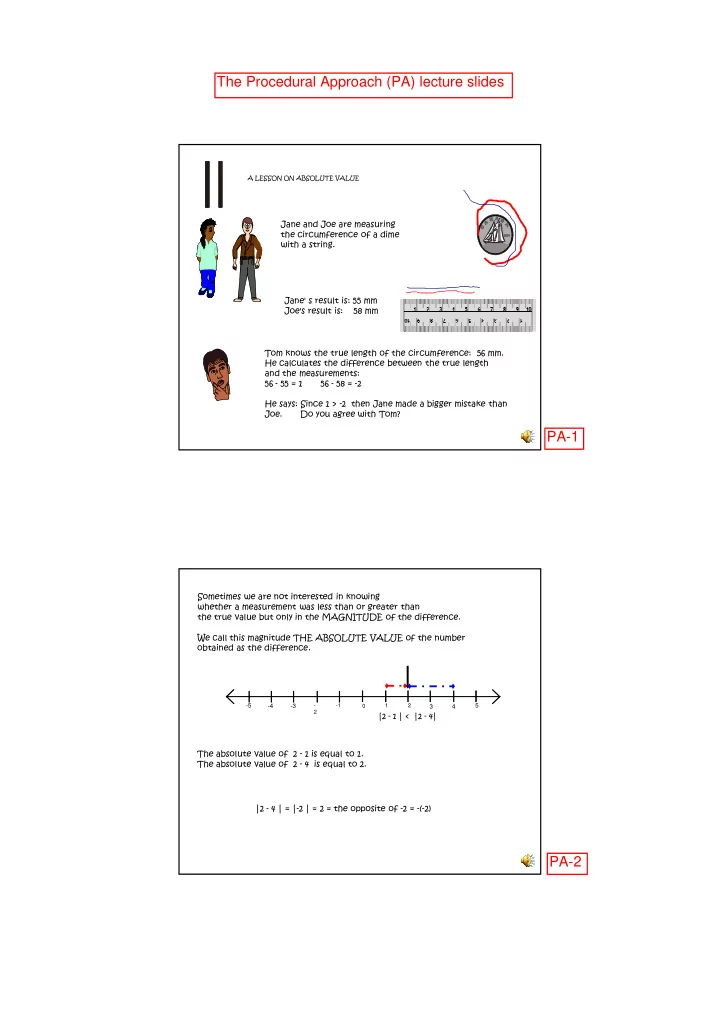
Jane and Joe are measuring the circumference of a dime with a string.
A LESSON ON ABSOLUTE VALUE
Tom knows the true length of the circumference: 56 mm. He calculates the difference between the true length and the measurements: 56 - 55 = 1 56 - 58 = -2 He says: Since 1 > -2 then Jane made a bigger mistake than Joe. Jane' s result is: 55 mm Joe's result is: 58 mm
Sometimes we are not interested in knowing whether a measurement was less than or greater than the true value but only in the MAGNITUDE of the difference. We call this magnitude THE ABSOLUTE VALUE of the number obtained as the difference.
1 2 3 4 5
|2 - 1 | < |2 - 4| The absolute value of the difference 2 - 1 is equal to 1. |2 - 4 | = |-2 | = 2 2 = the opposite of -2 = -(-2) The absolute value of the difference 2 - 4 is equal to 2. |2 - 1 | = | 1 | = 1
In general, we define the absolute value of a number x as equal to x for positive numbers x, and equal to the opposite of x for negative numbers x. As for the number zero, we decide that |0| = 0. The absolute value of a number is thus never negative. We can think of the absolute value of a number as a function, defined as follows:
|x| =
x if x is positive or 0
if x is negative
Here is a visual representation of this definition, using the number line:
1 2 3 4 5 |3|=3 |-2| = -(-2) = 2
The absolute value of a positive number is equal to itself. The absolute value of a negative number is equal to its opposite. Graphing absolute value functions
// / / /)/ 0/ /
+
Exercise: Find all values of x for which |x - 1| < |x + 2|
/ / /)/ + ,.+ 1%-2
Suppose it is not so easy to see from the graph for what values of x the values of one function are less than the values of the other one. What does one do in such cases? We can use reasoning and algebra. Let's look again at the inequality | x - 1 | < |x + 2|. (a) |x - 1 | = x - 1 for x - 1 ≥ 0 (b) |x - 1| = -(x - 1) for x - 1 < 0 (c) |x + 2| = x + 2 for x + 2 ≥ 0 (d) |x + 2| = -(x + 2) for x + 2 < 0 So we have 4 cases to consider:
Solving the inequality | x - 1 | < |x + 2|, continued
1 2 3 4 5
||16-24| - |7-56|| In each of the exercises below, find the values of the number x for which the given inequality is true