The Probabilistic Method Week 8: Second Moment Method Joshua Brody - - PowerPoint PPT Presentation

the probabilistic method
SMART_READER_LITE
LIVE PREVIEW

The Probabilistic Method Week 8: Second Moment Method Joshua Brody - - PowerPoint PPT Presentation

The Probabilistic Method Week 8: Second Moment Method Joshua Brody CS49/Math59 Fall 2015 Reading Quiz What is a graph property? (A) a set of graphs (B) a set of graphs closed under addition of edges (C) a set of graphs closed under


slide-1
SLIDE 1

The Probabilistic Method

Joshua Brody CS49/Math59 Fall 2015
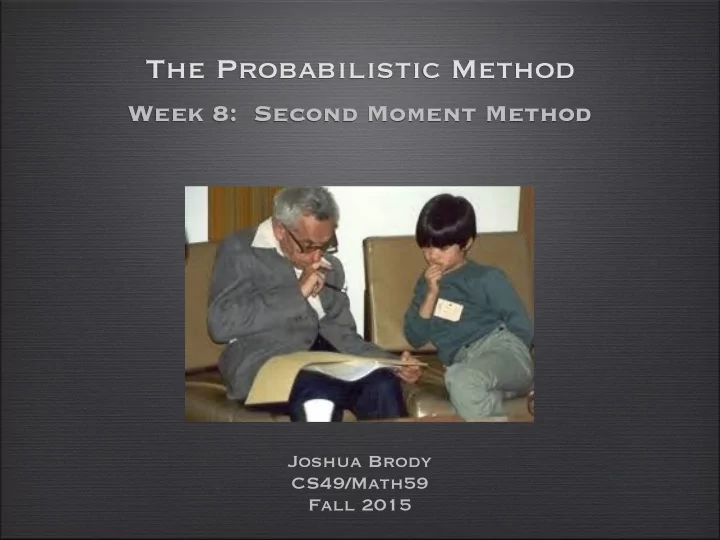
Week 8: Second Moment Method

slide-2
SLIDE 2

Reading Quiz

(A) a set of graphs (B) a set of graphs closed under addition of edges (C) a set of graphs closed under addition of vertices (D) a set of graphs closed under isomorphism (E) None of the above

What is a graph property?

slide-3
SLIDE 3

Reading Quiz

(A) a set of graphs (B) a set of graphs closed under addition of edges (C) a set of graphs closed under addition of vertices (D) a set of graphs closed under isomorphism (E) None of the above

What is a graph property?

slide-4
SLIDE 4

The First Moment Method

(1) Define bad events BADi (2) BAD := ∪i BADi (3) bound Pr[BADi] ≤ 휹 (4) Compute # bad events ≤ m (5) union bound: Pr[BAD] ≤ m휹 < 1 (6) ∴ Pr[GOOD] > 0 (1) Zi: indicator var for BADi (2) Z := ∑i Zi (3) E[Zi] = Pr[BADi] ≤ 휹 (4) Compute # bad events ≤ m (5) E[Z] = E[Zi] ≤ m휹 < 1 (6) ∴ Z = 0 w/prob > 0

Basic Method: as First Moment Method:

slide-5
SLIDE 5

Exploiting Expected Value

Suppose X is non-negative, integer random variable Fact: Pr[X > 0] ≤ E[X]

slide-6
SLIDE 6

Exploiting Expected Value

Suppose X is non-negative, integer random variable Fact: Pr[X > 0] ≤ E[X]

  • If E[X] < 1, then Pr[X=0] > 0
  • If E[X] = o(1), then Pr[X=0] = 1-o(1)
  • If E[X] →∞, then ???

Consequences:

slide-7
SLIDE 7

More on The Second Moment Method

Theorem: Pr[X = 0] ≤ Var[X]/E[X]2

  • use Chebyshev’s Inequality with α := E[X]

proof:

slide-8
SLIDE 8

More on The Second Moment Method

Theorem: Pr[X = 0] ≤ Var[X]/E[X]2

  • If Var[X] = o(E[X]2), then Pr[X=0] = o(1)

Consequences:

  • use Chebyshev’s Inequality with α := E[X]

proof:

slide-9
SLIDE 9

More on The Second Moment Method

Theorem: Pr[X = 0] ≤ Var[X]/E[X]2

  • If Var[X] = o(E[X]2), then Pr[X=0] = o(1)

Consequences:

  • use Chebyshev’s Inequality with α := E[X]

proof: X > 0 “almost always”

slide-10
SLIDE 10

More on The Second Moment Method

Theorem: Pr[X = 0] ≤ Var[X]/E[X]2

  • If Var[X] = o(E[X]2), then Pr[X=0] = o(1)
  • If Var[X] = o(E[X]2), then X ~ E[X] almost always.

Consequences:

  • use Chebyshev’s Inequality with α := E[X]

proof: X > 0 “almost always”

slide-11
SLIDE 11

Random Graphs

G ~ G(n,p) : random graph on n vertices V = {1, ..., n} each edge (i,j) ∈ E independently with prob. p

[Erdős-Rényi 60]

G(n,p) : probability distribution G : random variable

slide-12
SLIDE 12

Clicker Question

(A) S, T share at least one vertex (B) S, T share at least one edge (C) S, T share at least two vertices (D) (A) and (B) (E) (B) and (C)

When are AS and AT not independent?

slide-13
SLIDE 13

Clicker Question

(A) S, T share at least one vertex (B) S, T share at least one edge (C) S, T share at least two vertices (D) (A) and (B) (E) (B) and (C)

When are AS and AT not independent?

slide-14
SLIDE 14

The Probabilistic Method