The Post-2015 UN Development Agenda: ESCWAs Contribution to Global - - PowerPoint PPT Presentation

the post 2015 un development agenda
SMART_READER_LITE
LIVE PREVIEW

The Post-2015 UN Development Agenda: ESCWAs Contribution to Global - - PowerPoint PPT Presentation

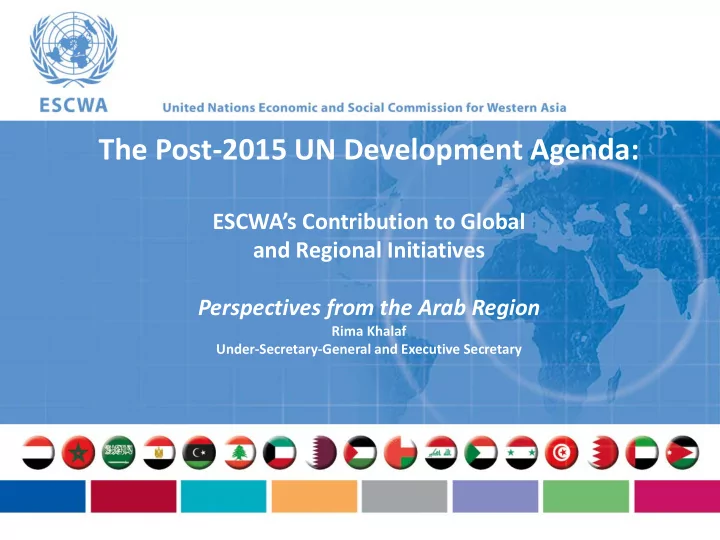
The Post-2015 UN Development Agenda: ESCWAs Contribution to Global and Regional Initiatives Perspectives from the Arab Region Rima Khalaf Under-Secretary-General and Executive Secretary ESCWAs Role in the Post-2015 Process Global level:

slide-1
SLIDE 1

The Post-2015 UN Development Agenda:

ESCWA’s Contribution to Global and Regional Initiatives Perspectives from the Arab Region

Rima Khalaf Under-Secretary-General and Executive Secretary

slide-2
SLIDE 2

2

ESCWA’s Role in the Post-2015 Process

  • UNTT Report to SG: “Realizing the Future We Want for All”
  • HLP Report to the SG: “A New Global Partnership”

Global level: ESCWA provided inputs to the

  • Joint RCs Report: “A Regional Perspective on the Post-

2015 United Nations Development Agenda” Inter-regional level: ESCWA reflected the Arab regional perspective in the

  • 17th and 18th meetings of the Regional Coordination

Mechanism (RCM) for Arab States

  • Regional consultative meeting with Arab CSOs
  • Rio+20 Arab Regional Implementation Meeting

Arab Regional Level: ESCWA led regional consultations during the

slide-3
SLIDE 3

3

UNTT Report Key Messages

  • Proposes a future vision based on the core

values of human rights, equality and sustainability.

  • Suggests the format to be based on goals and

targets (like the MDGs) that are reorganized along four central pillars:

Inclusive economic development Inclusive social development Environmental sustainability Peace and security

slide-4
SLIDE 4

4

HLP Report Key Messages

  • Five key messages:
  • 12 global goals, as well as several (national) targets within

those goals:

1 Leave no one behind 2 Put sustainable development at the core 3

Transform economies for jobs & inclusive growth

4

Build peace & effective, open & accountable institutions for all

5 Forge a new global partnership

  • 1. End poverty
  • 2. Empower girls

and women and achieve gender equality

  • 3. Provide quality

education and lifelong learning

  • 4. Ensure healthy

lives

  • 5. Ensure food

security and good nutrition

  • 6. Achieve

universal access to water and sanitation

  • 7. Secure

sustainable energy

  • 8. Create jobs,

sustainable livelihoods, and equitable growth

  • 9. Manage natural

resource assets sustainably

  • 10. Ensure good

governance and effective institutions

  • 11. Ensure stable

and peaceful societies

  • 12. Create a global

enabling environment and catalyze long-term finance

slide-5
SLIDE 5

5

The Joint RCs Report: A Regional Perspective

  • Highlights the need to adapt global goals to

regional and national ones

  • Assesses progress achieved in MDGs
  • Identifies key messages to inform global

debate

  • Calls for a nuanced approach that addresses

regional specificities within the global development agenda.

slide-6
SLIDE 6

6

The Joint RCs Report: Priorities for the Arab Region

Economic sustainability

Inclusive growth and diversification Adequate mapping and reduction of poverty Employment, especially youth and women Trade, investment and technology Regional cooperation and integration

Social sustainability

Education Health Gender equality and women’s empowerment Social protection Social justice

Environmental sustainability

Climate change Water and food security Desertification Urbanization

Governance & institutions

Democracy and the rule of law Effective institutions Rights and freedoms Conflict resolution and self- determination Global and regional governance

Source: ESCWA et al, A Regional Perspective On The Post-2015 United Nations Development Agenda, under publishing, Table 11, page 58

slide-7
SLIDE 7

7

The Joint RCs Report: Global messages

Placing employment generation at the centre of the post-2015 agenda More effective approaches to tackle inequality A more comprehensive approach to environmental sustainability The effective incorporation of democratic governance into the post- 2015 debate

slide-8
SLIDE 8

8

RCM Meetings: Key Messages

  • Emphasized the centrality of issues of dignity,

justice, equality and good governance.

  • Called on ESCWA to coordinate with LAS to

ensure coherence between different initiatives on the Post-2015

slide-9
SLIDE 9

9

CSO Declaration: Key Messages

  • Based on the main principles of the Millennium Declaration, provides qualitative

analysis, and strengthened means of implementation

  • Citizen-centered development paradigm that respects political, social, cultural,

environmental and economic rights; end all forms of exclusion; and ensures equity and social justice

  • A social contract that promotes participation and fair redistribution of wealth; generates

decent jobs and provides all the necessary public services with good quality Conceptual framework for a post 2015 Agenda

  • To address national priorities, protection of basic rights and inequalities, and provide

structural flexibility at the national level

  • Capture national, regional and international linkages and capitalize on them
  • Promote and enhance efforts leading to increased regional cooperation and

coordination

  • Be grounded in the intergovernmental processes and mechanisms of monitoring and

accountability of the existing international human rights instruments Framework's structure

  • Acknowledged the need to build a participatory platform for the regional

development agenda, in light of increased demands by citizens for social justice and greater participation

slide-10
SLIDE 10

10

Political

End occupation and right to self- determination Freedom and rights of individuals and nations Promote participatory frameworks of governance Clarify and uphold rights of refugees and displaced people

Social

Focus on equity, distribution and social justice Maintain social cohesion in transition countries Address knowledge deficits to empower citizens Address gender inequality

Economic

Fair and participatory global economic governance Right of policy space for developing countries Ensure sources of finance for development Address the specific needs and conditions of LDCs

Environmental

Comprehensive approach to development Tackling interlinked global challenges

CSO Declaration: Key Messages

slide-11
SLIDE 11

11

Arab RIM: Key Messages

  • The RIM outcome document :

– Reaffirms the Arab region's commitment to sustainable development – Highlights key regional messages to convey to the international community – Outlines the Arab regional priorities for implementation of SD

  • Strong global institutional framework for SD is needed
  • SDGs must take into account the Rio principles, especially the principle
  • f common but differentiated responsibilities, with the provision of

the means of implementation needed to achieve them

  • Target a balanced set of SDGs that address key regional challenges

such as peace and security and the sectors of food, energy, water and drought/desertification

  • Application of the green economy concept in line with national priorities
  • Committing to the Sustainable Development Initiative in the Arab Region
  • Acknowledgement of the effective role of ESCWA and its regional

partners and call for continued efforts in this regard Key messages of the outcome document:

slide-12
SLIDE 12

12

MDGs Approach Shortcomings

  • Not adequately incorporating important concepts contained

in the Millennium Declaration

  • Inadequate consultation with the representatives of

developing countries.

  • Insufficient attention to the importance of different initial

levels of human development across countries and regions

  • Insufficient priority accorded to the “enablers of

development”.

Focus on the outcomes of development, as opposed to the means to achieve those outcomes!

slide-13
SLIDE 13

13

MDGs Framework Shortcomings

  • Lack of clarity “on how to tailor global targets to national

realities and regional dynamics”

  • Insufficient attention to the conditions of vulnerable groups
  • Does not address the qualitative dimensions of service

provision, such as health and education

  • Implementation problems: including disregard to national

specific conditions.

  • Weaknesses in achieving an effective global partnership for

development.

These shortcomings raise important questions about how to frame a post-2015 development agenda!

slide-14
SLIDE 14

14

Introducing a regional dimension

  • A revised approach to align global development goals and

targets with regional and national development challenges , trends and priorities

  • Place responsibility on both developed and developing

countries for the attainment of human development at the global level

  • A strong regional dimension to keep pace with changing

regional socioeconomic and political dynamics: Region- specific developmental challenges require, to some degree, regional solutions

  • A continuous ‘bottom-up’ approach through regional

conduits: Sensitize and transmit the concerns and aspirations

  • f those mostly affected and propose necessary adjustments
slide-15
SLIDE 15

15

Thank You

  • Website: http://www.escwa.un.org/
  • Facebook: http://www.facebook.com/unescwa
  • Twitter: http://twitter.com/#!/unescwa
  • YouTube: http://www.youtube.com/user/UNESCWA
  • Flickr: http://www.flickr.com/photos/unescwa/