
SLIDE 1
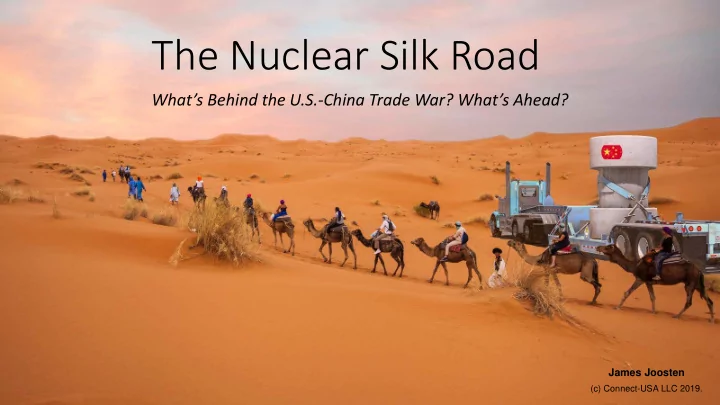
The Nuclear Silk Road
What’s Behind the U.S.-China Trade War? What’s Ahead?
James Joosten
(c) Connect-USA LLC 2019.
The Nuclear Silk Road Whats Behind the U.S.-China Trade War? Whats - - PowerPoint PPT Presentation
The Nuclear Silk Road Whats Behind the U.S.-China Trade War? Whats Ahead? James Joosten (c) Connect-USA LLC 2019. Are Chinas Nuclear Construction Plans Doable? 150GWe Installed by 2030 GWe 250 CGN 2016 LOW CGN 2016 HI WNA 2017 REF
What’s Behind the U.S.-China Trade War? What’s Ahead?
James Joosten
(c) Connect-USA LLC 2019.
2.2 10.8 26.1 58 150
50 100 150 200 250 2000 2005 2010 2015 2020 2025 2030 2035
CGN 2016 LOW CGN 2016 HI WNA 2017 REF
Year GWe
141
150GWe Installed by 2030
Downtown Shenzhen 1980
1980 today
HONG KONG-ZUHAI-MACAO BRIDGE - 34 MILES THREE GORGES DAM — 22,500 MWE
World’s Largest Hydro Plant World’s Largest Sea Crossing
CHANGSHA Mini Sky City Building: 57 STORIES —> 19 DAYS
As of October, 2019:
the grid worldwide in 2018, seven were in China.
Flamanville 3 - Construction Start Nov 2007 — Grid Connection: 2023? Olkiluoto 3 - Construction Start Nov 2007 — Grid Connection: 2020? Taishan 2 - Construction Start Apr 2010 — Grid Connection: Sept 2019 Taishan 1 - Construction Start Nov 2009 — Grid Connection: Dec 2018
Started Later, Completed Before European EPRs
Sanmen Units 1 & 2
China: Two already on line
Vogtle 4 - Construction Start Nov 2013 — Grid Connection: 2022? Vogtle 3 - Construction Start Mar 2013 — Grid Connection: 2021? Sanman 2 - Construction Start Dec 2009 — Grid Connection: Nov 2018 Sanman 1 - Construction Start Apr 2009 — Grid Connection: Sept 2018
Vogtle 3 & 4
USA: 79% complete
2.2 10.8 26.1 58 150
50 100 150 200 250 2000 2005 2010 2015 2020 2025 2030 2035
CGN 2016 LOW CGN 2016 HI WNA 2017 REF
Year GWe
141
PHOTO: Commons.Wikimedia.org
(200 BC – 1450 AD)
Xi Jianping
and is in talks with more than 40
(China lent $6.5bn to Pakistan to help fund the $9.6bn project)
Egypt, Ghana, Italy, Jordan, Kazakhstan, Kenya, Mongolia, Morocco, Namibia, Nigeria, Oman, Philippines, Saudi Arabia, Senegal, Sudan, Uzbekistan
CNNC: “China could build as many as 30 overseas nuclear reactors. BRI nuclear projects could earn Chinese firms as much as US$145.52 billion by 2030”
China’s Economy Could Soon Overtake and Displace United States
Annual IP Theft Losses: over US$300 billion CGN added to Dept of Commerce “Entity List” Some major nuclear espionage cases (Alan Ho Lee) DOE Labs banned hiring foreign scientific talent in August 2019
Concern SMR technology to be adapted to Chinese submarines, aircraft carriers, ice breakers and land bases
1/3rd of World’s shipping ($3 trillion) passes through South China Sea each year 40% of China’s total trade in 2018 80% of Global Trade by volume Major UN territorial disputes with China
Hambantota Port, Sri Lanka Djibouti Port Strategic Choke Point
Image: Columbo Gazette
China’s current debt is now a staggering: US$ 42-48 trillion! China’s debt has grown about 1000% over last decade As of Q1, 2019, China’s debt level exceeded 300% of GDP
It’s complicated. Typically refers to financial lending transactions that are done outside of normal, regulated, banking channels (i.e., off-the-books.) Effectively ’Borrowing from Peter to pay
borrowing from John at a higher interest rate to pay Peter, and from Fred to pay John, etc. No one - not even the Chinese government - currently knows the full extent of Shadow Banking loans within China and overseas by China’s State Owned Enterprises (SOEs).
Source: https://www.bis.org/publ/work701.pdf
Manageable debt? Gigantic Economic Bubble?
Declining GDP Growth Rate
GDP Growth Rate for 2019 Now Projected at 5.9% China’s Debt Service Now Growing Faster than GDP Bank Loan Defaults Occurring at Record Levels
Central Bank Foreign Exchange Reserves
200 400 600 800 1000
2014 2015 2016 2017 Domestic Non-Domestic (US$ Millions)
Reactor Construction Starts
1 2 3 4 5 6 7
2015 2016 2017 2018 2019 2020 Actual 13th Five Plan Target
Installed Nuclear Capacity
48.3 58
10 20 30 40 50 60 70
GWe
Current 2020 Target
Averaging only 2.2 construction starts per year since 2015 Debt Crisis onset
with China and the trade deficit. Chinese tariffs likely will be lifted during the election year. But watch
and China – particularly SMRs due to their linkage to Chinese nuclear navy, ice breakers, and military base applications. A high risk for IP theft of U.S. SMR technology to low cost vendors.
credit easing period but settling in at a modest 2-3 per year after that). Note: Despite expected economic recession, some new construction is necessary for Chinese labor stability.
to capital flight if the debt crisis worsens; alternately, party oligarchs could increase off-shore uranium inventories effectively creating an off-shore bank for parking USD in the form of U.
Western producers, and more term contracts so as to reduce geopolitical risk.