The Molecular Dynamics Method - 4.0 H-bond energy (kcal/mol) - - PowerPoint PPT Presentation

the molecular dynamics method
SMART_READER_LITE
LIVE PREVIEW

The Molecular Dynamics Method - 4.0 H-bond energy (kcal/mol) - - PowerPoint PPT Presentation

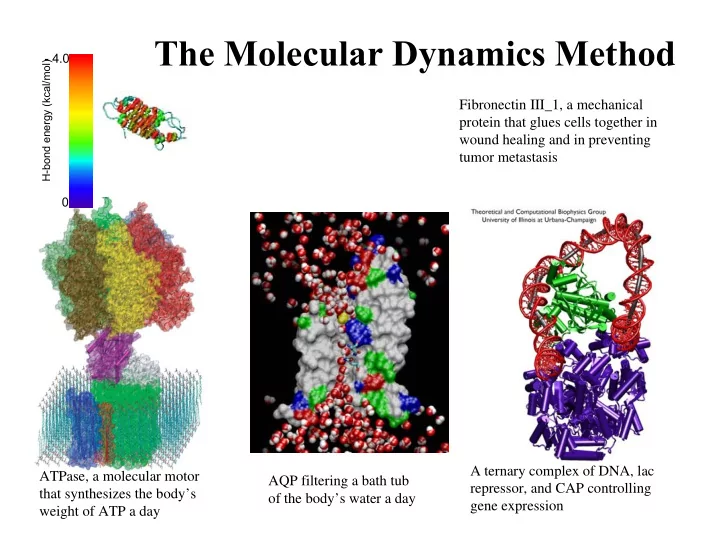
The Molecular Dynamics Method - 4.0 H-bond energy (kcal/mol) Fibronectin III_1, a mechanical protein that glues cells together in wound healing and in preventing tumor metastasis 0 A ternary complex of DNA, lac ATPase, a molecular motor


slide-1
SLIDE 1

The Molecular Dynamics Method

ATPase, a molecular motor that synthesizes the body’s weight of ATP a day A ternary complex of DNA, lac repressor, and CAP controlling gene expression AQP filtering a bath tub

  • f the body’s water a day

H-bond energy (kcal/mol)

  • 4.0

Fibronectin III_1, a mechanical protein that glues cells together in wound healing and in preventing tumor metastasis

slide-2
SLIDE 2

Classical Dynamics

F=ma at 300K

Energy function: used to determine the force on each atom: yields a set of 3N coupled 2nd-order differential equations that can be propagated forward (or backward) in time. Initial coordinates obtained from crystal structure, velocities taken at random from Boltzmann distribution. Maintain appropriate temperature by adjusting velocities.

slide-3
SLIDE 3

Langevin Dynamics

come on, feel the noise

Langevin dynamics deals with each atom separately, balancing a small friction term with Gaussian noise to control temperature:

slide-4
SLIDE 4

Classical Dynamics

discretization in time for computing

Use positions and accelerations at time t and the positions from time t-t to calculate new positions at time t+t.

+

slide-5
SLIDE 5

Potential Energy Function of Biopolymer

  • Simple, fixed algebraic form for every type of interaction.
  • Variable parameters depend on types of atoms involved.
slide-6
SLIDE 6

Large is no problem. But …

Molecular dynamics simulation of alpha- hemolysin with about 300,000 atoms NCSA machine room

slide-7
SLIDE 7

But long is!

biomolecular timescale and timestep limits

SPEED SPEED LIMIT LIMIT t = 1 fs t = 1 fs s fs µs ns ps ms

Bond stretching Elastic vibrations Rotation of surface sidechains Hinge bending Rotation of buried sidechains Local denaturations Allosteric transitions Molecular dynamics timestep

steps 100 103 106 109 1012 1015

(day) (year)

slide-8
SLIDE 8

PDB Files

a little information

  • Simulations start with a crystal structure from the Protein Data Bank,

in the standard PDB file format.

  • PDB files contain standard records for species, tissue, authorship,

citations, sequence, secondary structure, etc.

  • We only care about the atom records…

– atom name (N, C, CA) – residue name (ALA, HIS) – residue id (integer) – coordinates (x, y, z) – occupancy (0.0 to 1.0) – temp. factor (a.k.a. beta) – segment id (6PTI)

  • No hydrogen atoms!

(We must add them ourselves.)

slide-9
SLIDE 9

PSF Files

atomic properties (mass, charge, type)

  • Every atom in the simulation is listed.
  • Provides all static atom-specific values:

– atom name (N, C, CA) – atom type (NH1, C, CT1) – residue name (ALA, HIS) – residue id (integer) – segment id (6PTI) – atomic mass (in atomic mass units) – partial charge (in electronic charge units)

  • What is not in the PSF file?

– coordinates (dynamic data, initially read from PDB file) – velocities (dynamic data, initially from Boltzmann distribution) – force field parameters (non-specific, used for many molecules)

CA CB N

HN HA

C O

HB3 HB1 HB2

Ala

slide-10
SLIDE 10

PSF Files

molecular structure (bonds, angles, etc.)

Bonds: Every pair of covalently bonded atoms is listed. Angles: Two bonds that share a common atom form an angle. Every such set of three atoms in the molecule is listed. Dihedrals: Two angles that share a common bond form a dihedral. Every such set of four atoms in the molecule is listed. Impropers: Any planar group of four atoms forms an improper. Every such set of four atoms in the molecule is listed.

slide-11
SLIDE 11

From the Mountains to the Valleys

how to actually describe a protein

Initial coordinates have bad contacts, causing high energies and forces (due to averaging in observation, crystal packing, or due to difference between theoretical and actual forces) Minimization finds a nearby local minimum. Heating and cooling or equilibration at fixed temperature permits biopolymer to escape local minima with low energy barriers. kT kT kT kT Initial dynamics samples thermally accessible states. Energy Conformation

slide-12
SLIDE 12

From the Mountains to the Valleys

a molecular dynamics tale

Longer dynamics access other intermediate states; one may apply external forces to access other available states in a more timely manner. kT kT kT kT Energy Conformation

slide-13
SLIDE 13

0.01 0.1 1 10 2 4 8 16 32 64 128 256 512

time per step (seconds)

Simulation of large biomolecular systems 2002 Gordon Bell Award for parallel scalability. Runs at NSF centers, on clusters, and on desktop. Available for FREE as precompiled binaries; includes source code. 10,000 registered users.

NAMD: The Program we will Use

Ankyrin 340K atoms with PME

3 s/step

TeraGrid Phase 2 (NCSA)

Linear scaling

number of processors

32 ms 75% efficency

  • n 256 CPUs

NAMD programmer

  • J. Phillips

Ph.D. UIUC Physics

slide-14
SLIDE 14

CHARMM Potential Function

  • Simple, fixed algebraic form for every type of interaction.
  • Form stems from compromise between accuracy and speed.
  • Variable parameters depend on types of atoms involved.
slide-15
SLIDE 15

Parameter Files

biomolecular paint by numbers

  • Equilibrium value and spring constant for

– every pair of atom types that can form and bond – every triple of atom types that can form an angle – every quad of atom types that can form a dihedral or improper (many wildcard cases)

  • vdW radius and well depth for every atom type

– actually need these for every pair of atoms types! – pair radius calculated from arithmetic mean – pair well depth calculated from geometric mean

  • Closely tied to matching topology file!
slide-16
SLIDE 16
  • PDB, PSF, topology, and parameter files
  • Molecular dynamics

…in an ideal world …and in our world …with computers …using NAMD

  • Preparing a protein using VMD
  • You prepare a protein using VMD

…and simulate it using NAMD …in the hands-on Tuesday afternoon

Don’t worry, the written tutorial is very complete. You will learn by doing. This talk is an overview.

Molecular Dynamics Method

slide-17
SLIDE 17

From the Mountains to the Valleys

a molecular dynamics fairy tale

Initial coordinates have bad contacts, causing high energies and forces. Minimization finds a nearby local minimum. Equilibration escapes local minima with low energy barriers. kT kT kT kT Basic simulation samples thermally accessible states. Energy Conformation

slide-18
SLIDE 18

From the Mountains to the Valleys

a molecular dynamics fairy tale

Steering forces are needed to access other intermediate states in a timely manner. kT kT kT kT Energy Conformation

slide-19
SLIDE 19

Step by Step

discretization in time

Use positions and accelerations at time t and the positions from time t-t to calculate new positions at time t+t.

+

slide-20
SLIDE 20

Hurry Up and Wait

biomolecular timescale and timestep limits

SPEED SPEED LIMIT LIMIT t = 1 fs t = 1 fs s fs µs ns ps ms

Bond stretching Elastic vibrations Rotation of surface sidechains Hinge bending Rotation of buried sidechains Local denaturations Allosteric transitions Molecular dynamics timestep

slide-21
SLIDE 21

Cutting Corners

cutoffs, PME, rigid bonds, and multiple timesteps

  • Nonbonded interactions require order N2 computer time!

– Truncating at Rcutoff reduces this to order N Rcutoff

3

– Particle mesh Ewald (PME) method adds long range electrostatics at order N log N, only minor cost compared to cutoff calculation.

  • Can we extend the timestep, and do this work fewer times?

– Bonds to hydrogen atoms, which require a 1fs timestep, can be held at their equilibrium lengths, allowing 2fs steps. – Long range electrostatics forces vary slowly, and may be evaluated less

  • ften, such as on every second or third step.
slide-22
SLIDE 22

Linux Clusters 101

parallel computing on a professor’s salary

92K atoms with PME

(ns simulated per week)

0.2 0.4 0.6 0.8 1 1.2 1.4 8 16 24 32

Easy to manage $1000 per processor Learn to build your own Linux cluster!