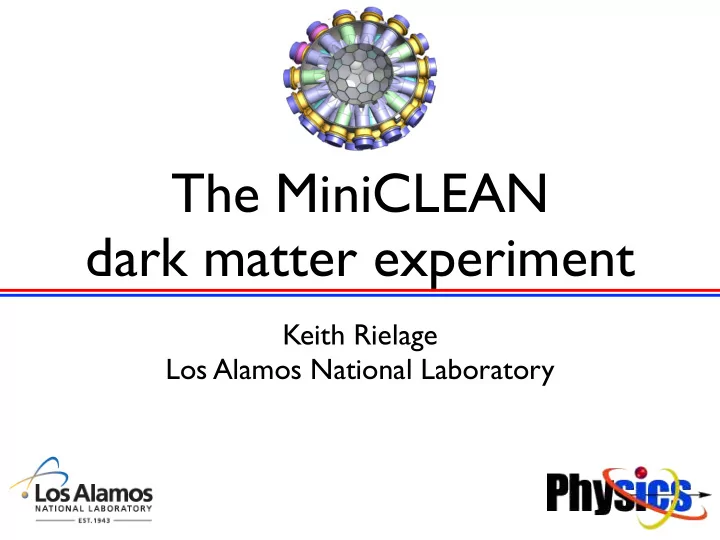
The MiniCLEAN dark matter experiment Keith Rielage Los Alamos - - PowerPoint PPT Presentation

the miniclean dark matter experiment
SMART_READER_LITE
LIVE PREVIEW

The MiniCLEAN dark matter experiment Keith Rielage Los Alamos - - PowerPoint PPT Presentation

The MiniCLEAN dark matter experiment Keith Rielage Los Alamos National Laboratory Single-phase Noble Liquid Electronic recoil (gamma) PMT pulses in LAr Nuclear recoil (neutron) Noble liquids have singlet and triplet excited states For


slide-1
SLIDE 1

The MiniCLEAN dark matter experiment

Keith Rielage Los Alamos National Laboratory

slide-2
SLIDE 2

Single-phase Noble Liquid

  • Noble liquids have singlet and triplet excited states
  • For argon and neon, decay times for these states are

different and long enough to provide discrimination between electronic and nuclear recoils

  • Electronic recoils result in more triplet states so more late

light

Electronic recoil (gamma) Nuclear recoil (neutron) PMT pulses in LAr

slide-3
SLIDE 3

Discrimination

  • Ratio of early to late light discriminates between types of

recoils

  • 1 part in 1015 of argon is 39Ar which beta decays so need

rejection of electronic recoils better than 109

  • R&D shows rejection is achievable
slide-4
SLIDE 4

LAr Lightguide & PMT

Conceptually Simple Detector

  • Sphere of argon or neon

serves as target for WIMPs

  • Scintillation light from recoils

at 80-128 nm

  • Converted to visible by

wavelength shifter on acrylic

  • Light guide brings visible light

to photomultiplier tube where signal recorded

Wavelength Shifter

slide-5
SLIDE 5

MiniCLEAN Detector

  • Liquid cryogen can be argon or neon
  • ~150 kg fiducial volume
  • PMTs - Hamamatsu R5912-02MOD operating in cryogenic

liquid

  • Cryogen, PMTs and wavelength shifters contained in

stainless steel Inner Vessel (IV)

  • IV is surrounded by stainless steel Outer

Vessel with vacuum insulation and thermal blanket

  • PMT and wavelength shifter (TPB) on acrylic plate are part
  • f modular optical cassette
  • 92 optical cassettes
slide-6
SLIDE 6

MiniCLEAN detector

Courtesy J. Griego

Inner Vessel PMT Outer Vessel LAr/ LNe

slide-7
SLIDE 7

Optical Cassette

PMT Acrylic Plate Light Guide Top Hat

slide-8
SLIDE 8

MiniCLEAN - Outer Vessel & Shield

O Ves

Courtesy J. Griego

Inner Vessel Outer Vessel Water Shield Tank Deck

slide-9
SLIDE 9

Target Exchange

8

slide-10
SLIDE 10

Outer Vessel Manufacturing

Courtesy F. Lopez

slide-11
SLIDE 11

Inner Vessel Progress

  • Stainless steel hemispheres made by Trinity Heads, Inc in Texas
  • Fabrication started at Winchester Precision Technologies

Courtesy F. Lopez

slide-12
SLIDE 12

Inner Vessel Progress

  • Stainless steel hemispheres made by Trinity Heads, Inc in Texas
  • Fabrication started at Winchester Precision Technologies

Courtesy F. Lopez

slide-13
SLIDE 13

Inner Vessel Progress

  • Stainless steel hemispheres made by Trinity Heads, Inc in Texas
  • Fabrication started at Winchester Precision Technologies

Courtesy F. Lopez

slide-14
SLIDE 14

Inner Vessel Progress

  • Stainless steel hemispheres made by Trinity Heads, Inc in Texas
  • Fabrication started at Winchester Precision Technologies

Courtesy F. Lopez

slide-15
SLIDE 15

SNOLAB

Surface Facility 2 km

  • f rock

Underground Laboratory

slide-16
SLIDE 16

SNOLAB

Personnel facilities SNO Cavern Ladder Labs Cube Hall Cryopit Utility Area South Drift Phase III Stub Utility Drift

slide-17
SLIDE 17

SNOLAB

Personnel facilities SNO Cavern Ladder Labs Cube Hall Cryopit Utility Area South Drift Phase III Stub Utility Drift

slide-18
SLIDE 18

SNOLAB

Personnel facilities SNO Cavern Ladder Labs Cube Hall Cryopit Utility Area South Drift Phase III Stub Utility Drift

slide-19
SLIDE 19

Courtesy F. Duncan

slide-20
SLIDE 20

Courtesy F. Duncan

Insert Detector Here

slide-21
SLIDE 21

The DEAP and CLEAN Family of Detectors

DEAP-0:

Initial R&D detector

DEAP-1:

7 kg LAr 2 warm PMTs At SNOLab 2008

picoCLEAN:

Initial R&D detector

microCLEAN:

4 kg LAr or LNe 2 cold PMTs surface tests at Yale

MiniCLEAN:

500 kg LAr or LNe (150 kg fiducial mass) 92 cold PMTs At SNOLAB mid-2011

DEAP-3600:

3600 kg LAr (1000 kg fiducial mass) 266 warm PMTs At SNOLAB 2012

50-tonne LNe/LAr Detector:

pp-solar ν, supernova ν, dark matter <10-46 cm2 At DUSEL ~2016?

10-44 cm2 10-45 cm2 10-46 cm2 WIMP σ Sensitivity

slide-22
SLIDE 22

Sensitivity

WIMP Mass [GeV/c2] Cross-section [cm2] (normalised to nucleon) 10

1

10

2

10

3

10

  • 47

10

  • 46

10

  • 45

10

  • 44

10

  • 43

10

  • 42

MiniCLEAN CLEAN, natural Ar CLEAN, depleted Ar LUX CDMS (2008) XENON10 (2007) CLEAN, Ne

!"#$%&'(')*'+,'('-.' !"#$%&'(')**'+,'('-.' !"#$%&'(')***'+,'('-.'

slide-23
SLIDE 23

Current Schedule

  • OV will be underground by end of year in tank with stand
  • Underground infrastructure (utilities, deck, water tank)

ready in September

  • Subsystem commissioning in early 2011
  • IV scheduled for completion in May 2011
  • Assembly scheduled for Summer 2011
  • Full commissioning in Fall 2011
  • Liquid argon dark matter run by end of 2011
slide-24
SLIDE 24

Overarching Goals of MiniCLEAN

Technical Proof-of-Principle

We aim to demonstrate all salient features of a 4π single-phase detector using, interchangeably, targets of LAr and LNe.

Analysis Philosophy

Using our experiences from SNO, SK etc … we aim to develop a robust analysis program where all detector parameters and response to signal and backgrounds are

  • ver-constrained through simulation and calibration.

Dark Matter Search

Perform a search for WIMP dark matter with a sensitivity competitive and complementary to next generation experiments with order 100 kg fiducial mass.

Future

MiniCLEAN serves as a prototype to a full-scale (~50T) CLEAN.

slide-25
SLIDE 25

DEAP/CLEAN Collaborators

University of Alberta

  • B. Beltran, P

. Gorel, A. Hallin, S. Liu, C. Ng, K.S. Olsen, J. Soukup

Boston University

  • D. Gastler, E. Kearns

Carleton University

  • M. Bowcock, K. Graham, P

. Gravelle, C. Oullet

Harvard University

  • J. Doyle

Los Alamos National Laboratory

  • K. Bingham, R. Bourque,

V.M. Gehman, J. Griego, R. Hennings- Yeomans, A. Hime, F. Lopez, J. Oertel, K. Rielage, L. Rodriguez,

  • S. Seibert, D. Steele

Massachusetts Institute of Technology

  • L. Feng, J.A. Formaggio, S. Jaditz, J. Kelsey, J. Monroe, K. Palladino

National Institute Standards and Technology

  • K. Coakley

University of New Mexico

  • M. Bodmer, F. Giuliani, M. Gold, D. Loomba, J. Matthews, P

. Palni

University of North Carolina/TUNL

  • M. Akashi-Ronquest, R. Henning

University of Pennsylvania

  • T. Caldwell, J.R. Klein, A. Mastbaum, G.D. Orebi Gann

Queen’s University

  • M. Boulay, B. Cai, M. Chen, S. Florian, R. Gagnon,
  • V. Golovko,

P . Harvey, M. Kuzniak, J. Lidgard, A. McDonald, T. Noble, P . Pasuthip, C. Pollman, W. Rau, P . Skensved, T. Sonley, M. Ward

SNOLAB Institute

  • M. Batygov, F.A. Duncan, I. Lawson, O. Li, P

. Liimatainen,

  • K. McFarlane, T. O’Malley, E.

Vazquez-Jauregi

University of South Dakota

  • V. Guiseppe, D.-M. Mei, G. Perumpilly, C. Zhang

Syracuse University

M.S. Kos, R.W. Schnee, B. Wang

TRIUMF

P .-A. Amaudruz, A. Muir, F. Retiere

Yale University

W.H. Lippincott, D.N. McKinsey, J.A. Nikkel,

  • Y. Shin