The Meaning of the Child others because they carried a particular - - PDF document

the meaning of the child
SMART_READER_LITE
LIVE PREVIEW

The Meaning of the Child others because they carried a particular - - PDF document

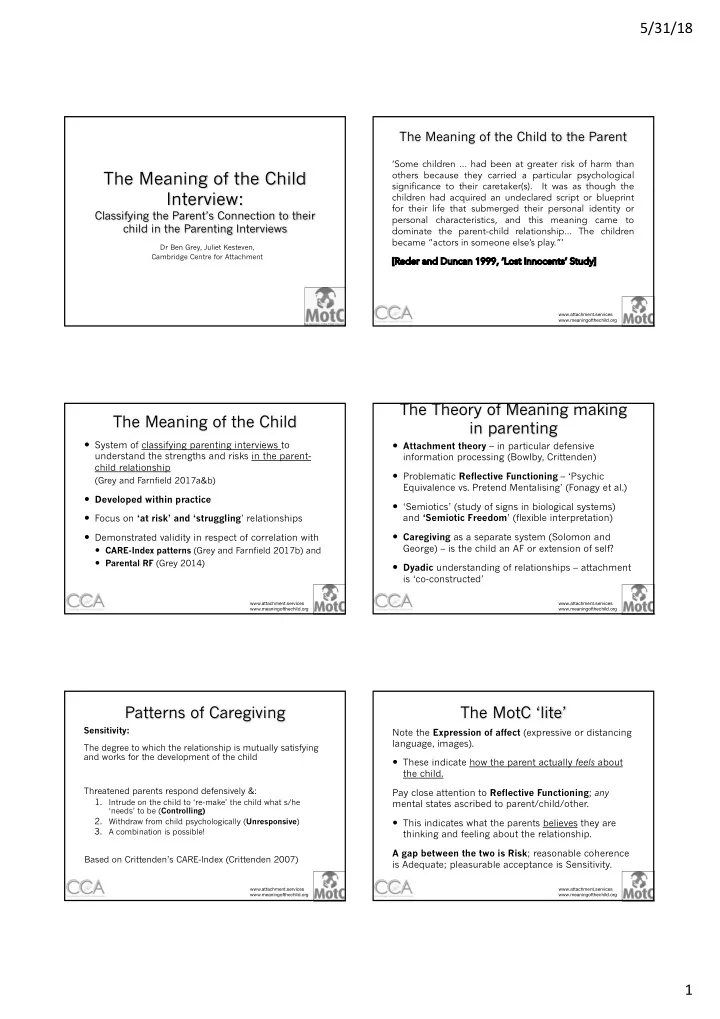
5/31/18 The Meaning of the Child to the Parent Some children ... had been at greater risk of harm than The Meaning of the Child others because they carried a particular psychological significance to their caretaker(s). It was as though the


slide-1
SLIDE 1

5/31/18 1

The Meaning of the Child Interview:

Classifying the Parent’s Connection to their child in the Parenting Interviews

Dr Ben Grey, Juliet Kesteven, Cambridge Centre for Attachment

www.attachment.services www.meaningofthechild.org

The Meaning of the Child to the Parent

‘Some children ... had been at greater risk of harm than

  • thers because they carried a particular psychological

significance to their caretaker(s). It was as though the children had acquired an undeclared script or blueprint for their life that submerged their personal identity or personal characteristics, and this meaning came to dominate the parent-child relationship... The children became “actors in someone else’s play.”’ [Red Reder er and and Du Duncan 1999 1999, ‘L ‘Lost In Innocents’ St Stud udy] y]

www.attachment.services www.meaningofthechild.org

The Meaning of the Child

— System of classifying parenting interviews to

understand the strengths and risks in the parent- child relationship (Grey and Farnfield 2017a&b)

— Developed within practice — Focus on ‘at risk’ and ‘struggling’ relationships — Demonstrated validity in respect of correlation with

— CARE-Index patterns (Grey and Farnfield 2017b) and — Parental RF (Grey 2014)

www.attachment.services www.meaningofthechild.org

The Theory of Meaning making in parenting

— Attachment theory – in particular defensive

information processing (Bowlby, Crittenden)

— Problematic Reflective Functioning – ‘Psychic

Equivalence vs. Pretend Mentalising’ (Fonagy et al.)

— ‘Semiotics’ (study of signs in biological systems)

and ‘Semiotic Freedom’ (flexible interpretation)

— Caregiving as a separate system (Solomon and

George) – is the child an AF or extension of self?

— Dyadic understanding of relationships – attachment

is ‘co-constructed’

www.attachment.services www.meaningofthechild.org

Patterns of Caregiving

Sensitivity: The degree to which the relationship is mutually satisfying and works for the development of the child Threatened parents respond defensively &: 1.

Intrude on the child to ‘re-make’ the child what s/he ‘needs’ to be (Controlling)

2.

Withdraw from child psychologically (Unresponsive)

3.

A combination is possible!

Based on Crittenden’s CARE-Index (Crittenden 2007)

www.attachment.services www.meaningofthechild.org

The MotC ‘lite’

Note the Expression of affect (expressive or distancing language, images).

— These indicate how the parent actually feels about

the child. Pay close attention to Reflective Functioning; any mental states ascribed to parent/child/other.

— This indicates what the parents believes they are

thinking and feeling about the relationship. A gap between the two is Risk; reasonable coherence is Adequate; pleasurable acceptance is Sensitivity.

slide-2
SLIDE 2

5/31/18 2

www.attachment.services www.meaningofthechild.org

Sensitive Caregiving

— Parent and child please each other; each finds the

relationship rewarding.

— The child is alive in the mind of the parent and the

parent is able to give appropriate meaning to the child’s signals,

— The parent can then respond appropriately to

comfort the child / resolve the problem.

www.attachment.services www.meaningofthechild.org

Sensitive Parenting

— Sensitive parents respond sensitively to their

children, because they have the flexibility to see where they and their child are and adapt (like dance partner).

— Beliefs have context, and are congruent with them. — Expression of feelings and content match each

  • ther.

— Absolutes are usually avoided; (‘never’, ’always’) or

qualified.

— All information is integrated with context and

reflection, or at least accessible to reflection.

www.attachment.services www.meaningofthechild.org

Sensitive

— What do you like most about Ellie? — Um...that’s quite a difficult question to answer (soft

laugh)

— It is a difficult question, have a go, have a shot. — (7-8 seconds silence- thinking) — Well it’s difficult to put my finger on one thing, there’s a

couple of things that I really love about Ellie...um (pause)

  • ne of them is um (pause) I really love her smile, she’s

got, she smiles at everybody but she’s got a particular smile that she turns around and grins for you, for somebody special in her life umm (pause) she’s got a very infectious laugh, she loves to laugh umm (pause) really like that about her umm (pause)

www.attachment.services www.meaningofthechild.org

— Sorry it’s very strange, the way she smells cos she’s

my child and it’s a funny parent thing I know, maybe only I’ve got but there’s the smell of Ellie and I can still go into her room and even though she’s not been there for a very, very long time, it smells like Ellie in that room (pause) it’s a very strange thing... And even though she’s been with her foster mother she still smells like Ellie (pause) um so that’s quite important to me um (pause) and um (pause) but when she calls mummy even if she’s upset or she’s (pause) um happy or you know when she calls for me that really melts my heart even if it’s, even if she’s annoyed with me (laughs) you know but it’s when she interacts with me and that’s possibly because I don’t get to spend the time with her but that’s really important to me.

www.attachment.services www.meaningofthechild.org

Sensitive

[Child is 8, adoptive mother’s first language is French] Taking the first of those err loving, can you give me a recent example, a time when you felt the relationship was loving – a sort of memory or an occasion? Well for example just yesterday mm when she yeah wanted to be a baby and wanted to be cuddled in my arms and erm, said she was born yesterday, “I was born yesterday mummy from your tummy” and erm she just wanted to sit on my lap and just be, be hugged and err her head against my chest and this moment of stillness – erm there was no chatting. We were just there together and that was really loving.

www.attachment.services www.meaningofthechild.org

Controlling Parenting

— The parent fears intrusion or rejection; what will

happen if the child is allowed to influence the relationship (contribute to the conversation)

— Parental beliefs are imposed on the ‘conversation’:

— Positive beliefs - the reality that the parents need to believe in — Negative beliefs express disappointment at the child’s failure to live up to it

— Can include ‘needy’ enmeshed relationships as well

as hostile ones

— Both fail to accept the child or the relationship as

they actually are

slide-3
SLIDE 3

5/31/18 3

www.attachment.services www.meaningofthechild.org

Controlling the Interview

— The parent is engaged in the interview because they need the interviewer to accept their version of reality. — They fear that the NTV might see things differently, and exaggerate and intensify the expression of affect in order to ‘bully’ the NTV into accepting their meanings. — One-sided and self-serving information offers no context to base an independent opinion. — Other perspectives are brought in bolster own perspective, or as ‘straw men’ to be dismissed. — A sense of struggle pervades even seemingly ‘positive’ interviews; things have to be how the speaker sees them, and others must or should recognise it too.

www.attachment.services www.meaningofthechild.org

The love, the uniqueness of my son and our relationship, cos it’s one of a kind, you won’t get one like me and my son has got, I don’t care who you got, whatever they think. I know there is no one better than the one I got with my son. I know that much - just by looking at him - and the way he looks at me....yeah... I think he understands, in my own heart. I do. I think he knows, where he is and he shouldn’t be there but - it’s

  • ne of them things, its happened now, I’m going

through the system. I don’t want to beat the system; I want to work with the system. So... ...so, taking first the love, can you tell me about just a particular moment, describe a time with him where, where, that has showed the love there is between you..

www.attachment.services www.meaningofthechild.org

...so, taking first the love, can you tell me about just a particular moment, describe a time with him where, where, that has showed the love there is between you.. Every time I open that door to walk in, to see him, every time, you can just feel the love in the room. Its, I don’t know if that sounds strange but, you just can, I walk in and as soon as his arms come up, and he just wraps himself and squeezes so tight that, that just shows me he loves me and that I do the same back, I show him I love him, I don’t make him feel unwanted or nothing like that cos it’s not nice really, but just that, that in general, just that love that’s in that room at that time and, but when I out him in the car, he won’t kiss me, he won’t wave goodbye – nothing, it hurts but I think I know why, cos he’s having to go back, which he doesn’t want to do, you can see it, he doesn’t wanna do it, but that’s my opinion, other people might have their own

  • utlook on that when they see it, and see how he is,

but that’s my personal opinion as his father.

www.attachment.services www.meaningofthechild.org

.. If [Tommy is not returned to my care], I dread to think what I’m going to do, honestly, I think, I think I’m gonna get – ‘bout 15 year’s jail or something stupid honestly if I don’t get my boy, I dread to think cos – like I said to you, that’s my life – in that little boy’s hands. He holds the key to my heart.

www.attachment.services www.meaningofthechild.org

Unresponsive Parenting

— Unresponsive parents fear the child will elicit difficult, even unbearable feelings. — There is a desire to escape from unpleasant or threatening aspects of reality. — This is done by idealising the child (and relationship) and making things impersonal. — The former avoids attention to negative feelings; when this fails, the latter distances the self from them. — The effect of both is to create an island where they cannot be touched; but then cannot ‘touch’ their child. — Their idealisation lacks context and genuine affect because the child is not seen; it is not based upon or contingent to the child.

www.attachment.services www.meaningofthechild.org

And him being a little baby, what do you think his favourite things are to do or his favourite times in the day? Well, he’s mainly awake first thing in the morning and he likes to play with his play gym and his soft toys, and he likes ya to talk to him and stuff Ok so he has good times first thing in the morning and playing? Yeah. Ok and what are the times or the things that he has most trouble with? When he has a bath cos he doesn’t really like his baths. Right. Cos he does cry a bit when he has a bath. Does he, yeah, is it the, why do you think he doesn’t like having a bath? Cos there’s not a lot of water in it for him, and he’s used to keeping, when they’re used to having clothes on they’re exposed and they get cold quicker.

slide-4
SLIDE 4

5/31/18 4

www.attachment.services www.meaningofthechild.org

Yeah, ok. And what would you say you like most about your son? Being able to talk to him and play with his toys with him.

  • Hmmm. Yeah, so you like playing with him? Yeah.

And what about him would you say you like least? Nothing, nothing at all. No, there’s nothing about him that’s difficult to manage or? No. No. Even when he’s upset I can cope with him, I just know how to look after him and calm him down and tell him everything’s ok, and when you tell him everything’s ok he calms down Hmmm. But he’s having a bit of a problem at the moment cos he’s teething. Right. But we’ve got under control I have cos when he starts crying, I give him his dummy and that soothes him. Right, he likes that, ok. Ok, we’ve got a bit of a picture of Tim and of you.

  • Yeah. I want to look

www.attachment.services www.meaningofthechild.org

Right, he likes that, ok. Ok, we’ve got a bit of a picture of Tim and of you.

  • Yeah. I want to look a little bit about your

relationship with Tim. Yeah. Ok, ummm and think about how that is, ok. So can you think of three words or phrases that would describe your relationship? It’s a good relationship with me and Tim. We’re bonded, he’s happy with me and there’s the occasional time when he’s upset when he’s in pain Yes, ok, you say you are bonded, can you give me a for example? He knows who I am. So when did you last have that feeling that he knew who you were? Well I’ve never had that feeling that he’s not known who I am.

www.attachment.services www.meaningofthechild.org

Further Information

— www.attachment.services — www.meaningofthechild.org

Email:

— ben@attachment.services

juliet@attachment.services