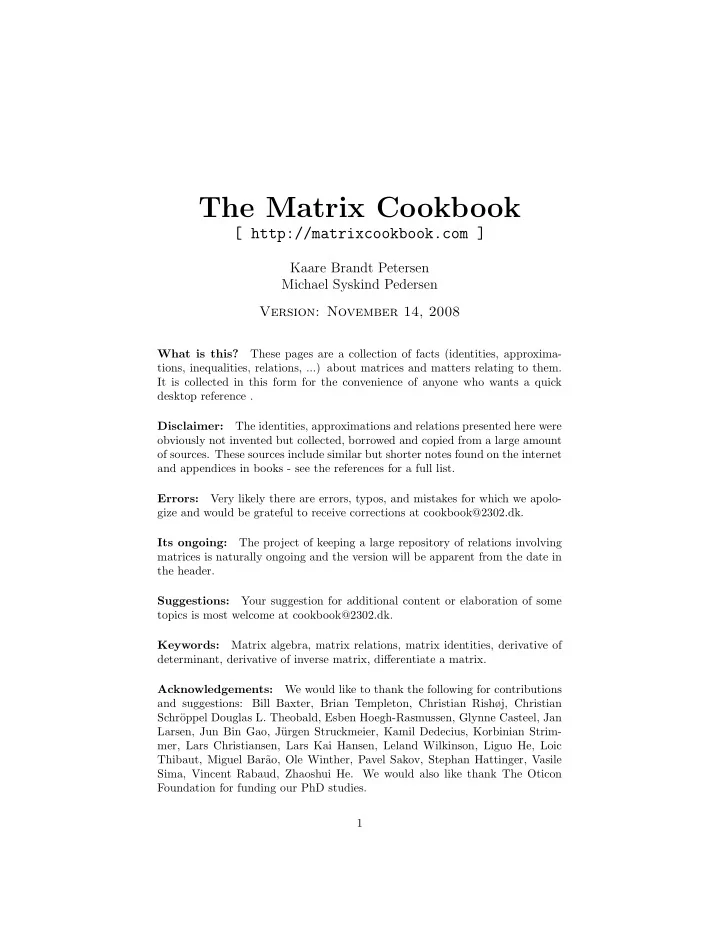
The Matrix Cookbook [ http://matrixcookbook.com ] Kaare Brandt - - PDF document

the matrix cookbook
SMART_READER_LITE
LIVE PREVIEW

The Matrix Cookbook [ http://matrixcookbook.com ] Kaare Brandt - - PDF document

The Matrix Cookbook [ http://matrixcookbook.com ] Kaare Brandt Petersen Michael Syskind Pedersen Version: November 14, 2008 What is this? These pages are a collection of facts (identities, approxima- tions, inequalities, relations, ...) about


slide-1
SLIDE 1

The Matrix Cookbook

[ http://matrixcookbook.com ]

Kaare Brandt Petersen Michael Syskind Pedersen Version: November 14, 2008

What is this? These pages are a collection of facts (identities, approxima- tions, inequalities, relations, ...) about matrices and matters relating to them. It is collected in this form for the convenience of anyone who wants a quick desktop reference . Disclaimer: The identities, approximations and relations presented here were

  • bviously not invented but collected, borrowed and copied from a large amount
  • f sources. These sources include similar but shorter notes found on the internet

and appendices in books - see the references for a full list. Errors: Very likely there are errors, typos, and mistakes for which we apolo- gize and would be grateful to receive corrections at cookbook@2302.dk. Its ongoing: The project of keeping a large repository of relations involving matrices is naturally ongoing and the version will be apparent from the date in the header. Suggestions: Your suggestion for additional content or elaboration of some topics is most welcome at cookbook@2302.dk. Keywords: Matrix algebra, matrix relations, matrix identities, derivative of determinant, derivative of inverse matrix, differentiate a matrix. Acknowledgements: We would like to thank the following for contributions and suggestions: Bill Baxter, Brian Templeton, Christian Rishøj, Christian Schr¨

  • ppel Douglas L. Theobald, Esben Hoegh-Rasmussen, Glynne Casteel, Jan

Larsen, Jun Bin Gao, J¨ urgen Struckmeier, Kamil Dedecius, Korbinian Strim- mer, Lars Christiansen, Lars Kai Hansen, Leland Wilkinson, Liguo He, Loic Thibaut, Miguel Bar˜ ao, Ole Winther, Pavel Sakov, Stephan Hattinger, Vasile Sima, Vincent Rabaud, Zhaoshui He. We would also like thank The Oticon Foundation for funding our PhD studies. 1

slide-2
SLIDE 2

CONTENTS CONTENTS

Contents

1 Basics 5 1.1 Trace and Determinants . . . . . . . . . . . . . . . . . . . . . . . 5 1.2 The Special Case 2x2 . . . . . . . . . . . . . . . . . . . . . . . . . 5 2 Derivatives 7 2.1 Derivatives of a Determinant . . . . . . . . . . . . . . . . . . . . 7 2.2 Derivatives of an Inverse . . . . . . . . . . . . . . . . . . . . . . . 8 2.3 Derivatives of Eigenvalues . . . . . . . . . . . . . . . . . . . . . . 9 2.4 Derivatives of Matrices, Vectors and Scalar Forms . . . . . . . . 9 2.5 Derivatives of Traces . . . . . . . . . . . . . . . . . . . . . . . . . 11 2.6 Derivatives of vector norms . . . . . . . . . . . . . . . . . . . . . 13 2.7 Derivatives of matrix norms . . . . . . . . . . . . . . . . . . . . . 13 2.8 Derivatives of Structured Matrices . . . . . . . . . . . . . . . . . 14 3 Inverses 16 3.1 Basic . . . . . . . . . . . . . . . . . . . . . . . . . . . . . . . . . . 16 3.2 Exact Relations . . . . . . . . . . . . . . . . . . . . . . . . . . . . 17 3.3 Implication on Inverses . . . . . . . . . . . . . . . . . . . . . . . . 19 3.4 Approximations . . . . . . . . . . . . . . . . . . . . . . . . . . . . 19 3.5 Generalized Inverse . . . . . . . . . . . . . . . . . . . . . . . . . . 20 3.6 Pseudo Inverse . . . . . . . . . . . . . . . . . . . . . . . . . . . . 20 4 Complex Matrices 23 4.1 Complex Derivatives . . . . . . . . . . . . . . . . . . . . . . . . . 23 4.2 Higher order and non-linear derivatives . . . . . . . . . . . . . . . 26 4.3 Inverse of complex sum . . . . . . . . . . . . . . . . . . . . . . . 26 5 Solutions and Decompositions 27 5.1 Solutions to linear equations . . . . . . . . . . . . . . . . . . . . . 27 5.2 Eigenvalues and Eigenvectors . . . . . . . . . . . . . . . . . . . . 29 5.3 Singular Value Decomposition . . . . . . . . . . . . . . . . . . . . 30 5.4 Triangular Decomposition . . . . . . . . . . . . . . . . . . . . . . 32 5.5 LU decomposition . . . . . . . . . . . . . . . . . . . . . . . . . . 32 5.6 LDM decomposition . . . . . . . . . . . . . . . . . . . . . . . . . 32 5.7 LDL decompositions . . . . . . . . . . . . . . . . . . . . . . . . . 32 6 Statistics and Probability 33 6.1 Definition of Moments . . . . . . . . . . . . . . . . . . . . . . . . 33 6.2 Expectation of Linear Combinations . . . . . . . . . . . . . . . . 34 6.3 Weighted Scalar Variable . . . . . . . . . . . . . . . . . . . . . . 35

Petersen & Pedersen, The Matrix Cookbook, Version: November 14, 2008, Page 2

slide-3
SLIDE 3

CONTENTS CONTENTS 7 Multivariate Distributions 36 7.1 Cauchy . . . . . . . . . . . . . . . . . . . . . . . . . . . . . . . . 36 7.2 Dirichlet . . . . . . . . . . . . . . . . . . . . . . . . . . . . . . . . 36 7.3 Normal . . . . . . . . . . . . . . . . . . . . . . . . . . . . . . . . 36 7.4 Normal-Inverse Gamma . . . . . . . . . . . . . . . . . . . . . . . 36 7.5 Gaussian . . . . . . . . . . . . . . . . . . . . . . . . . . . . . . . . 36 7.6 Multinomial . . . . . . . . . . . . . . . . . . . . . . . . . . . . . . 36 7.7 Student’s t . . . . . . . . . . . . . . . . . . . . . . . . . . . . . . 36 7.8 Wishart . . . . . . . . . . . . . . . . . . . . . . . . . . . . . . . . 37 7.9 Wishart, Inverse . . . . . . . . . . . . . . . . . . . . . . . . . . . 38 8 Gaussians 39 8.1 Basics . . . . . . . . . . . . . . . . . . . . . . . . . . . . . . . . . 39 8.2 Moments . . . . . . . . . . . . . . . . . . . . . . . . . . . . . . . 41 8.3 Miscellaneous . . . . . . . . . . . . . . . . . . . . . . . . . . . . . 43 8.4 Mixture of Gaussians . . . . . . . . . . . . . . . . . . . . . . . . . 44 9 Special Matrices 45 9.1 Block matrices . . . . . . . . . . . . . . . . . . . . . . . . . . . . 45 9.2 Discrete Fourier Transform Matrix, The . . . . . . . . . . . . . . 46 9.3 Hermitian Matrices and skew-Hermitian . . . . . . . . . . . . . . 47 9.4 Idempotent Matrices . . . . . . . . . . . . . . . . . . . . . . . . . 48 9.5 Orthogonal matrices . . . . . . . . . . . . . . . . . . . . . . . . . 48 9.6 Positive Definite and Semi-definite Matrices . . . . . . . . . . . . 50 9.7 Singleentry Matrix, The . . . . . . . . . . . . . . . . . . . . . . . 51 9.8 Symmetric, Skew-symmetric/Antisymmetric . . . . . . . . . . . . 53 9.9 Toeplitz Matrices . . . . . . . . . . . . . . . . . . . . . . . . . . . 54 9.10 Transition matrices . . . . . . . . . . . . . . . . . . . . . . . . . . 55 9.11 Units, Permutation and Shift . . . . . . . . . . . . . . . . . . . . 56 9.12 Vandermonde Matrices . . . . . . . . . . . . . . . . . . . . . . . . 57 10 Functions and Operators 58 10.1 Functions and Series . . . . . . . . . . . . . . . . . . . . . . . . . 58 10.2 Kronecker and Vec Operator . . . . . . . . . . . . . . . . . . . . 59 10.3 Vector Norms . . . . . . . . . . . . . . . . . . . . . . . . . . . . . 61 10.4 Matrix Norms . . . . . . . . . . . . . . . . . . . . . . . . . . . . . 61 10.5 Rank . . . . . . . . . . . . . . . . . . . . . . . . . . . . . . . . . . 62 10.6 Integral Involving Dirac Delta Functions . . . . . . . . . . . . . . 62 10.7 Miscellaneous . . . . . . . . . . . . . . . . . . . . . . . . . . . . . 63 A One-dimensional Results 64 A.1 Gaussian . . . . . . . . . . . . . . . . . . . . . . . . . . . . . . . . 64 A.2 One Dimensional Mixture of Gaussians . . . . . . . . . . . . . . . 65 B Proofs and Details 67 B.1 Misc Proofs . . . . . . . . . . . . . . . . . . . . . . . . . . . . . . 67

Petersen & Pedersen, The Matrix Cookbook, Version: November 14, 2008, Page 3

slide-4
SLIDE 4

CONTENTS CONTENTS

Notation and Nomenclature

A Matrix Aij Matrix indexed for some purpose Ai Matrix indexed for some purpose Aij Matrix indexed for some purpose An Matrix indexed for some purpose or The n.th power of a square matrix A−1 The inverse matrix of the matrix A A+ The pseudo inverse matrix of the matrix A (see Sec. 3.6) A1/2 The square root of a matrix (if unique), not elementwise (A)ij The (i, j).th entry of the matrix A Aij The (i, j).th entry of the matrix A [A]ij The ij-submatrix, i.e. A with i.th row and j.th column deleted a Vector ai Vector indexed for some purpose ai The i.th element of the vector a a Scalar ℜz Real part of a scalar ℜz Real part of a vector ℜZ Real part of a matrix ℑz Imaginary part of a scalar ℑz Imaginary part of a vector ℑZ Imaginary part of a matrix det(A) Determinant of A Tr(A) Trace of the matrix A diag(A) Diagonal matrix of the matrix A, i.e. (diag(A))ij = δijAij eig(A) Eigenvalues of the matrix A vec(A) The vector-version of the matrix A (see Sec. 10.2.2) sup Supremum of a set ||A|| Matrix norm (subscript if any denotes what norm) AT Transposed matrix A−T The inverse of the transposed and vice versa, A−T = (A−1)T = (AT )−1. A∗ Complex conjugated matrix AH Transposed and complex conjugated matrix (Hermitian) A ◦ B Hadamard (elementwise) product A ⊗ B Kronecker product The null matrix. Zero in all entries. I The identity matrix Jij The single-entry matrix, 1 at (i, j) and zero elsewhere Σ A positive definite matrix Λ A diagonal matrix

Petersen & Pedersen, The Matrix Cookbook, Version: November 14, 2008, Page 4

slide-5
SLIDE 5

1 BASICS

1 Basics

(AB)−1 = B−1A−1 (1) (ABC...)−1 = ...C−1B−1A−1 (2) (AT )−1 = (A−1)T (3) (A + B)T = AT + BT (4) (AB)T = BT AT (5) (ABC...)T = ...CT BT AT (6) (AH)−1 = (A−1)H (7) (A + B)H = AH + BH (8) (AB)H = BHAH (9) (ABC...)H = ...CHBHAH (10)

1.1 Trace and Determinants

Tr(A) =

  • iAii

(11) Tr(A) =

  • iλi,

λi = eig(A) (12) Tr(A) = Tr(AT ) (13) Tr(AB) = Tr(BA) (14) Tr(A + B) = Tr(A) + Tr(B) (15) Tr(ABC) = Tr(BCA) = Tr(CAB) (16) det(A) =

  • iλi

λi = eig(A) (17) det(cA) = cn det(A), if A ∈ Rn×n (18) det(AT ) = det(A) (19) det(AB) = det(A) det(B) (20) det(A−1) = 1/ det(A) (21) det(An) = det(A)n (22) det(I + uvT ) = 1 + uT v (23) det(I + εA) ∼ = 1 + εTr(A), ε small (24)

1.2 The Special Case 2x2

Consider the matrix A A =

  • A11

A12 A21 A22

  • Determinant and trace

det(A) = A11A22 − A12A21 (25) Tr(A) = A11 + A22 (26)

Petersen & Pedersen, The Matrix Cookbook, Version: November 14, 2008, Page 5

slide-6
SLIDE 6

1.2 The Special Case 2x2 1 BASICS Eigenvalues λ2 − λ · Tr(A) + det(A) = 0 λ1 = Tr(A) +

  • Tr(A)2 − 4 det(A)

2 λ2 = Tr(A) −

  • Tr(A)2 − 4 det(A)

2 λ1 + λ2 = Tr(A) λ1λ2 = det(A) Eigenvectors v1 ∝

  • A12

λ1 − A11

  • v2 ∝
  • A12

λ2 − A11

  • Inverse

A−1 = 1 det(A)

  • A22

−A12 −A21 A11

  • (27)

Petersen & Pedersen, The Matrix Cookbook, Version: November 14, 2008, Page 6

slide-7
SLIDE 7

2 DERIVATIVES

2 Derivatives

This section is covering differentiation of a number of expressions with respect to a matrix X. Note that it is always assumed that X has no special structure, i.e. that the elements of X are independent (e.g. not symmetric, Toeplitz, positive definite). See section 2.8 for differentiation of structured matrices. The basic assumptions can be written in a formula as ∂Xkl ∂Xij = δikδlj (28) that is for e.g. vector forms, ∂x ∂y

  • i

= ∂xi ∂y ∂x ∂y

  • i

= ∂x ∂yi ∂x ∂y

  • ij

= ∂xi ∂yj The following rules are general and very useful when deriving the differential of an expression ([19]): ∂A = (A is a constant) (29) ∂(αX) = α∂X (30) ∂(X + Y) = ∂X + ∂Y (31) ∂(Tr(X)) = Tr(∂X) (32) ∂(XY) = (∂X)Y + X(∂Y) (33) ∂(X ◦ Y) = (∂X) ◦ Y + X ◦ (∂Y) (34) ∂(X ⊗ Y) = (∂X) ⊗ Y + X ⊗ (∂Y) (35) ∂(X−1) = −X−1(∂X)X−1 (36) ∂(det(X)) = det(X)Tr(X−1∂X) (37) ∂(ln(det(X))) = Tr(X−1∂X) (38) ∂XT = (∂X)T (39) ∂XH = (∂X)H (40)

2.1 Derivatives of a Determinant

2.1.1 General form ∂ det(Y) ∂x = det(Y)Tr

  • Y−1 ∂Y

∂x

  • (41)

∂ ∂ det(Y)

∂x

∂x = det(Y)

  • Tr
  • Y−1 ∂ ∂Y

∂x

∂x

  • +Tr
  • Y−1 ∂Y

∂x

  • Tr
  • Y−1 ∂Y

∂x

  • −Tr
  • Y−1 ∂Y

∂x Y−1 ∂Y ∂x (42)

Petersen & Pedersen, The Matrix Cookbook, Version: November 14, 2008, Page 7

slide-8
SLIDE 8

2.2 Derivatives of an Inverse 2 DERIVATIVES 2.1.2 Linear forms ∂ det(X) ∂X = det(X)(X−1)T (43)

  • k

∂ det(X) ∂Xik Xjk = δij det(X) (44) ∂ det(AXB) ∂X = det(AXB)(X−1)T = det(AXB)(XT )−1 (45) 2.1.3 Square forms If X is square and invertible, then ∂ det(XT AX) ∂X = 2 det(XT AX)X−T (46) If X is not square but A is symmetric, then ∂ det(XT AX) ∂X = 2 det(XT AX)AX(XT AX)−1 (47) If X is not square and A is not symmetric, then ∂ det(XT AX) ∂X = det(XT AX)(AX(XT AX)−1 + AT X(XT AT X)−1) (48) 2.1.4 Other nonlinear forms Some special cases are (See [9, 7]) ∂ ln det(XT X)| ∂X = 2(X+)T (49) ∂ ln det(XT X) ∂X+ = −2XT (50) ∂ ln | det(X)| ∂X = (X−1)T = (XT )−1 (51) ∂ det(Xk) ∂X = k det(Xk)X−T (52)

2.2 Derivatives of an Inverse

From [27] we have the basic identity ∂Y−1 ∂x = −Y−1 ∂Y ∂x Y−1 (53)

Petersen & Pedersen, The Matrix Cookbook, Version: November 14, 2008, Page 8

slide-9
SLIDE 9

2.3 Derivatives of Eigenvalues 2 DERIVATIVES from which it follows ∂(X−1)kl ∂Xij = −(X−1)ki(X−1)jl (54) ∂aT X−1b ∂X = −X−T abT X−T (55) ∂ det(X−1) ∂X = − det(X−1)(X−1)T (56) ∂Tr(AX−1B) ∂X = −(X−1BAX−1)T (57) ∂Tr((X + A)−1) ∂X = −((X + A)−1(X + A)−1)T (58) From [32] we have the following result: Let A be an n × n invertible square matrix, W be the inverse of A, and J(A) is an n × n -variate and differentiable function with respect to A, then the partial differentials of J with respect to A and W satisfy ∂J ∂A = −A−T ∂J ∂WA−T

2.3 Derivatives of Eigenvalues

∂ ∂X

  • eig(X)

= ∂ ∂XTr(X) = I (59) ∂ ∂X

  • eig(X)

= ∂ ∂X det(X) = det(X)X−T (60)

2.4 Derivatives of Matrices, Vectors and Scalar Forms

2.4.1 First Order ∂xT a ∂x = ∂aT x ∂x = a (61) ∂aT Xb ∂X = abT (62) ∂aT XT b ∂X = baT (63) ∂aT Xa ∂X = ∂aT XT a ∂X = aaT (64) ∂X ∂Xij = Jij (65) ∂(XA)ij ∂Xmn = δim(A)nj = (JmnA)ij (66) ∂(XT A)ij ∂Xmn = δin(A)mj = (JnmA)ij (67)

Petersen & Pedersen, The Matrix Cookbook, Version: November 14, 2008, Page 9

slide-10
SLIDE 10

2.4 Derivatives of Matrices, Vectors and Scalar Forms 2 DERIVATIVES 2.4.2 Second Order ∂ ∂Xij

  • klmn

XklXmn = 2

  • kl

Xkl (68) ∂bT XT Xc ∂X = X(bcT + cbT ) (69) ∂(Bx + b)T C(Dx + d) ∂x = BT C(Dx + d) + DT CT (Bx + b) (70) ∂(XT BX)kl ∂Xij = δlj(XT B)ki + δkj(BX)il (71) ∂(XT BX) ∂Xij = XT BJij + JjiBX (Jij)kl = δikδjl (72) See Sec 9.7 for useful properties of the Single-entry matrix Jij ∂xT Bx ∂x = (B + BT )x (73) ∂bT XT DXc ∂X = DT XbcT + DXcbT (74) ∂ ∂X(Xb + c)T D(Xb + c) = (D + DT )(Xb + c)bT (75) Assume W is symmetric, then ∂ ∂s(x − As)T W(x − As) = −2AT W(x − As) (76) ∂ ∂x(x − s)T W(x − s) = 2W(x − s) (77) ∂ ∂s(x − s)T W(x − s) = −2W(x − s) (78) ∂ ∂x(x − As)T W(x − As) = 2W(x − As) (79) ∂ ∂A(x − As)T W(x − As) = −2W(x − As)sT (80) As a case with complex values the following holds ∂(a − xHb)2 ∂x = −2b(a − xHb)∗ (81) This formula is also known from the LMS algorithm [14] 2.4.3 Higher order and non-linear ∂(Xn)kl ∂Xij =

n−1

  • r=0

(XrJijXn−1−r)kl (82)

Petersen & Pedersen, The Matrix Cookbook, Version: November 14, 2008, Page 10

slide-11
SLIDE 11

2.5 Derivatives of Traces 2 DERIVATIVES For proof of the above, see B.1.1. ∂ ∂XaT Xnb =

n−1

  • r=0

(Xr)T abT (Xn−1−r)T (83) ∂ ∂XaT (Xn)T Xnb =

n−1

  • r=0
  • Xn−1−rabT (Xn)T Xr

+(Xr)T XnabT (Xn−1−r)T (84) See B.1.1 for a proof. Assume s and r are functions of x, i.e. s = s(x), r = r(x), and that A is a constant, then ∂ ∂xsT Ar = ∂s ∂x T Ar + ∂r ∂x T AT s (85) ∂ ∂x (Ax)T (Ax) (Bx)T (Bx) = ∂ ∂x xT AT Ax xT BT Bx (86) = 2 AT Ax xT BBx − 2xT AT AxBT Bx (xT BT Bx)2 (87) 2.4.4 Gradient and Hessian Using the above we have for the gradient and the Hessian f = xT Ax + bT x (88) ∇xf = ∂f ∂x = (A + AT )x + b (89) ∂2f ∂x∂xT = A + AT (90)

2.5 Derivatives of Traces

Assume F(X) to be a differentiable function of each of the elements of X. It then holds that ∂Tr(F(X)) ∂X = f(X)T where f(·) is the scalar derivative of F(·).

Petersen & Pedersen, The Matrix Cookbook, Version: November 14, 2008, Page 11

slide-12
SLIDE 12

2.5 Derivatives of Traces 2 DERIVATIVES 2.5.1 First Order ∂ ∂XTr(X) = I (91) ∂ ∂XTr(XA) = AT (92) ∂ ∂XTr(AXB) = AT BT (93) ∂ ∂XTr(AXT B) = BA (94) ∂ ∂XTr(XT A) = A (95) ∂ ∂XTr(AXT ) = A (96) ∂ ∂XTr(A ⊗ X) = Tr(A)I (97) 2.5.2 Second Order ∂ ∂XTr(X2) = 2XT (98) ∂ ∂XTr(X2B) = (XB + BX)T (99) ∂ ∂XTr(XT BX) = BX + BT X (100) ∂ ∂XTr(XBXT ) = XBT + XB (101) ∂ ∂XTr(AXBX) = AT XT BT + BT XT AT (102) ∂ ∂XTr(XT X) = 2X (103) ∂ ∂XTr(BXXT ) = (B + BT )X (104) ∂ ∂XTr(BT XT CXB) = CT XBBT + CXBBT (105) ∂ ∂XTr

  • XT BXC
  • =

BXC + BT XCT (106) ∂ ∂XTr(AXBXT C) = AT CT XBT + CAXB (107) ∂ ∂XTr

  • (AXB + C)(AXC + C)T

= 2AT (AXB + C)BT (108) ∂ ∂XTr(X ⊗ X) = ∂ ∂XTr(X)Tr(X) = 2Tr(X)I(109) See [7].

Petersen & Pedersen, The Matrix Cookbook, Version: November 14, 2008, Page 12

slide-13
SLIDE 13

2.6 Derivatives of vector norms 2 DERIVATIVES 2.5.3 Higher Order ∂ ∂XTr(Xk) = k(Xk−1)T (110) ∂ ∂XTr(AXk) =

k−1

  • r=0

(XrAXk−r−1)T (111)

∂ ∂XTr

  • BT XT CXXT CXB
  • =

CXXT CXBBT +CT XBBT XT CT X +CXBBT XT CX +CT XXT CT XBBT (112) 2.5.4 Other ∂ ∂XTr(AX−1B) = −(X−1BAX−1)T = −X−T AT BT X−T (113) Assume B and C to be symmetric, then ∂ ∂XTr

  • (XT CX)−1A
  • =

−(CX(XT CX)−1)(A + AT )(XT CX)−1 (114) ∂ ∂XTr

  • (XT CX)−1(XT BX)
  • =

−2CX(XT CX)−1XT BX(XT CX)−1 +2BX(XT CX)−1 (115) ∂ ∂XTr

  • (A + XT CX)−1(XT BX)
  • =

−2CX(A + XT CX)−1XT BX(A + XT CX)−1 +2BX(A + XT CX)−1 (116) See [7]. ∂Tr(sin(X)) ∂X = cos(X)T (117)

2.6 Derivatives of vector norms

2.6.1 Two-norm ∂ ∂x||x − a||2 = x − a ||x − a||2 (118) ∂ ∂x x − a x − a2 = I x − a2 − (x − a)(x − a)T x − a3

2

(119) ∂||x||2

2

∂x = ∂||xT x||2 ∂x = 2x (120)

2.7 Derivatives of matrix norms

For more on matrix norms, see Sec. 10.4.

Petersen & Pedersen, The Matrix Cookbook, Version: November 14, 2008, Page 13

slide-14
SLIDE 14

2.8 Derivatives of Structured Matrices 2 DERIVATIVES 2.7.1 Frobenius norm ∂ ∂X||X||2

F =

∂ ∂XTr(XXH) = 2X (121) See (227). Note that this is also a special case of the result in equation 108.

2.8 Derivatives of Structured Matrices

Assume that the matrix A has some structure, i.e. symmetric, toeplitz, etc. In that case the derivatives of the previous section does not apply in general. Instead, consider the following general rule for differentiating a scalar function f(A) d f dAij =

  • kl

∂f ∂Akl ∂Akl ∂Aij = Tr ∂f ∂A T ∂A ∂Aij

  • (122)

The matrix differentiated with respect to itself is in this document referred to as the structure matrix of A and is defined simply by ∂A ∂Aij = Sij (123) If A has no special structure we have simply Sij = Jij, that is, the structure matrix is simply the singleentry matrix. Many structures have a representation in singleentry matrices, see Sec. 9.7.6 for more examples of structure matrices. 2.8.1 The Chain Rule Sometimes the objective is to find the derivative of a matrix which is a function

  • f another matrix.

Let U = f(X), the goal is to find the derivative of the function g(U) with respect to X: ∂g(U) ∂X = ∂g(f(X)) ∂X (124) Then the Chain Rule can then be written the following way: ∂g(U) ∂X = ∂g(U) ∂xij =

M

  • k=1

N

  • l=1

∂g(U) ∂ukl ∂ukl ∂xij (125) Using matrix notation, this can be written as: ∂g(U) ∂Xij = Tr

  • (∂g(U)

∂U )T ∂U ∂Xij

  • .

(126)

Petersen & Pedersen, The Matrix Cookbook, Version: November 14, 2008, Page 14

slide-15
SLIDE 15

2.8 Derivatives of Structured Matrices 2 DERIVATIVES 2.8.2 Symmetric If A is symmetric, then Sij = Jij + Jji − JijJij and therefore d f dA = ∂f ∂A

  • +

∂f ∂A T − diag ∂f ∂A

  • (127)

That is, e.g., ([5]): ∂Tr(AX) ∂X = A + AT − (A ◦ I), see (131) (128) ∂ det(X) ∂X = det(X)(2X−1 − (X−1 ◦ I)) (129) ∂ ln det(X) ∂X = 2X−1 − (X−1 ◦ I) (130) 2.8.3 Diagonal If X is diagonal, then ([19]): ∂Tr(AX) ∂X = A ◦ I (131) 2.8.4 Toeplitz Like symmetric matrices and diagonal matrices also Toeplitz matrices has a special structure which should be taken into account when the derivative with respect to a matrix with Toeplitz structure. ∂Tr(AT) ∂T (132) = ∂Tr(TA) ∂T =       

Tr(A) Tr([AT ]n1) Tr([[AT ]1n]n−1,2) · · · An1 Tr([AT ]1n)) Tr(A) . . . . . . . . . Tr([[AT ]1n]2,n−1) . . . . . . . . . Tr([[AT ]1n]n−1,2) . . . . . . . . . . . . Tr([AT ]n1) A1n · · · Tr([[AT ]1n]2,n−1) Tr([AT ]1n)) Tr(A)

       ≡ α(A) As it can be seen, the derivative α(A) also has a Toeplitz structure. Each value in the diagonal is the sum of all the diagonal valued in A, the values in the diagonals next to the main diagonal equal the sum of the diagonal next to the main diagonal in AT . This result is only valid for the unconstrained Toeplitz

  • matrix. If the Toeplitz matrix also is symmetric, the same derivative yields

∂Tr(AT) ∂T = ∂Tr(TA) ∂T = α(A) + α(A)T − α(A) ◦ I (133)

Petersen & Pedersen, The Matrix Cookbook, Version: November 14, 2008, Page 15

slide-16
SLIDE 16

3 INVERSES

3 Inverses

3.1 Basic

3.1.1 Definition The inverse A−1 of a matrix A ∈ Cn×n is defined such that AA−1 = A−1A = I, (134) where I is the n × n identity matrix. If A−1 exists, A is said to be nonsingular. Otherwise, A is said to be singular (see e.g. [12]). 3.1.2 Cofactors and Adjoint The submatrix of a matrix A, denoted by [A]ij is a (n − 1) × (n − 1) matrix

  • btained by deleting the ith row and the jth column of A. The (i, j) cofactor
  • f a matrix is defined as

cof(A, i, j) = (−1)i+j det([A]ij), (135) The matrix of cofactors can be created from the cofactors cof(A) =        cof(A, 1, 1) · · · cof(A, 1, n) . . . cof(A, i, j) . . . cof(A, n, 1) · · · cof(A, n, n)        (136) The adjoint matrix is the transpose of the cofactor matrix adj(A) = (cof(A))T , (137) 3.1.3 Determinant The determinant of a matrix A ∈ Cn×n is defined as (see [12]) det(A) =

n

  • j=1

(−1)j+1A1j det ([A]1j) (138) =

n

  • j=1

A1jcof(A, 1, j). (139) 3.1.4 Construction The inverse matrix can be constructed, using the adjoint matrix, by A−1 = 1 det(A) · adj(A) (140) For the case of 2 × 2 matrices, see section 1.2.

Petersen & Pedersen, The Matrix Cookbook, Version: November 14, 2008, Page 16

slide-17
SLIDE 17

3.2 Exact Relations 3 INVERSES 3.1.5 Condition number The condition number of a matrix c(A) is the ratio between the largest and the smallest singular value of a matrix (see Section 5.3 on singular values), c(A) = d+ d− (141) The condition number can be used to measure how singular a matrix is. If the condition number is large, it indicates that the matrix is nearly singular. The condition number can also be estimated from the matrix norms. Here c(A) = A · A−1, (142) where · is a norm such as e.g the 1-norm, the 2-norm, the ∞-norm or the Frobenius norm (see Sec 10.4 for more on matrix norms). The 2-norm of A equals

  • (max(eig(AHA))) [12, p.57]. For a symmetric

matrix, this reduces to ||A||2 = max(|eig(A)|) [12, p.394]. If the matrix ia symmetric and positive definite, ||A||2 = max(eig(A)). The condition number based on the 2-norm thus reduces to A2A−12 = max(eig(A)) max(eig(A−1)) = max(eig(A)) min(eig(A)) . (143)

3.2 Exact Relations

3.2.1 Basic (AB)−1 = B−1A−1 (144) 3.2.2 The Woodbury identity The Woodbury identity comes in many variants. The latter of the two can be found in [12] (A + CBCT )−1 = A−1 − A−1C(B−1 + CT A−1C)−1CT A−1 (145) (A + UBV)−1 = A−1 − A−1U(B−1 + VA−1U)−1VA−1 (146) If P, R are positive definite, then (see [30]) (P−1 + BT R−1B)−1BT R−1 = PBT (BPBT + R)−1 (147) 3.2.3 The Kailath Variant (A + BC)−1 = A−1 − A−1B(I + CA−1B)−1CA−1 (148) See [4, page 153].

Petersen & Pedersen, The Matrix Cookbook, Version: November 14, 2008, Page 17

slide-18
SLIDE 18

3.2 Exact Relations 3 INVERSES 3.2.4 The Searle Set of Identities The following set of identities, can be found in [25, page 151], (I + A−1)−1 = A(A + I)−1 (149) (A + BBT )−1B = A−1B(I + BT A−1B)−1 (150) (A−1 + B−1)−1 = A(A + B)−1B = B(A + B)−1A (151) A − A(A + B)−1A = B − B(A + B)−1B (152) A−1 + B−1 = A−1(A + B)B−1 (153) (I + AB)−1 = I − A(I + BA)−1B (154) (I + AB)−1A = A(I + BA)−1 (155) 3.2.5 Rank-1 update of Moore-Penrose Inverse The following is a rank-1 update for the Moore-Penrose pseudo-inverse of real valued matrices and proof can be found in [18]. The matrix G is defined below: (A + cdT )+ = A+ + G (156) Using the the notation β = 1 + dT A+c (157) v = A+c (158) n = (A+)T d (159) w = (I − AA+)c (160) m = (I − A+A)T d (161) the solution is given as six different cases, depending on the entities ||w||, ||m||, and β. Please note, that for any (column) vector v it holds that v+ = vT (vT v)−1 =

vT ||v||2 . The solution is:

Case 1 of 6: If ||w|| = 0 and ||m|| = 0. Then G = −vw+ − (m+)T nT + β(m+)T w+ (162) = − 1 ||w||2 vwT − 1 ||m||2 mnT + β ||m||2||w||2 mwT (163) Case 2 of 6: If ||w|| = 0 and ||m|| = 0 and β = 0. Then G = −vv+A+ − (m+)T nT (164) = − 1 ||v||2 vvT A+ − 1 ||m||2 mnT (165)

Petersen & Pedersen, The Matrix Cookbook, Version: November 14, 2008, Page 18

slide-19
SLIDE 19

3.3 Implication on Inverses 3 INVERSES Case 3 of 6: If ||w|| = 0 and β = 0. Then G = 1 β mvT A+ − β ||v||2||m||2 + |β|2 ||v||2 β m + v ||m||2 β (A+)T v + n T (166) Case 4 of 6: If ||w|| = 0 and ||m|| = 0 and β = 0. Then G = −A+nn+ − vw+ (167) = − 1 ||n||2 A+nnT − 1 ||w||2 vwT (168) Case 5 of 6: If ||m|| = 0 and β = 0. Then G = 1 β A+nwT − β ||n||2||w||2 + |β|2 ||w||2 β A+n + v ||n||2 β w + n T (169) Case 6 of 6: If ||w|| = 0 and ||m|| = 0 and β = 0. Then G = −vv+A+ − A+nn+ + v+A+nvn+ (170) = − 1 ||v||2 vvT A+ − 1 ||n||2 A+nnT + vT A+n ||v||2||n||2 vnT (171)

3.3 Implication on Inverses

If (A + B)−1 = A−1 + B−1 then AB−1A = BA−1B (172) See [25]. 3.3.1 A PosDef identity Assume P, R to be positive definite and invertible, then (P−1 + BT R−1B)−1BT R−1 = PBT (BPBT + R)−1 (173) See [30].

3.4 Approximations

The following is a Taylor expansion if An → 0 when n → ∞, (I + A)−1 = I − A + A2 − A3 + ... (174) Note the following variant can be useful (I + A)−1 = 1 c 1 c I − 1 c A + 1 c2 A2 − 1 c3 A3 + ...

  • (175)

The following approximation is from [22] and holds when A large and symmetric A − A(I + A)−1A ∼ = I − A−1 (176) If σ2 is small compared to Q and M then (Q + σ2M)−1 ∼ = Q−1 − σ2Q−1MQ−1 (177)

Petersen & Pedersen, The Matrix Cookbook, Version: November 14, 2008, Page 19

slide-20
SLIDE 20

3.5 Generalized Inverse 3 INVERSES

3.5 Generalized Inverse

3.5.1 Definition A generalized inverse matrix of the matrix A is any matrix A− such that (see [26]) AA−A = A (178) The matrix A− is not unique.

3.6 Pseudo Inverse

3.6.1 Definition The pseudo inverse (or Moore-Penrose inverse) of a matrix A is the matrix A+ that fulfils I AA+A = A II A+AA+ = A+ III AA+ symmetric IV A+A symmetric The matrix A+ is unique and does always exist. Note that in case of com- plex matrices, the symmetric condition is substituted by a condition of being Hermitian.

Petersen & Pedersen, The Matrix Cookbook, Version: November 14, 2008, Page 20

slide-21
SLIDE 21

3.6 Pseudo Inverse 3 INVERSES 3.6.2 Properties Assume A+ to be the pseudo-inverse of A, then (See [3] for some of them) (A+)+ = A (179) (AT )+ = (A+)T (180) (AH)+ = (A+)H (181) (A∗)+ = (A+)∗ (182) (A+A)AH = AH (183) (A+A)AT = AT (184) (cA)+ = (1/c)A+ (185) A+ = (AT A)+AT (186) A+ = AT (AAT )+ (187) (AT A)+ = A+(AT )+ (188) (AAT )+ = (AT )+A+ (189) A+ = (AHA)+AH (190) A+ = AH(AAH)+ (191) (AHA)+ = A+(AH)+ (192) (AAH)+ = (AH)+A+ (193) (AB)+ = (A+AB)+(ABB+)+ (194) f(AHA) − f(0)I = A+[f(AAH) − f(0)I]A (195) f(AAH) − f(0)I = A[f(AHA) − f(0)I]A+ (196) where A ∈ Cn×m. Assume A to have full rank, then (AA+)(AA+) = AA+ (197) (A+A)(A+A) = A+A (198) Tr(AA+) = rank(AA+) (See [26]) (199) Tr(A+A) = rank(A+A) (See [26]) (200) For two matrices it hold that (AB)+ = (A+AB)+(ABB+)+ (201) (A ⊗ B)+ = A+ ⊗ B+ (202) 3.6.3 Construction Assume that A has full rank, then A n × n Square rank(A) = n ⇒ A+ = A−1 A n × m Broad rank(A) = n ⇒ A+ = AT (AAT )−1 A n × m Tall rank(A) = m ⇒ A+ = (AT A)−1AT

Petersen & Pedersen, The Matrix Cookbook, Version: November 14, 2008, Page 21

slide-22
SLIDE 22

3.6 Pseudo Inverse 3 INVERSES Assume A does not have full rank, i.e. A is n×m and rank(A) = r < min(n, m). The pseudo inverse A+ can be constructed from the singular value decomposi- tion A = UDVT , by A+ = VrD−1

r UT r

(203) where Ur, Dr, and Vr are the matrices with the degenerated rows and columns

  • deleted. A different way is this: There do always exist two matrices C n × r

and D r × m of rank r, such that A = CD. Using these matrices it holds that A+ = DT (DDT )−1(CT C)−1CT (204) See [3].

Petersen & Pedersen, The Matrix Cookbook, Version: November 14, 2008, Page 22

slide-23
SLIDE 23

4 COMPLEX MATRICES

4 Complex Matrices

4.1 Complex Derivatives

In order to differentiate an expression f(z) with respect to a complex z, the Cauchy-Riemann equations have to be satisfied ([7]): d f(z) dz = ∂ℜ(f(z)) ∂ℜz + i∂ℑ(f(z)) ∂ℜz (205) and d f(z) dz = −i∂ℜ(f(z)) ∂ℑz + ∂ℑ(f(z)) ∂ℑz (206)

  • r in a more compact form:

∂f(z) ∂ℑz = i∂f(z) ∂ℜz . (207) A complex function that satisfies the Cauchy-Riemann equations for points in a region R is said yo be analytic in this region R. In general, expressions involving complex conjugate or conjugate transpose do not satisfy the Cauchy-Riemann equations. In order to avoid this problem, a more generalized definition of complex derivative is used ([24], [6]):

  • Generalized Complex Derivative:

d f(z) dz = 1 2 ∂f(z) ∂ℜz − i∂f(z) ∂ℑz

  • .

(208)

  • Conjugate Complex Derivative

d f(z) dz∗ = 1 2 ∂f(z) ∂ℜz + i∂f(z) ∂ℑz

  • .

(209) The Generalized Complex Derivative equals the normal derivative, when f is an analytic function. For a non-analytic function such as f(z) = z∗, the derivative equals zero. The Conjugate Complex Derivative equals zero, when f is an analytic function. The Conjugate Complex Derivative has e.g been used by [21] when deriving a complex gradient. Notice: d f(z) dz = ∂f(z) ∂ℜz + i∂f(z) ∂ℑz . (210)

  • Complex Gradient Vector: If f is a real function of a complex vector z,

then the complex gradient vector is given by ([14, p. 798]) ∇f(z) = 2d f(z) dz∗ (211) = ∂f(z) ∂ℜz + i∂f(z) ∂ℑz .

Petersen & Pedersen, The Matrix Cookbook, Version: November 14, 2008, Page 23

slide-24
SLIDE 24

4.1 Complex Derivatives 4 COMPLEX MATRICES

  • Complex Gradient Matrix: If f is a real function of a complex matrix Z,

then the complex gradient matrix is given by ([2]) ∇f(Z) = 2d f(Z) dZ∗ (212) = ∂f(Z) ∂ℜZ + i∂f(Z) ∂ℑZ . These expressions can be used for gradient descent algorithms. 4.1.1 The Chain Rule for complex numbers The chain rule is a little more complicated when the function of a complex u = f(x) is non-analytic. For a non-analytic function, the following chain rule can be applied ([7]) ∂g(u) ∂x = ∂g ∂u ∂u ∂x + ∂g ∂u∗ ∂u∗ ∂x (213) = ∂g ∂u ∂u ∂x + ∂g∗ ∂u ∗ ∂u∗ ∂x Notice, if the function is analytic, the second term reduces to zero, and the func- tion is reduced to the normal well-known chain rule. For the matrix derivative

  • f a scalar function g(U), the chain rule can be written the following way:

∂g(U) ∂X = Tr(( ∂g(U)

∂U )T ∂U)

∂X + Tr(( ∂g(U)

∂U∗ )T ∂U∗)

∂X . (214) 4.1.2 Complex Derivatives of Traces If the derivatives involve complex numbers, the conjugate transpose is often in-

  • volved. The most useful way to show complex derivative is to show the derivative

with respect to the real and the imaginary part separately. An easy example is: ∂Tr(X∗) ∂ℜX = ∂Tr(XH) ∂ℜX = I (215) i∂Tr(X∗) ∂ℑX = i∂Tr(XH) ∂ℑX = I (216) Since the two results have the same sign, the conjugate complex derivative (209) should be used. ∂Tr(X) ∂ℜX = ∂Tr(XT ) ∂ℜX = I (217) i∂Tr(X) ∂ℑX = i∂Tr(XT ) ∂ℑX = −I (218) Here, the two results have different signs, and the generalized complex derivative (208) should be used. Hereby, it can be seen that (92) holds even if X is a

Petersen & Pedersen, The Matrix Cookbook, Version: November 14, 2008, Page 24

slide-25
SLIDE 25

4.1 Complex Derivatives 4 COMPLEX MATRICES complex number. ∂Tr(AXH) ∂ℜX = A (219) i∂Tr(AXH) ∂ℑX = A (220) ∂Tr(AX∗) ∂ℜX = AT (221) i∂Tr(AX∗) ∂ℑX = AT (222) ∂Tr(XXH) ∂ℜX = ∂Tr(XHX) ∂ℜX = 2ℜX (223) i∂Tr(XXH) ∂ℑX = i∂Tr(XHX) ∂ℑX = i2ℑX (224) By inserting (223) and (224) in (208) and (209), it can be seen that ∂Tr(XXH) ∂X = X∗ (225) ∂Tr(XXH) ∂X∗ = X (226) Since the function Tr(XXH) is a real function of the complex matrix X, the complex gradient matrix (212) is given by ∇Tr(XXH) = 2∂Tr(XXH) ∂X∗ = 2X (227) 4.1.3 Complex Derivative Involving Determinants Here, a calculation example is provided. The objective is to find the derivative of det(XHAX) with respect to X ∈ Cm×n. The derivative is found with respect to the real part and the imaginary part of X, by use of (37) and (33), det(XHAX) can be calculated as (see App. B.1.2 for details) ∂ det(XHAX) ∂X = 1 2 ∂ det(XHAX) ∂ℜX − i∂ det(XHAX) ∂ℑX

  • =

det(XHAX)

  • (XHAX)−1XHA

T (228) and the complex conjugate derivative yields ∂ det(XHAX) ∂X∗ = 1 2 ∂ det(XHAX) ∂ℜX + i∂ det(XHAX) ∂ℑX

  • =

det(XHAX)AX(XHAX)−1 (229)

Petersen & Pedersen, The Matrix Cookbook, Version: November 14, 2008, Page 25

slide-26
SLIDE 26

4.2 Higher order and non-linear derivatives 4 COMPLEX MATRICES

4.2 Higher order and non-linear derivatives

∂ ∂x (Ax)H(Ax) (Bx)H(Bx) = ∂ ∂x xHAHAx xHBHBx (230) = 2 AHAx xHBBx − 2xHAHAxBHBx (xHBHBx)2 (231)

4.3 Inverse of complex sum

Given real matrices A, B find the inverse of the complex sum A + iB. Form the auxiliary matrices E = A + tB (232) F = B − tA, (233) and find a value of t such that E−1 exists. Then (A + iB)−1 = (1 − it)(E + iF)−1 (234) = (1 − it)((E + FE−1F)−1 − i(E + FE−1F)−1FE−1)(235) = (1 − it)(E + FE−1F)−1(I − iFE−1) (236) = (E + FE−1F)−1((I − tFE−1) − i(tI + FE−1)) (237) = (E + FE−1F)−1(I − tFE−1) −i(E + FE−1F)−1(tI + FE−1) (238)

Petersen & Pedersen, The Matrix Cookbook, Version: November 14, 2008, Page 26

slide-27
SLIDE 27

5 SOLUTIONS AND DECOMPOSITIONS

5 Solutions and Decompositions

5.1 Solutions to linear equations

5.1.1 Simple Linear Regression Assume we have data (xn, yn) for n = 1, ..., N and are seeking the parameters a, b ∈ R such that yi ∼ = axi +b. With a least squares error function, the optimal values for a, b can be expressed using the notation x = (x1, ..., xN)T y = (y1, ..., yN)T 1 = (1, ..., 1)T ∈ RN×1 and Rxx = xT x Rx1 = xT 1 R11 = 1T 1 Ryx = yT x Ry1 = yT 1 as

  • a

b

  • =
  • Rxx

Rx1 Rx1 R11 −1 Rx,y Ry1

  • (239)

5.1.2 Existence in Linear Systems Assume A is n × m and consider the linear system Ax = b (240) Construct the augmented matrix B = [A b] then Condition Solution rank(A) = rank(B) = m Unique solution x rank(A) = rank(B) < m Many solutions x rank(A) < rank(B) No solutions x 5.1.3 Standard Square Assume A is square and invertible, then Ax = b ⇒ x = A−1b (241) 5.1.4 Degenerated Square Assume A is n×n but of rank r < n. In that case, the system Ax = b is solved by x = A+b where A+ is the pseudo-inverse of the rank-deficient matrix, constructed as described in section 3.6.3.

Petersen & Pedersen, The Matrix Cookbook, Version: November 14, 2008, Page 27

slide-28
SLIDE 28

5.1 Solutions to linear equations5 SOLUTIONS AND DECOMPOSITIONS 5.1.5 Cramer’s rule The equation Ax = b, (242) where A is square has exactly one solution x if the ith element in x can be found as xi = det B det A, (243) where B equals A, but the ith column in A has been substituted by b. 5.1.6 Over-determined Rectangular Assume A to be n × m, n > m (tall) and rank(A) = m, then Ax = b ⇒ x = (AT A)−1AT b = A+b (244) that is if there exists a solution x at all! If there is no solution the following can be useful: Ax = b ⇒ xmin = A+b (245) Now xmin is the vector x which minimizes ||Ax − b||2, i.e. the vector which is ”least wrong”. The matrix A+ is the pseudo-inverse of A. See [3]. 5.1.7 Under-determined Rectangular Assume A is n × m and n < m (”broad”) and rank(A) = n. Ax = b ⇒ xmin = AT (AAT )−1b (246) The equation have many solutions x. But xmin is the solution which minimizes ||Ax − b||2 and also the solution with the smallest norm ||x||2. The same holds for a matrix version: Assume A is n × m, X is m × n and B is n × n, then AX = B ⇒ Xmin = A+B (247) The equation have many solutions X. But Xmin is the solution which minimizes ||AX − B||2 and also the solution with the smallest norm ||X||2. See [3]. Similar but different: Assume A is square n × n and the matrices B0, B1 are n × N, where N > n, then if B0 has maximal rank AB0 = B1 ⇒ Amin = B1BT

0 (B0BT 0 )−1

(248) where Amin denotes the matrix which is optimal in a least square sense. An interpretation is that A is the linear approximation which maps the columns vectors of B0 into the columns vectors of B1. 5.1.8 Linear form and zeros Ax = 0, ∀x ⇒ A = 0 (249)

Petersen & Pedersen, The Matrix Cookbook, Version: November 14, 2008, Page 28

slide-29
SLIDE 29

5.2 Eigenvalues and Eigenvectors 5 SOLUTIONS AND DECOMPOSITIONS 5.1.9 Square form and zeros If A is symmetric, then xT Ax = 0, ∀x ⇒ A = 0 (250) 5.1.10 The Lyapunov Equation AX + XB = C (251) vec(X) = (I ⊗ A + BT ⊗ I)−1vec(C) (252) Sec 10.2.1 and 10.2.2 for details on the Kronecker product and the vec op- erator. 5.1.11 Encapsulating Sum

  • nAnXBn

= C (253) vec(X) =

  • nBT

n ⊗ An

−1 vec(C) (254) See Sec 10.2.1 and 10.2.2 for details on the Kronecker product and the vec

  • perator.

5.2 Eigenvalues and Eigenvectors

5.2.1 Definition The eigenvectors v and eigenvalues λ are the ones satisfying Avi = λivi (255) AV = VD, (D)ij = δijλi, (256) where the columns of V are the vectors vi 5.2.2 General Properties Assume that A ∈ Rn×m and B ∈ Rm×n, eig(AB) = eig(BA) (257) A is n × m ⇒ At most min(n, m) distinct λi (258) rank(A) = r ⇒ At most r non-zero λi (259)

Petersen & Pedersen, The Matrix Cookbook, Version: November 14, 2008, Page 29

slide-30
SLIDE 30

5.3 Singular Value Decomposition 5 SOLUTIONS AND DECOMPOSITIONS 5.2.3 Symmetric Assume A is symmetric, then VVT = I (i.e. V is orthogonal) (260) λi ∈ R (i.e. λi is real) (261) Tr(Ap) =

  • iλp

i

(262) eig(I + cA) = 1 + cλi (263) eig(A − cI) = λi − c (264) eig(A−1) = λ−1

i

(265) For a symmetric, positive matrix A, eig(AT A) = eig(AAT ) = eig(A) ◦ eig(A) (266) 5.2.4 Characteristic polynomial The characteristic polynomial for the matrix A is = det(A − λI) (267) = λn − g1λn−1 + g2λn−2 − ... + (−1)ngn (268) Note that the coefficients gj for j = 1, ..., n are the n invariants under rotation

  • f A. Thus, gj is the sum of the determinants of all the sub-matrices of A taken

j rows and columns at a time. That is, g1 is the trace of A, and g2 is the sum

  • f the determinants of the n(n − 1)/2 sub-matrices that can be formed from A

by deleting all but two rows and columns, and so on – see [17].

5.3 Singular Value Decomposition

Any n × m matrix A can be written as A = UDVT , (269) where U = eigenvectors of AAT n × n D =

  • diag(eig(AAT ))

n × m V = eigenvectors of AT A m × m (270) 5.3.1 Symmetric Square decomposed into squares Assume A to be n × n and symmetric. Then A = V D VT , (271) where D is diagonal with the eigenvalues of A, and V is orthogonal and the eigenvectors of A.

Petersen & Pedersen, The Matrix Cookbook, Version: November 14, 2008, Page 30

slide-31
SLIDE 31

5.3 Singular Value Decomposition 5 SOLUTIONS AND DECOMPOSITIONS 5.3.2 Square decomposed into squares Assume A ∈ Rn×n. Then A = V D UT , (272) where D is diagonal with the square root of the eigenvalues of AAT , V is the eigenvectors of AAT and UT is the eigenvectors of AT A. 5.3.3 Square decomposed into rectangular Assume V∗D∗UT

∗ = 0 then we can expand the SVD of A into

  • A
  • =
  • V

V∗ D D∗ UT UT

  • ,

(273) where the SVD of A is A = VDUT . 5.3.4 Rectangular decomposition I Assume A is n × m, V is n × n, D is n × n, UT is n × m

  • A
  • =

V D UT

  • ,

(274) where D is diagonal with the square root of the eigenvalues of AAT , V is the eigenvectors of AAT and UT is the eigenvectors of AT A. 5.3.5 Rectangular decomposition II Assume A is n × m, V is n × m, D is m × m, UT is m × m

  • A
  • =
  • V

 D     UT   (275) 5.3.6 Rectangular decomposition III Assume A is n × m, V is n × n, D is n × m, UT is m × m

  • A
  • =

V D

 UT   , (276) where D is diagonal with the square root of the eigenvalues of AAT , V is the eigenvectors of AAT and UT is the eigenvectors of AT A.

Petersen & Pedersen, The Matrix Cookbook, Version: November 14, 2008, Page 31

slide-32
SLIDE 32

5.4 Triangular Decomposition 5 SOLUTIONS AND DECOMPOSITIONS

5.4 Triangular Decomposition 5.5 LU decomposition

Assume A is a square matrix with non-zero leading principal minors, then A = LU (277) where L is a unique unit lower triangular matrix and U is a unique upper triangular matrix. 5.5.1 Cholesky-decomposition Assume A is a symmetric positive definite square matrix, then A = UT U = LLT , (278) where U is a unique upper triangular matrix and L is a unique lower triangular matrix.

5.6 LDM decomposition

Assume A is a square matrix with non-zero leading principal minors1, then A = LDMT (279) where L, M are unique unit lower triangular matrices and D is a unique diagonal matrix.

5.7 LDL decompositions

The LDL decomposition are special cases of the LDM decomposition. Assume A is a non-singular symmetric definite square matrix, then A = LDLT = LT DL (280) where L is a unit lower triangular matrix and D is a diagonal matrix. If A is also positive definite, then D has strictly positive diagonal entries.

1If the matrix that corresponds to a principal minor is a quadratic upper-left part of the

larger matrix (i.e., it consists of matrix elements in rows and columns from 1 to k), then the principal minor is called a leading principal minor. For an n times n square matrix, there are n leading principal minors. [31] Petersen & Pedersen, The Matrix Cookbook, Version: November 14, 2008, Page 32

slide-33
SLIDE 33

6 STATISTICS AND PROBABILITY

6 Statistics and Probability

6.1 Definition of Moments

Assume x ∈ Rn×1 is a random variable 6.1.1 Mean The vector of means, m, is defined by (m)i = xi (281) 6.1.2 Covariance The matrix of covariance M is defined by (M)ij = (xi − xi)(xj − xj) (282)

  • r alternatively as

M = (x − m)(x − m)T (283) 6.1.3 Third moments The matrix of third centralized moments – in some contexts referred to as coskewness – is defined using the notation m(3)

ijk = (xi − xi)(xj − xj)(xk − xk)

(284) as M3 =

  • m(3)

::1 m(3) ::2 ...m(3) ::n

  • (285)

where ’:’ denotes all elements within the given index. M3 can alternatively be expressed as M3 = (x − m)(x − m)T ⊗ (x − m)T (286) 6.1.4 Fourth moments The matrix of fourth centralized moments – in some contexts referred to as cokurtosis – is defined using the notation m(4)

ijkl = (xi − xi)(xj − xj)(xk − xk)(xl − xl)

(287) as M4 =

  • m(4)

::11m(4) ::21...m(4) ::n1|m(4) ::12m(4) ::22...m(4) ::n2|...|m(4) ::1nm(4) ::2n...m(4) ::nn

  • (288)
  • r alternatively as

M4 = (x − m)(x − m)T ⊗ (x − m)T ⊗ (x − m)T (289)

Petersen & Pedersen, The Matrix Cookbook, Version: November 14, 2008, Page 33

slide-34
SLIDE 34

6.2 Expectation of Linear Combinations 6 STATISTICS AND PROBABILITY

6.2 Expectation of Linear Combinations

6.2.1 Linear Forms Assume X and x to be a matrix and a vector of random variables. Then (see See [26]) E[AXB + C] = AE[X]B + C (290) Var[Ax] = AVar[x]AT (291) Cov[Ax, By] = ACov[x, y]BT (292) Assume x to be a stochastic vector with mean m, then (see [7]) E[Ax + b] = Am + b (293) E[Ax] = Am (294) E[x + b] = m + b (295) 6.2.2 Quadratic Forms Assume A is symmetric, c = E[x] and Σ = Var[x]. Assume also that all coordinates xi are independent, have the same central moments µ1, µ2, µ3, µ4 and denote a = diag(A). Then (See [26]) E[xT Ax] = Tr(AΣ) + cT Ac (296) Var[xT Ax] = 2µ2

2Tr(A2) + 4µ2cT A2c + 4µ3cT Aa + (µ4 − 3µ2 2)aT a (297)

Also, assume x to be a stochastic vector with mean m, and covariance M. Then (see [7]) E[(Ax + a)(Bx + b)T ] = AMBT + (Am + a)(Bm + b)T (298) E[xxT ] = M + mmT (299) E[xaT x] = (M + mmT )a (300) E[xT axT ] = aT (M + mmT ) (301) E[(Ax)(Ax)T ] = A(M + mmT )AT (302) E[(x + a)(x + a)T ] = M + (m + a)(m + a)T (303) E[(Ax + a)T (Bx + b)] = Tr(AMBT ) + (Am + a)T (Bm + b) (304) E[xT x] = Tr(M) + mT m (305) E[xT Ax] = Tr(AM) + mT Am (306) E[(Ax)T (Ax)] = Tr(AMAT ) + (Am)T (Am) (307) E[(x + a)T (x + a)] = Tr(M) + (m + a)T (m + a) (308) See [7].

Petersen & Pedersen, The Matrix Cookbook, Version: November 14, 2008, Page 34

slide-35
SLIDE 35

6.3 Weighted Scalar Variable 6 STATISTICS AND PROBABILITY 6.2.3 Cubic Forms Assume x to be a stochastic vector with independent coordinates, mean m, covariance M and central moments v3 = E[(x − m)3]. Then (see [7]) E[(Ax + a)(Bx + b)T (Cx + c)] = Adiag(BT C)v3 +Tr(BMCT )(Am + a) +AMCT (Bm + b) +(AMBT + (Am + a)(Bm + b)T )(Cm + c) E[xxT x] = v3 + 2Mm + (Tr(M) + mT m)m E[(Ax + a)(Ax + a)T (Ax + a)] = Adiag(AT A)v3 +[2AMAT + (Ax + a)(Ax + a)T ](Am + a) +Tr(AMAT )(Am + a) E[(Ax + a)bT (Cx + c)(Dx + d)T ] = (Ax + a)bT (CMDT + (Cm + c)(Dm + d)T ) +(AMCT + (Am + a)(Cm + c)T )b(Dm + d)T +bT (Cm + c)(AMDT − (Am + a)(Dm + d)T )

6.3 Weighted Scalar Variable

Assume x ∈ Rn×1 is a random variable, w ∈ Rn×1 is a vector of constants and y is the linear combination y = wT x. Assume further that m, M2, M3, M4 denotes the mean, covariance, and central third and fourth moment matrix of the variable x. Then it holds that y = wT m (309) (y − y)2 = wT M2w (310) (y − y)3 = wT M3w ⊗ w (311) (y − y)4 = wT M4w ⊗ w ⊗ w (312)

Petersen & Pedersen, The Matrix Cookbook, Version: November 14, 2008, Page 35

slide-36
SLIDE 36

7 MULTIVARIATE DISTRIBUTIONS

7 Multivariate Distributions

7.1 Cauchy

The density function for a Cauchy distributed vector t ∈ RP ×1, is given by p(t|µ, Σ) = π−P/2 Γ( 1+P

2 )

Γ(1/2) det(Σ)−1/2

  • 1 + (t − µ)TΣ−1(t − µ)

(1+P )/2 (313) where µ is the location, Σ is positive definite, and Γ denotes the gamma func-

  • tion. The Cauchy distribution is a special case of the Student-t distribution.

7.2 Dirichlet

The Dirichlet distribution is a kind of “inverse” distribution compared to the multinomial distribution on the bounded continuous variate x = [x1, . . . , xP ] [16, p. 44] p(x|α) = Γ P

p αp

  • P

p Γ(αp) P

  • p

xαp−1

p

7.3 Normal

The normal distribution is also known as a Gaussian distribution. See sec. 8.

7.4 Normal-Inverse Gamma 7.5 Gaussian

See sec. 8.

7.6 Multinomial

If the vector n contains counts, i.e. (n)i ∈ 0, 1, 2, ..., then the discrete multino- mial disitrbution for n is given by P(n|a, n) = n! n1! . . . nd!

d

  • i

ani

i , d

  • i

ni = n (314) where ai are probabilities, i.e. 0 ≤ ai ≤ 1 and

i ai = 1.

7.7 Student’s t

The density of a Student-t distributed vector t ∈ RP ×1, is given by p(t|µ, Σ, ν) = (πν)−P/2 Γ( ν+P

2 )

Γ(ν/2) det(Σ)−1/2

  • 1 + ν−1(t − µ)TΣ−1(t − µ)

(ν+P )/2 (315)

Petersen & Pedersen, The Matrix Cookbook, Version: November 14, 2008, Page 36

slide-37
SLIDE 37

7.8 Wishart 7 MULTIVARIATE DISTRIBUTIONS where µ is the location, the scale matrix Σ is symmetric, positive definite, ν is the degrees of freedom, and Γ denotes the gamma function. For ν = 1, the Student-t distribution becomes the Cauchy distribution (see sec 7.1). 7.7.1 Mean E(t) = µ, ν > 1 (316) 7.7.2 Variance cov(t) = ν ν − 2Σ, ν > 2 (317) 7.7.3 Mode The notion mode meaning the position of the most probable value mode(t) = µ (318) 7.7.4 Full Matrix Version If instead of a vector t ∈ RP ×1 one has a matrix T ∈ RP ×N, then the Student-t distribution for T is p(T|M, Ω, Σ, ν) = π−NP/2

P

  • p=1

Γ [(ν + P − p + 1)/2] Γ [(ν − p + 1)/2] × ν det(Ω)−ν/2 det(Σ)−N/2 × det

  • Ω−1 + (T − M)Σ−1(T − M)T−(ν+P )/2(319)

where M is the location, Ω is the rescaling matrix, Σ is positive definite, ν is the degrees of freedom, and Γ denotes the gamma function.

7.8 Wishart

The central Wishart distribution for M ∈ RP ×P , M is positive definite, where m can be regarded as a degree of freedom parameter [16, equation 3.8.1] [8, section 2.5],[11] p(M|Σ, m) = 1 2mP/2πP (P −1)/4 P

p Γ[ 1 2(m + 1 − p)]

× det(Σ)−m/2 det(M)(m−P −1)/2 × exp

  • −1

2Tr(Σ−1M)

  • (320)

7.8.1 Mean E(M) = mΣ (321)

Petersen & Pedersen, The Matrix Cookbook, Version: November 14, 2008, Page 37

slide-38
SLIDE 38

7.9 Wishart, Inverse 7 MULTIVARIATE DISTRIBUTIONS

7.9 Wishart, Inverse

The (normal) Inverse Wishart distribution for M ∈ RP ×P , M is positive defi- nite, where m can be regarded as a degree of freedom parameter [11] p(M|Σ, m) = 1 2mP/2πP (P −1)/4 P

p Γ[ 1 2(m + 1 − p)]

× det(Σ)m/2 det(M)−(m−P −1)/2 × exp

  • −1

2Tr(ΣM−1)

  • (322)

7.9.1 Mean E(M) = Σ 1 m − P − 1 (323)

Petersen & Pedersen, The Matrix Cookbook, Version: November 14, 2008, Page 38

slide-39
SLIDE 39

8 GAUSSIANS

8 Gaussians

8.1 Basics

8.1.1 Density and normalization The density of x ∼ N(m, Σ) is p(x) = 1

  • det(2πΣ)

exp

  • −1

2(x − m)T Σ−1(x − m)

  • (324)

Note that if x is d-dimensional, then det(2πΣ) = (2π)d det(Σ). Integration and normalization

  • exp
  • −1

2(x − m)T Σ−1(x − m)

  • dx

=

  • det(2πΣ)
  • exp
  • −1

2xT Σ−1x + mT Σ−1x

  • dx

=

  • det(2πΣ) exp

1 2mT Σ−1m

  • exp
  • −1

2xT Ax + cT x

  • dx

=

  • det(2πA−1) exp

1 2cT A−T c

  • If X = [x1x2...xn] and C = [c1c2...cn], then
  • exp
  • −1

2Tr(XT AX) + Tr(CT X)

  • dX =
  • det(2πA−1)

n exp

1 2Tr(CT A−1C)

  • The derivatives of the density are

∂p(x) ∂x = −p(x)Σ−1(x − m) (325) ∂2p ∂x∂xT = p(x)

  • Σ−1(x − m)(x − m)T Σ−1 − Σ−1

(326) 8.1.2 Marginal Distribution Assume x ∼ Nx(µ, Σ) where x = xa xb

  • µ =

µa µb

  • Σ =

Σa Σc ΣT

c

Σb

  • (327)

then p(xa) = Nxa(µa, Σa) (328) p(xb) = Nxb(µb, Σb) (329)

Petersen & Pedersen, The Matrix Cookbook, Version: November 14, 2008, Page 39

slide-40
SLIDE 40

8.1 Basics 8 GAUSSIANS 8.1.3 Conditional Distribution Assume x ∼ Nx(µ, Σ) where x = xa xb

  • µ =

µa µb

  • Σ =

Σa Σc ΣT

c

Σb

  • (330)

then p(xa|xb) = Nxa(ˆ µa, ˆ Σa) ˆ µa = µa + ΣcΣ−1

b (xb − µb)

ˆ Σa = Σa − ΣcΣ−1

b ΣT c

(331) p(xb|xa) = Nxb(ˆ µb, ˆ Σb) ˆ µb = µb + ΣT

c Σ−1 a (xa − µa)

ˆ Σb = Σb − ΣT

c Σ−1 a Σc

(332) Note, that the covariance matrices are the Schur complement of the block ma- trix, see 9.1.5 for details. 8.1.4 Linear combination Assume x ∼ N(mx, Σx) and y ∼ N(my, Σy) then Ax + By + c ∼ N(Amx + Bmy + c, AΣxAT + BΣyBT ) (333) 8.1.5 Rearranging Means NAx[m, Σ] =

  • det(2π(AT Σ−1A)−1)
  • det(2πΣ)

Nx[A−1m, (AT Σ−1A)−1] (334) 8.1.6 Rearranging into squared form If A is symmetric, then −1 2xT Ax + bT x = −1 2(x − A−1b)T A(x − A−1b) + 1 2bT A−1b −1 2Tr(XT AX) + Tr(BT X) = −1 2Tr[(X − A−1B)T A(X − A−1B)] + 1 2Tr(BT A−1B) 8.1.7 Sum of two squared forms In vector formulation (assuming Σ1, Σ2 are symmetric) −1 2(x − m1)T Σ−1

1 (x − m1)

(335) −1 2(x − m2)T Σ−1

2 (x − m2)

(336) = −1 2(x − mc)T Σ−1

c (x − mc) + C

(337)

Petersen & Pedersen, The Matrix Cookbook, Version: November 14, 2008, Page 40

slide-41
SLIDE 41

8.2 Moments 8 GAUSSIANS Σ−1

c

= Σ−1

1

+ Σ−1

2

(338) mc = (Σ−1

1

+ Σ−1

2 )−1(Σ−1 1 m1 + Σ−1 2 m2)

(339) C = 1 2(mT

1 Σ−1 1

+ mT

2 Σ−1 2 )(Σ−1 1

+ Σ−1

2 )−1(Σ−1 1 m1 + Σ−1 2 m2)(340)

−1 2

  • mT

1 Σ−1 1 m1 + mT 2 Σ−1 2 m2

  • (341)

In a trace formulation (assuming Σ1, Σ2 are symmetric) −1 2Tr((X − M1)T Σ−1

1 (X − M1))

(342) −1 2Tr((X − M2)T Σ−1

2 (X − M2))

(343) = −1 2Tr[(X − Mc)T Σ−1

c (X − Mc)] + C

(344) Σ−1

c

= Σ−1

1

+ Σ−1

2

(345) Mc = (Σ−1

1

+ Σ−1

2 )−1(Σ−1 1 M1 + Σ−1 2 M2)

(346) C = 1 2Tr

  • (Σ−1

1 M1 + Σ−1 2 M2)T (Σ−1 1

+ Σ−1

2 )−1(Σ−1 1 M1 + Σ−1 2 M2)

  • −1

2Tr(MT

1 Σ−1 1 M1 + MT 2 Σ−1 2 M2)

(347) 8.1.8 Product of gaussian densities Let Nx(m, Σ) denote a density of x, then Nx(m1, Σ1) · Nx(m2, Σ2) = ccNx(mc, Σc) (348) cc = Nm1(m2, (Σ1 + Σ2)) = 1

  • det(2π(Σ1 + Σ2))

exp

  • −1

2(m1 − m2)T (Σ1 + Σ2)−1(m1 − m2)

  • mc

= (Σ−1

1

+ Σ−1

2 )−1(Σ−1 1 m1 + Σ−1 2 m2)

Σc = (Σ−1

1

+ Σ−1

2 )−1

but note that the product is not normalized as a density of x.

8.2 Moments

8.2.1 Mean and covariance of linear forms First and second moments. Assume x ∼ N(m, Σ) E(x) = m (349)

Petersen & Pedersen, The Matrix Cookbook, Version: November 14, 2008, Page 41

slide-42
SLIDE 42

8.2 Moments 8 GAUSSIANS Cov(x, x) = Var(x) = Σ = E(xxT ) − E(x)E(xT ) = E(xxT ) − mmT (350) As for any other distribution is holds for gaussians that E[Ax] = AE[x] (351) Var[Ax] = AVar[x]AT (352) Cov[Ax, By] = ACov[x, y]BT (353) 8.2.2 Mean and variance of square forms Mean and variance of square forms: Assume x ∼ N(m, Σ) E(xxT ) = Σ + mmT (354) E[xT Ax] = Tr(AΣ) + mT Am (355) Var(xT Ax) = Tr[AΣ(A + AT )Σ] + ... +mT (A + AT )Σ(A + AT )m (356) E[(x − m′)T A(x − m′)] = (m − m′)T A(m − m′) + Tr(AΣ) (357) If Σ = σ2I and A is symmetric, then Var(xT Ax) = 2σ4Tr(A2) + 4σ2mT A2m (358) Assume x ∼ N(0, σ2I) and A and B to be symmetric, then Cov(xT Ax, xT Bx) = 2σ4Tr(AB) (359) 8.2.3 Cubic forms E[xbT xxT ] = mbT (M + mmT ) + (M + mmT )bmT +bT m(M − mmT ) (360) 8.2.4 Mean of Quartic Forms E[xxT xxT ] = 2(Σ + mmT )2 + mT m(Σ − mmT ) +Tr(Σ)(Σ + mmT ) E[xxT AxxT ] = (Σ + mmT )(A + AT )(Σ + mmT ) +mT Am(Σ − mmT ) + Tr[AΣ](Σ + mmT ) E[xT xxT x] = 2Tr(Σ2) + 4mT Σm + (Tr(Σ) + mT m)2 E[xT AxxT Bx] = Tr[AΣ(B + BT )Σ] + mT (A + AT )Σ(B + BT )m +(Tr(AΣ) + mT Am)(Tr(BΣ) + mT Bm)

Petersen & Pedersen, The Matrix Cookbook, Version: November 14, 2008, Page 42

slide-43
SLIDE 43

8.3 Miscellaneous 8 GAUSSIANS E[aT xbT xcT xdT x] = (aT (Σ + mmT )b)(cT (Σ + mmT )d) +(aT (Σ + mmT )c)(bT (Σ + mmT )d) +(aT (Σ + mmT )d)(bT (Σ + mmT )c) − 2aT mbT mcT mdT m E[(Ax + a)(Bx + b)T (Cx + c)(Dx + d)T ] = [AΣBT + (Am + a)(Bm + b)T ][CΣDT + (Cm + c)(Dm + d)T ] +[AΣCT + (Am + a)(Cm + c)T ][BΣDT + (Bm + b)(Dm + d)T ] +(Bm + b)T (Cm + c)[AΣDT − (Am + a)(Dm + d)T ] +Tr(BΣCT )[AΣDT + (Am + a)(Dm + d)T ] E[(Ax + a)T (Bx + b)(Cx + c)T (Dx + d)] = Tr[AΣ(CT D + DT C)ΣBT ] +[(Am + a)T B + (Bm + b)T A]Σ[CT (Dm + d) + DT (Cm + c)] +[Tr(AΣBT ) + (Am + a)T (Bm + b)][Tr(CΣDT ) + (Cm + c)T (Dm + d)] See [7]. 8.2.5 Moments E[x] =

  • k

ρkmk (361) Cov(x) =

  • k
  • k′

ρkρk′(Σk + mkmT

k − mkmT k′)

(362)

8.3 Miscellaneous

8.3.1 Whitening Assume x ∼ N(m, Σ) then z = Σ−1/2(x − m) ∼ N(0, I) (363) Conversely having z ∼ N(0, I) one can generate data x ∼ N(m, Σ) by setting x = Σ1/2z + m ∼ N(m, Σ) (364) Note that Σ1/2 means the matrix which fulfils Σ1/2Σ1/2 = Σ, and that it exists and is unique since Σ is positive definite. 8.3.2 The Chi-Square connection Assume x ∼ N(m, Σ) and x to be n dimensional, then z = (x − m)T Σ−1(x − m) ∼ χ2

n

(365) where χ2

n denotes the Chi square distribution with n degrees of freedom.

Petersen & Pedersen, The Matrix Cookbook, Version: November 14, 2008, Page 43

slide-44
SLIDE 44

8.4 Mixture of Gaussians 8 GAUSSIANS 8.3.3 Entropy Entropy of a D-dimensional gaussian H(x) = −

  • N(m, Σ) ln N(m, Σ)dx = ln
  • det(2πΣ) + D

2 (366)

8.4 Mixture of Gaussians

8.4.1 Density The variable x is distributed as a mixture of gaussians if it has the density p(x) =

K

  • k=1

ρk 1

  • det(2πΣk)

exp

  • −1

2(x − mk)T Σ−1

k (x − mk)

  • (367)

where ρk sum to 1 and the Σk all are positive definite. 8.4.2 Derivatives Defining p(s) =

k ρkNs(µk, Σk) one get

∂ ln p(s) ∂ρj = ρjNs(µj, Σj)

  • k ρkNs(µk, Σk)

∂ ∂ρj ln[ρjNs(µj, Σj)] (368) = ρjNs(µj, Σj)

  • k ρkNs(µk, Σk)

1 ρj (369) ∂ ln p(s) ∂µj = ρjNs(µj, Σj)

  • k ρkNs(µk, Σk)

∂ ∂µj ln[ρjNs(µj, Σj)] (370) = ρjNs(µj, Σj)

  • k ρkNs(µk, Σk)
  • Σ−1

j (s − µj)

  • (371)

∂ ln p(s) ∂Σj = ρjNs(µj, Σj)

  • k ρkNs(µk, Σk)

∂ ∂Σj ln[ρjNs(µj, Σj)] (372) = ρjNs(µj, Σj)

  • k ρkNs(µk, Σk)

1 2

  • −Σ−1

j

+ Σ−1

j (s − µj)(s − µj)T Σ−1 j

  • (373)

But ρk and Σk needs to be constrained.

Petersen & Pedersen, The Matrix Cookbook, Version: November 14, 2008, Page 44

slide-45
SLIDE 45

9 SPECIAL MATRICES

9 Special Matrices

9.1 Block matrices

Let Aij denote the ijth block of A. 9.1.1 Multiplication Assuming the dimensions of the blocks matches we have A11 A12 A21 A22 B11 B12 B21 B22

  • =

A11B11 + A12B21 A11B12 + A12B22 A21B11 + A22B21 A21B12 + A22B22

  • 9.1.2

The Determinant The determinant can be expressed as by the use of C1 = A11 − A12A−1

22 A21

(374) C2 = A22 − A21A−1

11 A12

(375) as det A11 A12 A21 A22

  • = det(A22) · det(C1) = det(A11) · det(C2)

9.1.3 The Inverse The inverse can be expressed as by the use of C1 = A11 − A12A−1

22 A21

(376) C2 = A22 − A21A−1

11 A12

(377) as A11 A12 A21 A22 −1 =

  • C−1

1

−A−1

11 A12C−1 2

−C−1

2 A21A−1 11

C−1

2

  • =

A−1

11 + A−1 11 A12C−1 2 A21A−1 11

−C−1

1 A12A−1 22

−A−1

22 A21C−1 1

A−1

22 + A−1 22 A21C−1 1 A12A−1 22

  • 9.1.4

Block diagonal For block diagonal matrices we have A11 A22 −1 = (A11)−1 (A22)−1

  • (378)

det A11 A22

  • =

det(A11) · det(A22) (379)

Petersen & Pedersen, The Matrix Cookbook, Version: November 14, 2008, Page 45

slide-46
SLIDE 46

9.2 Discrete Fourier Transform Matrix, The 9 SPECIAL MATRICES 9.1.5 Schur complement The Schur complement of the matrix A11 A12 A21 A22

  • is the matrix

A11 − A12A−1

22 A21

that is, what is denoted C2 above. Using the Schur complement, one can rewrite the inverse of a block matrix A11 A12 A21 A22 −1 =

  • I

−A−1

22 A21

I (A11 − A12A−1

22 A21)−1

A−1

22

I −A12A−1

22

I

  • The Schur complement is useful when solving linear systems of the form

A11 A12 A21 A22 x1 x2

  • =

b1 b2

  • which has the following equation for x1

(A11 − A12A−1

22 A21)x1 = b1 − A12A−1 22 b2

When the appropriate inverses exists, this can be solved for x1 which can then be inserted in the equation for x2 to solve for x2.

9.2 Discrete Fourier Transform Matrix, The

The DFT matrix is an N ×N symmetric matrix WN, where the k, nth element is given by W kn

N = e

−j2πkn N

(380) Thus the discrete Fourier transform (DFT) can be expressed as X(k) =

N−1

  • n=0

x(n)W kn

N .

(381) Likewise the inverse discrete Fourier transform (IDFT) can be expressed as x(n) = 1 N

N−1

  • k=0

X(k)W −kn

N

. (382) The DFT of the vector x = [x(0), x(1), · · · , x(N −1)]T can be written in matrix form as X = WNx, (383)

Petersen & Pedersen, The Matrix Cookbook, Version: November 14, 2008, Page 46

slide-47
SLIDE 47

9.3 Hermitian Matrices and skew-Hermitian 9 SPECIAL MATRICES where X = [X(0), X(1), · · · , x(N − 1)]T . The IDFT is similarly given as x = W−1

N X.

(384) Some properties of WN exist: W−1

N

= 1 N W∗

N

(385) WNW∗

N

= NI (386) W∗

N

= WH

N

(387) If WN = e

−j2π N , then [23]

W m+N/2

N

= −W m

N

(388) Notice, the DFT matrix is a Vandermonde Matrix. The following important relation between the circulant matrix and the dis- crete Fourier transform (DFT) exists TC = W−1

N (I ◦ (WNt))WN,

(389) where t = [t0, t1, · · · , tn−1]T is the first row of TC.

9.3 Hermitian Matrices and skew-Hermitian

A matrix A ∈ Cm×n is called Hermitian if AH = A For real valued matrices, Hermitian and symmetric matrices are equivalent. A is Hermitian ⇔ xHAx ∈ R, ∀x ∈ Cn×1 (390) A is Hermitian ⇔ eig(A) ∈ R (391) Note that A = B + iC where B, C are hermitian, then B = A + AH 2 , C = A − AH 2i 9.3.1 Skew-Hermitian A matrix A is called skew-hermitian if A = −AH For real valued matrices, skew-Hermitian and skew-symmetric matrices are equivalent. A Hermitian ⇔ iA is skew-hermitian (392) A skew-Hermitian ⇔ xHAy = −xHAHy, ∀x, y (393) A skew-Hermitian ⇒ eig(A) = iλ, λ ∈ R (394)

Petersen & Pedersen, The Matrix Cookbook, Version: November 14, 2008, Page 47

slide-48
SLIDE 48

9.4 Idempotent Matrices 9 SPECIAL MATRICES

9.4 Idempotent Matrices

A matrix A is idempotent if AA = A Idempotent matrices A and B, have the following properties An = A, forn = 1, 2, 3, ... (395) I − A is idempotent (396) AH is idempotent (397) I − AH is idempotent (398) If AB = BA ⇒ AB is idempotent (399) rank(A) = Tr(A) (400) A(I − A) = (401) (I − A)A = (402) A+ = A (403) f(sI + tA) = (I − A)f(s) + Af(s + t) (404) Note that A − I is not necessarily idempotent. 9.4.1 Nilpotent A matrix A is nilpotent if A2 = 0 A nilpotent matrix has the following property: f(sI + tA) = If(s) + tAf ′(s) (405) 9.4.2 Unipotent A matrix A is unipotent if AA = I A unipotent matrix has the following property: f(sI + tA) = [(I + A)f(s + t) + (I − A)f(s − t)]/2 (406)

9.5 Orthogonal matrices

If a square matrix Q is orthogonal, if and only if, QT Q = QQT = I and then Q has the following properties

  • Its eigenvalues are placed on the unit circle.

Petersen & Pedersen, The Matrix Cookbook, Version: November 14, 2008, Page 48

slide-49
SLIDE 49

9.5 Orthogonal matrices 9 SPECIAL MATRICES

  • Its eigenvectors are unitary, i.e. have length one.
  • The inverse of an orthogonal matrix is orthogonal too.

Basic properties for the orthogonal matrix Q Q−1 = QT Q−T = Q QQT = I QT Q = I det(Q) = ±1 9.5.1 Ortho-Sym A matrix Q+ which simultaneously is orthogonal and symmetric is called an

  • rtho-sym matrix [20]. Hereby

QT

+Q+

= I (407) Q+ = QT

+

(408) The powers of an ortho-sym matrix are given by the following rule Qk

+

= 1 + (−1)k 2 I + 1 + (−1)k+1 2 Q+ (409) = 1 + cos(kπ) 2 I + 1 − cos(kπ) 2 Q+ (410) 9.5.2 Ortho-Skew A matrix which simultaneously is orthogonal and antisymmetric is called an

  • rtho-skew matrix [20]. Hereby

QH

−Q−

= I (411) Q− = −QH

(412) The powers of an ortho-skew matrix are given by the following rule Qk

= ik + (−i)k 2 I − iik − (−i)k 2 Q− (413) = cos(k π 2 )I + sin(k π 2 )Q− (414) 9.5.3 Decomposition A square matrix A can always be written as a sum of a symmetric A+ and an antisymmetric matrix A− A = A+ + A− (415)

Petersen & Pedersen, The Matrix Cookbook, Version: November 14, 2008, Page 49

slide-50
SLIDE 50

9.6 Positive Definite and Semi-definite Matrices 9 SPECIAL MATRICES

9.6 Positive Definite and Semi-definite Matrices

9.6.1 Definitions A matrix A is positive definite if and only if xT Ax > 0, ∀x = 0 (416) A matrix A is positive semi-definite if and only if xT Ax ≥ 0, ∀x (417) Note that if A is positive definite, then A is also positive semi-definite. 9.6.2 Eigenvalues The following holds with respect to the eigenvalues: A pos. def. ⇔ eig( A+AH

2

) > 0 A pos. semi-def. ⇔ eig( A+AH

2

) ≥ 0 (418) 9.6.3 Trace The following holds with respect to the trace: A pos. def. ⇒ Tr(A) > 0 A pos. semi-def. ⇒ Tr(A) ≥ 0 (419) 9.6.4 Inverse If A is positive definite, then A is invertible and A−1 is also positive definite. 9.6.5 Diagonal If A is positive definite, then Aii > 0, ∀i 9.6.6 Decomposition I The matrix A is positive semi-definite of rank r ⇔ there exists a matrix B of rank r such that A = BBT The matrix A is positive definite ⇔ there exists an invertible matrix B such that A = BBT 9.6.7 Decomposition II Assume A is an n × n positive semi-definite, then there exists an n × r matrix B of rank r such that BT AB = I.

Petersen & Pedersen, The Matrix Cookbook, Version: November 14, 2008, Page 50

slide-51
SLIDE 51

9.7 Singleentry Matrix, The 9 SPECIAL MATRICES 9.6.8 Equation with zeros Assume A is positive semi-definite, then XT AX = 0 ⇒ AX = 0 9.6.9 Rank of product Assume A is positive definite, then rank(BABT ) = rank(B) 9.6.10 Positive definite property If A is n × n positive definite and B is r × n of rank r, then BABT is positive definite. 9.6.11 Outer Product If X is n × r, where n ≤ r and rank(X) = n, then XXT is positive definite. 9.6.12 Small pertubations If A is positive definite and B is symmetric, then A − tB is positive definite for sufficiently small t. 9.6.13 Hadamard inequality If A is a positive definite or semi-definite matrix, then det(A) ≤

  • i

Aii See [15, pp.477] 9.6.14 Hadamard product relation Assume that P = AAT and Q = BBT are semi positive definite matrices, it then holds that P ◦ Q = RRT where the columns of R are constructed as follows: ri+(j−1)NA = ai ◦ bj, for i = 1, 2, ..., NA and j = 1, 2, ..., NB. The result is unpublished, but reported by Pavel Sakov and Craig Bishop.

9.7 Singleentry Matrix, The

9.7.1 Definition The single-entry matrix Jij ∈ Rn×n is defined as the matrix which is zero everywhere except in the entry (i, j) in which it is 1. In a 4 × 4 example one

Petersen & Pedersen, The Matrix Cookbook, Version: November 14, 2008, Page 51

slide-52
SLIDE 52

9.7 Singleentry Matrix, The 9 SPECIAL MATRICES might have J23 =     1     (420) The single-entry matrix is very useful when working with derivatives of expres- sions involving matrices. 9.7.2 Swap and Zeros Assume A to be n × m and Jij to be m × p AJij = . . . Ai . . . (421) i.e. an n × p matrix of zeros with the i.th column of A in place of the j.th

  • column. Assume A to be n × m and Jij to be p × n

JijA =             . . . Aj . . .             (422) i.e. an p × m matrix of zeros with the j.th row of A in the placed of the i.th row. 9.7.3 Rewriting product of elements AkiBjl = (AeieT

j B)kl

= (AJijB)kl (423) AikBlj = (AT eieT

j BT )kl

= (AT JijBT )kl (424) AikBjl = (AT eieT

j B)kl

= (AT JijB)kl (425) AkiBlj = (AeieT

j BT )kl

= (AJijBT )kl (426) 9.7.4 Properties of the Singleentry Matrix If i = j JijJij = Jij (Jij)T (Jij)T = Jij Jij(Jij)T = Jij (Jij)T Jij = Jij If i = j JijJij = 0 (Jij)T (Jij)T = 0 Jij(Jij)T = Jii (Jij)T Jij = Jjj

Petersen & Pedersen, The Matrix Cookbook, Version: November 14, 2008, Page 52

slide-53
SLIDE 53

9.8 Symmetric, Skew-symmetric/Antisymmetric 9 SPECIAL MATRICES 9.7.5 The Singleentry Matrix in Scalar Expressions Assume A is n × m and J is m × n, then Tr(AJij) = Tr(JijA) = (AT )ij (427) Assume A is n × n, J is n × m and B is m × n, then Tr(AJijB) = (AT BT )ij (428) Tr(AJjiB) = (BA)ij (429) Tr(AJijJijB) = diag(AT BT )ij (430) Assume A is n × n, Jij is n × m B is m × n, then xT AJijBx = (AT xxT BT )ij (431) xT AJijJijBx = diag(AT xxT BT )ij (432) 9.7.6 Structure Matrices The structure matrix is defined by ∂A ∂Aij = Sij (433) If A has no special structure then Sij = Jij (434) If A is symmetric then Sij = Jij + Jji − JijJij (435)

9.8 Symmetric, Skew-symmetric/Antisymmetric

9.8.1 Symmetric The matrix A is said to be symmetric if A = AT (436) Symmetric matrices have many important properties, e.g. that their eigenvalues are real and eigenvectors orthogonal. 9.8.2 Skew-symmetric/Antisymmetric The antisymmetric matrix is also known as the skew symmetric matrix. It has the following property from which it is defined A = −AT (437)

Petersen & Pedersen, The Matrix Cookbook, Version: November 14, 2008, Page 53

slide-54
SLIDE 54

9.9 Toeplitz Matrices 9 SPECIAL MATRICES Hereby, it can be seen that the antisymmetric matrices always have a zero

  • diagonal. The n × n antisymmetric matrices also have the following properties.

det(AT ) = det(−A) = (−1)n det(A) (438) − det(A) = det(−A) = 0, if n is odd (439) The eigenvalues of an antisymmetric matrix are placed on the imaginary axis and the eigenvectors are unitary. 9.8.3 Decomposition A square matrix A can always be written as a sum of a symmetric A+ and an antisymmetric matrix A− A = A+ + A− (440) Such a decomposition could e.g. be A = A + AT 2 + A − AT 2 = A+ + A− (441)

9.9 Toeplitz Matrices

A Toeplitz matrix T is a matrix where the elements of each diagonal is the

  • same. In the n × n square case, it has the following structure:

T =       t11 t12 · · · t1n t21 ... ... . . . . . . ... ... t12 tn1 · · · t21 t11       =       t0 t1 · · · tn−1 t−1 ... ... . . . . . . ... ... t1 t−(n−1) · · · t−1 t0       (442) A Toeplitz matrix is persymmetric. If a matrix is persymmetric (or orthosym- metric), it means that the matrix is symmetric about its northeast-southwest diagonal (anti-diagonal) [12]. Persymmetric matrices is a larger class of matri- ces, since a persymmetric matrix not necessarily has a Toeplitz structure. There are some special cases of Toeplitz matrices. The symmetric Toeplitz matrix is given by: T =       t0 t1 · · · tn−1 t1 ... ... . . . . . . ... ... t1 t−(n−1) · · · t1 t0       (443) The circular Toeplitz matrix: TC =       t0 t1 · · · tn−1 tn ... ... . . . . . . ... ... t1 t1 · · · tn−1 t0       (444)

Petersen & Pedersen, The Matrix Cookbook, Version: November 14, 2008, Page 54

slide-55
SLIDE 55

9.10 Transition matrices 9 SPECIAL MATRICES The upper triangular Toeplitz matrix: TU =       t0 t1 · · · tn−1 ... ... . . . . . . ... ... t1 · · · t0       , (445) and the lower triangular Toeplitz matrix: TL =       t0 · · · t−1 ... ... . . . . . . ... ... t−(n−1) · · · t−1 t0       (446) 9.9.1 Properties of Toeplitz Matrices The Toeplitz matrix has some computational advantages. The addition of two Toeplitz matrices can be done with O(n) flops, multiplication of two Toeplitz matrices can be done in O(n ln n) flops. Toeplitz equation systems can be solved in O(n2) flops. The inverse of a positive definite Toeplitz matrix can be found in O(n2) flops too. The inverse of a Toeplitz matrix is persymmetric. The product of two lower triangular Toeplitz matrices is a Toeplitz matrix. More information on Toeplitz matrices and circulant matrices can be found in [13, 7].

9.10 Transition matrices

A square matrix P is a transition matrix, also known as stochastic matrix or probability matrix, if 0 ≤ (P)ij ≤ 1,

  • j

(P)ij = 1 The transition matrix usually describes the probability of moving from state i to j in one step and is closely related to markov processes. Transition matrices have the following properties Prob[i → j in 1 step] = (P)ij (447) Prob[i → j in 2 steps] = (P2)ij (448) Prob[i → j in k steps] = (Pk)ij (449) If all rows are identical ⇒ Pn = P (450) αP = α, α is called invariant (451) where α is a so-called stationary probability vector, i.e., 0 ≤ αi ≤ 1 and

i αi =

1.

Petersen & Pedersen, The Matrix Cookbook, Version: November 14, 2008, Page 55

slide-56
SLIDE 56

9.11 Units, Permutation and Shift 9 SPECIAL MATRICES

9.11 Units, Permutation and Shift

9.11.1 Unit vector Let ei ∈ Rn×1 be the ith unit vector, i.e. the vector which is zero in all entries except the ith at which it is 1. 9.11.2 Rows and Columns i.th row of A = eT

i A

(452) j.th column of A = Aej (453) 9.11.3 Permutations Let P be some permutation matrix, e.g. P =   1 1 1   = e2 e1 e3

  • =

  eT

2

eT

1

eT

3

  (454) For permutation matrices it holds that PPT = I (455) and that AP = Ae2 Ae1 Ae3

  • PA =

  eT

2 A

eT

1 A

eT

3 A

  (456) That is, the first is a matrix which has columns of A but in permuted sequence and the second is a matrix which has the rows of A but in the permuted se- quence. 9.11.4 Translation, Shift or Lag Operators Let L denote the lag (or ’translation’ or ’shift’) operator defined on a 4 × 4 example by L =     1 1 1     (457) i.e. a matrix of zeros with one on the sub-diagonal, (L)ij = δi,j+1. With some signal xt for t = 1, ..., N, the n.th power of the lag operator shifts the indices, i.e. (Lnx)t =

  • for

t = 1, .., n xt−n for t = n + 1, ..., N (458)

Petersen & Pedersen, The Matrix Cookbook, Version: November 14, 2008, Page 56

slide-57
SLIDE 57

9.12 Vandermonde Matrices 9 SPECIAL MATRICES A related but slightly different matrix is the ’recurrent shifted’ operator defined

  • n a 4x4 example by

ˆ L =     1 1 1 1     (459) i.e. a matrix defined by (ˆ L)ij = δi,j+1 + δi,1δj,dim(L). On a signal x it has the effect (ˆ Lnx)t = xt′, t′ = [(t − n) mod N] + 1 (460) That is, ˆ L is like the shift operator L except that it ’wraps’ the signal as if it was periodic and shifted (substituting the zeros with the rear end of the signal). Note that ˆ L is invertible and orthogonal, i.e. ˆ L−1 = ˆ LT (461)

9.12 Vandermonde Matrices

A Vandermonde matrix has the form [15] V =      1 v1 v2

1

· · · vn−1

1

1 v2 v2

2

· · · vn−1

2

. . . . . . . . . . . . 1 vn v2

n

· · · vn−1

n

     . (462) The transpose of V is also said to a Vandermonde matrix. The determinant is given by [29] det V =

  • i>j

(vi − vj) (463)

Petersen & Pedersen, The Matrix Cookbook, Version: November 14, 2008, Page 57

slide-58
SLIDE 58

10 FUNCTIONS AND OPERATORS

10 Functions and Operators

10.1 Functions and Series

10.1.1 Finite Series (Xn − I)(X − I)−1 = I + X + X2 + ... + Xn−1 (464) 10.1.2 Taylor Expansion of Scalar Function Consider some scalar function f(x) which takes the vector x as an argument. This we can Taylor expand around x0 f(x) ∼ = f(x0) + g(x0)T (x − x0) + 1 2(x − x0)T H(x0)(x − x0) (465) where g(x0) = ∂f(x) ∂x

  • x0

H(x0) = ∂2f(x) ∂x∂xT

  • x0

10.1.3 Matrix Functions by Infinite Series As for analytical functions in one dimension, one can define a matrix function for square matrices X by an infinite series f(X) =

  • n=0

cnXn (466) assuming the limit exists and is finite. If the coefficients cn fulfils

n cnxn < ∞,

then one can prove that the above series exists and is finite, see [1]. Thus for any analytical function f(x) there exists a corresponding matrix function f(x) constructed by the Taylor expansion. Using this one can prove the following results: 1) A matrix A is a zero of its own characteristic polynomium [1]: p(λ) = det(Iλ − A) =

  • n

cnλn ⇒ p(A) = 0 (467) 2) If A is square it holds that [1] A = UBU−1 ⇒ f(A) = Uf(B)U−1 (468) 3) A useful fact when using power series is that An → 0forn → ∞ if |A| < 1 (469)

Petersen & Pedersen, The Matrix Cookbook, Version: November 14, 2008, Page 58

slide-59
SLIDE 59

10.2 Kronecker and Vec Operator 10 FUNCTIONS AND OPERATORS 10.1.4 Exponential Matrix Function In analogy to the ordinary scalar exponential function, one can define exponen- tial and logarithmic matrix functions: eA ≡

  • n=0

1 n!An = I + A + 1 2A2 + ... (470) e−A ≡

  • n=0

1 n!(−1)nAn = I − A + 1 2A2 − ... (471) etA ≡

  • n=0

1 n!(tA)n = I + tA + 1 2t2A2 + ... (472) ln(I + A) ≡

  • n=1

(−1)n−1 n An = A − 1 2A2 + 1 3A3 − ... (473) Some of the properties of the exponential function are [1] eAeB = eA+B if AB = BA (474) (eA)−1 = e−A (475) d dtetA = AetA = etAA, t ∈ R (476) d dtTr(etA) = Tr(AetA) (477) det(eA) = eTr(A) (478) 10.1.5 Trigonometric Functions sin(A) ≡

  • n=0

(−1)nA2n+1 (2n + 1)! = A − 1 3!A3 + 1 5!A5 − ... (479) cos(A) ≡

  • n=0

(−1)nA2n (2n)! = I − 1 2!A2 + 1 4!A4 − ... (480)

10.2 Kronecker and Vec Operator

10.2.1 The Kronecker Product The Kronecker product of an m × n matrix A and an r × q matrix B, is an mr × nq matrix, A ⊗ B defined as A ⊗ B =      A11B A12B ... A1nB A21B A22B ... A2nB . . . . . . Am1B Am2B ... AmnB      (481)

Petersen & Pedersen, The Matrix Cookbook, Version: November 14, 2008, Page 59

slide-60
SLIDE 60

10.2 Kronecker and Vec Operator 10 FUNCTIONS AND OPERATORS The Kronecker product has the following properties (see [19]) A ⊗ (B + C) = A ⊗ B + A ⊗ C (482) A ⊗ B = B ⊗ A in general (483) A ⊗ (B ⊗ C) = (A ⊗ B) ⊗ C (484) (αAA ⊗ αBB) = αAαB(A ⊗ B) (485) (A ⊗ B)T = AT ⊗ BT (486) (A ⊗ B)(C ⊗ D) = AC ⊗ BD (487) (A ⊗ B)−1 = A−1 ⊗ B−1 (488) (A ⊗ B)+ = A+ ⊗ B+ (489) rank(A ⊗ B) = rank(A)rank(B) (490) Tr(A ⊗ B) = Tr(A)Tr(B) = Tr(ΛA ⊗ ΛB) (491) det(A ⊗ B) = det(A)rank(B) det(B)rank(A) (492) {eig(A ⊗ B)} = {eig(B ⊗ A)} if A, B are square (493) {eig(A ⊗ B)} = {eig(A)eig(B)T } (494) if A, B are symmetric and square eig(A ⊗ B) = eig(A) ⊗ eig(B) (495) Where {λi} denotes the set of values λi, that is, the values in no particular

  • rder or structure, and ΛA denotes the diagonal matrix with the eigenvalues of

A. 10.2.2 The Vec Operator The vec-operator applied on a matrix A stacks the columns into a vector, i.e. for a 2 × 2 matrix A = A11 A12 A21 A22

  • vec(A) =

    A11 A21 A12 A22     Properties of the vec-operator include (see [19]) vec(AXB) = (BT ⊗ A)vec(X) (496) Tr(AT B) = vec(A)T vec(B) (497) vec(A + B) = vec(A) + vec(B) (498) vec(αA) = α · vec(A) (499)

Petersen & Pedersen, The Matrix Cookbook, Version: November 14, 2008, Page 60

slide-61
SLIDE 61

10.3 Vector Norms 10 FUNCTIONS AND OPERATORS

10.3 Vector Norms

10.3.1 Examples ||x||1 =

  • i

|xi| (500) ||x||2

2

= xHx (501) ||x||p =

  • i

|xi|p 1/p (502) ||x||∞ = max

i

|xi| (503) Further reading in e.g. [12, p. 52]

10.4 Matrix Norms

10.4.1 Definitions A matrix norm is a mapping which fulfils ||A|| ≥ (504) ||A|| = 0 ⇔ A = 0 (505) ||cA|| = |c|||A||, c ∈ R (506) ||A + B|| ≤ ||A|| + ||B|| (507) 10.4.2 Induced Norm or Operator Norm An induced norm is a matrix norm induced by a vector norm by the following ||A|| = sup{||Ax|| | ||x|| = 1} (508) where || · || ont the left side is the induced matrix norm, while || · || on the right side denotes the vector norm. For induced norms it holds that ||I|| = 1 (509) ||Ax|| ≤ ||A|| · ||x||, for all A, x (510) ||AB|| ≤ ||A|| · ||B||, for all A, B (511) 10.4.3 Examples ||A||1 = max

j

  • i

|Aij| (512) ||A||2 =

  • max eig(AHA)

(513) ||A||p = ( max

||x||p=1 ||Ax||p)1/p

(514) ||A||∞ = max

i

  • j

|Aij| (515)

Petersen & Pedersen, The Matrix Cookbook, Version: November 14, 2008, Page 61

slide-62
SLIDE 62

10.5 Rank 10 FUNCTIONS AND OPERATORS ||A||F =

  • ij

|Aij|2 =

  • Tr(AAH)

(Frobenius) (516) ||A||max = max

ij

|Aij| (517) ||A||KF = ||sing(A)||1 (Ky Fan) (518) where sing(A) is the vector of singular values of the matrix A. 10.4.4 Inequalities

  • E. H. Rasmussen has in yet unpublished material derived and collected the

following inequalities. They are collected in a table as below, assuming A is an m × n, and d = rank(A) ||A||max ||A||1 ||A||∞ ||A||2 ||A||F ||A||KF ||A||max 1 1 1 1 1 ||A||1 m m √m √m √m ||A||∞ n n √n √n √n ||A||2 √mn √n √m 1 1 ||A||F √mn √n √m √ d 1 ||A||KF √ mnd √ nd √ md d √ d which are to be read as, e.g. ||A||2 ≤ √m · ||A||∞ (519) 10.4.5 Condition Number The 2-norm of A equals

  • (max(eig(AT A))) [12, p.57]. For a symmetric, pos-

itive definite matrix, this reduces to max(eig(A)) The condition number based

  • n the 2-norm thus reduces to

A2A−12 = max(eig(A)) max(eig(A−1)) = max(eig(A)) min(eig(A)) . (520)

10.5 Rank

10.5.1 Sylvester’s Inequality If A is m × n and B is n × r, then rank(A) + rank(B) − n ≤ rank(AB) ≤ min{rank(A), rank(B)} (521)

10.6 Integral Involving Dirac Delta Functions

Assuming A to be square, then

  • p(s)δ(x − As)ds =

1 det(A)p(A−1x) (522)

Petersen & Pedersen, The Matrix Cookbook, Version: November 14, 2008, Page 62

slide-63
SLIDE 63

10.7 Miscellaneous 10 FUNCTIONS AND OPERATORS Assuming A to be ”underdetermined”, i.e. ”tall”, then

  • p(s)δ(x − As)ds =
  • 1

det(AT A)p(A+x)

if x = AA+x elsewhere

  • (523)

See [9].

10.7 Miscellaneous

For any A it holds that rank(A) = rank(AT ) = rank(AAT ) = rank(AT A) (524) It holds that A is positive definite ⇔ ∃B invertible, such that A = BBT (525)

Petersen & Pedersen, The Matrix Cookbook, Version: November 14, 2008, Page 63

slide-64
SLIDE 64

A ONE-DIMENSIONAL RESULTS

A One-dimensional Results

A.1 Gaussian

A.1.1 Density p(x) = 1 √ 2πσ2 exp

  • −(x − µ)2

2σ2

  • (526)

A.1.2 Normalization

  • e− (s−µ)2

2σ2 ds

= √ 2πσ2 (527)

  • e−(ax2+bx+c)dx

= π a exp b2 − 4ac 4a

  • (528)
  • ec2x2+c1x+c0dx

= π −c2 exp c2

1 − 4c2c0

−4c2

  • (529)

A.1.3 Derivatives ∂p(x) ∂µ = p(x)(x − µ) σ2 (530) ∂ ln p(x) ∂µ = (x − µ) σ2 (531) ∂p(x) ∂σ = p(x) 1 σ (x − µ)2 σ2 − 1

  • (532)

∂ ln p(x) ∂σ = 1 σ (x − µ)2 σ2 − 1

  • (533)

A.1.4 Completing the Squares c2x2 + c1x + c0 = −a(x − b)2 + w −a = c2 b = 1 2 c1 c2 w = 1 4 c2

1

c2 + c0

  • r

c2x2 + c1x + c0 = − 1 2σ2 (x − µ)2 + d µ = −c1 2c2 σ2 = −1 2c2 d = c0 − c2

1

4c2 A.1.5 Moments If the density is expressed by p(x) = 1 √ 2πσ2 exp

  • −(s − µ)2

2σ2

  • r

p(x) = C exp(c2x2 + c1x) (534) then the first few basic moments are

Petersen & Pedersen, The Matrix Cookbook, Version: November 14, 2008, Page 64

slide-65
SLIDE 65

A.2 One Dimensional Mixture of Gaussians A ONE-DIMENSIONAL RESULTS x = µ =

−c1 2c2

x2 = σ2 + µ2 =

−1 2c2 +

  • −c1

2c2

2 x3 = 3σ2µ + µ3 =

c1 (2c2)2

  • 3 − c2

1

2c2

  • x4

= µ4 + 6µ2σ2 + 3σ4 =

  • c1

2c2

4 + 6

  • c1

2c2

2

−1 2c2

  • + 3
  • 1

2c2

2 and the central moments are (x − µ) = = (x − µ)2 = σ2 =

  • −1

2c2

  • (x − µ)3

= = (x − µ)4 = 3σ4 = 3

  • 1

2c2

2 A kind of pseudo-moments (un-normalized integrals) can easily be derived as

  • exp(c2x2 + c1x)xndx = Zxn =

π −c2 exp c2

1

−4c2

  • xn

(535) ¿From the un-centralized moments one can derive other entities like x2 − x2 = σ2 =

−1 2c2

x3 − x2x = 2σ2µ =

2c1 (2c2)2

x4 − x22 = 2σ4 + 4µ2σ2 =

2 (2c2)2

  • 1 − 4 c2

1

2c2

  • A.2

One Dimensional Mixture of Gaussians

A.2.1 Density and Normalization p(s) =

K

  • k

ρk

  • 2πσ2

k

exp

  • −1

2 (s − µk)2 σ2

k

  • (536)

A.2.2 Moments An useful fact of MoG, is that xn =

  • k

ρkxnk (537) where ·k denotes average with respect to the k.th component. We can calculate the first four moments from the densities p(x) =

  • k

ρk 1

  • 2πσ2

k

exp

  • −1

2 (x − µk)2 σ2

k

  • (538)

p(x) =

  • k

ρkCk exp

  • ck2x2 + ck1x
  • (539)

as

Petersen & Pedersen, The Matrix Cookbook, Version: November 14, 2008, Page 65

slide-66
SLIDE 66

A.2 One Dimensional Mixture of Gaussians A ONE-DIMENSIONAL RESULTS x =

  • k ρkµk

=

  • k ρk
  • −ck1

2ck2

  • x2

=

  • k ρk(σ2

k + µ2 k)

=

  • k ρk
  • −1

2ck2 +

  • −ck1

2ck2

2 x3 =

  • k ρk(3σ2

kµk + µ3 k)

=

  • k ρk
  • ck1

(2ck2)2

  • 3 − c2

k1

2ck2

  • x4

=

  • k ρk(µ4

k + 6µ2 kσ2 k + 3σ4 k)

=

  • k ρk
  • 1

2ck2

2

ck1 2ck2

2 − 6 c2

k1

2ck2 + 3

  • If all the gaussians are centered, i.e. µk = 0 for all k, then

x = = x2 =

  • k ρkσ2

k

=

  • k ρk
  • −1

2ck2

  • x3

= = x4 =

  • k ρk3σ4

k

=

  • k ρk3
  • −1

2ck2

2 ¿From the un-centralized moments one can derive other entities like x2 − x2 =

  • k,k′ ρkρk′

µ2

k + σ2 k − µkµk′

x3 − x2x =

  • k,k′ ρkρk′

3σ2

kµk + µ3 k − (σ2 k + µ2 k)µk′

x4 − x22 =

  • k,k′ ρkρk′

µ4

k + 6µ2 kσ2 k + 3σ4 k − (σ2 k + µ2 k)(σ2 k′ + µ2 k′)

  • A.2.3

Derivatives Defining p(s) =

k ρkNs(µk, σ2 k) we get for a parameter θj of the j.th compo-

nent ∂ ln p(s) ∂θj = ρjNs(µj, σ2

j )

  • k ρkNs(µk, σ2

k)

∂ ln(ρjNs(µj, σ2

j ))

∂θj (540) that is, ∂ ln p(s) ∂ρj = ρjNs(µj, σ2

j )

  • k ρkNs(µk, σ2

k)

1 ρj (541) ∂ ln p(s) ∂µj = ρjNs(µj, σ2

j )

  • k ρkNs(µk, σ2

k)

(s − µj) σ2

j

(542) ∂ ln p(s) ∂σj = ρjNs(µj, σ2

j )

  • k ρkNs(µk, σ2

k)

1 σj

  • (s − µj)2

σ2

j

− 1

  • (543)

Note that ρk must be constrained to be proper ratios. Defining the ratios by ρj = erj/

k erk, we obtain

∂ ln p(s) ∂rj =

  • l

∂ ln p(s) ∂ρl ∂ρl ∂rj where ∂ρl ∂rj = ρl(δlj − ρj) (544)

Petersen & Pedersen, The Matrix Cookbook, Version: November 14, 2008, Page 66

slide-67
SLIDE 67

B PROOFS AND DETAILS

B Proofs and Details

B.1 Misc Proofs

B.1.1 Proof of Equation 83 Essentially we need to calculate ∂(Xn)kl ∂Xij = ∂ ∂Xij

  • u1,...,un−1

Xk,u1Xu1,u2...Xun−1,l = δk,iδu1,jXu1,u2...Xun−1,l +Xk,u1δu1,iδu2,j...Xun−1,l . . . +Xk,u1Xu1,u2...δun−1,iδl,j =

n−1

  • r=0

(Xr)ki(Xn−1−r)jl =

n−1

  • r=0

(XrJijXn−1−r)kl Using the properties of the single entry matrix found in Sec. 9.7.4, the result follows easily. B.1.2 Details on Eq. 546 ∂ det(XHAX) = det(XHAX)Tr[(XHAX)−1∂(XHAX)] = det(XHAX)Tr[(XHAX)−1(∂(XH)AX + XH∂(AX))] = det(XHAX)

  • Tr[(XHAX)−1∂(XH)AX]

+Tr[(XHAX)−1XH∂(AX)]

  • =

det(XHAX)

  • Tr[AX(XHAX)−1∂(XH)]

+Tr[(XHAX)−1XHA∂(X)]

  • First, the derivative is found with respect to the real part of X

∂ det(XHAX) ∂ℜX = det(XHAX) Tr[AX(XHAX)−1∂(XH)] ∂ℜX +Tr[(XHAX)−1XHA∂(X)] ∂ℜX

  • =

det(XHAX)

  • AX(XHAX)−1 + ((XHAX)−1XHA)T

Petersen & Pedersen, The Matrix Cookbook, Version: November 14, 2008, Page 67

slide-68
SLIDE 68

B.1 Misc Proofs B PROOFS AND DETAILS Through the calculations, (92) and (219) were used. In addition, by use of (220), the derivative is found with respect to the imaginary part of X i∂ det(XHAX) ∂ℑX = i det(XHAX) Tr[AX(XHAX)−1∂(XH)] ∂ℑX +Tr[(XHAX)−1XHA∂(X)] ∂ℑX

  • =

det(XHAX)

  • AX(XHAX)−1 − ((XHAX)−1XHA)T

Hence, derivative yields ∂ det(XHAX) ∂X = 1 2 ∂ det(XHAX) ∂ℜX − i∂ det(XHAX) ∂ℑX

  • =

det(XHAX)

  • (XHAX)−1XHA

T and the complex conjugate derivative yields ∂ det(XHAX) ∂X∗ = 1 2 ∂ det(XHAX) ∂ℜX + i∂ det(XHAX) ∂ℑX

  • =

det(XHAX)AX(XHAX)−1 Notice, for real X, A, the sum of (228) and (229) is reduced to (48). Similar calculations yield ∂ det(XAXH) ∂X = 1 2 ∂ det(XAXH) ∂ℜX − i∂ det(XAXH) ∂ℑX

  • =

det(XAXH)

  • AXH(XAXH)−1T

(545) and ∂ det(XAXH) ∂X∗ = 1 2 ∂ det(XAXH) ∂ℜX + i∂ det(XAXH) ∂ℑX

  • =

det(XAXH)(XAXH)−1XA (546)

Petersen & Pedersen, The Matrix Cookbook, Version: November 14, 2008, Page 68

slide-69
SLIDE 69

REFERENCES REFERENCES

References

[1] Karl Gustav Andersson and Lars-Christer Boiers. Ordinaera differentialek-

  • vationer. Studenterlitteratur, 1992.

[2] J¨

  • rn Anem¨

uller, Terrence J. Sejnowski, and Scott Makeig. Complex inde- pendent component analysis of frequency-domain electroencephalographic

  • data. Neural Networks, 16(9):1311–1323, November 2003.

[3] S. Barnet. Matrices. Methods and Applications. Oxford Applied Mathe- matics and Computin Science Series. Clarendon Press, 1990. [4] Christopher Bishop. Neural Networks for Pattern Recognition. Oxford University Press, 1995. [5] Robert J. Boik. Lecture notes: Statistics 550. Online, April 22 2002. Notes. [6] D. H. Brandwood. A complex gradient operator and its application in adaptive array theory. IEE Proceedings, 130(1):11–16, February 1983. PTS. F and H. [7] M. Brookes. Matrix Reference Manual, 2004. Website May 20, 2004. [8] Contradsen K., En introduktion til statistik, IMM lecture notes, 1984. [9] Mads Dyrholm. Some matrix results, 2004. Website August 23, 2004. [10] Nielsen F. A., Formula, Neuro Research Unit and Technical university of Denmark, 2002. [11] Gelman A. B., J. S. Carlin, H. S. Stern, D. B. Rubin, Bayesian Data Analysis, Chapman and Hall / CRC, 1995. [12] Gene H. Golub and Charles F. van Loan. Matrix Computations. The Johns Hopkins University Press, Baltimore, 3rd edition, 1996. [13] Robert M. Gray. Toeplitz and circulant matrices: A review. Technical report, Information Systems Laboratory, Department of Electrical Engi- neering,Stanford University, Stanford, California 94305, August 2002. [14] Simon Haykin. Adaptive Filter Theory. Prentice Hall, Upper Saddle River, NJ, 4th edition, 2002. [15] Roger A. Horn and Charles R. Johnson. Matrix Analysis. Cambridge University Press, 1985. [16] Mardia K. V., J.T. Kent and J.M. Bibby, Multivariate Analysis, Academic Press Ltd., 1979. [17] Mathpages on ”Eigenvalue Problems and Matrix Invariants”,

Petersen & Pedersen, The Matrix Cookbook, Version: November 14, 2008, Page 69

slide-70
SLIDE 70

REFERENCES REFERENCES http://www.mathpages.com/home/kmath128.htm [18] Carl D. Meyer. Generalized inversion of modified matrices. SIAM Journal

  • f Applied Mathematics, 24(3):315–323, May 1973.

[19] Thomas P. Minka. Old and new matrix algebra useful for statistics, De- cember 2000. Notes. [20] Daniele Mortari Ortho–Skew and Ortho–Sym Matrix Trigonometry John Lee Junkins Astrodynamics Symposium, AAS 03–265, May 2003. Texas A&M University, College Station, TX [21] L. Parra and C. Spence. Convolutive blind separation of non-stationary

  • sources. In IEEE Transactions Speech and Audio Processing, pages 320–

327, May 2000. [22] Kaare Brandt Petersen, Jiucang Hao, and Te-Won Lee. Generative and filtering approaches for overcomplete representations. Neural Information Processing - Letters and Reviews, vol. 8(1), 2005. [23] John G. Proakis and Dimitris G. Manolakis. Digital Signal Processing. Prentice-Hall, 1996. [24] Laurent Schwartz. Cours d’Analyse, volume II. Hermann, Paris, 1967. As referenced in [14]. [25] Shayle R. Searle. Matrix Algebra Useful for Statistics. John Wiley and Sons, 1982. [26] G. Seber and A. Lee. Linear Regression Analysis. John Wiley and Sons, 2002. [27] S. M. Selby. Standard Mathematical Tables. CRC Press, 1974. [28] Inna Stainvas. Matrix algebra in differential calculus. Neural Computing Research Group, Information Engeneering, Aston University, UK, August

  • 2002. Notes.

[29] P. P. Vaidyanathan. Multirate Systems and Filter Banks. Prentice Hall, 1993. [30] Max Welling. The Kalman Filter. Lecture Note. [31] Wikipedia on minors: ”Minor (linear algebra)”, http://en.wikipedia.org/wiki/Minor_(linear_algebra) [32] Zhaoshui He, Shengli Xie, et al, ”Convolutive blind source separation in frequency domain based on sparse representation”, IEEE Transactions on Audio, Speech and Language Processing, vol.15(5):1551-1563, July 2007.

Petersen & Pedersen, The Matrix Cookbook, Version: November 14, 2008, Page 70

slide-71
SLIDE 71

Index

Anti-symmetric, 49 Block matrix, 41 Chain rule, 14 Cholesky-decomposition, 28 Co-kurtosis, 29 Co-skewness, 29 Condition number, 61 Cramers Rule, 57 Derivative of a complex matrix, 22 Derivative of a determinant, 7 Derivative of a trace, 11 Derivative of an inverse, 8 Derivative of symmetric matrix, 15 Derivatives of Toeplitz matrix, 15 Dirichlet distribution, 33 Eigenvalues, 26 Eigenvectors, 26 Exponential Matrix Function, 55 Gaussian, conditional, 36 Gaussian, entropy, 40 Gaussian, linear combination, 36 Gaussian, marginal, 35 Gaussian, product of densities, 37 Generalized inverse, 20 Hermitian, 43 Idempotent, 44 Kronecker product, 55 LDL decomposition, 28 LDM-decomposition, 28 Linear regression, 56 LU decomposition, 28 Lyapunov Equation, 59 Moore-Penrose inverse, 20 Multinomial distribution, 33 Nilpotent, 44 Norm of a matrix, 59 Norm of a vector, 59 Normal-Inverse Gamma distribution, 33 Normal-Inverse Wishart distribution, 34 Orthogonal, 44 Power series of matrices, 54 Probability matrix, 51 Pseudo-inverse, 20 Schur complement, 36, 42 Single entry matrix, 47 Singular Valued Decomposition (SVD), 26 Skew-Hermitian, 43 Skew-symmetric, 49 Stochastic matrix, 51 Student-t, 32 Sylvester’s Inequality, 61 Symmetric, 49 Taylor expansion, 54 Toeplitz matrix, 50 Transition matrix, 51 Trigonometric functions, 55 Unipotent, 44 Vandermonde matrix, 53 Vec operator, 55, 56 Wishart distribution, 33 Woodbury identity, 17 71