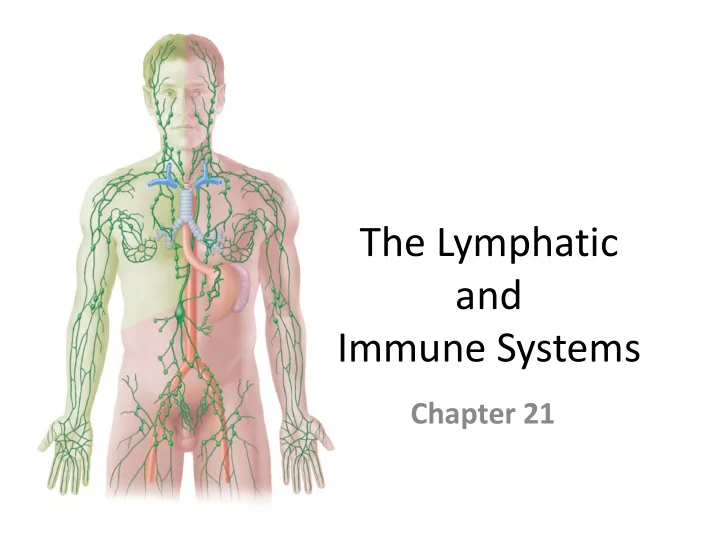
The Lymphatic and Immune Systems Chapter 21 The Lymphatic and - - PowerPoint PPT Presentation

the lymphatic and immune systems
SMART_READER_LITE
LIVE PREVIEW

The Lymphatic and Immune Systems Chapter 21 The Lymphatic and - - PowerPoint PPT Presentation

The Lymphatic and Immune Systems Chapter 21 The Lymphatic and Immune Systems Lymphatic system Main function is to return excess tissue fluid to blood vascular system Lymphatic vessels collect tissue fluid Immune system


slide-1
SLIDE 1

The Lymphatic and Immune Systems

Chapter 21

slide-2
SLIDE 2

The Lymphatic and Immune Systems

  • Lymphatic system

– Main function is to return excess tissue fluid to blood vascular system – Lymphatic vessels collect tissue fluid

  • Immune system

– Protects our bodies from foreign organisms – Confers immunity to disease – Main components

  • Lymphocytes, lymphoid tissue, and lymphoid organs
slide-3
SLIDE 3

The Lymphatic System

  • Lymphatic vessels collect tissue fluid from loose

connective tissue

– Carry fluid to great veins in the neck – Fluid flows only toward the heart – Once tissue fluid is within lymphatic vessels it is termed lymph

  • Functions of lymphatic vessels – collect excess

tissue fluid and blood proteins

  • Return tissue fluid and blood proteins to

bloodstream

slide-4
SLIDE 4

Orders of Lymphatic Vessels

  • Lymph capillaries – smallest

lymph vessels – First to receive lymph

  • Lymphatic collecting vessels –

collect from lymph capillaries – Lymph nodes are scattered along collection vessels

Lymphatic system Lymph duct Lymph trunk Lymph node Lymphatic capillary Blood capillaries Lymphatic collecting vessels, with valves (a) Structural relationship betw een a capillary bed of the blood vascular system and lymphatic capillaries

Heart

Arterial system Venous system

slide-5
SLIDE 5

Orders of Lymphatic Vessels

  • Lymph nodes

– Scattered along collecting vessels

  • Lymph trunks

– Collect lymph from collecting vessels

  • Lymph ducts

– Empty into veins of the neck

slide-6
SLIDE 6

Lymphatic Capillaries

  • Located near blood capillaries
  • Receive tissue fluid from CT

– Increased volume of tissue fluid

  • Minivalve flaps open and allow fluid to enter
  • High permeability allows entrance of

– Tissue fluid and protein molecules – Bacteria, viruses, and cancer cells

slide-7
SLIDE 7

Lymphatic Capillaries

  • Lacteals—specialized lymphatic capillaries

– Located in the villi of the small intestines

  • Receive digested fats
  • Fatty lymph—chyle
slide-8
SLIDE 8

Distribution and Features of Lymphatic Capillaries

Figure 21.1

Lymphatic system Lymph duct Lymph trunk Lymph node Lymphatic capillary Blood capillaries Lymphatic collecting vessels, with valves (a) Structural relationship betw een a capillary bed of the blood vascular system and lymphatic capillaries

Heart

Arterial system Venous system Filaments anchored to connective tissue Fibroblast in loose connective tissue Endothelial cell Flaplike minivalve (b) Lymphatic capillaries are blind-ended tubes in w hich adjacent endothelial cells overlap each other, forming flaplike minivalves. Tissue fluid Tissue cell Blood capillaries Lymphatic capillaries

slide-9
SLIDE 9

Lymphatic Collecting Vessels

  • Accompany blood vessels
  • Composed of the same three tunics as blood vessels
  • Contain more valves than veins do

– Helps direct the flow of blood

  • Lymph propelled by

– Skeletal muscles bulging – Nearby arteries pulsing – Tunica media of the lymph vessels

  • Lymph flow is unaided by heartbeat
slide-10
SLIDE 10

Lymph Nodes

  • Cleanse the lymph of pathogens
  • Human body contains around 500
  • Superficial lymph nodes located in

– Cervical, axillary, and inguinal regions

  • Deep nodes are

– Tracheobronchial, aortic, and iliac lymph nodes

slide-11
SLIDE 11

General Distribution of Lymphatic Collecting Vessels and Regional Lymph Nodes

Figure 21.2 Cervical nodes Entrance of right lymphatic duct into vein Internal jugular vein Entrance of thoracic duct into vein Thoracic duct Cisterna chyli Lymphatic collecting vessels Axillary nodes Aorta Inguinal nodes Regional lymph nodes

Drained by the right lymphatic duct Drained by the thoracic duct

slide-12
SLIDE 12

Microscopic Anatomy of a Lymph Node

  • Fibrous capsule—surrounds lymph nodes
  • Trabeculae—connective tissue strands
  • Lymph vessels

– Afferent lymphatic vessels – Efferent lymphatic vessels

slide-13
SLIDE 13

Microscopic Anatomy of a Lymph Node

Figure 21.3a Afferent lymphatic vessels Efferent lymphatic vessels Capsule Trabeculae Hilum Cortex Lymphoid follicle Germinal center Subcapsular sinus Medulla Medullary cord Medullary sinus (a) Longitudinal view of the internal structure

  • f a lymph node and associated lymphatics
slide-14
SLIDE 14

Microscopic Anatomy of a Lymph Node

Figure 21.3b Follicles Trabecula Subcapsular sinus Capsule Medullary cords Medullary sinuses (b) Photomicrograph of part of a lymph node (14X)

slide-15
SLIDE 15

Microscopic Anatomy of a Lymph Node

Figure 21.3c (c) Reticular tissue w ithin the medullary sinus (540X) Macrophage Medullary sinus Reticular fiber Lymphocytes Reticular cells

  • n reticular

fibers

slide-16
SLIDE 16

Lymph Trunks

  • Lymphatic collecting vessels converge
  • Five major lymph trunks

– Lumbar trunks

  • Receives lymph from lower limbs

– Intestinal trunk

  • Receives chyle from digestive organs

– Bronchomediastinal trunks

  • Collects lymph from thoracic viscera
slide-17
SLIDE 17

Lymph Trunks

  • Five major lymph trunks (continued)

– Subclavian trunks

  • Receive lymph from upper limbs and thoracic wall

– Jugular trunks

  • Drain lymph from the head and neck
slide-18
SLIDE 18

The Lymphatic Trunks

Figure 21.4a Left jugular trunk Internal jugular veins Left subclavian trunk Left subclavian vein Esophagus Trachea Ribs Left lumbar trunk Left broncho- mediastinal trunk Entrance of thoracic duct into vein Thoracic duct Hemiazygos vein Intestinal trunk Inferior vena cava Right jugular trunk Right lymphatic duct Right subclavian trunk Right subclavian vein Right broncho- mediastinal trunk Brachiocephalic veins Superior vena cava Azygos vein Cisterna chyli Right lumbar trunk (a) Major lymphatic trunks and ducts in relation to veins and surrounding structures, anterior view

slide-19
SLIDE 19

The Lymphatic Trunks

Figure 21.4b (b) Thoracic duct (colored green) along the posterior thoracic w all Azygos vein

  • n vertebral

bodies Thoracic duct Aorta

slide-20
SLIDE 20

Lymph Ducts

  • Cisterna chyli

– Located at the union of lumbar and intestinal trunks

  • Thoracic duct

– Ascends along vertebral bodies – Empties into venous circulation

  • Junction of left internal jugular and left subclavian veins
  • Drains three quarters of the body
slide-21
SLIDE 21

Right Lymphatic Duct

  • Empties into right

internal jugular and subclavian veins

Internal jugular veins Right jugular trunk Right lymphatic duct Right subclavian trunk Right subclavian vein Right broncho- mediastinal trunk Brachiocephalic veins Superior vena cava Azygos vein Cisterna chyli Right lumbar trunk

slide-22
SLIDE 22

The Immune System

  • Recognizes specific foreign molecules
  • Destroys pathogens effectively
  • Key cells—lymphocytes
  • Also includes lymphoid tissue and lymphoid organs
  • Lymphoid organs

– Lymph nodes, spleen, thymus, tonsils, aggregated lymphoid nodules, and appendix

slide-23
SLIDE 23

Lymphocytes

  • Infectious organisms attacked by inflammatory

response

– Macrophages, then lymphocytes

  • Are effective fighters of infectious organisms

– Each lymphocyte recognizes a specific foreign molecule

  • Antigens are any molecules inducing a response from a

lymphocyte

slide-24
SLIDE 24

Lymphocytes

  • B lymphocytes and T lymphocytes are the two main

classes of lymphocytes

  • Cytotoxic T lymphocytes

– Attack foreign cells directly

  • Binds to antigen-bearing cells
  • Perforates cell membrane
  • Signals cell to undergo apoptosis
  • Destroy virus infected cells and some cancer cells
slide-25
SLIDE 25

Lymphocytes

  • B lymphocytes

– Become plasma cells – Secrete antibodies

  • Mark cells for destruction by macrophages

– Respond primarily to bacteria and bacterial toxins

slide-26
SLIDE 26

Lymphocyte Function

Figure 21.5 T lymphocyte binds to target cell, secretes proteins that lyse the cell’s membrane, and signals the cell to die. B lymphocyte gives rise to plasma cell, which secretes antibodies. Antibodies bind to antigens on bacteria, marking the bacteria for destruction. Antibody-coated bacteria are avidly phagocytized. T lymphocyte detaches from target cell. Target cell dies by apoptosis. T lymphocyte Target cell, bearing antigen Dead target cell Antigen (a) Action of cytotoxic T lymphocyte (b) Differentiation and activity of B lymphocyte B lymphocyte Plasma cell Macrophage Surface antigen Antibodies Bacterium

1 2 3 1 2 3

slide-27
SLIDE 27

Lymphocyte Activation

  • Lymphocytes originate in bone marrow
  • Some travel to the thymus gland

– T lymphocytes

  • Some stay in bone marrow

– B lymphocytes

  • Able to recognize a unique antigen

– Gain immunocompetence

  • Travels through blood stream

– Meets and binds to a specific antigen

slide-28
SLIDE 28

Lymphocyte Activation

  • During activation

– Lymphocyte is presented its antigen by

  • A macrophage
  • Or a dendritic cell
slide-29
SLIDE 29

Lymphocyte Activation

  • Both T and B lymphocytes produce clones of

– Effector lymphocytes

  • Respond immediately, then die

– Memory cells

  • Wait until the body encounters the antigen again
  • Basis of acquired immunity
  • Prevent subsequent infections of the same illness
slide-30
SLIDE 30

Lymphocyte Activation

Figure 21.6 Red bone marrow Bone marrow Immature lymphocytes Red bone marrow : site of lymphocyte origin Secondary lymphoid organs: site of antigen encounter, and activation to become effector and memory B or T cells Primary lymphoid organs: site of development of immuno- competence as B or T cells Lymphocytes destined to become T cells migrate (in blood) to the thymus and develop immunocompetence there. B cells develop immunocompetence in red bone marrow. Immunocompetent but still naive lymphocytes leave the thymus and bone marrow. They “seed” the lymph nodes, spleen, and other lymphoid tissues where they encounter their antigen. Antigen-activated immuno- competent lymphocytes (effector cells and memory cells) circulate continuously in the bloodstream and lymph and throughout the lymphoid

  • rgans of the body.

1 2 3 Thymus Lymph nodes, spleen, and other lymphoid tissues

slide-31
SLIDE 31

Lymphoid Tissue

  • Most important tissue of the immune system
  • Two general locations

– Mucous membranes of

  • Digestive, urinary, respiratory, and reproductive

tracts

– Mucosa-associated lymphoid tissue (MALT)

  • Lymphoid organs (except thymus)
slide-32
SLIDE 32

Lymphoid Tissue

Figure 21.7 Lymphoid follicle Mucous membrane lining small intestine Lumen Muscle layers Intestine Germinal center Lumen of intestine Lymphoid tissue from mucosa of small intestine (14×)

slide-33
SLIDE 33

Lymphoid Organs

  • Primary lymphoid organs

– Bone marrow – Thymus

  • Secondary lymphoid organs

– Lymph nodes, spleen, tonsils – Aggregated lymphoid nodules – Appendix

slide-34
SLIDE 34

Lymphoid Organs

  • Designed to gather and destroy infectious microorganisms and to

store lymphocytes

Figure 21.8 Tonsils (in pharyngeal region) Thymus (in thorax; most active during youth) Spleen (curves around left side of stomach) Aggregated lymphoid nodule (in intestine) Appendix

slide-35
SLIDE 35

Thymus

  • Immature lymphocytes develop into T lymphocytes
  • Secretes thymic hormones
  • Most active in childhood
  • Functional tissue atrophies with age
  • Composed of cortex and medulla

– Medulla contains Hassall’s corpuscles (thymic corpuseles)

  • Differs from other lymphoid organs

– Functions strictly in lymphocyte maturation – Arises from epithelial tissue

slide-36
SLIDE 36

Thymus

Figure 21.9 Cortex Medulla Thymic corpuscle (b) Micrograph of thymic tissue show ing part of a lobule Thymus (a)Thymus located in the superior mediastinum

slide-37
SLIDE 37

Lymph Nodes

  • Function

– Lymph percolates through lymph sinuses – Most antigenic challenges occur in lymph nodes – Antigens destroyed and activate B and T lymphocytes

slide-38
SLIDE 38

Spleen

  • Largest lymphoid organ
  • Two main blood-cleansing functions

– Removal of blood-borne antigens – Removal and destruction of old or defective blood cells

  • Site of hematopoiesis in the fetus
slide-39
SLIDE 39

Spleen

  • Destruction of antigens
  • Site of B cell maturation into plasma cells
  • Phagocytosis of bacteria and worn-out RBCs, WBCs

and platelets

  • Storage of platelets
slide-40
SLIDE 40

Spleen

  • White pulp

– Thick sleeves of lymphoid tissue – Blood-borne antigens are destroyed as they activate the immune response – Provides the immune function of the spleen

  • Red pulp

– Surrounds white pulp – Composed of

  • Venous sinuses
  • Splenic cords
  • Responsible for disposing of worn out RBCs
slide-41
SLIDE 41

Spleen

Figure 21.10a, b Splenic artery Splenic vein Hilum (a) Diagram of the spleen, anterior view Arterioles and capillaries Capsule Trabecula Venous sinuses Red pulp Splenic cords White pulp Central artery Splenic artery Splenic vein (b) Diagram of spleen histology

slide-42
SLIDE 42

Spleen

Figure 21.10c, d

(c) Photograph of the spleen in its normal position in the abdominal cavity, anterior view Diaphragm Spleen Adrenal gland Splenic artery Pancreas Left kidney (d) Photomicrograph of spleen tissue (7×). The white pulp, a lymphoid tissue with many lymphocytes, is surrounded by red pulp containing abundant erythrocytes. Capsule White pulp Red pulp

slide-43
SLIDE 43

Tonsils

  • Simplest lymphoid organs
  • Four groups of tonsils

– Palatine, lingual, pharyngeal, and tubal tonsils

  • Arranged in a ring to gather and remove pathogens
  • Underlying lamina propria consists of MALT
slide-44
SLIDE 44

Tonsil Tonsillar crypt Germinal centers in lymphoid follicles Pharyngeal tonsil Palatine tonsil Lingual tonsil

Palatine Tonsil

Figure 21.11

slide-45
SLIDE 45

Aggregated Lymphoid Nodules & Appendix

  • MALT—abundant in walls of intestines
  • Fight invading bacteria
  • Generate a wide variety of memory lymphocytes

– Aggregated lymphoid nodules (Peyer’s patches)

  • Located in the distal part of the small intestine

– Appendix—tubular offshoot of the cecum

slide-46
SLIDE 46

Smooth muscle in the intestinal wall Aggregated lymphoid nodules (Peyer’s patch)

Aggregated Lymphoid Nodule

Figure 21.12

slide-47
SLIDE 47

Disorders of the Lymphatic and Immune Systems

  • Chylothorax

– Leakage of fatty lymph into the thorax

  • Lymphangitis

– Inflammation of a lymph vessel

  • Mononucleosis

– Viral disease caused by Epstein-Barr virus – Attacks B lymphocytes

slide-48
SLIDE 48

Disorders of the Lymphatic and Immune Systems

  • Hodgkin’s disease

– Malignancy of lymph nodes

  • Non-Hodgkin’s lymphoma

– Uncontrolled multiplication and metastasis of undifferentiated lymphocytes

slide-49
SLIDE 49

The Lymphatic and Immune Systems Throughout Life

  • Lymphatic vessels and lymph nodes

– Develop from lymphatic sacs

  • Thymus originates as an outgrowth of the endoderm
  • Spleen, lymph nodes, and MALT

– Arise from mesodermal mesenchyme