The Life & Times of Jacob FROM FLIGHT T0 RECONCILIATION - - PowerPoint PPT Presentation

the life times of jacob
SMART_READER_LITE
LIVE PREVIEW

The Life & Times of Jacob FROM FLIGHT T0 RECONCILIATION - - PowerPoint PPT Presentation

The Life & Times of Jacob FROM FLIGHT T0 RECONCILIATION GENESIS 28:10-36:43 General Structural Overview REFERENCE SECTION TITLE The Journey to Haran 28:10-22 The Birthing of a Nation Literally! 29:1-30:24 Jacobs


slide-1
SLIDE 1

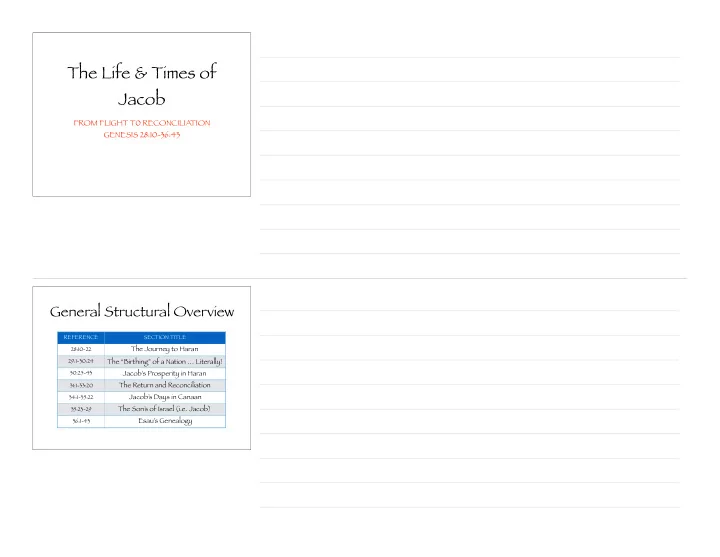
The Life & Times of Jacob

FROM FLIGHT T0 RECONCILIATION GENESIS 28:10-36:43

General Structural Overview

REFERENCE SECTION TITLE 28:10-22

The Journey to Haran

29:1-30:24

The “Birthing” of a Nation … Literally!

30:25-43

Jacob’s Prosperity in Haran

31:1-33:20

The Return and Reconciliation

34:1-35:22

Jacob’s Days in Canaan

35:23-29

The Son’s of Israel (i.e. Jacob)

36:1-43

Esau’s Genealogy

slide-2
SLIDE 2

Opening Thoughts

Jacob is an amalgamation of the “best” and the “worst

  • f Abraham & Isaac

While a “Momma’s Boy” Jacob was a capable individual He was leaving his father’s house, but the God of his fathers appeared, spoke to, and became his God

God’s assurances are striking considering Jacob’s behavior ... Reminding us that our failures cannot overpower God’s grace

Opening Thoughts

Jacob’s marital problems rival Abraham’s … producing conflict & bitterness “in the camp” Excepting Moses, Jacob had the most vivid & frequent encounters with the LORD … the ladder; the wrestling match Jacob reaped what he sowed — Reminding us of Gal 6:7ff

slide-3
SLIDE 3

The Journey to Haran

GENESIS 28:10-22

Structure

God’s assurance — vv. 10-15 Jacob’s response — vv. 16-22

Worship — vv. 16-19 Vow — vv. 20-22

slide-4
SLIDE 4

God’s Assurance

What is most notable about God’s assurance?

The timing … and, of course, on the heels of treachery Jacob was likely having a moment of weakness 2-3 days into the journey ≈ 50 miles from Beersheba

Though in his 70’s this is his first time alone away from home

This is the 1st of 7 theophanies Jacob experiences

  • Cf. 31:3, 11-13; 32:1-2; 32:24-30; 35:1; 35:9-13; 46:1-4

The dream has two parts — what are they?

God’s Assurance

The vision itself — vv. 10-13a The vision explained — vv. 13b-15

The heavenly vision itself — vv. 10-13a

Having traveled 2-3 days, and the sun setting, Jacob “beds down” for the night Anyone ever slept on a “rock pillow?” … I’d at least have a neck ache — if not a dream!

slide-5
SLIDE 5

God’s Assurance

What in vv. 10-13a tells us that Jacob is impressed or startled by the dream?

The word BEHOLD repeated three times in vv. 12 (2x’s), 13a Behold .. A ladder; Behold .. Angels; Behold .. THE LORD!!!!

God led Jacob “to” or “near to” the site of God’s appearance to Abram in Gen 12:7-9 What does Jacob see in the vision?

A BIG ladder — or staircase … That extends from heaven to earth … An “angel shuttle” …

God’s Assurance

Yahweh Himself — either above the ladder or beside Jacob … “above” is probably better

What does this “vision” symbolize?

Continuous communion between heaven & earth Mediated by God through His holy angels For the care of His children on earth!

What later revelation does the Bible provide about the ladder?

It prefigures Christ and His mediating work - John 1:51 [TURN]

slide-6
SLIDE 6

Angelology

AN EXCURSUS — NEXT WEEK

God’s Assurance

The vision explained — vv. 13b-15

As magnificent as the vision must have been … God’s words of assurance provided the real comfort

What do we learn about God in the assurance?

He is a living God who exists - v. 13b (“I am”) He is an omnipresent God - v. 15 (“wherever”) He is an omnipotent God - v. 15 (“until I have done …”) He is a gracious God - v. 15 (“what I have promised you”)

slide-7
SLIDE 7

God’s Assurance

What are God’s assurance in vv. 13-14?

The land and its extent - vv. 13c, 14b Numerous descendants - v. 14a General blessings to the families of the earth - v. 14c The specific “Seed” blessing - v. 14d

Hard to see in the EV’s … as they combine the blessing Literally, v. 14 reads … “ And all the families of the earth will be blessed in you, AND in your seed.”

God’s Assurance

I think it is constructed this way for emphasis — There will be general blessings flowing through the Abrahamic Covenant … And, a very specific Messianic blessing … THE SEED

These all repeat aspects of the Abrahamic Covenant — being passed on to Jacob But God strings on something in addition … What is it?

Four very personal reassurances —

I am with you … God’s personal presence

slide-8
SLIDE 8

God’s Assurance

I will keep you — God’s personal protection I will bring you back — God’s personal promise .. part 1 I will not leave you until I have fulfilled everything I have promises — God’s personal promise .. part 2

Why does God add these personal assurances to the Covenant promises?

Because He is taking Jacob out of the land … So God spoke to all of Jacob’s unspoken insecurities

God’s assurances

I’m lonely God … “I’ll be with you” I’m afraid God … “I’ll keep you” Will I ever come home God … “I’ll bring you back” Will everything work out God … “I’ll do what I’ve promised” All marvelous and precious promises … and a great reminder to us in times of trial!

slide-9
SLIDE 9

Jacob’s Worship

Jacob responds as his forefathers did … in worship His immediate reaction to the dream comes in vv. 16-17 Likely waking from the dream in the night, Jacob first recognizes the significance … the LORD is in this place!!! “… and I did not know it” suggests the full extent of the revelation made to Jacob — namely God’s omnipresence

He experienced nothing less than God’s presence in the dream — precisely where he was …

Jacob’s Worship

Receiving and experiencing great relief that God has gone “with him,” and not deserted him … Which alone would be a great reassurance having left the safe confines of his home and his parents

And then in v. 17 Jacob has the appropriate reaction of any sinner in God’s presence What is it?

Fear first, followed by reverent awe

slide-10
SLIDE 10

Jacob’s Worship

Does this remind you of other occasions of God’s presence?

How about the transfiguration … Matt 17:5-6 Or Isaiah … Isa 6:1ff Or Moses … Exod 3:5-6

Jacob goes on to recognize the place as “God’s house” and the “gate of heaven” His lasting reaction comes in vv. 18-19 when he arises in the morning

Jacob’s Worship

What are they?

T

  • place and anoint a memorial stone — note this is

not an altar T

  • give the place a memorial name … lae-tyBe … which

is a compound word meaning “House of God”

Jacob now moves to the second part of his response in vv. 20-22 … which is to make a vow

slide-11
SLIDE 11

Jacob’s Vow

What is going on here — is the wheeler dealer Jacob “making” a bargain with God?

NO … but it is tricky to understand because of the “conditional clause” construction (i.e. “if/then”)

We need to do a little background work on Biblical vows to understand The noun (rd<n<) and verbal (rd:n") forms of the Hebrew words “vow, to vow” occur 91x’s

89x’s in the OT , 2 x’s in the NT — It is a OT concept!

Jacob’s Vow

NT use is found in Acts alone

Acts 18:18 of Paul shaving his head upon fulfillment of a vow Acts 21:23 of Paul to appease “Jewish Christians” who felt he was denying the Law In both instances, Paul is exercising his “liberties” fully knowing that he is not bound by the OT Law

In the one case he exercises his liberty to make & complete a vow … shaving his head (18:18) And in the other case he is giving us a liberty so as not to stumble Jewish believers (21:23)

slide-12
SLIDE 12

Jacob’s Vow

The OT use of vow is far more extensive … Falling into three categories

Laws about vows in general Laws about the Nazirite vow Actual vows made by OT people

Laws about vows deal with the rituals associated with making and fulfilling a vow (votive offerings)

These are found in Lev, Num, Deut, 1 Sam, Eccl

Jacob’s Vow

Laws about the Nazirite vow (Num 6 … [T urn])

This is a special vow to set oneself apart for the Lord for a particular service for a specific period of time

Though Samson and Samuel were lifetime examples

Verses 1-8 define the three rules of the Nazirite vow

You shall not shave the hair of your head You shall not imbibe alcohol You shall not come in to contact with a dead person

slide-13
SLIDE 13

Jacob’s Vow

It goes on to define the remedy for unintentional impurity related to a dead person - vv. 9-12

Shave your head, make sacrifices, start over again … no previous time credit given!

And closes with the procedure for “closing” the vow once fulfilled - vv. 13-20

Additional Naziritic vow laws are found in Deut 30 … defining who can and cannot make a binding vow

A man … presumably of age

Jacob’s Vow

A female widow An unmarried woman … if not disapproved by her father A married woman … if not disapproved by her husband (Hannah is an example)

Actual vows in the OT

The first is found in our text today … Jacob Then we have the nation of Israel in Num 21:2

Vow to go to war against King Arad in the Negev

slide-14
SLIDE 14

Jacob’s Vow

Followed by a VERY RASH vow … anyone remember who this is?

Jephthah - Judg 11:30 … 39 = fulfillment

Samson is next … actually set aside by God to be a Nazirite from birth - Judg 13:2ff Samuel … offered by his Mother Hannah ( and Elkanah’s approval) for life - 1 Sam 1:11 Absalom … though used for trickery - 2 Sam 15-7-8

Jacob’s Vow

OT vow formula … “if/then”

Each of the aforementioned vows follow the same “grammatical construction” In every case, the “if” is not a pure condition Rather it is defining a request or supplication (petition) made to God to do something The “then” part of the vow states what the supplicant will do in thanksgiving NOTE: In every case, the one making the vow proceeds in anticipation of God fulfilling the supplication!

slide-15
SLIDE 15

Jacob’s Vow

Vows are not imposing a condition upon God … rather they are appeals for Him to act in some particular way

Perhaps even an “acknowledgment” or a “confidence” that God WILL ACT in a particular way T

  • see this, substitute the word “since” for “if”

So with that — let’s look at Jacob’s vow … He has just finished worshipping in vv. 16-19

Jacob’s Vow

So it is incomprehensible to me that Jacob would follow this by “testing God” … or attempting to bargain with God Rather, I believe it is Jacob’s expression of thanksgiving and gratitude for God’s assurances in vv. 13b-15 OR … it could be an expression of faith in what God will do! Either way, note how he connects his vow in v. 20 with the promise of v. 15

  • v. 15: Behold I am with you and will keep you …
  • v. 20: If God will be with me and will keep me …
slide-16
SLIDE 16

Jacob’s Vow

And then Jacob goes on in v. 20 to enumerate temporal details like food & clothing

Even though he focuses on the “personal and temporal” over the “grand and eternal” he is not ignorant of the greater promises … Rather, he is unfolding in his mind the potentialities, in practical terms, of God’s presence Jacob may be petty in his focus, but he does “GET IT”

Jacob’s Vow

We work this out 1 of 3 ways grammatically …

The first, and easiest, is to substitute the word “since” for the word “if” in v. 20 …

This would suggest that Jacob is simply “owning” and further articulating the promises of God … With a particular focus on the final part of God’s promise … “I am with you”

This is acceptable, but a little “accommodating” because every vow follows the if/then structure

slide-17
SLIDE 17

Jacob’s Vow

The second way to address the “if” is to view it as an “if of assumption”

We do this all the time — for example … Lets say you tell me that you are going to the grocery store I might say … Well IF you are going to the grocery store, THEN would you pick up a gallon of milk for me. I’m not bargaining or questioning, I’m simply affirming your statement and responding to its veracity with a request.

This is also an acceptable grammatical solution that would fit all situations, but …

Jacob’s Vow

There is a “best” grammatical solution

This solution identifies the protasis and apodosis differently than the text …

This is fancy language for where you put the “if” and the “then” in a conditional clause The if indicates the protasis … i.e. the “condition” And the then indicates the apodosis … i.e. the “the result”

slide-18
SLIDE 18

Jacob’s Vow

The forms of the verb give us strong support for moving the “then” from the final clause of v. 21 to the beginning of v. 22 [READ] Notice vv. 20-21

If God … will be with me; will keep me; will give me; will return me; will be my God The first “will be” uses a form that gives us the view of the person affected as the action of the verb develops … i.e. looking at the action from the “inside-out” The following “will be’s” use a form that expresses the action as a completed whole — here expressing the certainty of occurrence in the mind of the speaker … also known as looking “outside-in”

Jacob’s Vow

Grammatically these two things are know as “aspect”

Hebrew verbs do not strictly indicate time — rather the nature of the action of the verb … we get time from the context of the verse

Now in v. 22 the grammatical construction changes to a different and abnormal construction

Normal Hebrew sentences follow verb, subject, object order Verse 22 alters this with a subject, adjective clause, verb order … indicating a “disjunctive relationship” with the prior verse — by disjunctive I mean a change in direction The “disjunction” defines the switch from conditions to results

slide-19
SLIDE 19

Jacob’s Vow

Making this is the most natural point to place the beginning of the apodosis … i.e. the THEN statement

Jacob’s response to God’s promises and the affirmations he recites in vv. 20-21, THEN, is to do two things — what are they?

Mark the place with the stone of v. 18 as the house of God (which is the name of the place … Bethel) And give a tenth back to God

For which God demands payment and Jacob complies in Gen 35:1-7 [READ] PRETTY COOL … DON’T YOU THINK!😁