The Levites Concubine CLASS 5A Orientation to the land of the - - PDF document

the levite s concubine
SMART_READER_LITE
LIVE PREVIEW

The Levites Concubine CLASS 5A Orientation to the land of the - - PDF document

3/10/20 The Levites Concubine CLASS 5A Orientation to the land of the confederation of 12 tribes Story set in the period of judges, before the monarchies, 11501000 BCE Story TOLD much later; after destruction of the Northern


slide-1
SLIDE 1

3/10/20 1

The Levite’s Concubine

CLASS 5A

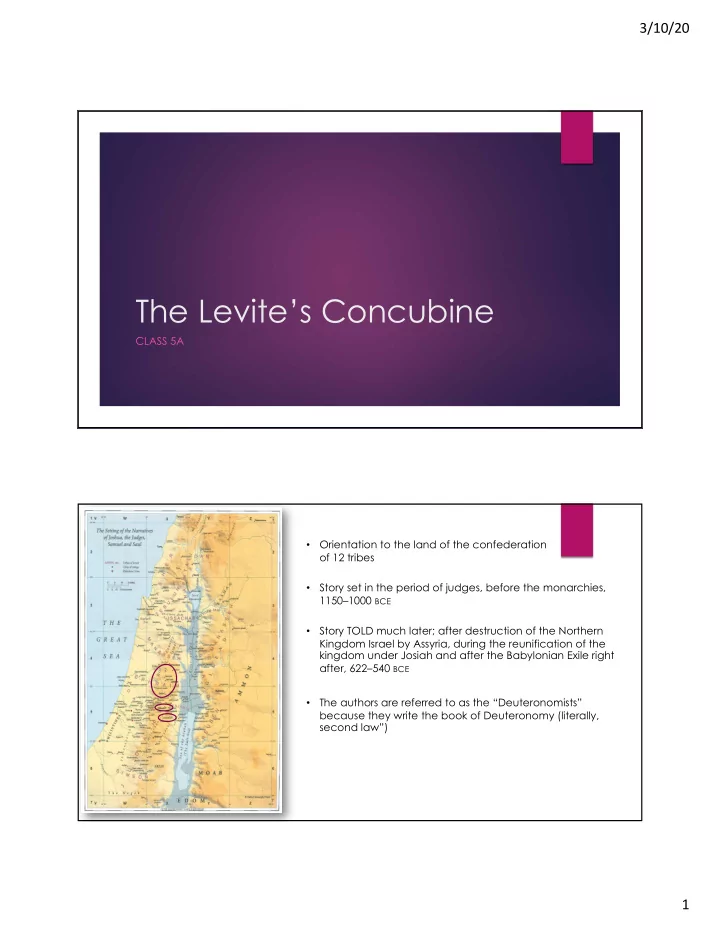
  • Orientation to the land of the confederation
  • f 12 tribes
  • Story set in the period of judges, before the monarchies,

1150–1000 BCE

  • Story TOLD much later; after destruction of the Northern

Kingdom Israel by Assyria, during the reunification of the kingdom under Josiah and after the Babylonian Exile right after, 622–540 BCE

  • The authors are referred to as the “Deuteronomists”

because they write the book of Deuteronomy (literally, second law”)

slide-2
SLIDE 2

3/10/20 2

Our Authors & Their Plot

  • The Deuteronomists write much of the Hebrew

Bible (Deuteronomy, Joshua, Judges, 1–2 Samuel, 1–2 Kings)

  • They have endured first the loss of the northern

kingdom to Assyria, and then the reunified kingdom to Babylon

  • There are several issues they are trying to

address:

  • Is their covenant with YHWH still valid?
  • What sort of monarchy, if any, is good?
  • What is the relationship of the people Israel

to the land Israel?

David, first king of unified Israel

Our plot lies early in their wider story of Israel’s history, just before its first King Saul is chosen. Its role is to explain why a king is needed.

Our Characters

  • Levite
  • Levite’s concubine
  • Levite’s father-in-law
  • The old man from

Ephraim, living in Gibeah

  • The Benjaminites of

Gibeah

  • All of the Israelites
slide-3
SLIDE 3

3/10/20 3

The original Hebrew has “she fornicated against him” Some wonder if the last letter is het (ח) rather than he (ה); in that case, the verb would be “she resisted him” – closer to the LXX On your handout of Judges 19, review the part of the story in the left column against the part of the story on the right. How do the actions on the left compare or contrast with the actions on the right? The verb, “to know” (ידע) The verb, “to oppress, humiliate, afflict, violate” (ענה)

Judges 19:22-26

slide-4
SLIDE 4

3/10/20 4

When the Levite recounts the crime, he uses the second verb,ענה , “to oppress humiliate, afflict, violate” Is this what happened? Has the Levite left anything out?

Judges 20:4-7