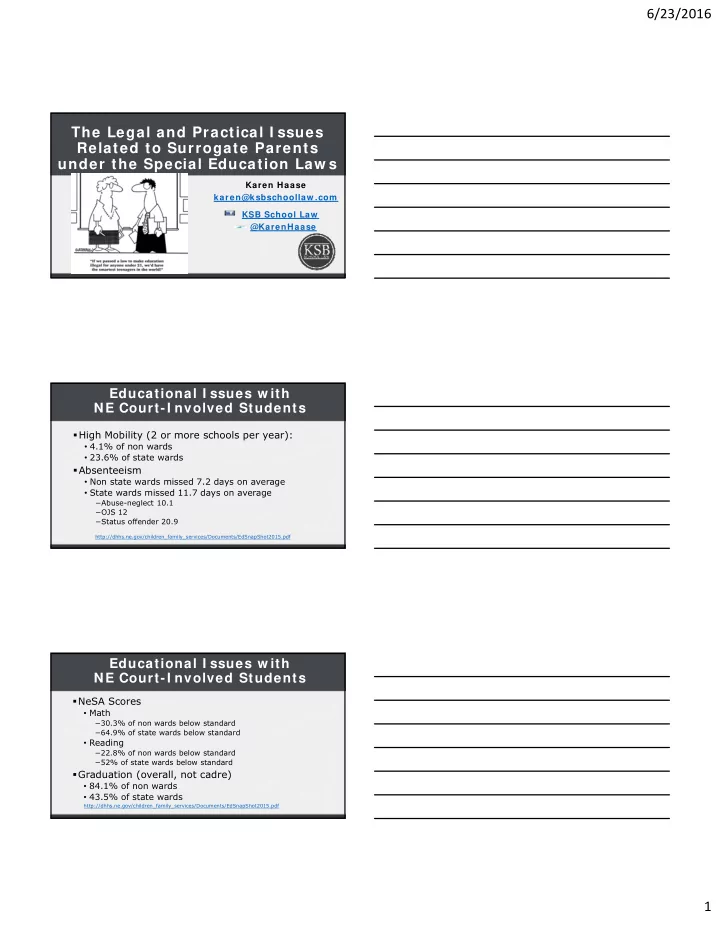
The Legal and Practical I ssues Related to Surrogate Parents under - - PDF document

the legal and practical i ssues related to surrogate
SMART_READER_LITE
LIVE PREVIEW

The Legal and Practical I ssues Related to Surrogate Parents under - - PDF document

6/23/2016 The Legal and Practical I ssues Related to Surrogate Parents under the Special Education Law s Karen Haase karen@ksbschoollaw .com KSB School Law @KarenHaase Educational I ssues w ith NE Court-I nvolved Students High Mobility


slide-1
SLIDE 1

6/23/2016 1 The Legal and Practical I ssues Related to Surrogate Parents under the Special Education Law s

Karen Haase karen@ksbschoollaw .com KSB School Law @KarenHaase

Educational I ssues w ith NE Court-I nvolved Students

  • High Mobility (2 or more schools per year):
  • 4.1% of non wards
  • 23.6% of state wards
  • Absenteeism
  • Non state wards missed 7.2 days on average
  • State wards missed 11.7 days on average

−Abuse-neglect 10.1 −OJS 12 −Status offender 20.9

http://dhhs.ne.gov/children_family_services/Documents/EdSnapShot2015.pdf

Educational I ssues w ith NE Court-I nvolved Students

  • NeSA Scores
  • Math

−30.3% of non wards below standard −64.9% of state wards below standard

  • Reading

−22.8% of non wards below standard −52% of state wards below standard

  • Graduation (overall, not cadre)
  • 84.1% of non wards
  • 43.5% of state wards

http://dhhs.ne.gov/children_family_services/Documents/EdSnapShot2015.pdf

slide-2
SLIDE 2

6/23/2016 2

A w ord about extracurriculars

  • Not part of the data tracked by the NE

State Ward Statistical Snapshot

  • Nebraska Strengthening Families Act (LB

746 2016)

  • Requires that caregivers be trained and authorized to

apply the “reasonable and prudent parent standard” to decisions involving the “participation of the child in age or developmentally appropriate activities”

  • does not give children in out-of-home care special

rights to participate based on their status as foster children

North Carolina study ( 2 0 0 1 )

  • GPA
  • Activities: 2.98
  • Non-activities: 2.17
  • Absences
  • Activities: 6.3
  • Non-activities: 11.9
  • Discipline referrals
  • Activities: 33.3%
  • Non-activities: 41.8%
  • Dropout Rate
  • Activities: .6%
  • Non-activities: 10.32
  • Graduation rate
  • Activities: 99.4%
  • Non-activities: 93.5%

College Entrance Exam ination Board study ( 2 0 0 5 )

  • SAT scores analyzed for 480,000 students
  • Statistically significant difference related to

activity participation

  • Controlled for:

−Academic achievement −Native language of household −Family socioeconomic factors −Effects magnified for students of color

slide-3
SLIDE 3

6/23/2016 3

Special Education I ssues For Children I n Child W elfare System

  • Between 30-40% of school-age children in

the foster care need special education services

  • Compared to 11-15% of their peers

www.fostercareandeducation.org/OurWork/NationalWorkingGroup.aspx

W hy A Child Needs A “Parent” I n the Special Education Process

  • Special education is a parent-driven process.

Nothing happens without a “parent”-- an active, involved decisionmaker who can consent to an evaluation, services, placement, and advocate for a child with disabilities.

  • The IDEA confers specific rights and obligations
  • n the “IDEA Parent.”

W ho is a parent?

slide-4
SLIDE 4

6/23/2016 4

A parent is…

( 3 4 CFR 3 0 0 .3 0 )

  • Natural or adoptive parent of a child

A parent is…

( 3 4 CFR 3 0 0 .3 0 )

  • Two caveats to “parent” definition:
  • Presumption in favor of Biological or Adoptive Parent if

−Bio./adoptive parent still has legal authority −Bio./adoptive parent is “attempting to act as the parent”

  • Unless a court orders someone else to act as the

“parent”

−So if no bio parent, but there is a foster parent, foster parent is the “parent”

See 34 C.F.R. § 300.30(b)

A parent is…

( 3 4 CFR 3 0 0 .3 0 )

  • Natural or adoptive parent of a child
  • A foster parent
  • A guardian but not the state if the child is a

ward of the state (thus no caseworkers)

  • An individual acting in the place of a

natural or adoptive parent with who the child lives who is legally responsible for the child’s welfare

slide-5
SLIDE 5

6/23/2016 5

Surrogate parent

( 3 4 CFR 3 0 0 .5 1 9 )

  • The LEA shall appoint a surrogate parent

when:

  • no parent can be identified
  • Or be located
  • Or child is a ward of the state
  • Or child is unaccompanied homeless youth.

Presence of Parent Prevents Appointm ent of Surrogate Garvey Elem . Sch. Dist.

1 1 0 LRP 3 0 5 4 3 ( SEA CA 2 0 1 0 )

  • Parent’s legal guardian had work conflict
  • Consented to a last-minute appointment of

surrogate parent

  • ALJ:
  • District not permitted to appoint surrogate when

parent/guardian is involved

  • Consent did not excuse meeting without

presence of parent

slide-6
SLIDE 6

6/23/2016 6

Cincinnati City Schs.

1 1 4 LRP 4 8 5 0 ( SEA OH 2 0 1 3 )

  • Student placed in foster care
  • Juvenile court ordered that mother be included in

treatment team planning and placement meetings

  • School appointed surrogate parent
  • State Dep’t of Ed:
  • Court did not terminate mother’s educational rights
  • Placement in foster care alone not sufficient

Charles County Schs.

1 1 1 LRP 5 5 0 2 7 ( SEA MD 2 0 1 0 )

  • Student placed in group home by county

department of juvenile services

  • School appointed surrogate parent
  • State Dep’t of Ed:
  • School failed to make sufficient efforts to contact

mother or grandfather

  • Placement in group home alone not sufficient

Letter to Caplan

5 8 I DELR 1 3 9 ( OSEP 2 0 1 1 )

  • CWA director – is surrogate parent required when:
  • Court assigned limited guardianship to state agency and

parent is available

  • Court assigned guardianship and reunification sought
  • Court has revoked educational rights
  • OSEP:
  • We do not believe 34 CFR 300.519(b) requires automatic

appointment of surrogate parent for every child who is a ward of the State

  • Decision lies with the school, not the CWA
  • Key is whether biological or adoptive parent retains the

authority to participate in the development of the child’s IEP and make other educational choices for the child

slide-7
SLIDE 7

6/23/2016 7

A parent is…

( 3 4 CFR 3 0 0 .3 0 )

  • Natural or adoptive parent of a child
  • A foster parent
  • A guardian but not the state if the child is a

ward of the state (thus no caseworkers)

  • An individual acting in the place of a

natural or adoptive parent with who the child lives who is legally responsible for the child’s welfare

W hat if the Parent is Being a Jerk?

  • School can’t appoint a surrogate just because

the bio./adoptive parent is “uncooperative” or won’t attend a meeting (Letter to Perryman, 211 IDELR 438 (OSEP 1987))

  • School can’t appoint surrogate due to a parent

acting in a manner opposed to, or inconsistent with the best interests of the child (Dundee

  • Cent. Sch. Dist., 509 IDELR 191 (SEA NY 1987)

Presence of Another Adult Prevents Appointm ent of Surrogate

slide-8
SLIDE 8

6/23/2016 8

Presence of Another Adult Prevents Appointm ent of Surrogate

  • Foster
  • In loco parentis

Converse County Sch. Dist.

6 3 I DELR 2 1 ( Mont. 2 0 1 4 )

  • 19 year old student with autism
  • Biological mother’s parental rights terminated
  • Foster father willing to make educational

decisions

  • School appointed surrogate
  • Court
  • IDEA does say school required to appoint surrogate

parent when child is a ward of the state

  • But IDEA also defines “parent” to include foster

parent unless state law prohibits

  • Foster parent willing and without conflict, therefore

no surrogate necessary

Brow nsburg Cm ty. Sch. Corp.

1 1 4 LRP 3 2 8 2 7 ( SEA I N 2 0 1 4 )

  • Student placed in foster care with Aunt and Uncle
  • School appointed Aunt and Uncle as surrogate parents
  • Mom sent e-mail: The judge lifted the restrictions and

[Student] and I am [sic] spending lots of time together."

  • School proceeded with IEP meetings with Aunt and

Uncle; mom sued

  • State Department of Ed:
  • Student placed in care of foster parents
  • Mother did not provide any documentation to the contrary
  • Foster parent willing and without conflict, therefore no

surrogate necessary

slide-9
SLIDE 9

6/23/2016 9

Marysville Joint Unif. Sch. Dist.

1 1 4 LRP 6 9 3 4 ( SEA CA 2 0 1 4 )

  • Student ward of court
  • Court made no finding about “educational rights”
  • Placed in transitional housing program
  • Assigned “independent study mentor”
  • Responsible for arranging and transporting her to medical

appointments

  • Helped student with life skills decisions (financial, self-care,

etc.)

  • School treated mentor as in loco parentis
  • Student sued after aged out (21) seeking more services
  • Court
  • Mentor acted in parental role
  • School properly declined to appoint surrogate

Special Problem : Unaccom panied Hom eless Youth

  • McKinney-Vento Homeless Assistance Act (42

U.S.C. §11431 et. seq.)

  • lack a fixed, regular, and adequate nighttime

residence

  • Includes:

−Living with family or in motel −Abandoned −Living in cars, parks, etc −Migratory children −Abused, homeless, not yet in system −Aged out of foster and homeless −awaiting foster care

Special Problem : Unaccom panied Hom eless Youth

  • ESSA removed “awaiting foster care” from

homeless definition

  • Effective 12/10/16 in NE
  • Instead CWAs and LEAs must meet school

stability provisions of Title I of ESSA (Fostering Connections Act requirements)

slide-10
SLIDE 10

6/23/2016 10

Tim eline for Appointing Surrogate

  • Should appoint within 30 days – 34 CFR

300.519(h)

Surrogate Parent Responsibilities Surrogate parent responsibilities

  • May represent the child in all matters

relating to

  • The identification, evaluation, and educational

placement of the child

  • The provision of FAPE to the child
  • The surrogate must complete a surrogate

training program

slide-11
SLIDE 11

6/23/2016 11

Qualifications of Surrogate Parents

  • School must recruit volunteers
  • Must have knowledge and skills to represent child
  • School must train
  • Does not apply to judge-appointed surrogates, so

school can’t force them to them to attend training

  • May not be:
  • Employees of school district
  • Employees of NE Dept. of Ed.
  • Employees of “any agency that is involved in the

education or care of the child”

−DHS, Children &Youth or Private Agency workers

Qualifications of Surrogate Parents

  • Can’t have a conflict of interest
  • “Conflict” is defined by U.S. Dept. of Ed as coming

from the employer relationship (e.g., can’t be teacher in another school district, or in the group home where child is living)

  • Does not apply to court-appointed surrogates
  • Must have knowledge and skills to represent

child

Letter to Shatley,

6 2 I DELR 3 0 1 ( OSEP 2 0 1 3 )

  • School attorney wrote to ask whether IDEA allowed state court

judge to appoint members of the legal aid organization to be surrogate parents when they also advocate for these same children in both education-related and non-education-related matters.

  • OSEP:
  • Where a judge appoints the surrogate parent, the applicable IDEA

requirements are only those in 34 CFR § 300.519(c) [may not be an employee of the SEA, LEA, or any other agency involved in the child's education or care]

  • The IDEA doesn't strictly bar a judge from assigning a legal aid employee

to act as a child's surrogate parent, even if the individual also represents the child in noneducational matters. The only caveat is that the court- appointed surrogate must not be employed by an agency involved in the child's education or care

  • We decline to impose additional requirements for surrogate parents for

children who are wards of the State beyond what is required in the Act, so as to interfere as little as possible with State practice[s] in appointing individuals to act for the child.

slide-12
SLIDE 12

6/23/2016 12

Special I ssues w ith I nfants and Toddlers Special I ssues w ith I nfants and Toddlers

  • Definition of “student” under Neb. Rev. Stat. §

79-215 for educational stability issues

  • If LEA offers preschool education and child is in

foster care, ESSA educational stability rules apply - ESEA § 1111 (g)(1)(E)

  • If a surrogate parent is appointed for an infant
  • r toddler, surrogate has all the rights of a

parent under Part C - 34 CFR 303.42(f)

LEA Responsibilities to the Parent ( including surrogates)

slide-13
SLIDE 13

6/23/2016 13

District/ schools m ust seek

  • Consent for evaluation
  • District/school may request due process

hearing if parent refuses

  • Consent for initial placement
  • Required before a student receives any special

education and related services

  • If parents refuse, district/schools may not

place or serve student in special education

W ritten Prior Notice

  • Written Prior Notice to parents is required

when the LEA initiates or changes, or refuses to initiate or change:

  • identification
  • evaluation
  • educational placement
  • provision of a free appropriate public

education of the student

W ritten Prior Notice ( cont.)

  • This notice must be provided in:
  • Written language understandable to the

general public

  • The native language or other mode of

communication used by the parent

slide-14
SLIDE 14

6/23/2016 14

Opportunity to Participate

  • Parents must be notified of their
  • pportunity to participate in meetings

regarding:

  • identification
  • evaluation
  • educational placement
  • provision of a free appropriate public

education of the student

Notice of Meeting

  • Districts/Schools must provide Notice of

Meetings to parents with enough advance notice to ensure that parents can participate

  • A written record must be kept of the

district/schools attempts to arrange a mutually agreed on time and place for such meetings

Progress Reports

  • District/school must provide periodic

reports of progress on IEP goals to parents

slide-15
SLIDE 15

6/23/2016 15

A Surrogate Parent’s Right to Education Records

  • Have the right to see all of the child’s education

records.

  • Have the right to retain the privacy of those

records, including preventing the LEA from sending the records to someone else without your written permission (until the youth is 18

  • r older at which time this right passes to the

student).

  • The school must give surrogate parents a free

copy of the child’s IEP.

Parent’s Rights in Discipline Process

  • The child is expected to follow his or her school’s

code of conduct.

  • However, children receiving special education

services have certain rights when it comes to school discipline. Some rules a school must follow are:

  • The IEP team must decide if the child’s disability

caused the misbehavior for which the school wants to discipline the child.

  • Parent MUST participate in this process.

Parent’s Rights in Discipline Process

  • Must conduct manifestation determination

before suspending for more than 10 school days

  • Special rules for drugs, weapons, or serious

injury

  • The rules about discipline of students with

disabilities are complicated – seek advice from an expert.

slide-16
SLIDE 16

6/23/2016 16

Christina Sch. Dist.

1 1 1 LRP 6 9 5 5 6 ( SEA Del. 2 0 1 1 )

  • School appointed surrogate parent for homeless child in

custody of CWA, adopted IEP

  • Student proposed suspension for violation of school rules
  • Did not provide surrogate notice of suspension
  • Did not provide surrogate notice of manifestation

determination

  • Did not provide notice of formal disciplinary hearings
  • Surrogate filed complaint with State DOE
  • DOE
  • School obligated to treat as parent for all purposes once

appointed

  • Student placed back in prior placement
  • School required to engage in training

A Parent’s Right to an I ndependent Evaluation ( “I EE”)

  • Parent may request an independent educational

evaluation if she thinks the school’s evaluation was not done properly.

  • Parent can ask the school to pay for an

educational evaluation of child by an approved evaluator who does not work for the LEA.

  • However, if the district believes that an

independent evaluation is unnecessary and a hearing officer decides that the school’s evaluation is appropriate, parent can still pay for own evaluation.

Parent’s Right to Disagree

  • Parent may raise disagreements with the school district

at the IEP meeting, before the IEP meeting and at anytime.

  • Parent may request an IEP meeting to address these

concerns.

  • LEAs must document a parent’s disagreements with the

school on the NOREP where applicable.

  • Parents should be actively encouraged to communicate

disagreements and need to understand what a school is willing or not willing to do.

  • Disagreements are inevitable and an important part of

providing effective services.

slide-17
SLIDE 17

6/23/2016 17

Parent’s Right to Rem ove

  • Parent can unilaterally decide to withdraw a child with a

disability from the receipt of special education and related services at any time.

  • Parent must request this in writing to LEA
  • Request includes every aspect of special education and related

services; it is “all or nothing”

  • School district/LEA:
  • May not challenge decision by taking Parent to due process
  • May not continue to provide special education and related services

to the child

  • Must provide a NOREP/Prior Written Notice within 10 calendar days

after receipt of written revocation before stopping the provision of special education and related services

  • LEA will not amend child’s education records or to remove

references to receipt of special education services

The Legal and Practical I ssues Related to Surrogate Parents under the Special Education Law s

Karen Haase

(402) 804-8000 karen@ksbschoollaw.com www.ksbschoollaw.com KSB School Law @KarenHaase