The K to 12 Curriculum Usec. Dina S. Ocampo 30 January 2014 The K - - PDF document

the k to 12 curriculum
SMART_READER_LITE
LIVE PREVIEW

The K to 12 Curriculum Usec. Dina S. Ocampo 30 January 2014 The K - - PDF document

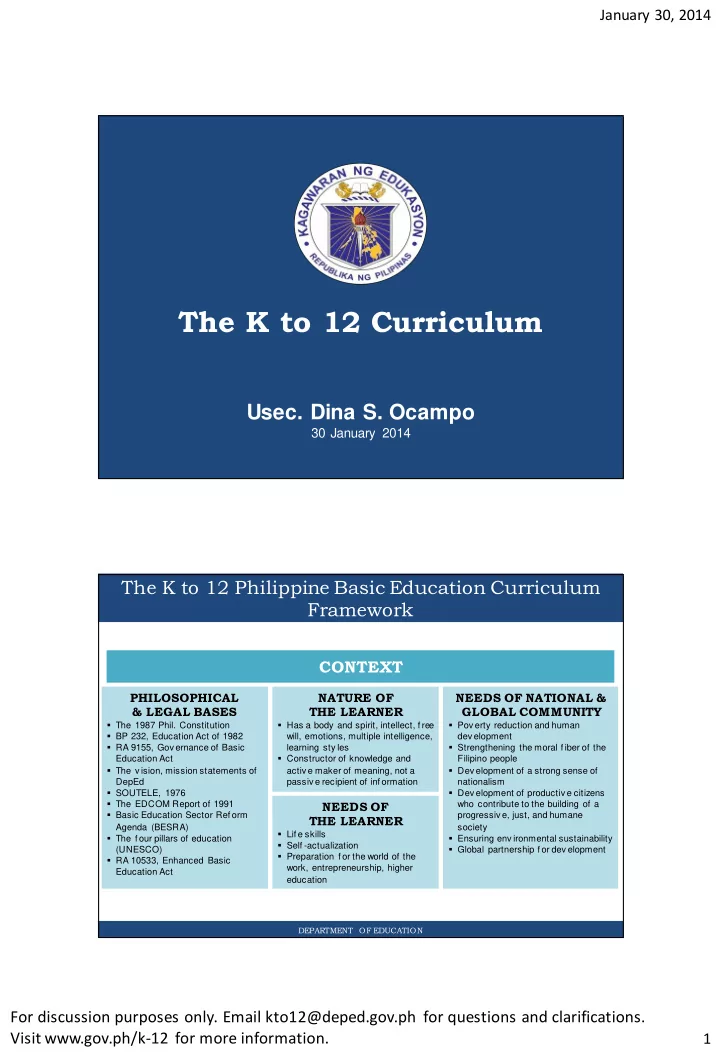
January 30, 2014 The K to 12 Curriculum Usec. Dina S. Ocampo 30 January 2014 The K to 12 Philippine Basic Education Curriculum Framework CONTEXT PHILOSOPHICAL NATURE OF NEEDS OF NATIONAL & & LEGAL BASES THE LEARNER GLOBAL


slide-1
SLIDE 1

January 30, 2014 1

For discussion purposes only. Email kto12@deped.gov.ph for questions and clarifications. Visit www.gov.ph/k-12 for more information.

The K to 12 Curriculum

  • Usec. Dina S. Ocampo

30 January 2014

The K to 12 Philippine Basic Education Curriculum Framework

DEPARTMENT OF EDUCATION

CONTEXT

PHILOSOPHICAL & LEGAL BASES

  • The 1987 Phil. Constitution
  • BP 232, Education Act of 1982
  • RA 9155, Gov ernance of Basic

Education Act

  • The v ision, mission statements of

DepEd

  • SOUTELE, 1976
  • The EDCOM Report of 1991
  • Basic Education Sector Ref orm

Agenda (BESRA)

  • The f our pillars of education

(UNESCO)

  • RA 10533, Enhanced Basic

Education Act

NATURE OF THE LEARNER

  • Has a body and spirit, intellect, f ree

will, emotions, multiple intelligence, learning sty les

  • Constructor of knowledge and

activ e maker of meaning, not a passiv e recipient of inf ormation

NEEDS OF THE LEARNER

  • Lif e skills
  • Self -actualization
  • Preparation f or the world of the

work, entrepreneurship, higher education

NEEDS OF NATIONAL & GLOBAL COMMUNITY

  • Pov erty reduction and human

dev elopment

  • Strengthening the moral f iber of the

Filipino people

  • Dev elopment of a strong sense of

nationalism

  • Dev elopment of productiv e citizens

who contribute to the building of a progressiv e, just, and humane society

  • Ensuring env ironmental sustainability
  • Global partnership f or dev elopment
slide-2
SLIDE 2

January 30, 2014 2

For discussion purposes only. Email kto12@deped.gov.ph for questions and clarifications. Visit www.gov.ph/k-12 for more information.

SKILLS Information, Media, and Technology Skills Learning and Innovation Skills Communication Skills Life and Career Skills LEARNING AREAS Language Technology and Livelihood Education (TLE) Mathematics and Science Arts and Humanities Materials, Facilities, and Equipment ICT Assessment School Leadership and Management Schools Divisions Technical Assistance Community- Industry Relevance and Partnerships Teachers

The K to 12 Philippine Basic Education Curriculum Framework

DEPARTMENT OF EDUCATION

Monitoring and Evaluation System Curriculum Support System Being and Becoming a Whole Person

Holistically Developed Filipino with 21st Century Skills

The K to 12 Philippine Basic Education Curriculum Framework

slide-3
SLIDE 3

January 30, 2014 3

For discussion purposes only. Email kto12@deped.gov.ph for questions and clarifications. Visit www.gov.ph/k-12 for more information.

Features of the K to 12 Curriculum

DEPARTMENT OF EDUCATION

Learner-centered, inclusive and research- based. Inclusive, culture- responsive and culture- sensitive, integrative and contextualized, relevant and responsive. Standard and competence based, seamless, decongested Flexible, ICT-based, and global.

Curriculum Exits

DEPARTMENT OF EDUCATION

slide-4
SLIDE 4

January 30, 2014 4

For discussion purposes only. Email kto12@deped.gov.ph for questions and clarifications. Visit www.gov.ph/k-12 for more information.

Curriculum Exits

DEPARTMENT OF EDUCATION

  • 1. Visual and information

literacies

  • 2. Media literacy
  • 3. Basic, scientific,

economic and technological literacies and multicultural literacy

  • 4. Global aw areness
  • 1. Creativity and curiosity
  • 2. Critical thinking

problem solving skills

  • 3. Risk taking
  • 1. Collaboration and

interpersonal skills

  • 1. Flexibility and

adaptability

  • 2. Initiative and self-

direction

  • 3. Social and cross-

cultural skills

  • 4. Productivity and

accountability

  • 5. Leadership and

responsibility

  • 6. Ethical, moral and

spiritual values

Mother Tongue as a subject is taught from Grades 1-3 where the child’s mother tongue is used in instruction and learning materials.

Mother Tongue-Based Multilingual Education (MTB-MLE)

DEPARTMENT OF EDUCATION

The learners retain their ethnic identity, culture, heritage and values. Children learn better and are more active in class and learn a second language even faster when they are first taught in a language they understand. Filipino and English language proficiency is developed from K-3 but very gradually. Mother Tongue is used in instruction and learning materials of other learning areas.

slide-5
SLIDE 5

January 30, 2014 5

For discussion purposes only. Email kto12@deped.gov.ph for questions and clarifications. Visit www.gov.ph/k-12 for more information.

Technology and Livelihood Education and the Technical Vocational Track

DEPARTMENT OF EDUCATION

Exploratory at Grades 7 and 8 Given the opportunity to explore from a maximum of 4 TLE mini courses for each level Taught five basic competencies common to all TLE courses Learners may earn the Certificate of Competency (COC) in Grade 9 and the National Certificate I/II (NC I/II) in Grades 9 and 10 The learner may opt to take the Technical Vocational Livelihood Track in Grades 11 and 12 to continue the TLE specialization taken in Grades 9 and

  • 10. This enables him to get an NC II.

TLE in Junior High School

Philippine Qualifications Framework

DEPARTMENT OF EDUCATION

BACCALAUREATE

slide-6
SLIDE 6

January 30, 2014 6

For discussion purposes only. Email kto12@deped.gov.ph for questions and clarifications. Visit www.gov.ph/k-12 for more information.

DEPARTMENT OF EDUCATION

PQF Articulation for Grades 10 & 12

Level Knowledge, Skills and Values Application Degree of Independence I (G10)

  • Possess foundational know ledge across a

range of learning areas w ith core competencies in communication; scientific, critical and creative thinking; and the use of technologies.

  • Have an understanding of right and w rong;
  • ne’s history and cultural heritage; and deep

respect for self, others and their culture, and the environment. Apply foundational know ledge, skills, and values in academic and real-life situations through sound reasoning, informed decision-making, and the judicious use of resources. Apply skills in limited situations w ith close supervision. II (G12)

  • Possess functional know ledge across a range
  • f learning areas and technical skills in chosen

career tracks w ith advanced competencies in communication; scientific, critical and creative thinking; and the use of technologies.

  • Have an understanding of right and w rong;
  • ne’s history and cultural heritage; and deep

respect for self, others and their culture, and the environment. Apply functional know ledge, technical skills and values in academic and real-life situations through sound reasoning, informed decision- making, and the judicious use of resources. Apply skills in varied situations w ith minimal supervision.

Curriculum Outcomes

PQF

DEPARTMENT OF EDUCATION

Key Stage Outcomes

G3 G6 G10 G12

Content and Performance

STANDARDS

LEARNING COMPETENCIES LEARNING RESOURCES

Teacher’s Guides and Learner’s Materials

Learning Areas / Grade Level Outcomes / Standards

slide-7
SLIDE 7

January 30, 2014 7

For discussion purposes only. Email kto12@deped.gov.ph for questions and clarifications. Visit www.gov.ph/k-12 for more information.

Learning and Innovation Skills

English (Philippine Literature) The learner transfers learning by: resolving conflicts presented in literary selections; using tools and mechanisms in locating library resources; extracting information and noting details from texts to write a précis, summary, or paraphrase; distinguishing between and using literal and figurative language and verbal and non-verbal cues; use phrases, clauses, and sentences meaningfully and appropriately. Filipino (Ibong Adarna) Naisasagawa ng mag-aaral ang malikhaing pagtatanghal ng ilang saknong ng koridong naglalarawan ng mga pagpapahalagang Pilipino. Math Numbers and Number Sense The learner is able to formulate challenging situations involving sets and real numbers and solve these in a variety of strategies. Statistics and Probability The learner is able to collect and organize data systematically and compute accurately measures of central tendency and variability and apply these appropriately in data analysis and interpretation in different fields. Science The learner investigates the properties of mixtures of varying concentrations using available materials in the community for specific purposes. AP (Sinaunang Kabihasnan sa Asya) Ang mag-aaral ay kritikal na nakapagsusuri sa mga kaisipang Asyano pilosopiya at relihiyon na nagbigay-daan sa paghubog ng sinaunang kabihasnan sa Asya at sa pagbuo ng pagkakilanlang Asyano. Music (Music of Cordillera, Mindoro, Palawan, and the Visayas) The learner improvises simple rhythmic/melodic accompaniments to selected music from the Cordillera, Mindoro, Palawan and of the Visayas. Arts (Festivals and Theatrical Forms) The learner creates appropriate festival attire with accessories based on authentic festival costumes. PE (Training Guidelines, FITT Principles) The learner designs an individualized exercise program to achieve personal fitness. Health (Injury, Prevention, Safety and First Aid) The learner consistently demonstrates resilience, vigilance and proactive behaviors to prevent intentional injuries. TLE Personal Entrepreneurial Competencies (PECS) across AF, IA, HE and ICT

Grade 7

EsP Naisasagawa ng mag-aaral ang paglalapat ng wastong paraan upang itama ang mga maling pasya o kilos bilang kabataan batay sa tamang konsensya.

Academic Track

Technical Vocational Livelihood Track

Sports Track

Arts & Design Track

Basic Education Program

DEPARTMENT OF EDUCATION

Kinder to Grade 6

Elementary

Grades 7 to 8 (Exploratory TLE)

Junior High School

Grades 9 to 10 (Specialized TLE)

Core Subjects

Senior High School

Contextualized Track Subjects

  • General

Academic Strand

  • STEM
  • ABM
  • HUMSS
  • Home

Economics

  • Agri-Fishery
  • Industrial

Arts

  • ICT

Tracks

slide-8
SLIDE 8

January 30, 2014 8

For discussion purposes only. Email kto12@deped.gov.ph for questions and clarifications. Visit www.gov.ph/k-12 for more information.

Senior High School Curriculum

DEPARTMENT OF EDUCATION *The Academ ic track includes four (4) s trands : Accountancy, Bus ines s and Managem ent (ABM); General Academ ic; Hum anities and Social Science (HUMSS); and Science, Technology, Engineering and Mathem atics (STEM).

K to 12 Basic Education Curriculum New General Education Curriculum (CHED) Grades 7-10 SHS Core Subjects SHS Contextualized Subjects

  • Edukasyon sa

Pagpapakatao

  • Health

Personal Development Understanding the Self / Pag-uunawa sa Sarili

  • Araling Panlipunan
  • Filipino

Readings in Philippine History / Mga Babasahin hinggil sa Kasaysayan ng Pilipinas

  • English / Filipino
  • Araling Panlipunan

21st Century Literature from the Philippines and the World The Contemporary World / Ang Kasalukuyang Daigdig

  • Math
  • General Math
  • Statistics and Probability

Mathematics in the World / Matematika sa Makabagong Daigdig

  • English
  • Filipino
  • Oral Communication
  • Reading and Writing
  • Komunikasyon at Pananaliksik

sa Wika at Kulturang Filipino

  • Pagbasa at Pagsusuri ng Iba't-

Ibang Teksto Tungo sa Pananaliksik

  • Media and Information Literacy
  • English for Academic

and Professional Purposes

  • Pagsulat sa Filipino sa

Piling Larangan (Akademik, Arts, Isports at Tech-Voc) Purposive Communication / Malayuning Komunikasyon

K to 12 and CHED GE Course Comparison

DEPARTMENT OF EDUCATION

slide-9
SLIDE 9

January 30, 2014 9

For discussion purposes only. Email kto12@deped.gov.ph for questions and clarifications. Visit www.gov.ph/k-12 for more information.

K to 12 and CHED GE Course Comparison

K to 12 Basic Education Curriculum

New General Education Curriculum (CHED)

Grades 7-10 SHS Core Subjects SHS Contextualized Subjects

  • M usic and A rts
  • P hysical Education

C ontemporary P hilippine A rts from the Regions A rt A ppreciation / Pagpapahalaga sa Sining

  • P hysical Education
  • Health

P hysical Education and Health

  • Science
  • Araling Panlipunan
  • English
  • Filipino
  • Health
  • U nderstanding

C ulture, P olitics and Society

  • P hysical Science
  • Earth and Life Science

Empowerment Technologies: ICT for P rofessional Tracks Science, Technology and Society / Agham, Teknolohiya, at Lipunan

  • Edukasyon sa

Pagpapakatao

  • Araling Panlipunan

Introduction to P hilosophy of the Human P erson Ethics / Etika

  • Edukasyong Pantahanan at

Pangkabuhayan

  • Technology Livelihood

Education Entrepreneurship

  • English
  • Filipino
  • Araling Panlipunan
  • Science
  • M ath

Research in Daily Life 1 and 2 A ll learning areas Research P roject/Career A dvocacy/Work Immersion/Culminating A ctivity

The Proposed Grades 11 and 12 will have 31 80-hour subjects, totalling 2,480 hours.

15

Core Subjects

16

Track Subjects

7

Contextualized Subjects

9

Specialization subjects

31 TOTAL SUBJECTS

Each subject will have 80 hours per semester P.E. and Health will have 20 hours per semester for 4 semesters

DEPARTMENT OF EDUCATION

slide-10
SLIDE 10

January 30, 2014 10

For discussion purposes only. Email kto12@deped.gov.ph for questions and clarifications. Visit www.gov.ph/k-12 for more information.

Senior High School Core Subjects

Core Learning Areas and Subjects

hours per semester Language Oral Communication 80 Reading & Writing 80 Komunikasy on at Pananaliksik sa Wikang Filipino at Kulturang Pilipino 80 Pagbasa at Pagsusuri ng Iba’t Ibang T eksto Tungo sa Pananaliksik 80 Humanities 21st Century Literature f rom the Philippines and the World 80 The Contemporary Arts f rom the Regions 80 Communication Media & Inf ormation Literacy 80 Mathematics General Mathematics 80 Statistics & Probability 80 Science Earth and Lif e Science (Lecture and Laboratory ) 80 Phy sical Science (Lecture and Laboratory ) 80 Social Science Personal Dev elopment 80 Understanding Society & Culture 80 Philosophy Intro to Philosophy of the Human Person 80 PE and Health Phy sical Education and Health 80 CORE T

  • tal Number of Hours

1,200 TRA CK T

  • tal Number of Hours

1,280 T

  • tal Number of Hours (CORE + TRA

CK) 2,480

Total Hours (CORE + TRACK) divided by Number of School Day s in SHS (400) = average hours/day

6.2 hours/day

DEPARTMENT OF EDUCATION

Each subject will have 80 hours per semester *For Finalization

Contextualized Track Subjects

DEPARTMENT OF EDUCATION

Academic, Technical-Vocational-Livelihood, Sports, Arts & Design Tracks

1 English for Academic and Professional Purposes 2 Research 1: Qualitative Research in Daily Life 3 Research 2: Quantitative Research in Daily Life 4 Pagsulat sa Filipino sa Piling Larangan (Akademik, Isports, Sining at Tech-V

  • c)

5 Empowerment Technologies (E-Tech): ICT for Professional Tracks 6 Entrepreneurship 7 Research Project / Culminating Activity*

slide-11
SLIDE 11

January 30, 2014 11

For discussion purposes only. Email kto12@deped.gov.ph for questions and clarifications. Visit www.gov.ph/k-12 for more information.

Academic Track

Accountancy, Business and Management Strand

8 ABM Strand 1

Applied Economics

9 ABM Strand 2

Business Ethics and Social Responsibility

10 ABM Strand 3 Fundamentals of Accountancy, Business and Management 1 11 ABM Strand 4 Fundamentals of Accountancy, Business and Management 2 12 ABM Strand 5

Business Math

13 ABM Strand 6

Business Finance

14 ABM Strand 7

Organization and Management

15 ABM Strand 8

Principles of Marketing

16 ABM Strand 9 Work Immersion/Research/Career Advocacy/Culminating Activity

i.e. Business Enterprise Simulation Each subject will have 80 hours per semester

DEPARTMENT OF EDUCATION

Academic Track

Proposed Humanities and Social Science Strand*

8 HUMSS Strand 1

Creative Writing

9 HUMSS Strand 2

Creative Nonfiction: The Literary Essay

10 HUMSS Strand 3

World Religions and Belief Systems

11 HUMSS Strand 4

Megatrends and Critical Thinking in the 21st Century Culture

12 HUMSS Strand 5

Philippine Politics and Governance

13 HUMSS Strand 6

Community Involvement and Social Issues

14 HUMSS Strand 7 Introducing the Social Sciences (Anthropology, Economics, History, Psychology, Sociology, Political Science) 15 HUMSS Strand 8 Introducing the Applied Social Sciences (Communication, Journalism, Guidance and Counseling, Social Work) 16 HUMSS Strand 9

Work Immersion/Research/Career Advocacy/Culminating Activity Each subject will have 80 hours per semester *For Finalization

DEPARTMENT OF EDUCATION as of December 18, 2013

slide-12
SLIDE 12

January 30, 2014 12

For discussion purposes only. Email kto12@deped.gov.ph for questions and clarifications. Visit www.gov.ph/k-12 for more information.

Senior High School Core Subjects for the STEM Strand

DEPARTMENT OF EDUCATION

Core Learning Areas and Subjects

hours per semester Language Oral Communication 80 Reading & Writing 80 Komunikasy on at Pananaliksik sa Wikang Filipino at Kulturang Pilipino 80 Pagbasa at Pagsusuri ng Iba’t Ibang T eksto Tungo sa Pananaliksik 80 Humanities 21st Century Literature f rom the Philippines and the World 80 The Contemporary Arts f rom the Regions 80 Communication Media & Inf ormation Literacy 80 Mathematics General Mathematics 80 Statistics & Probability 80 Science Earth Science 80 Disaster Readiness and Risk Reduction 80 Social Science Personal Dev elopment 80 Understanding Society & Culture 80 Philosophy Intro to Philosophy of the Human Person 80 PE and Health Phy sical Education and Health 80 CORE T

  • tal Number of Hours

1,200 TRA CK T

  • tal Number of Hours

1,280 T

  • tal Number of Hours (CORE + TRA

CK) 2,480

Total Hours (CORE + TRACK) divided by Number of School Day s in SHS (400) = average hours/day

6.2 hours/day

DEPARTMENT OF EDUCATION

Academic Track

Science, Technology, Engineering and Mathematics Strand

8

STEM Strand 1 Pre-Calculus

9

STEM Strand 2 Basic Calculus

10 STEM Strand 3

General Biology 1

11 STEM Strand 4

General Biology 2

12 STEM Strand 5

General Physics 1

13 STEM Strand 6

General Physics 2

14 STEM Strand 7

General Chemistry 1

15 STEM Strand 8

General Chemistry 2

16 STEM Strand 9

Work Immersion/Research/Career Advocacy/Culminating Activity

Each subject will have 80 hours per semester

DEPARTMENT OF EDUCATION

slide-13
SLIDE 13

January 30, 2014 13

For discussion purposes only. Email kto12@deped.gov.ph for questions and clarifications. Visit www.gov.ph/k-12 for more information.

Academic Track

Proposed General Academic Strand*

8

Strand 1 Humanities 1

9

Strand 2 Humanities 2

10 Strand 3

Social Science 1

11 Strand 4

Applied Economics

12 Strand 5

Organization and Management

13 Strand 6

Disaster Readiness and Risk Reduction

14 Strand 7

Elective 1 (from any Track/Strand)

15 Strand 8

Elective 2 (from any Track/Strand)

16 Strand 9

Work Immersion/Research/Career Advocacy/Culminating Activity Each subject will have 80 hours per semester *For Finalization

DEPARTMENT OF EDUCATION

Sports Track Subjects

Each subject will have 80 hours per semester

DEPARTMENT OF EDUCATION

Sports Track

8

Sports Track 1 Safety and First Aid

9

Sports Track 2 Human Movement

10

Sports Track 3 Fundamentals of Coaching

11

Sports Track 4 Sports Officiating and Activity Management

12

Sports Track 5 Fitness, Sports and Recreation Leadership

13

Sports Track 6 Psychosocial Aspects of Sports and Exercise

14

Sports Track 7 Fitness Testing and Exercise Programming

15

Sports Track 8 Practicum (in-campus)

16

Sports Track 9 Work Immersion/Research/Career Advocacy/Culminating Activity i.e. Apprenticeship (off-campus)

slide-14
SLIDE 14

January 30, 2014 14

For discussion purposes only. Email kto12@deped.gov.ph for questions and clarifications. Visit www.gov.ph/k-12 for more information.

Arts and Design Track Subjects

Each subject will have 80 hours per semester except Apprenticeship and Exploration of Different Arts Fields which will have 160 hours

DEPARTMENT OF EDUCATION

Arts and Design Track

8 Arts Track 1 Creative Industries I: Arts and Design Appreciation and Production 9 Arts Track 2 Creative Industries II: Performing Arts 10 Arts Track 3 Physical and Personal Development in the Arts 11 Arts Track 4 Developing Filipino Identity in the Arts 12 Arts Track 5 Integrating the Elements and Principles of Organization in the Arts 13 Arts Track 6 Leadership and Management in Different Arts Fields 14 Arts Track 7 Apprenticeship and Exploration of Different Arts Fields 15 Arts Track 8 16 Arts Track 9 Work Immersion/Research/Career Advocacy/Culminating Activity Exhibit for Arts Production/ Performing Arts Production

Technical-Vocational-Livelihood Track (Table 1) and TESDA Training Regulations-Based Specializations* (Table 2)

HE ICT Agri-Fishery Arts Industrial Arts

  • 1. Hairdressing
  • 2. Tailoring
  • 3. Caregiving
  • 4. Food and

Beverage Services

  • 5. Bread and Pastry

Production

  • 6. Housekeeping
  • 7. Tour Guiding

Services

  • 8. Travel Services
  • 9. Attractions and

Theme Parks Tourism

  • 10. Handicraft
  • a. Fashion

Accessories

  • b. Paper Craft
  • c. Woodcraft
  • d. Leathercraft

1. Computer Programming 2. Medical Transcription 3. Animation

AGRICROP PRODUCTION

  • 1. Horticulture
  • 2. Landscape Installation and

Maintenance

  • 3. Organic Agriculture

Production

  • 4. Pest Management
  • 5. Rice Machinery Operation
  • 1. Automotive

Servicing

  • 2. Refrigeration

and Air- Conditioning

  • 3. Consumer

Electronics Servicing

  • 4. Electrical

Installation and Maintenance

  • 5. Shielded Metal-

Arc Welding

  • 6. Carpentry
  • 7. Plumbing
  • 8. Masonry
  • 9. Tile Setting

ANIMAL PRODUCTION

  • 1. Artifical Insemmination
  • 2. Raising Large Ruminants

(Dairy Cattle and Buffaloes)

  • 3. Raising Swine
  • 4. Slaughtering

FISH PRODUCTION

  • 1. Fish Nursery Operation
  • 2. Fish or Shrimp Grow Out

Operation

  • 3. Fishport/Wharf Operation

Tech-Voc Track TESDA Training Regulations-Based Specializations TVL Track Subjects

Subjects Example 8 T ech-Voc Track 1 Beauty Care / Nail Care 9 T ech-Voc Track 2 10 T ech-Voc Track 3 Hairdressing 11 T ech-Voc Track 4 12 T ech-Voc Track 5 13 T ech-Voc Track 6 14 T ech-Voc Track 7 15 T ech-Voc Track 8 16 T ech-Voc Track 9

DEPARTMENT OF EDUCATION

Each subject will have 80 hours per semester.

*Aligned with Technology and Livelihood Education (TLE) in Grades 7 to 10.

slide-15
SLIDE 15

January 30, 2014 15

For discussion purposes only. Email kto12@deped.gov.ph for questions and clarifications. Visit www.gov.ph/k-12 for more information.

Curriculum Guide Writing Workshops were held which were attended by the following:

– Bureau Focal Person – Field Person – External Reviewer – Internal Reviewer – Encoder

Who helped make the Curriculum Guide?

Who helped make the Curriculum Guide

Bureau Focal Person Field Person Internal and External Reviewer CHED Technical Panel Member / Crafters Encoder

DEPARTMENT OF EDUCATION

The Curriculum Guide Process

DEPARTMENT OF EDUCATION

  • 1. Content and Skills Review

Draft 1 Comments Draft 2

Final Curriculum Guide

Technical Panel/Technical Committee/Drafting Committee Review of CGs Return to crafters of Draft 1 DepEd reads comments in a Curriculum Finalization Workshop

STEPS OUTPUT

slide-16
SLIDE 16

January 30, 2014 16

For discussion purposes only. Email kto12@deped.gov.ph for questions and clarifications. Visit www.gov.ph/k-12 for more information.

  • 2. Language Review

The Curriculum Guide Process

  • 3. Copy and Proofreading

Select language editors Send Curriculum Guides to selected language editors Encoders key in revisions

DEPARTMENT OF EDUCATION

Sample Curriculum Guide

DEPARTMENT OF EDUCATION

slide-17
SLIDE 17

January 30, 2014 17

For discussion purposes only. Email kto12@deped.gov.ph for questions and clarifications. Visit www.gov.ph/k-12 for more information.

Who helped make the Curriculum Guide

  • Ateneo de Manila High School
  • Ateneo de Manila University
  • Ballet Philippines
  • Cavite State University
  • Central Bicol State University
  • Centro Escolar University
  • CHED
  • Cultural Center of the Philippines
  • Davao Wisdom Academy
  • De La Salle University -

Dasmariñas

  • De La Salle-College of St. Benilde
  • Don Bosco School
  • Foundation for Information

Technology Education and Development

  • International Training for Pig

Husbandry

  • Jose Rizal University
  • La Consolacion College Manila
  • Let’s GO Foundation
  • Lyceum of the Philippines
  • Mariano Marcos State University
  • Miriam College
  • National Commission for Culture

and the Arts

  • National Historical Commission
  • Palawan State University
  • Philippine Center for Post-Harvest

Development and Mechanization

  • Philippine Educational Theater

Association

  • Philippine High School for the Arts
  • Philippine National Historical

Society

  • Philippine Normal University
  • Philippine Science High School
  • Philippine Society for Music

Education

  • Queen of Heart Academy Cavite
  • Raya School
  • San Beda College
  • St. Mary’s University – Nueva

Vizcaya

  • Technological University of the

Philippines

  • TESDA
  • University of Asia and the Pacific
  • University of Santo Tomas
  • UP Diliman
  • UP Integrated School
  • UP Los Baños
  • UP Manila
  • UP NISMED
  • UP Open University
  • USAID
  • Xavier School

DEPARTMENT OF EDUCATION

We are in the process of producing Learner’s Materials and T eacher’s Guides based on the competencies in the Curriculum Guide.

What else are we preparing for implementation?

DEPARTMENT OF EDUCATION

slide-18
SLIDE 18

January 30, 2014 18

For discussion purposes only. Email kto12@deped.gov.ph for questions and clarifications. Visit www.gov.ph/k-12 for more information.

K to 12 Curriculum Guides

DEPARTMENT OF EDUCATION

Download them at: http://bit.ly/kto12curriculum

Thank You Very Much!