The Handbook of Environmental Policy Evaluation Ann Crabb, Ph.D. - - PowerPoint PPT Presentation

the handbook of environmental policy evaluation
SMART_READER_LITE
LIVE PREVIEW

The Handbook of Environmental Policy Evaluation Ann Crabb, Ph.D. - - PowerPoint PPT Presentation

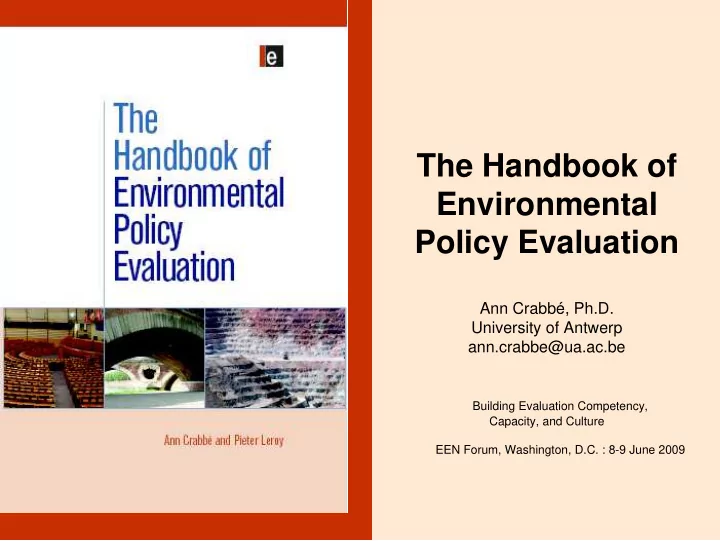
The Handbook of Environmental Policy Evaluation Ann Crabb, Ph.D. University of Antwerp ann.crabbe@ua.ac.be Building Evaluation Competency, Capacity, and Culture EEN Forum, Washington, D.C. : 8-9 June 2009 The books coming into being

slide-1
SLIDE 1

The Handbook of Environmental Policy Evaluation

Ann Crabbé, Ph.D. University of Antwerp ann.crabbe@ua.ac.be

Building Evaluation Competency, Capacity, and Culture EEN Forum, Washington, D.C. : 8-9 June 2009

slide-2
SLIDE 2

The book’s coming into being

  • Demand for a “cookbook”: linking evaluation

questions with evaluation methods

  • Background: state of the environment

reporting focuses on distances to targets, but not on answering why and how questions

slide-3
SLIDE 3
  • Result: a Dutch version,
  • utlined and edited in co-
  • peration with the target

group (civil servants, NGO-representatives)

  • Built on a post-academic

course

  • Resulting in turn into

– presentations – workshops

  • Two years later: new

edition, in English

slide-4
SLIDE 4

The book’s content and structure

  • Perspectives on policy and policy evaluation

– goal rationality, political interaction, institutional

  • Distinct features of environmental policy

– typical difficulties of EPE

  • Series of methods

– academically characterised, – and a series of examples, – from all over

slide-5
SLIDE 5

Perspectives on policy & policy evaluation

– perspective of goal rationality

  • evaluation of policy theory
  • impact assessments
  • (quasi)experiments…

– political interactive perspective

  • responsive evaluation
  • deliberative democratic evaluation…

– institutional perspective

  • focus on networks, regimes,

policy arrangements, discursive coalitions etc.

slide-6
SLIDE 6

Criteria for policy evaluation

– control and accountability > juridical criteria – effectiveness and efficiency > economical criteria – responsiveness and transparency > political criteria

slide-7
SLIDE 7

Typical features of environmental policies

– complexity

  • intervening (f)actors, delineating the object

– data availability and data appropriateness

  • overload and scarcity, (in)appropriateness

– time, space and level of analysis

  • time-lag, relevant selection of space &

level of analysis vs level of observation

– case studies

  • single vs plural
  • quantitative vs qualitative

– the position of the evaluator and the evaluation’s impact

  • in fear of the mirror
  • utilization
slide-8
SLIDE 8
  • Series of methods:

– not exhaustive, rather: apparently useful – all described with the same framework – with examples of EE from all over the world

slide-9
SLIDE 9

Framework method description

Elucidation and context

  • the essence of the method:

– what? – when? – advantages and disadvantages?

  • historical context
  • position in research and evaluation context

Methodology

  • steps in the application of the method
  • remarks

References

  • primary and additional references
  • examples
slide-10
SLIDE 10

Chapter 3

  • 1. Needs analysis
  • 2. Programme theory evaluation
  • 3. Case study evaluation
  • 4. Experiment and quasi-experiment
  • 5. Formative/developmental evaluation
  • 6. Goal-free evaluation
  • 7. Impact assessment:
  • Social impact assessment
  • Environmental impact assessment
  • Regulatory impact assessment
  • 8. Cost-benefit analysis and

cost-effectiveness analysis

  • 9. Logframe method
  • 10. Multi-criteria analysis
  • 11. Realistic evaluation
slide-11
SLIDE 11

Chapter 4

1. Advocate–adversary evaluation 2. Context, input, process and product evaluation (CIPP) model 3. Connoisseurship and criticism 4. Constructivist evaluation 5. Deliberative democratic evaluation 6. Empowerment evaluation 7. Evaluability assessment 8. Meta-evaluation 9. Mixed-method evaluation

  • 10. Responsive evaluation
  • 11. Utilization-focused evaluation
slide-12
SLIDE 12

More information:

www.earthscan.co.uk