
SLIDE 1
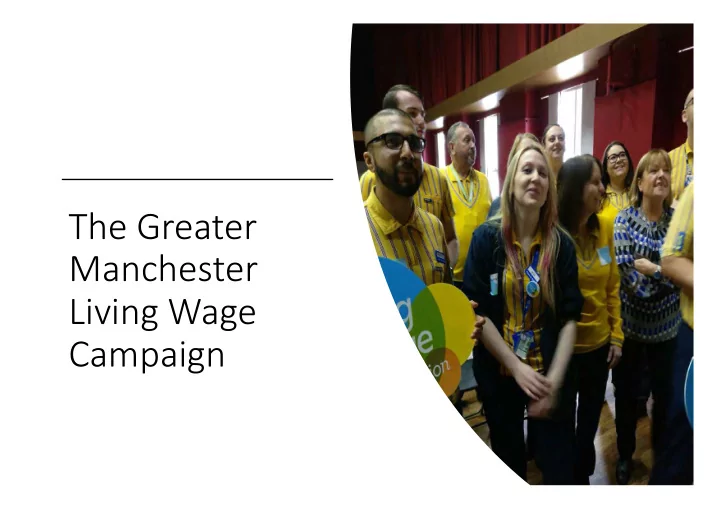
The Greater Manchester Living Wage Campaign What is the Living - - PowerPoint PPT Presentation
The Greater Manchester Living Wage Campaign What is the Living Wage? h7ps:// www.livingwage.org.uk/ Only the real Living Wage is independently calculated, each year, based on what employees and their families need to live Employers
h7ps:// www.livingwage.org.uk/
independently calculated, each year, based on what employees and their families need to live
real Living Wage on a voluntary basis
young people face the same living costs as everyone else
live on is good for business, good for the individual and good for society.
in Greater Manchester (GM)
households in GM
working in around 105,000 businesses
travel to work area in any conurba@on in the UK outside of London with 7 million people living within one hours drive of the city centre
million people are paid less than the real Living Wage (KPMG 2013)
employees are paid less than the real LW & 1 in 6 working households receive financial support through Tax Credits to top up their wages (GM Poverty Commission)
2010) & Resolu@on Founda@on 2013).
Work by the Employment Research Ins@tute at Napier University and published by the Joseph Rowntree Founda@on found that:
poverty were: birth of a child, rela@onship breakdown and job loss
improve their financial situa@on enough
was effected by types of work available, debt, lack of affordable and suitable child care, difficult to access educa@on and the opera@on and monetary levels of benefits and tax credits
to escape poverty and the low pay/no pay cycle, paid employment must improve their financial circumstances, increase their ability to fulfil care responsibili@es including for older people.
The Ins@tute of Fiscal Studies, funded by Joseph Rowntree Founda@on, found that:
2014, employment rose so more children were living with in- work parents
child poverty rose from 54% to 63%.
Church adopted the real Living Wage, its internal research showed that many of their low paid employees worked as part @me cleaners,
gardeners and caretakers
same will be true in
work; they are more mo@vated; there is less staff turnover; there is less absenteeism and produc@vity is increased
Studies es@mates that not paying the Living Wage amounts to £6 billion a year in benefits and forgone revenue.
Founda6on provide:
How to become an accredited Living Wage Employer. For more informa@on please visit: h8ps:// www.livingwage.org.uk/
Group
Campaign Newsleher
Good Employment Charter
by the Inclusive Growth Analysis Unit, Oxfam and GM Poverty Ac@on provides a comprehensive introduc@on to employment charters:
hummedia.manchester.ac.uk/ ins@tutes/mui/igau/briefings/ IGAU-Briefing-2-Employment- Charters.pdf
Wage Founda@on will announce the new Living Wage rate.
Mee@ngs, during the rest
be running community engagement events, and asking key ques@ons, about all aspects rela@ng to the crea@on of a GM Good Employment Charter.
person
More informa@on available at h8ps:// www.livingwage.org.uk/