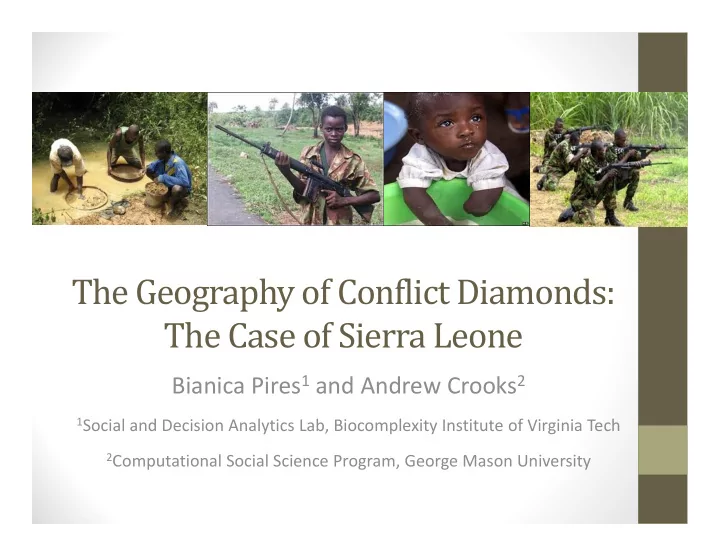
The Geography of Conflict Diamonds: The Case of Sierra Leone Bianica - - PowerPoint PPT Presentation

the geography of conflict diamonds the case of sierra
SMART_READER_LITE
LIVE PREVIEW

The Geography of Conflict Diamonds: The Case of Sierra Leone Bianica - - PowerPoint PPT Presentation

The Geography of Conflict Diamonds: The Case of Sierra Leone Bianica Pires 1 and Andrew Crooks 2 1 Social and Decision Analytics Lab, Biocomplexity Institute of Virginia Tech 2 Computational Social Science Program, George Mason University


slide-1
SLIDE 1

The Geography of Conflict Diamonds: The Case of Sierra Leone

Bianica Pires1 and Andrew Crooks2

1Social and Decision Analytics Lab, Biocomplexity Institute of Virginia Tech 2Computational Social Science Program, George Mason University

slide-2
SLIDE 2

Background

  • Sierra Leone entered into

nearly 10 years of civil war in 1991

  • Killed an estimated 70,000

and displaced another 2.6 million

  • Endowed with an

abundance of diamond resources

  • An ABM is developed to

explore the role of geography in a resource- driven war

slide-3
SLIDE 3

The Model

  • An ABM is integrated with GIS to explore Le Billon’s

(2001) theory about the spatial dispersion of a resource

  • Modeling world is the country of Sierra Leone
  • Broken down into one km2 parcels
  • Total population is 4.9 million
  • Population within each parcel was reclassified to 1% of total

population

  • The agents represent individual residents
  • Attributes include age, income level, and employment status

Concentration / Relation to Center Diffuse Point Distant Warlordism Secession Proximate Mass rebellion / rioting State control or coup

slide-4
SLIDE 4

Agent Behavior

Set of possible motives

(1) Need for basic necessities,

such as food, water, and shelter (2) Need for security of employment, shelter, and resources

Intensity Analyzer Set of possible actions

(2) Get employment as Diamond Miner (3) Remain employed with Other Employers (1) Rebel (3) Need to maintain household (4) Stay home

  • The PECS framework is used to implement agent

behavior

  • Intensity analyzer is responsible for determining the

action-guiding motive

slide-5
SLIDE 5

Physis Sensor Percep on Input State Variables & Transi on Processes Actor Behavior Output Social Status

Individual Characteris cs Social Role and Group Iden ty

Emo on Cogni on

Ac on Sequence Informa on about Environment within Vision Legend

Needs Model Opportunity Model Iden ty Model

The Identity Model (Stets and Burke, 2000) The Needs Model (Maslow, 1954) The Opportunity Model (Fearon and Laitin, 2003; Le Billon, 2005; Lujala et al, 2005)

Agent Behavior

slide-6
SLIDE 6

MOVIE

slide-7
SLIDE 7

Qualitative Agreement of Model Results

slide-8
SLIDE 8

The Impact of the Spatial Dispersion of a Resource

  • Experiments were performed seeking to replicate Le

Billon’s (2001) theory about the spatial dispersion of resources and its impact on the type of conflict

Concentration / Relation to Center Diffuse Point Distant Warlordism Secession Proximate Mass rebellion / rioting State control or coup Experiment Parameter Range Location of Diamond Mines Distant Government Control [0, 1] Actual Proximate Government Control [0, 1] Freetown

The relationship between the spatial dispersion of a resource and conflict type. Experiment specifications

slide-9
SLIDE 9

Results – Distant Resources

  • No government control
  • Widespread conflict emerged spatially similar to the actual situation
  • f Sierra Leone
  • Spatial dispersion seems to support warlordism
  • Increasing government control
  • Displaces the conflict
  • Conflict is contained to the periphery of the country
  • Spatial dispersion looks to support succession

Warlordism Secession

slide-10
SLIDE 10

Results – Proximate Resources

  • When the resource moves to the city so does the

violence

  • Conflict is contained, even with no government

control

  • Minimal control is sufficient to prevent rebellion
  • Difficulty in supporting the case of state coup

Mass rebellion State coup

slide-11
SLIDE 11

Summary

  • Through the integration of ABM and GIS, the model

explores Le Billon’s theory and the impact that the unique socioeconomic attributes of a region and its population can have on the onset of conflict

  • Spatial dynamics were observed as diamond mines were

made more secure and moved near city centers

  • Model results support Le Billon’s argument for distant

resources

  • Warlordism is associated with diffuse and distant resources
  • Secession is associated with point and distant resources
  • Model results do not support or reject the argument for proximate

resources

  • When an environment is ripe for conflict, this type of model

could potentially provide insights into the locations most prone to conflict and the characteristics of the conflict

slide-12
SLIDE 12

The Agent‐Based Model

Figure 5‐4. Flow diagram of key processes.