THE GAP, INC. (Exact name of registrant as specified in its charter) - - PDF document

the gap inc
SMART_READER_LITE
LIVE PREVIEW

THE GAP, INC. (Exact name of registrant as specified in its charter) - - PDF document

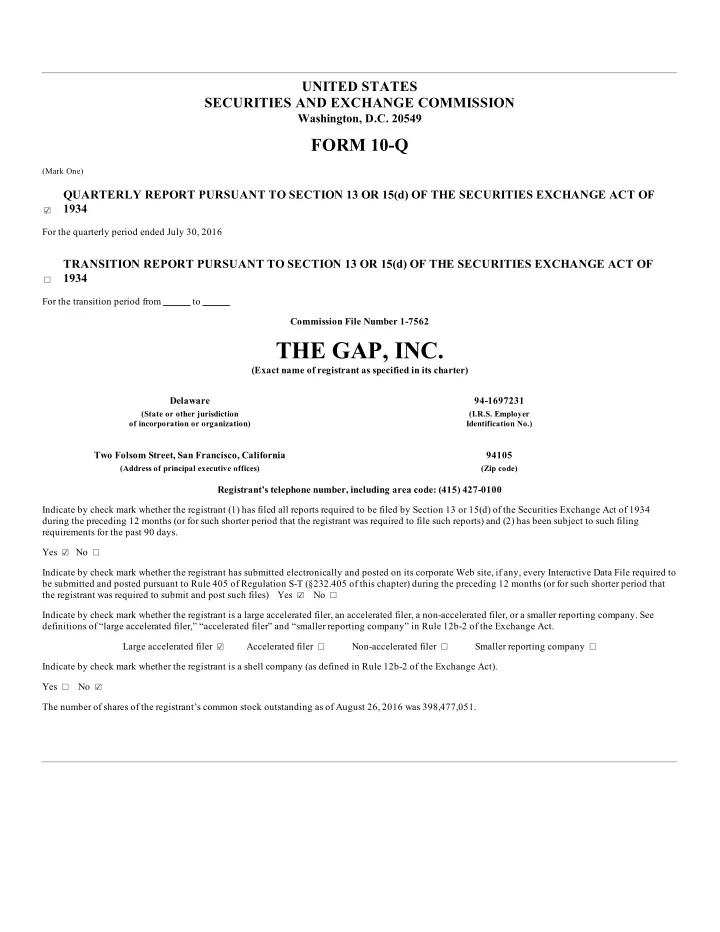
UNITED STATES SECURITIES AND EXCHANGE COMMISSION Washington, D.C. 20549 FORM 10-Q (Mark One) QUARTERLY REPORT PURSUANT TO SECTION 13 OR 15(d) OF THE SECURITIES EXCHANGE ACT OF 1934 For the quarterly period ended July 30, 2016 TRANSITION


slide-1
SLIDE 1

UNITED STATES SECURITIES AND EXCHANGE COMMISSION

Washington, D.C. 20549

FORM 10-Q

(Mark One)

QUARTERLY REPORT PURSUANT TO SECTION 13 OR 15(d) OF THE SECURITIES EXCHANGE ACT OF 1934

For the quarterly period ended July 30, 2016 ☐

TRANSITION REPORT PURSUANT TO SECTION 13 OR 15(d) OF THE SECURITIES EXCHANGE ACT OF 1934

For the transition period from to Commission File Number 1-7562

THE GAP, INC.

(Exact name of registrant as specified in its charter) Delaware 94-1697231

(State or other jurisdiction

  • f incorporation or organization)

(I.R.S. Employer Identification No.)

Two Folsom Street, San Francisco, California 94105

(Address of principal executive offices) (Zip code)

Registrant’s telephone number, including area code: (415) 427-0100 Indicate by check mark whether the registrant (1) has filed all reports required to be filed by Section 13 or 15(d) of the Securities Exchange Act of 1934 during the preceding 12 months (or for such shorter period that the registrant was required to file such reports) and (2) has been subject to such filing requirements for the past 90 days. Yes ☑ No ☐ Indicate by check mark whether the registrant has submitted electronically and posted on its corporate Web site, if any, every Interactive Data File required to be submitted and posted pursuant to Rule 405 of Regulation S-T (§232.405 of this chapter) during the preceding 12 months (or for such shorter period that the registrant was required to submit and post such files) Yes ☑ No ☐ Indicate by check mark whether the registrant is a large accelerated filer, an accelerated filer, a non-accelerated filer, or a smaller reporting company. See definitions of “large accelerated filer,” “accelerated filer” and “smaller reporting company” in Rule 12b-2 of the Exchange Act. Large accelerated filer ☑ Accelerated filer ☐ Non-accelerated filer ☐ Smaller reporting company ☐ Indicate by check mark whether the registrant is a shell company (as defined in Rule 12b-2 of the Exchange Act). Yes ☐ No ☑ The number of shares of the registrant’s common stock outstanding as of August 26, 2016 was 398,477,051.

slide-2
SLIDE 2

FORWARD-LOOKING STATEMENTS This Quarterly Report on Form 10-Q contains forward-looking statements within the “safe harbor” provisions of the Private Securities Litigation Reform Act

  • f 1995. All statements other than those that are purely historical are forward-looking statements. Words such as “expect,” “anticipate,” “believe,” “estimate,”

“intend,” “plan,” “project,” and similar expressions also identify forward-looking statements. Forward-looking statements include, but are not limited to, statements regarding the following:

  • the impact of the adoption of new accounting standards;
  • total store closures in fiscal 2016, including winding down Old Navy operations in Japan and closure of select Banana Republic stores,

primarily internationally;

  • impact of store closures and streamlining measures, including annualized savings, lost sales, tax expense, and restructuring costs;
  • recognition of unrealized gains and losses from designated cash flow hedges into income;
  • the impact of the potential settlement of outstanding tax matters and the closing of audits;
  • the impact of losses due to indemnification obligations;
  • the outcome of proceedings, lawsuits, disputes, and claims;
  • Old Navy’s near-term growth ambitions anchored in North America and Mexico, as well as China and its franchise operations;
  • continuing investment in our mobile digital capabilities;
  • further enhancing our shopping experience for our customers;
  • creation of a more efficient operating model;
  • the impact of foreign exchange rate fluctuations on our financial results;
  • current cash balances and cash flows being sufficient to support our business operations, including growth initiatives and planned capital

expenditures;

  • ability to supplement near-term liquidity, if necessary, with our $500 million revolving credit facility or other available market instruments;
  • the impact of the seasonality of our operations;
  • dividend payments in fiscal 2016; and
  • the impact of changes in internal control over financial reporting.

Because these forward-looking statements involve risks and uncertainties, there are important factors that could cause our actual results to differ materially from those in the forward-looking statements. These factors include, without limitation, the following:

  • the risk that adoption of new accounting pronouncements will impact future results;
  • the risk that we or our franchisees will be unsuccessful in gauging apparel trends and changing consumer preferences;
  • the risk that changes in global economic conditions or consumer spending patterns could adversely impact our results of operations;
  • the highly competitive nature of our business in the United States and internationally;
  • the risk that if we are unable to manage our inventory effectively, our gross margins will be adversely affected;
  • the risk that the failure to attract and retain key personnel, or effectively manage succession, could have an adverse impact on our results of
  • perations;
  • the risk that we are subject to data or other security breaches that may result in increased costs, violations of law, significant legal and financial

exposure, and a loss of confidence in our security measures, which could have an adverse effect on our results of operations and our reputation;

  • the risks to our efforts to expand internationally, including our ability to operate under a global brand structure and operating in regions where

we have less experience;

  • the risk that foreign currency exchange rate fluctuations could adversely impact our financial results;
  • the risks to our business, including our costs and supply chain, associated with global sourcing and manufacturing;
  • the risks to our reputation or operations associated with importing merchandise from foreign countries, including failure of our vendors to

adhere to our Code of Vendor Conduct;

  • the risk that trade matters could increase the cost or reduce the supply of apparel available to us and adversely affect our business, financial

condition, and results of operations;

slide-3
SLIDE 3
  • the risk that our franchisees’ operation of franchise stores is not directly within our control and could impair the value of our brands;
  • the risk that we or our franchisees will be unsuccessful in identifying, negotiating, and securing new store locations and renewing, modifying, or

terminating leases for existing store locations effectively;

  • the risk that our investments in omni-channel shopping initiatives may not deliver the results we anticipate;
  • the risk that comparable sales and margins will experience fluctuations;
  • the risk that changes in our credit profile or deterioration in market conditions may limit our access to the capital markets and adversely impact
  • ur financial results or our business initiatives;
  • the risk that updates or changes to our information technology (“IT”) systems may disrupt our operations;
  • the risk that failure to maintain, enhance, and protect our brand image could have an adverse effect on our results of operations;
  • the risk that natural disasters, public health crises, political crises, or other catastrophic events could adversely affect our operations and

financial results, or those of our franchisees or vendors;

  • the risk that changes in the regulatory or administrative landscape could adversely affect our financial condition, strategies, and results of
  • perations;
  • the risk that we do not repurchase some or all of the shares we anticipate purchasing pursuant to our repurchase program; and
  • the risk that we will not be successful in defending various proceedings, lawsuits, disputes, claims, and audits.

Additional information regarding factors that could cause results to differ can be found in our Annual Report on Form 10-K for the fiscal year ended January 30, 2016 and our other filings with the U.S. Securities and Exchange Commission. Future economic and industry trends that could potentially impact net sales and profitability are difficult to predict. These forward-looking statements are based on information as of September 2, 2016, and we assume no obligation to publicly update or revise our forward-looking statements even if experience or future changes make it clear that any projected results expressed or implied therein will not be realized. We suggest that this document be read in conjunction with Management’s Discussion and Analysis included in our Annual Report on Form 10-K for the fiscal year ended January 30, 2016.

slide-4
SLIDE 4

THE GAP, INC. TABLE OF CONTENTS

Page

PART I - FINANCIAL INFORMATION Item 1. Financial Statements 1 Condensed Consolidated Balance Sheets as of July 30, 2016, January 30, 2016, and August 1, 2015 1 Condensed Consolidated Statements of Income for the Thirteen and Twenty-Six Weeks Ended July 30, 2016 and August 1, 2015 2 Condensed Consolidated Statements of Comprehensive Income for the Thirteen and Twenty-Six Weeks Ended July 30, 2016 and August 1, 2015 3 Condensed Consolidated Statements of Cash Flows for the Twenty-Six Weeks Ended July 30, 2016 and August 1, 2015 4 Notes to Condensed Consolidated Financial Statements 5 Item 2. Management’s Discussion and Analysis of Financial Condition and Results of Operations 16 Item 3. Quantitative and Qualitative Disclosures About Market Risk 21 Item 4. Controls and Procedures 21 PART II - OTHER INFORMATION Item 1. Legal Proceedings 22 Item 1A. Risk Factors 22 Item 2. Unregistered Sales of Equity Securities and Use of Proceeds 22 Item 6. Exhibits 22

slide-5
SLIDE 5

PART I – FINANCIAL INFORMATION Item 1. Financial Statements. THE GAP, INC. CONDENSED CONSOLIDATED BALANCE SHEETS (Unaudited)

($ and shares in millions except par value) July 30, 2016 January 30, 2016 August 1, 2015

ASSETS Current assets: Cash and cash equivalents $ 1,681 $ 1,370 $ 1,043 Merchandise inventory 1,951 1,873 2,005 Other current assets 669 742 899 Total current assets 4,301 3,985 3,947 Property and equipment, net of accumulated depreciation of $5,903, $5,644, and $5,671 2,755 2,850 2,740 Other long-term assets 681 638 600 Total assets $ 7,737 $ 7,473 $ 7,287 LIABILITIES AND STOCKHOLDERS’ EQUITY Current liabilities: Current maturities of debt $ 424 $ 421 $ 20 Accounts payable 1,224 1,112 1,206 Accrued expenses and other current liabilities 1,063 979 954 Income taxes payable 70 23 4 Total current liabilities 2,781 2,535 2,184 Long-term liabilities: Long-term debt 1,321 1,310 1,328 Lease incentives and other long-term liabilities 1,076 1,083 1,104 Total long-term liabilities 2,397 2,393 2,432 Commitments and contingencies (see Note 12) Stockholders’ equity: Common stock $0.05 par value Authorized 2,300 shares for all periods presented; Issued and Outstanding 398, 397, and 410 shares 20 20 20 Additional paid-in capital 31 — — Retained earnings 2,509 2,440 2,507 Accumulated other comprehensive income (loss) (1) 85 144 Total stockholders’ equity 2,559 2,545 2,671 Total liabilities and stockholders’ equity $ 7,737 $ 7,473 $ 7,287 See Accompanying Notes to Condensed Consolidated Financial Statements 1

slide-6
SLIDE 6

THE GAP, INC. CONDENSED CONSOLIDATED STATEMENTS OF INCOME (Unaudited)

13 Weeks Ended 26 Weeks Ended ($ and shares in millions except per share amounts) July 30, 2016 August 1, 2015 July 30, 2016 August 1, 2015

Net sales $ 3,851 $ 3,898 $ 7,289 $ 7,555 Cost of goods sold and occupancy expenses 2,414 2,440 4,643 4,715 Gross profit 1,437 1,458 2,646 2,840 Operating expenses 1,158 1,089 2,145 2,085 Operating income 279 369 501 755 Interest expense 18 17 37 22 Interest income (2) (1) (3) (2) Income before income taxes 263 353 467 735 Income taxes 138 134 215 277 Net income $ 125 $ 219 $ 252 $ 458 Weighted-average number of shares - basic 398 417 398 419 Weighted-average number of shares - diluted 399 418 399 421 Earnings per share - basic $ 0.31 $ 0.53 $ 0.63 $ 1.09 Earnings per share - diluted $ 0.31 $ 0.52 $ 0.63 $ 1.09 Cash dividends declared and paid per share $ 0.23 $ 0.23 $ 0.46 $ 0.46 See Accompanying Notes to Condensed Consolidated Financial Statements 2

slide-7
SLIDE 7

THE GAP, INC. CONDENSED CONSOLIDATED STATEMENTS OF COMPREHENSIVE INCOME (Unaudited)

13 Weeks Ended 26 Weeks Ended ($ in millions) July 30, 2016 August 1, 2015 July 30, 2016 August 1, 2015

Net income $ 125 $ 219 $ 252 $ 458 Other comprehensive income (loss), net of tax: Foreign currency translation (22) (13) 9 (7) Change in fair value of derivative financial instruments, net of tax (tax benefit) of $27, $17 , $(9) and $13 (7) 36 (96) 26 Reclassification adjustment for (gains) losses on derivative financial instruments, net of tax of $(2), $(8), $(6) and $(17) 8 (19) 1 (40) Other comprehensive income (loss), net of tax (21) 4 (86) (21) Comprehensive income $ 104 $ 223 $ 166 $ 437 See Accompanying Notes to Condensed Consolidated Financial Statements 3

slide-8
SLIDE 8

THE GAP, INC. CONDENSED CONSOLIDATED STATEMENTS OF CASH FLOWS (Unaudited)

26 Weeks Ended ($ in millions) July 30, 2016 August 1, 2015

Cash flows from operating activities: Net income $ 252 $ 458 Adjustments to reconcile net income to net cash provided by operating activities: Depreciation and amortization 303 294 Amortization of lease incentives (31) (31) Share-based compensation 36 43 Tax benefit from exercise of stock options and vesting of stock units (3) 23 Excess tax benefit from exercise of stock options and vesting of stock units (1) (24) Non-cash and other items 62 (12) Deferred income taxes (14) 2 Changes in operating assets and liabilities: Merchandise inventory (52) (124) Other current assets and other long-term assets 31 36 Accounts payable 102 36 Accrued expenses and other current liabilities (20) (56) Income taxes payable, net of prepaid and other tax-related items 92 (16) Lease incentives and other long-term liabilities (23) 13 Net cash provided by operating activities 734 642 Cash flows from investing activities: Purchases of property and equipment (270) (301) Other (1) (1) Net cash used for investing activities (271) (302) Cash flows from financing activities: Proceeds from issuances under share-based compensation plans 16 53 Withholding tax payments related to vesting of stock units (17) (68) Repurchases of common stock — (622) Excess tax benefit from exercise of stock options and vesting of stock units 1 24 Cash dividends paid (183) (192) Other 23 (1) Net cash used for financing activities (160) (806) Effect of foreign exchange rate fluctuations on cash and cash equivalents 8 (6) Net increase (decrease) in cash and cash equivalents 311 (472) Cash and cash equivalents at beginning of period 1,370 1,515 Cash and cash equivalents at end of period $ 1,681 $ 1,043 Non-cash investing activities: Purchases of property and equipment not yet paid at end of period $ 46 $ 70 Supplemental disclosure of cash flow information: Cash paid for interest during the period $ 41 $ 39 Cash paid for income taxes during the period, net of refunds $ 143 $ 266 See Accompanying Notes to Condensed Consolidated Financial Statements 4

slide-9
SLIDE 9

THE GAP, INC. NOTES TO CONDENSED CONSOLIDATED FINANCIAL STATEMENTS (Unaudited) Note 1. Basis of Presentation The Condensed Consolidated Balance Sheets as of July 30, 2016 and August 1, 2015, the Condensed Consolidated Statements of Income and the Condensed Consolidated Statements of Comprehensive Income for the thirteen and twenty-six weeks ended July 30, 2016 and August 1, 2015, and the Condensed Consolidated Statements of Cash Flows for the twenty-six weeks ended July 30, 2016 and August 1, 2015 have been prepared by The Gap, Inc. (the “Company,” “we,” and “our”). In the opinion of management, such statements include all adjustments (which include normal recurring adjustments) considered necessary to present fairly our financial position, results of operations, and cash flows as of July 30, 2016 and August 1, 2015 and for all periods

  • presented. The Condensed Consolidated Balance Sheet as of January 30, 2016 has been derived from our audited financial statements.

The accompanying unaudited Condensed Consolidated Financial Statements have been prepared in accordance with the rules and regulations of the Securities and Exchange Commission. Accordingly, certain information and disclosures normally included in the notes to the annual financial statements prepared in accordance with accounting principles generally accepted in the United States of America (“GAAP”) have been omitted from these interim financial statements, although the Company believes that the disclosures made are adequate to make the information not misleading. We suggest that you read these Condensed Consolidated Financial Statements in conjunction with the Consolidated Financial Statements and notes thereto included in our Annual Report on Form 10-K for the fiscal year ended January 30, 2016. The results of operations for the thirteen and twenty-six weeks ended July 30, 2016 are not necessarily indicative of the operating results that may be expected for the 52-week period ending January 28, 2017. Subsequent Event On August 29, 2016, a fire caused significant damage to a company-owned distribution center in Fishkill, New York. The full extent of the damage and resulting financial statement impact are not known at the time of this filing. The Company maintains property and business interruption insurance coverage. Note 2. Recent Accounting Pronouncements In May 2014, the Financial Accounting Standards Board ("FASB") issued an accounting standards update ("ASU") No. 2014-09, Revenue from Contracts with Customers, to clarify the principles of recognizing revenue and create common revenue recognition guidance between U.S. GAAP and International Financial Reporting Standards. In August 2015, the FASB issued ASU No. 2015-14, Revenue from Contracts with Customers, Deferral of the Effective Date, which defers the effective date of the new revenue recognition standard by one year. As a result, the ASU No. 2014-09 is effective retrospectively for fiscal years and interim periods within those years beginning after December 15, 2017. In March 2016, the FASB issued ASU No. 2016-08, Revenue from Contracts with Customers: Principal versus Agent Considerations, which is intended to improve the operability and understandability of the implementation guidance on principal versus agent considerations. In April 2016, the FASB issued ASU

  • No. 2016-10, Revenue from Contracts with Customers: Identifying Performance Obligations and Licensing, which clarifies the identification of performance
  • bligations and the licensing implementation guidance. In May 2016, the FASB issued ASU No. 2016-11, Revenue Recognition and Derivatives and

Hedging: Rescission of SEC Guidance Because of Accounting Standards Updates 2014-09 and 2014-16 Pursuant to Staff Announcements at the March 3, 2016 EITF Meeting, which rescinds SEC paragraphs pursuant to SEC staff announcements. These rescissions include changes to topics pertaining to accounting for shipping and handling fees and costs and accounting for consideration given by a vendor to a customer. In May 2016, the FASB issued ASU

  • No. 2016-12, Revenue from Contracts with Customers: Narrow-Scope Improvements and Practical Expedients, which provides clarifying guidance in certain

narrow areas and adds some practical expedients. The effective dates for these ASUs are the same as the effective date for ASU No. 2014-09. We are currently assessing the potential impact of these ASUs on our Condensed Consolidated Financial Statements. In November 2015, the FASB issued ASU No. 2015-17, Income Taxes, which changes how deferred taxes are classified on the balance sheet. The ASU eliminates the requirement for organizations to present deferred tax liabilities and assets as current and noncurrent in a classified balance sheet. Instead,

  • rganizations will be required to classify all deferred tax assets and liabilities as noncurrent. The ASU is effective for fiscal years and interim periods within

those years beginning after December 15, 2016. Early adoption is permitted under this ASU. We adopted ASU No. 2015-17 prospectively effective January 30, 2016, which resulted in a reclassification of our net current deferred tax assets to the net noncurrent deferred tax assets in our Consolidated Balance Sheet. No prior periods were retrospectively adjusted. 5

slide-10
SLIDE 10

In January 2016, the FASB issued ASU No. 2016-01, Financial Instruments - Overall: Recognition and Measurement of Financial Assets and Financial

  • Liabilities. The new guidance is intended to improve the recognition and measurement of financial instruments. The ASU is effective for fiscal years and

interim periods within those years beginning after December 15, 2017. We are currently assessing the potential impact of this ASU on our Condensed Consolidated Financial Statements. In February 2016, the FASB issued ASU No. 2016-02, Leases. Under the new guidance, lessees will be required to recognize a lease liability and a right-of- use asset for all leases (with the exception of short-term leases) at the commencement date. The ASU is effective for fiscal years and interim periods within those years beginning after December 15, 2018. We are currently assessing the impact of this ASU on our Condensed Consolidated Financial Statements, but expect that it will result in a significant increase in our long-term assets and liabilities. In March 2016, the FASB issued ASU No. 2016-09, Compensation - Stock Compensation: Improvements to Employee Share-Based Payment Accounting. The amendments are intended to improve the accounting for employee share-based payments and affect all organizations that issue share-based payment awards to their employees. The ASU is effective for fiscal years and interim periods within those years beginning after December 15, 2016. We are currently assessing the potential impact of this ASU on our Condensed Consolidated Financial Statements. In June 2016, the FASB issued ASU No. 2016-13, Financial Instruments - Credit Losses: Measurement of Credit Losses on Financial Instruments. The amendments require the measurement of all expected credit losses for financial assets held at the reporting date based on historical experience, current conditions, and reasonable and supportable forecasts. The ASU is effective for fiscal years and interim periods within those years beginning after December 15, 2019. We are currently assessing the potential impact of this ASU on our Condensed Consolidated Financial Statements. Note 3. Store Closing and Other Operating Charges In May 2016, the Company announced measures to better align talent and financial resources against its most important priorities; these measures include (i) focusing each brand on geographies with the greatest potential and (ii) streamlining the Company’s operating model. The measures will result in the closure

  • f its fleet of 53 Old Navy stores in Japan, the closure of select Banana Republic stores, primarily internationally, and the creation of a more efficient global

brand structure. Including the Old Navy closures in Japan, the Company expects to close about 75 stores in total related to these measures in fiscal 2016. In connection with the decision to close stores and streamline the Company's operations, the Company incurred $150 million in restructuring costs, on a pre- tax basis, during the thirteen weeks ended July 30, 2016. The summary of the costs incurred during the thirteen weeks ended July 30, 2016, as well as the Company’s current estimates of the pre-tax amount expected to be incurred during the remainder of fiscal 2016, are as follows:

Costs Incurred Estimated Costs to be Incurred ($ in millions) 13 Weeks Ended July 30, 2016 Remainder of Fiscal 2016 Total

Costs recorded in cost of goods sold and occupancy expenses: Accelerated depreciation $ 4 $ 10 - 15 $ 15 - 20 Employee related costs 11 Less than 5 10 - 15 Other — — — Total costs recorded in cost of goods sold and occupancy expenses 15 10 - 20 25 - 35 Costs recorded in operating expenses: Lease termination fees and lease losses 34 50 - 65 85 - 100 Employee related costs 30 15 - 20 45 - 50 Store asset impairment 52 Less than 5 50 - 55 Other 19 5 - 10 25 - 30 Total costs recorded in operating expenses 135 70 - 100 205 - 235 Total restructuring costs $ 150 $ 80 - 120 $ 230 - 270 In addition to the total pre-tax amount estimated above, the Company also expects to incur incremental tax expense related to the restructuring costs and resulting valuation allowances on certain foreign deferred tax assets. The Company’s estimates of future charges associated with the store closures and streamlining of its operating model could change as the Company’s plans evolve and become finalized. The actual amounts will depend on the timing of closures and negotiations on lease termination fees during the remainder of fiscal 2016. 6

slide-11
SLIDE 11

The following table summarizes activity during the thirteen weeks ended July 30, 2016 related to certain restructuring costs that will be settled with cash payments and the related liability balances as of July 30, 2016.

($ in millions) Lease Termination Fees and Lease Losses Employee Related Costs Other Total

Balance at April 30, 2016 $ — $ — $ — $ — Provision 34 41 12 87 Cash payments — — (6) (6) Balance at July 30, 2016 $ 34 $ 41 $ 6 $ 81 Note 4. Debt and Credit Facilities Long-term debt consists of the following:

($ in millions) July 30, 2016 January 30, 2016 August 1, 2015

Notes $ 1,248 $ 1,248 $ 1,248 Japan Term Loan 97 83 100 Total long-term debt 1,345 1,331 1,348 Less: Current portion (24) (21) (20) Total long-term debt, less current portion $ 1,321 $ 1,310 $ 1,328 As of July 30, 2016, January 30, 2016, and August 1, 2015, the estimated fair value of our $1.25 billion aggregate principal amount of 5.95 percent notes (the "Notes”) due April 2021 was $1.34 billion, $1.29 billion, and $1.40 billion, respectively, and was based on the quoted market price of the Notes (level 1 inputs) as of the last business day of the respective fiscal quarter. The aggregate principal amount of the Notes is recorded in long-term debt in the Condensed Consolidated Balance Sheets, net of the unamortized discount. As of July 30, 2016, January 30, 2016, and August 1, 2015, the carrying amount of our 15 billion Japanese yen, four-year, unsecured term loan ("Japan Term Loan") approximated its fair value, as the interest rate varies depending on quoted market rates (level 1 inputs). Repayments of 2.5 billion Japanese yen ($24 million as of July 30, 2016) are payable on January 15 of each year, and commenced on January 15, 2015, with a final repayment of 7.5 billion Japanese yen ($73 million as of July 30, 2016) due on January 15, 2018. Interest is payable at least quarterly based on an interest rate equal to the Tokyo Interbank Offered Rate plus a fixed margin. In October 2015, we entered into a $400 million unsecured term loan (the “Term Loan”). The Term Loan was originally scheduled to mature, and was payable in full, on October 15, 2016, but had an option to be extended until October 15, 2017. In August 2016, the Company exercised the option to extend the Term

  • Loan. As of July 30, 2016, the carrying amount of our $400 million Term Loan approximated its fair value due to the short-term nature of the loan. Interest is

payable at least quarterly based on an interest rate equal to the London Interbank Offered Rate plus a fixed margin. The Term Loan is included in current maturities of debt in the Condensed Consolidated Balance Sheet. We have a $500 million, five-year, unsecured revolving credit facility (the “Facility”), which is scheduled to expire in May 2020. There were no borrowings and no material outstanding standby letters of credit under the Facility as of July 30, 2016. We maintain multiple agreements with third parties that make unsecured revolving credit facilities available for our operations in foreign locations (the “Foreign Facilities”). These Foreign Facilities are uncommitted and are generally available for borrowings, overdraft borrowings, and the issuance of bank

  • guarantees. The total capacity of the Foreign Facilities was $47 million as of July 30, 2016. As of July 30, 2016, there were no borrowings under the Foreign
  • Facilities. There were $13 million in bank guarantees issued and outstanding primarily related to store leases under the Foreign Facilities as of July 30, 2016.

We have bilateral unsecured standby letter of credit agreements that are uncommitted and do not have expiration dates. As of July 30, 2016, we had $18 million in standby letters of credit issued under these agreements. We also have a $50 million, two-year, unsecured committed letter of credit agreement, which expires in September 2016. We had no trade letters of credit issued under this letter of credit agreement as of July 30, 2016. Note 5. Fair Value Measurements There were no purchases, sales, issuances, or settlements related to recurring level 3 measurements during the thirteen and twenty-six weeks ended July 30, 2016 or August 1, 2015. There were no transfers of financial assets or liabilities into or out of level 1 and level 2 during the thirteen and twenty-six weeks ended July 30, 2016 or August 1, 2015. 7

slide-12
SLIDE 12

Financial Assets and Liabilities Financial assets and liabilities measured at fair value on a recurring basis and cash equivalents are as follows:

Fair Value Measurements at Reporting Date Using ($ in millions) July 30, 2016 Quoted Prices in Active Markets for Identical Assets (Level 1) Significant Other Observable Inputs (Level 2) Significant Unobservable Inputs (Level 3)

Assets: Cash equivalents $ 756 $ 169 $ 587 $ — Derivative financial instruments 52 — 52 — Deferred compensation plan assets 41 41 — — Total $ 849 $ 210 $ 639 $ — Liabilities: Derivative financial instruments $ 83 $ — $ 83 $ —

Fair Value Measurements at Reporting Date Using ($ in millions) January 30, 2016 Quoted Prices in Active Markets for Identical Assets (Level 1) Significant Other Observable Inputs (Level 2) Significant Unobservable Inputs (Level 3)

Assets: Cash equivalents $ 517 $ 204 $ 313 $ — Derivative financial instruments 93 — 93 — Deferred compensation plan assets 37 37 — — Total $ 647 $ 241 $ 406 $ — Liabilities: Derivative financial instruments $ 3 $ — $ 3 $ —

Fair Value Measurements at Reporting Date Using ($ in millions) August 1, 2015 Quoted Prices in Active Markets for Identical Assets (Level 1) Significant Other Observable Inputs (Level 2) Significant Unobservable Inputs (Level 3)

Assets: Cash equivalents $ 239 $ 96 $ 143 $ — Derivative financial instruments 141 — 141 — Deferred compensation plan assets 46 46 — — Total $ 426 $ 142 $ 284 $ — Liabilities: Derivative financial instruments $ 8 $ — $ 8 $ — We have highly liquid investments classified as cash equivalents, which are placed primarily in time deposits, money market funds, and commercial paper. These investments are classified as held-to-maturity based on our positive intent and ability to hold the securities to maturity. We value these investments at their original purchase prices plus interest that has accrued at the stated rate. Derivative financial instruments primarily include foreign exchange forward contracts. The currencies hedged against changes in the U.S. dollar are Japanese yen, Canadian dollars, British pounds, Euro, Mexican pesos, Hong Kong dollars, Chinese yuan, and Taiwan dollars. The fair value of the Company’s derivative financial instruments is determined using pricing models based on current market rates. Derivative financial instruments in an asset position are recorded in other current assets or other long-term assets in the Condensed Consolidated Balance Sheets. Derivative financial instruments in a liability position are recorded in accrued expenses and other current liabilities or lease incentives and other long-term liabilities in the Condensed Consolidated Balance Sheets. We maintain the Gap Inc. Deferred Compensation Plan (“DCP”), which allows eligible employees and non-employee directors to defer compensation up to a maximum amount. Plan investments are recorded at market value and are designated for the DCP. The fair value of the Company’s DCP assets is determined based on quoted market prices, and the assets are recorded in other long-term assets in the Condensed Consolidated Balance Sheets. 8

slide-13
SLIDE 13

Nonfinancial Assets We review the carrying amount of goodwill and other indefinite-lived intangible assets for impairment annually and whenever events or changes in circumstances indicate that it is more likely than not that the carrying amount may not be recoverable. There were no material impairment charges recorded for goodwill or other indefinite-lived intangible assets for the thirteen and twenty-six weeks ended July 30, 2016 or August 1, 2015. We review the carrying amount of long-lived assets for impairment whenever events or changes in circumstances indicate that the carrying amount of an asset may not be recoverable. In May 2016, the Company announced measures that will result in the closure of its fleet of 53 Old Navy stores in Japan and select Banana Republic stores, primarily internationally. As a result of the announced measures, we reviewed the global Banana Republic specialty fleet for impairment during the thirteen weeks ended July 30, 2016. During the thirteen weeks ended July 30, 2016, we recorded charges for impairment of long-lived assets of $52 million related to the announced store closures, primarily related to Old Navy Japan, and an additional $4 million for long-lived assets that were unrelated to the announced

  • measures. The impairment charges were recorded in operating expenses in the Condensed Consolidated Statements of Income and reduced the then carrying

amount of the applicable long-lived assets of $68 million to their fair value of $12 million. In June 2015, the Company announced a series of strategic actions to position Gap brand for improved business performance in the future, including its decision to close about 175 Gap brand specialty stores in North America and a limited number of international stores. As a result of the announced strategic actions, we reviewed the global Gap brand specialty fleet for impairment and recorded a charge for the impairment of long-lived assets of $37 million for the thirteen weeks ended August 1, 2015, primarily related to Gap brand. The amount was recorded in operating expenses in the Condensed Consolidated Statement of Income and reduced the then carrying amount of the applicable long-lived assets of $43 million to their fair value of $6 million. The fair value of the long-lived assets was determined using level 3 inputs and based on discounted future cash flows of the asset or asset group using a discount rate commensurate with the risk. The asset group is defined as the lowest level for which identifiable cash flows are available and largely independent of the cash flows of other groups of assets, which for our retail stores is primarily at the store level. Note 6. Derivative Financial Instruments We operate in foreign countries, which exposes us to market risk associated with foreign currency exchange rate fluctuations. We use derivative financial instruments to manage our exposure to foreign currency exchange rate risk and do not enter into derivative financial contracts for trading purposes. Consistent with our risk management guidelines, we hedge a portion of our transactions related to merchandise purchases for foreign operations and certain intercompany transactions using foreign exchange forward contracts. These contracts are entered into with large, reputable financial institutions that are monitored for counterparty risk. The currencies hedged against changes in the U.S. dollar are Japanese yen, Canadian dollars, British pounds, Euro, Mexican pesos, Hong Kong dollars, Chinese yuan, and Taiwan dollars. Cash flows from derivative financial instruments are classified as cash flows from operating activities in the Condensed Consolidated Statements of Cash Flows. Cash Flow Hedges We designate the following foreign exchange forward contracts as cash flow hedges: (1) forward contracts used to hedge forecasted merchandise purchases and related costs denominated in U.S. dollars made by our international subsidiaries whose functional currencies are their local currencies; (2) forward contracts used to hedge forecasted intercompany royalty payments denominated in foreign currencies received by entities whose functional currencies are U.S. dollars; and (3) forward contracts used to hedge forecasted intercompany revenue transactions related to merchandise sold from our regional purchasing entities, whose functional currency is the U.S. dollar, to certain international subsidiaries in their local currencies. The foreign exchange forward contracts entered into to hedge forecasted merchandise purchases and related costs, intercompany royalty payments, and intercompany revenue transactions generally have terms of up to 24 months. The effective portion of the gain or loss on the derivative financial instruments is reported as a component of other comprehensive income and is recognized in income in the period in which the underlying transaction impacts the income statement. There were no material amounts recorded in the Condensed Consolidated Statements of Income for the thirteen and twenty-six weeks ended July 30, 2016 or August 1, 2015 as a result of our analysis of hedge ineffectiveness or hedge components excluded from the assessment of effectiveness. There were no material amounts reclassified into earnings during the thirteen and twenty-six weeks ended July 30, 2016 or August 1, 2015 as a result of the discontinuance

  • f cash flow hedges because the forecasted transactions were no longer probable.

9

slide-14
SLIDE 14

Net Investment Hedges We also use foreign exchange forward contracts to hedge the net assets of international subsidiaries to offset the foreign currency translation and economic exposures related to our investment in the subsidiaries. There were no material amounts recorded in the Condensed Consolidated Statements of Income for the thirteen and twenty-six weeks ended July 30, 2016 or August 1, 2015 as a result of our analysis of hedge ineffectiveness or hedge components excluded from the assessment of effectiveness. Other Derivatives Not Designated as Hedging Instruments We enter into foreign exchange forward contracts to hedge our market risk exposure associated with foreign currency exchange rate fluctuations for certain intercompany balances denominated in currencies other than the functional currency of the entity with the intercompany balance. The gain or loss on the derivative financial instruments that represent economic hedges, as well as the remeasurement impact of the underlying intercompany balances, is recorded in

  • perating expenses in the Condensed Consolidated Statements of Income in the same period and generally offset.

Outstanding Notional Amounts We had foreign exchange forward contracts outstanding in the following notional amounts:

($ in millions) July 30, 2016 January 30, 2016 August 1, 2015

Derivatives designated as cash flow hedges $ 1,449 $ 1,220 $ 1,468 Derivatives designated as net investment hedges 32 30 31 Derivatives not designated as hedging instruments 625 324 313 Total $ 2,106 $ 1,574 $ 1,812 Quantitative Disclosures about Derivative Financial Instruments The fair values of foreign exchange forward contracts are as follows:

($ in millions) July 30, 2016 January 30, 2016 August 1, 2015

Derivatives designated as cash flow hedges: Other current assets $ 30 $ 71 $ 95 Other long-term assets $ 8 $ 8 $ 29 Accrued expenses and other current liabilities $ 38 $ 1 $ 3 Lease incentives and other long-term liabilities $ 23 $ 1 $ 4 Derivatives designated as net investment hedges: Other current assets $ 1 $ 1 $ — Other long-term assets $ — $ — $ — Accrued expenses and other current liabilities $ — $ — $ — Lease incentives and other long-term liabilities $ — $ — $ — Derivatives not designated as hedging instruments: Other current assets $ 12 $ 13 $ 17 Other long-term assets $ 1 $ — $ — Accrued expenses and other current liabilities $ 19 $ 1 $ 1 Lease incentives and other long-term liabilities $ 3 $ — $ — Total derivatives in an asset position $ 52 $ 93 $ 141 Total derivatives in a liability position $ 83 $ 3 $ 8 The majority of the unrealized gains and losses from designated cash flow hedges as of July 30, 2016 will be recognized in income within the next 12 months at the then-current values, which may differ from the fair values as of July 30, 2016 shown above. 10

slide-15
SLIDE 15

Our foreign exchange forward contracts are subject to master netting arrangements with each of our counterparties and such arrangements are enforceable in the event of default or early termination of the contract. We do not elect to offset the fair values of our derivative financial instruments in the Condensed Consolidated Balance Sheets, and as such, the fair values shown above represent gross amounts. The amounts subject to enforceable master netting arrangements are $11 million, $2 million, and $5 million as of July 30, 2016, January 30, 2016, and August 1, 2015, respectively. If we did elect to offset, the net amounts of our derivative financial instruments in an asset position would be $41 million, $91 million, and $136 million and the net amounts of the derivative financial instruments in a liability position would be $72 million, $1 million, and $3 million as of July 30, 2016, January 30, 2016 and August 1, 2015, respectively. See Note 5 of Notes to Condensed Consolidated Financial Statements for disclosures on the fair value measurements of our derivative financial instruments. The effective portion of gains and losses on foreign exchange forward contracts in cash flow hedging and net investment hedging relationships recorded in

  • ther comprehensive income and the Condensed Consolidated Statements of Income, on a pre-tax basis, are as follows:

13 Weeks Ended 26 Weeks Ended ($ in millions) July 30, 2016 August 1, 2015 July 30, 2016 August 1, 2015

Derivatives in cash flow hedging relationships: Gain (loss) recognized in other comprehensive income $ 20 $ 53 $ (105) $ 39 Gain reclassified into cost of goods sold and occupancy expenses $ — $ 26 $ 13 $ 54 Gain (loss) reclassified into operating expenses $ (6) $ 1 $ (8) $ 3 Derivatives in net investment hedging relationships: Gain (loss) recognized in other comprehensive income $ 1 $ 2 $ (2) $ 1 For the thirteen and twenty-six weeks ended July 30, 2016 and August 1, 2015, there were no amounts of gain or loss reclassified from accumulated other comprehensive income into net income for derivative financial instruments in net investment hedging relationships, as we did not sell or liquidate (or substantially liquidate) any of our hedged subsidiaries during the periods. Gains and losses on foreign exchange forward contracts not designated as hedging instruments recorded in the Condensed Consolidated Statements of Income, on a pre-tax basis, are as follows:

13 Weeks Ended 26 Weeks Ended ($ in millions) July 30, 2016 August 1, 2015 July 30, 2016 August 1, 2015

Gain (loss) recognized in operating expenses $ 10 $ — $ (17) $ — Note 7. Share Repurchases Share repurchase activity is as follows:

13 Weeks Ended 26 Weeks Ended ($ and shares in millions except average per share cost) July 30, 2016 August 1, 2015 July 30, 2016 August 1, 2015

Number of shares repurchased — 10.0 — 15.6 Total cost $ — $ 377 $ — $ 607 Average per share cost including commissions $ — $ 37.60 $ — $ 38.82 In October 2014, we announced that the Board of Directors approved a $500 million share repurchase authorization, all of which was completed by the end of May 2015. In February 2015, we announced that the Board of Directors approved a $1.0 billion share repurchase authorization (the "February 2015 repurchase program"). In February 2016, we announced that the Board of Directors approved a new $1.0 billion share repurchase authorization (the "February 2016 repurchase program"). The February 2015 repurchase program, which had $302 million remaining, was superseded and replaced by the February 2016 repurchase program. The February 2016 repurchase program still had $1.0 billion remaining as of July 30, 2016, as there were no shares repurchased during the thirteen and twenty-six weeks ended July 30, 2016. All of the share repurchases were paid for as of January 30, 2016 and August 1, 2015. All common stock repurchased is immediately retired. 11

slide-16
SLIDE 16

Note 8. Share-Based Compensation Share-based compensation expense recognized in the Condensed Consolidated Statements of Income, primarily in operating expenses, is as follows:

13 Weeks Ended 26 Weeks Ended ($ in millions) July 30, 2016 August 1, 2015 July 30, 2016 August 1, 2015

Stock units $ 17 $ 16 $ 29 $ 34 Stock options 3 3 5 6 Employee stock purchase plan 1 2 2 3 Share-based compensation expense 21 21 36 43 Less: Income tax benefit (11) (8) (17) (16) Share-based compensation expense, net of tax $ 10 $ 13 $ 19 $ 27 Note 9. Accumulated Other Comprehensive Income Changes in accumulated other comprehensive income by component, net of tax, are as follows:

($ in millions) Foreign Currency Translation Cash Flow Hedges Total

Balance at January 30, 2016 $ 22 $ 63 $ 85 13 Weeks Ended April 30, 2016: Foreign currency translation 31 — 31 Change in fair value of derivative financial instruments — (89) (89) Amounts reclassified from accumulated other comprehensive income — (7) (7) Other comprehensive income (loss), net 31 (96) (65) Balance at April 30, 2016 53 (33) 20 13 Weeks Ended July 30, 2016: Foreign currency translation (22) — (22) Change in fair value of derivative financial instruments — (7) (7) Amounts reclassified from accumulated other comprehensive income — 8 8 Other comprehensive income (loss), net (22) 1 (21) Balance at July 30, 2016 $ 31 $ (32) $ (1)

($ in millions) Foreign Currency Translation Cash Flow Hedges Total

Balance at January 31, 2015 $ 60 $ 105 $ 165 13 Weeks Ended May 2, 2015: Foreign currency translation 6 — 6 Change in fair value of derivative financial instruments — (10) (10) Amounts reclassified from accumulated other comprehensive income — (21) (21) Other comprehensive income (loss), net 6 (31) (25) Balance at May 2, 2015 66 74 140 13 Weeks Ended August 1, 2015: Foreign currency translation (13) — (13) Change in fair value of derivative financial instruments — 36 36 Amounts reclassified from accumulated other comprehensive income — (19) (19) Other comprehensive income (loss), net (13) 17 4 Balance at August 1, 2015 $ 53 $ 91 $ 144 See Note 6 of Notes to Condensed Consolidated Financial Statements for additional disclosures about reclassifications out of accumulated other comprehensive income and their corresponding effects on the respective line items in the Condensed Consolidated Statements of Income. 12

slide-17
SLIDE 17

Note 10. Income Taxes The Company conducts business globally, and as a result, files income tax returns in the U.S. federal jurisdiction and various state and foreign jurisdictions. In the normal course of business, we are subject to examination by taxing authorities throughout the world, including such major jurisdictions as the United States, Canada, France, the United Kingdom, China, Hong Kong, Japan, and India. We are no longer subject to U.S. federal income tax examinations for fiscal years before 2009, and with few exceptions, we are also no longer subject to U.S. state, local, or non-U.S. income tax examinations for fiscal years before 2008. The Company engages in continual discussions with taxing authorities regarding tax matters in the various U.S. and foreign jurisdictions in the normal course of business. As of July 30, 2016, it is reasonably possible that we will recognize a decrease in gross unrecognized tax benefits within the next 12 months of up to $2 million, primarily due to the closing of audits. If we do recognize such a decrease, the net impact on the Condensed Consolidated Statement of Income would not be material. The effective income tax rate was 52.5 percent for the thirteen weeks ended July 30, 2016, compared with 38.0 percent for the thirteen weeks ended August 1,

  • 2015. The increase in the effective tax rate was primarily due to the impact of restructuring costs incurred for foreign subsidiaries during the thirteen weeks

ended July 30, 2016 and resulting valuation allowances on certain foreign deferred tax assets. Note 11. Earnings Per Share Weighted-average number of shares used for earnings per share is as follows:

13 Weeks Ended 26 Weeks Ended (shares in millions) July 30, 2016 August 1, 2015 July 30, 2016 August 1, 2015

Weighted-average number of shares - basic 398 417 398 419 Common stock equivalents 1 1 1 2 Weighted-average number of shares - diluted 399 418 399 421 The above computations of weighted-average number of shares – diluted exclude 11 million and 3 million shares related to stock options and other stock awards for the thirteen weeks ended July 30, 2016 and August 1, 2015, respectively, and 8 million and 3 million shares related to stock options and other stock awards for the twenty-six weeks ended July 30, 2016 and August 1, 2015, respectively, as their inclusion would have an anti-dilutive effect on earnings per share. Note 12. Commitments and Contingencies We are a party to a variety of contractual agreements under which we may be obligated to indemnify the other party for certain matters. These contracts primarily relate to our commercial contracts, operating leases, trademarks, intellectual property, financial agreements, and various other agreements. Under these contracts, we may provide certain routine indemnifications relating to representations and warranties (e.g., ownership of assets, environmental or tax indemnifications) or personal injury matters. The terms of these indemnifications range in duration and may not be explicitly defined. Generally, the maximum obligation under such indemnifications is not explicitly stated, and as a result, the overall amount of these obligations cannot be reasonably

  • estimated. Historically, we have not made significant payments for these indemnifications. We believe that if we were to incur a loss in any of these matters,

the loss would not have a material effect on our Condensed Consolidated Financial Statements taken as a whole. As a multinational company, we are subject to various proceedings, lawsuits, disputes, and claims (“Actions”) arising in the ordinary course of our business. Many of these Actions raise complex factual and legal issues and are subject to uncertainties. As of July 30, 2016, Actions filed against us included commercial, intellectual property, customer, employment, and data privacy claims, including class action lawsuits. The plaintiffs in some Actions seek unspecified damages or injunctive relief, or both. Actions are in various procedural stages and some are covered in part by insurance. As of July 30, 2016, January 30, 2016, and August 1, 2015, we recorded a liability for an estimated loss if the outcome of an Action is expected to result in a loss that is considered probable and reasonably estimable. The liability recorded as of July 30, 2016, January 30, 2016, and August 1, 2015 was not material for any individual Action or in total. Subsequent to July 30, 2016 and through the filing date of this Quarterly Report on Form 10-Q, no information has become available that indicates a change is required that would be material to our Condensed Consolidated Financial Statements taken as a whole. We cannot predict with assurance the outcome of Actions brought against us. Accordingly, developments, settlements, or resolutions may occur and impact income in the quarter of such development, settlement, or resolution. However, we do not believe that the outcome of any current Action would have a material effect on our Condensed Consolidated Financial Statements taken as a whole. 13
slide-18
SLIDE 18

Note 13. Segment Information The Gap, Inc. is a global retailer that sells apparel, accessories, and personal care products under the Gap, Old Navy, Banana Republic, Athleta, and Intermix

  • brands. We identify our operating segments according to how our business activities are managed and evaluated. As of July 30, 2016, our operating segments

included Gap Global, Old Navy Global, Banana Republic Global, Athleta, and Intermix. The operating results for the twenty-six weeks ended August 1, 2015 also include Piperlime, which was discontinued as of the first quarter of fiscal 2015. We have determined that each of our operating segments share similar economic and other qualitative characteristics, and therefore the results of our operating segments are aggregated into one reportable segment as of July 30, 2016. 14

slide-19
SLIDE 19

Net sales by brand and region are as follows:

($ in millions) Gap Global Old Navy Global Banana Republic Global Other (2) Total Percentage of Net Sales 13 Weeks Ended July 30, 2016

U.S. (1) $ 749 $ 1,500 $ 523 $ 200 $ 2,972 77% Canada 92 129 57 — 278 7 Europe 159 — 17 — 176 5 Asia 280 66 29 — 375 10 Other regions 33 10 7 — 50 1 Total $ 1,313 $ 1,705 $ 633 $ 200 $ 3,851 100% Sales growth (decline) (4)% 2 % (6)% 12 % (1)%

($ in millions) Gap Global Old Navy Global Banana Republic Global Other (2) Total Percentage of Net Sales 13 Weeks Ended August 1, 2015

U.S. (1) $ 795 $ 1,500 $ 563 $ 177 $ 3,035 78% Canada 88 124 59 1 272 7 Europe 176 — 20 — 196 5 Asia 270 49 27 — 346 9 Other regions 39 2 8 — 49 1 Total $ 1,368 $ 1,675 $ 677 $ 178 $ 3,898 100% Sales growth (decline) (7)% 3 % (4)% (4)% (2)%

($ in millions) Gap Global Old Navy Global Banana Republic Global Other (2) Total Percentage of Net Sales 26 Weeks Ended July 30, 2016

U.S. (1) $ 1,447 $ 2,828 $ 977 $ 378 $ 5,630 77% Canada 162 227 104 1 494 7 Europe 303 — 31 — 334 5 Asia 560 116 55 — 731 10 Other regions 64 20 16 — 100 1 Total $ 2,536 $ 3,191 $ 1,183 $ 379 $ 7,289 100% Sales growth (decline) (5)% (1)% (9)% 7 % (4)%

($ in millions) Gap Global Old Navy Global Banana Republic Global Other (3) Total Percentage of Net Sales 26 Weeks Ended August 1, 2015

U.S. (1) $ 1,530 $ 2,903 $ 1,078 $ 352 $ 5,863 78% Canada 157 226 111 2 496 6 Europe 340 — 37 — 377 5 Asia 555 92 54 — 701 9 Other regions 94 6 18 — 118 2 Total $ 2,676 $ 3,227 $ 1,298 $ 354 $ 7,555 100% Sales growth (decline) (8)% 4 % (5)% (4)% (3)% __________

(1) U.S. includes the United States, Puerto Rico, and Guam. (2) Includes Athleta and Intermix. (3) Includes Athleta, Intermix, and Piperlime, which was discontinued as of the first quarter of fiscal 2015.

Net sales by region are allocated based on the location of the store where the customer paid for and received the merchandise or the distribution center or store from which the products were shipped. 15

slide-20
SLIDE 20

Item 2. Management's Discussion and Analysis of Financial Condition and Results of Operations. OUR BUSINESS We are a global retailer offering apparel, accessories, and personal care products for men, women, and children under the Gap, Old Navy, Banana Republic, Athleta, and Intermix brands. We have Company-operated stores in the United States, Canada, the United Kingdom, France, Ireland, Japan, Italy, China, Hong Kong, Taiwan, and beginning in October 2015, Mexico. Our products are also available to customers online through Company-owned websites and through the use of third parties that provide logistics and fulfillment services. We have franchise agreements with unaffiliated franchisees to operate Gap, Banana Republic, and Old Navy stores throughout Asia, Australia, Europe, Latin America, the Middle East, and Africa. Under these agreements, third parties operate,

  • r will operate, stores that sell apparel and related products under our brand names. In addition to operating in the specialty, outlet, online, and franchise

channels, we also use our omni-channel capabilities to bridge the digital world and physical stores to further enhance our shopping experience for our

  • customers. Our omni-channel services, including order-in-store, reserve-in-store, find-in-store, and ship-from-store, as well as enhanced mobile experiences,

are tailored uniquely across our portfolio of brands. Most of the products sold under our brand names are designed by us and manufactured by independent

  • sources. We also sell products that are designed and manufactured by branded third parties, primarily at our Intermix brand.

OVERVIEW In fiscal 2016, our objective is to improve performance through a more consistent, on-trend product offering and a compelling customer experience in stores and online. To enable this, we have several product and supply chain initiatives underway. Further, we expect to continue our investment in our mobile digital capabilities to enhance our shopping experience for our customers. Trends in the apparel retail environment have been challenging, and the change in our business trajectory is not happening at the desired pace. On May 19, 2016, we announced measures to better align talent and financial resources against our most important priorities to position the Company for improved business performance and long-term success. Our aim is to recapture market share in our home market, North America, where we have our largest structural advantages, and to focus on international regions with the greatest potential. As part of this effort, Old Navy will wind down its operations in Japan, resulting in the closure of its fleet of 53 stores. The brand’s near-term growth ambitions will be anchored in North America, including its most recent debut of Company-operated stores in Mexico, as well as China and its global franchise operations. Japan remains an important market for the Company's portfolio, with a continued strong presence of more than 200 Gap and Banana Republic stores. Additionally, the Company expects to close select Banana Republic stores, primarily internationally. We also intend to create a more efficient operating model, enabling us to more fully leverage our scale. The Company estimates that its actions will result in annualized pre-tax savings of about $275 million. The Company estimates an annualized sales loss of about $250 million associated with the store closures and expects to recognize pre-tax restructuring costs in fiscal 2016 of about $230 million to $270 million from the store closures and operating model changes. In addition to the total pre-tax amount of restructuring costs estimated, the Company also expects to incur incremental tax expense related to the restructuring costs and resulting valuation allowances on certain foreign deferred tax assets. The Company expects that the charges will primarily include lease termination fees, store asset impairment, and employee related costs. In connection with the decision to close stores and streamline the Company's operations, the Company incurred $150 million in restructuring costs, on a pre-tax basis, during the second quarter of fiscal 2016. Financial results for the second quarter of fiscal 2016 are as follows:

  • Net sales for the second quarter of fiscal 2016 decreased 1 percent compared with the second quarter of fiscal 2015.
  • Comparable sales for the second quarter of fiscal 2016 decreased 2 percent compared with a 2 percent decrease for the second quarter of fiscal

2015.

  • Net income for the second quarter of fiscal 2016 was $125 million compared with $219 million for the second quarter of fiscal 2015, and diluted

earnings per share was $0.31 for the second quarter of fiscal 2016 compared with $0.52 for the second quarter of fiscal 2015. Diluted earnings per share for the second quarter of fiscal 2016 included about $0.29 impact of restructuring costs incurred in the second quarter of fiscal 2016.

  • During the first half of fiscal 2016, we distributed $183 million to shareholders through dividends.

We expect that foreign exchange rate fluctuations will continue to have a meaningful negative impact on our results in fiscal 2016, primarily in gross margin. Our merchandise purchases are primarily in U.S. dollars, which can have a negative impact on gross margins for our largest foreign subsidiaries whose currencies weakened. 16

slide-21
SLIDE 21

Fiscal 2015 results were impacted by a series of strategic actions to position Gap brand for improved business performance in the future, including right- sizing the Gap brand store fleet primarily in North America, streamlining the brand's headquarter workforce, and developing a clear, on-brand product aesthetic framework to strengthen the Gap brand to compete more successfully on the global stage. During fiscal 2015, the Company completed the closure

  • f about 150 Gap global specialty stores related to the strategic actions. In the second quarter of fiscal 2015, the Company incurred $83 million of charges in

connection with the strategic actions, primarily consisting of impairment of store assets, lease termination fees and lease losses, employee related expenses, and impairment of inventory that did not meet brand standards. RESULTS OF OPERATIONS Net Sales See Note 13 of Notes to Condensed Consolidated Financial Statements included in Part I, Item 1 in this Form 10-Q, for net sales by brand and region. Comparable Sales The percentage change in comparable ("Comp") sales by global brand and for total Company, as compared with the preceding year, is as follows:

13 Weeks Ended 26 Weeks Ended July 30, 2016 August 1, 2015 July 30, 2016 August 1, 2015

Gap Global (3)% (6)% (3)% (8)% Old Navy Global — % 3 % (3)% 3 % Banana Republic Global (9)% (4)% (10)% (6)% The Gap, Inc. (2)% (2)% (4)% (3)% Comp sales include the results of Company-operated stores and sales through online channels in those countries where we have existing Comp store sales. The calculation of total Company Comp sales includes the results of Athleta and Intermix but excludes the results of our franchise business. A store is included in the Comp sales calculations when it has been open and operated by the Company for at least one year and the selling square footage has not changed by 15 percent or more within the past year. A store is included in the Comp sales calculations on the first day it has comparable prior year

  • sales. Stores in which the selling square footage has changed by 15 percent or more as a result of a remodel, expansion, or reduction are excluded from the

Comp sales calculations until the first day they have comparable prior year sales. A store is considered non-comparable (“Non-comp”) when it has been open and operated by the Company for less than one year or has changed its selling square footage by 15 percent or more within the past year. A store is considered “Closed” if it is temporarily closed for three or more full consecutive days or it is permanently closed. When a temporarily closed store reopens, the store will be placed in the Comp/Non-comp status it was in prior to its closure. If a store was in Closed status for three or more days in the prior year, the store will be in Non-comp status for the same days the following year. Current year foreign exchange rates are applied to both current year and prior year Comp sales to achieve a consistent basis for comparison. Store Count and Square Footage Information Net sales per average square foot is as follows:

13 Weeks Ended 26 Weeks Ended July 30, 2016 August 1, 2015 July 30, 2016 August 1, 2015

Net sales per average square foot (1) $ 85 $ 86 159 $ 164 __________

(1) Excludes net sales associated with our online and franchise businesses.

17

slide-22
SLIDE 22

Store count, openings, closings, and square footage for our stores are as follows:

January 30, 2016 26 Weeks Ended July 30, 2016 July 30, 2016 Number of Store Locations Number of Stores Opened Number of Stores Closed Number of Store Locations Square Footage (in millions)

Gap North America 866 5 15 856 8.9 Gap Asia 305 11 2 314 3.1 Gap Europe 175 1 9 167 1.4 Old Navy North America 1,030 8 6 1,032 17.4 Old Navy Asia 65 4 — 69 1.0 Banana Republic North America 612 2 5 609 5.1 Banana Republic Asia 51 — 1 50 0.2 Banana Republic Europe 10 — — 10 0.1 Athleta North America 120 6 — 126 0.5 Intermix North America 41 — 1 40 0.1 Company-operated stores total 3,275 37 39 3,273 37.8 Franchise 446 35 24 457 N/A Total 3,721 72 63 3,730 37.8 Decrease over prior year (0.6)% (1.0)%

January 31, 2015 26 Weeks Ended August 1, 2015 August 1, 2015 Number of Store Locations Number of Stores Opened Number of Stores Closed Number of Store Locations Square Footage (in millions)

Gap North America 960 16 33 943 9.9 Gap Asia 266 21 1 286 2.8 Gap Europe 189 4 4 189 1.6 Old Navy North America 1,013 11 11 1,013 17.1 Old Navy Asia 43 8 — 51 0.8 Banana Republic North America 610 10 6 614 5.1 Banana Republic Asia 44 4 — 48 0.2 Banana Republic Europe 11 — — 11 0.1 Athleta North America 101 10 — 111 0.5 Intermix North America 42 1 — 43 0.1 Piperlime North America 1 — 1 — — Company-operated stores total 3,280 85 56 3,309 38.2 Franchise 429 21 8 442 N/A Total 3,709 106 64 3,751 38.2 Increase over prior year 4.4 % 2.1 % Gap and Banana Republic outlet and factory stores are reflected in each of the respective brands. Net Sales Our net sales for the second quarter of fiscal 2016 decreased $47 million, or 1 percent, compared with the second quarter of fiscal 2015 driven by a decrease in net sales at Gap and Banana Republic, primarily in the United States. Our net sales for the first half of fiscal 2016 decreased $266 million, or 4 percent, compared with the first half of fiscal 2015 driven by a decrease in net sales at Gap, Old Navy, and Banana Republic, primarily in the United States, as well as an unfavorable impact of foreign exchange of $17 million. The unfavorable impact of foreign exchange was primarily due to the weakening of the Canadian dollar and British pound against the U.S. dollar, offset by the strengthening

  • f the Japanese yen. The foreign exchange impact is the translation impact if net sales for the first half of fiscal 2015 were translated at exchange rates

applicable during the first half of fiscal 2016. 18

slide-23
SLIDE 23

Cost of Goods Sold and Occupancy Expenses

13 Weeks Ended 26 Weeks Ended ($ in millions) July 30, 2016 August 1, 2015 July 30, 2016 August 1, 2015

Cost of goods sold and occupancy expenses $ 2,414 $ 2,440 $ 4,643 $ 4,715 Gross profit $ 1,437 $ 1,458 $ 2,646 $ 2,840 Cost of goods sold and occupancy expenses as a percentage of net sales 62.7% 62.6% 63.7% 62.4% Gross margin 37.3% 37.4% 36.3% 37.6% Cost of goods sold and occupancy expenses increased 0.1 percentage points in the second quarter of fiscal 2016 compared with the second quarter of fiscal 2015.

  • Cost of goods sold decreased 0.2 percent as a percentage of net sales in the second quarter of fiscal 2016 compared with the second quarter of

fiscal 2015 primarily driven by improved performance at Old Navy.

  • Occupancy expenses increased 0.3 percentage points in the second quarter of fiscal 2016 compared with the second quarter of fiscal 2015,

primarily driven by the decrease in net sales without a corresponding decrease in occupancy expenses. Cost of goods sold and occupancy expenses increased 1.3 percentage points in the first half of fiscal 2016 compared with the first half of fiscal 2015.

  • Cost of goods sold increased 0.7 percent as a percentage of net sales in the first half of fiscal 2016 compared with the first half of fiscal 2015

primarily driven by lower markdown margins at Banana Republic and Old Navy.

  • Occupancy expenses increased 0.6 percentage points in the first half of fiscal 2016 compared with the first half of fiscal 2015, primarily driven

by the decrease in net sales without a corresponding decrease in occupancy expenses. Operating Expenses

13 Weeks Ended 26 Weeks Ended ($ in millions) July 30, 2016 August 1, 2015 July 30, 2016 August 1, 2015

Operating expenses $ 1,158 $ 1,089 $ 2,145 $ 2,085 Operating expenses as a percentage of net sales 30.1% 27.9% 29.4% 27.6% Operating margin 7.2% 9.5% 6.9% 10.0% Operating expenses increased $69 million, or 2.2 percent as a percentage of net sales, in the second quarter of fiscal 2016 compared with the second quarter of fiscal 2015. Operating expenses increased $60 million, or 1.8 percent as a percentage of net sales, in the first half of fiscal 2016 compared with the first half of fiscal 2015. The increase in operating expenses for the second quarter and first half of fiscal 2016 compared with the respective periods of fiscal 2015 was primarily due to restructuring costs of $135 million incurred in the second quarter of fiscal 2016 compared with the costs related to strategic actions of $71 million incurred in the second quarter of fiscal 2015. Interest Expense

13 Weeks Ended 26 Weeks Ended ($ in millions) July 30, 2016 August 1, 2015 July 30, 2016 August 1, 2015

Interest expense $ 18 $ 17 $ 37 $ 22 Interest expense for the second quarters of fiscal 2016 and 2015 and the first half of fiscal 2016 primarily consists of interest on overall borrowings and

  • bligations mainly related to our $1.25 billion 5.95 percent Notes.

Interest expense for the first half of fiscal 2015 includes $37 million of interest on overall borrowings and other obligations mainly related to our $1.25 billion 5.95 percent Notes, partially offset by a reversal of approximately $15 million of tax-related interest expense primarily resulting from a favorable foreign tax ruling and actions of foreign tax authorities related to transfer pricing matters. 19

slide-24
SLIDE 24

Income Taxes

13 Weeks Ended 26 Weeks Ended ($ in millions) July 30, 2016 August 1, 2015 July 30, 2016 August 1, 2015

Income taxes $ 138 $ 134 $ 215 $ 277 Effective tax rate 52.5% 38.0% 46.0% 37.7% The increase in the effective tax rate for the second quarter and first half of fiscal 2016 compared with the second quarter and first half of fiscal 2015 was primarily due to the impact of restructuring costs incurred for foreign subsidiaries during the second quarter of fiscal 2016 and resulting valuation allowances

  • n certain foreign deferred tax assets.

LIQUIDITY AND CAPITAL RESOURCES Our largest source of cash flows is cash collections from the sale of our merchandise. Our primary uses of cash include merchandise inventory purchases,

  • ccupancy costs, personnel-related expenses, purchases of property and equipment, payment of taxes, dividends, and share repurchases. As of July 30, 2016,

cash and cash equivalents were $1.7 billion. As of July 30, 2016, over half of our cash and cash equivalents were held in the United States and are generally accessible without any limitations. We believe that current cash balances and cash flows from our operations will be sufficient to support our business operations, including growth initiatives and planned capital expenditures, for the next 12 months and beyond. We are also able to supplement near-term liquidity, if necessary, with our $500 million revolving credit facility or other available market instruments. Cash Flows from Operating Activities Net cash provided by operating activities during the first half of fiscal 2016 increased $92 million compared with the first half of fiscal 2015, primarily due to the following:

  • an increase of $108 million in income taxes payable, net of prepaid and other tax-related items, primarily due to lower estimated earnings for

fiscal 2016;

  • an increase of $74 million in non cash and other items, primarily due to the reclassification of gain related to our derivative financial

instruments in the first half of fiscal 2015 and an increase in store asset impairment in the first half of fiscal 2016 compared with the first half of fiscal 2015;

  • an increase of $72 million in merchandise inventory, primarily due to the volume and timing of receipts; and
  • an increase of $66 million in accounts payable, primarily due to the timing of payments; partially offset by
  • a decrease of $206 million in net income.

We fund inventory expenditures during normal and peak periods through cash flows from operating activities and available cash. Our business follows a seasonal pattern, with sales peaking during the end-of-year holiday period. The seasonality of our operations may lead to significant fluctuations in certain asset and liability accounts between fiscal year-end and subsequent interim periods. Cash Flows from Investing Activities Net cash used for investing activities during the first half of fiscal 2016 decreased $31 million compared with the first half of fiscal 2015, due to less property and equipment purchases. Cash Flows from Financing Activities Net cash used for financing activities during the first half of fiscal 2016 decreased $646 million compared with the first half of fiscal 2015, primarily due to the following:

  • no repurchases of common stock in the first half of fiscal 2016 compared with $622 million cash outflows related to repurchases of common

stock in the first half of fiscal 2015. Free Cash Flow Free cash flow is a non-GAAP financial measure. We believe free cash flow is an important metric because it represents a measure of how much cash a company has available for discretionary and non-discretionary items after the deduction of capital expenditures, as we require regular capital expenditures to build and maintain stores and purchase new equipment to improve our business. We use this metric internally, as we believe our sustained ability to generate free cash flow is an important driver of value creation. However, this non-GAAP financial measure is not intended to supersede or replace our GAAP results. 20

slide-25
SLIDE 25

The following table reconciles free cash flow, a non-GAAP financial measure, from a GAAP financial measure.

26 Weeks Ended ($ in millions) July 30, 2016 August 1, 2015

Net cash provided by operating activities $ 734 $ 642 Less: Purchases of property and equipment (270) (301) Free cash flow $ 464 $ 341 Debt and Credit Facilities Certain financial information about the Company's debt and credit facilities is set forth under the heading "Debt and Credit Facilities" in Note 4 of Notes to Condensed Consolidated Financial Statements included in Part I, Item 1 of this Form 10-Q. Dividend Policy In determining whether and at what level to declare a dividend, we consider a number of factors including sustainability, operating performance, liquidity, and market conditions. We paid a dividend of $0.46 per share during each of the first half of fiscal 2016 and fiscal 2015. Including the dividend paid during the first half of fiscal 2016, we intend to pay an annual dividend of $0.92 per share for fiscal 2016, consistent with the annual dividend for fiscal 2015. Share Repurchases Certain financial information about the Company's share repurchases is set forth under the heading "Share Repurchases" in Note 7 of Notes to Condensed Consolidated Financial Statements included in Part I, Item 1 of this Form 10-Q. Summary Disclosures about Contractual Cash Obligations and Commercial Commitments There have been no material changes to our contractual obligations and commercial commitments as disclosed in our Annual Report on Form 10-K as of January 30, 2016, other than those which occur in the normal course of business. See Note 12 of Notes to Condensed Consolidated Financial Statements included in Part I, Item 1 of this Form 10-Q, for disclosures on commitments and contingencies. Critical Accounting Policies and Estimates There have been no significant changes to our critical accounting policies and estimates as discussed in our Annual Report on Form 10-K for the fiscal year ended January 30, 2016. Item 3. Quantitative and Qualitative Disclosures About Market Risk. Our market risk profile as of July 30, 2016 has not significantly changed since January 30, 2016. Our market risk profile as of January 30, 2016 is disclosed in

  • ur Annual Report on Form 10-K. See Notes 4, 5, and 6 of Notes to Condensed Consolidated Financial Statements included in Part I, Item 1, of this Form 10-

Q, for disclosures on our debt, investments, and derivative financial instruments. Item 4. Controls and Procedures. Evaluation of Disclosure Controls and Procedures We carried out an evaluation, under the supervision and with the participation of management, including the Chief Executive Officer and Chief Financial Officer, of the effectiveness of the design and operation of our disclosure controls and procedures (as defined in Exchange Act Rule 13a-15(e)) as of the end

  • f the period covered by this Quarterly Report on Form 10-Q. Based upon that evaluation, the Chief Executive Officer and Chief Financial Officer concluded

that the Company’s disclosure controls and procedures are effective. Changes in Internal Control over Financial Reporting There was no change in the Company’s internal control over financial reporting that occurred during the Company’s second quarter of fiscal 2016 that has materially affected, or is reasonably likely to materially affect, the Company’s internal control over financial reporting. 21

slide-26
SLIDE 26

PART II – OTHER INFORMATION Item 1. Legal Proceedings. As a multinational company, we are subject to various proceedings, lawsuits, disputes, and claims arising in the ordinary course of our business. Many of these Actions raise complex factual and legal issues and are subject to uncertainties. Actions filed against us from time to time include commercial, intellectual property, customer, employment, and data privacy claims, including class action lawsuits. The plaintiffs in some Actions seek unspecified damages or injunctive relief, or both. Actions are in various procedural stages, and some are covered in part by insurance. We cannot predict with assurance the outcome of Actions brought against us. Accordingly, developments, settlements, or resolutions may occur and impact income in the quarter of such development, settlement, or resolution. However, we do not believe that the outcome of any current Action would have a material effect on our financial results. Item 1A. Risk Factors. There have been no material changes in our risk factors from those disclosed in Part I, Item 1A of our Annual Report on Form 10-K for the fiscal year ended January 30, 2016, other than what was previously disclosed in Part II, Item 1A of our Quarterly Report on Form 10-Q for the fiscal quarter ended April 30, 2016. Item 2. Unregistered Sales of Equity Securities and Use of Proceeds. The following table presents information with respect to purchases of common stock of the Company made during the thirteen weeks ended July 30, 2016 by The Gap, Inc. or any affiliated purchaser, as defined in Exchange Act Rule 10b-18(a)(3). There were no shares repurchased during the period.

Total Number of Shares Purchased Average Price Paid Per Share Including Commissions Total Number

  • f Shares

Purchased as Part of Publicly Announced Plans or Programs Maximum Number (or approximate dollar amount) of Shares that May Yet be Purchased Under the Plans

  • r Programs (1)

Month #1 (May 1 - May 28) — $ — — $ 1,000 million Month #2 (May 29 - July 2) — $ — — $ 1,000 million Month #3 (July 3 - July 30) — $ — — $ 1,000 million Total — $ — —

__________ (1) On February 26, 2015, we announced that the Board of Directors approved a $1 billion share repurchase authorization. On February 25, 2016, we announced that the Board of Directors approved a new $1 billion share repurchase authorization. The February 2015 repurchase program, which had $302 million remaining, was superseded and replaced by the February 2016 repurchase program, which has no expiration date.

Item 6. Exhibits. 10.1 Agreement with Sebastian DiGrande dated April 22, 2016 and confirmed on April 22, 2016. (1) 10.2 Letter Amendment No. 1 to the Amended and Restated Revolving Credit Agreement dated August 31, 2016. (1) 31.1 Rule 13a-14(a)/15d-14(a) Certification of the Chief Executive Officer of The Gap, Inc. (Section 302 of the Sarbanes-Oxley Act of 2002). (1) 31.2 Rule 13a-14(a)/15d-14(a) Certification of the Chief Financial Officer of The Gap, Inc. (Section 302 of the Sarbanes-Oxley Act of 2002). (1) 32.1 Certification of the Chief Executive Officer of The Gap, Inc. pursuant to 18 U.S.C. Section 1350, as adopted pursuant to Section 906 of the Sarbanes-Oxley Act of 2002. (2) 32.2 Certification of the Chief Financial Officer of The Gap, Inc. pursuant to 18 U.S.C. Section 1350, as adopted pursuant to Section 906 of the Sarbanes-Oxley Act of 2002. (2) 101 The following materials from The Gap, Inc.’s Quarterly Report on Form 10-Q for the quarter ended July 30, 2016, formatted in XBRL (eXtensible Business Reporting Language): (i) the Condensed Consolidated Balance Sheets, (ii) the Condensed Consolidated Statements

  • f Income, (iii) the Condensed Consolidated Statements of Comprehensive Income, (iv) the Condensed Consolidated Statements of Cash

Flows, and (v) Notes to Condensed Consolidated Financial Statements. (1) __________

(1) Filed herewith. (2) Furnished herewith.

22

slide-27
SLIDE 27

SIGNATURES Pursuant to the requirements of the Securities Exchange Act of 1934, the registrant has duly caused this report to be signed on its behalf by the undersigned thereunto duly authorized. THE GAP, INC. Date: September 2, 2016 By /s/ Arthur Peck Arthur Peck Chief Executive Officer Date: September 2, 2016 By /s/ Sabrina L. Simmons Sabrina L. Simmons Executive Vice President and Chief Financial Officer 23

slide-28
SLIDE 28

Exhibit Index 10.1 Agreement with Sebastian DiGrande dated April 22, 2016 and confirmed on April 22, 2016. (1) 10.2 Letter Amendment No. 1 to the Amended and Restated Revolving Credit Agreement dated August 31, 2016. (1) 31.1 Rule 13a-14(a)/15d-14(a) Certification of the Chief Executive Officer of The Gap, Inc. (Section 302 of the Sarbanes-Oxley Act of 2002). (1) 31.2 Rule 13a-14(a)/15d-14(a) Certification of the Chief Financial Officer of The Gap, Inc. (Section 302 of the Sarbanes-Oxley Act of 2002). (1) 32.1 Certification of the Chief Executive Officer of The Gap, Inc. pursuant to 18 U.S.C. Section 1350, as adopted pursuant to Section 906 of the Sarbanes-Oxley Act of 2002. (2) 32.2 Certification of the Chief Financial Officer of The Gap, Inc. pursuant to 18 U.S.C. Section 1350, as adopted pursuant to Section 906 of the Sarbanes-Oxley Act of 2002. (2) 101 The following materials from The Gap, Inc.’s Quarterly Report on Form 10-Q for the quarter ended July 30, 2016, formatted in XBRL (eXtensible Business Reporting Language): (i) the Condensed Consolidated Balance Sheets, (ii) the Condensed Consolidated Statements

  • f Income, (iii) the Condensed Consolidated Statements of Comprehensive Income, (iv) the Condensed Consolidated Statements of Cash

Flows, and (v) Notes to Condensed Consolidated Financial Statements. (1) _____________________________

(1) Filed herewith. (2) Furnished herewith.

24

slide-29
SLIDE 29

Exhibit 10.1 [Gap Inc. Letterhead] April 22, 2016 Sebastian DiGrande Dear Sebastian: It is our pleasure to offer you a position at Gap Inc. We’re a company driven by passion, innovation and a focus on quality-the same characteristics we look for in our employees. You reflect these values and we feel confident you will find rewarding opportunities with us. This letter sets forth our offer to you to join Gap Inc. (the “Company”) as Corporate Executive Vice President, Strategy and Chief Customer Officer. In this position you will report to Art Peck, Chief Executive Officer.

  • Salary. Your annual salary will be $730,000, payable every two weeks. You are scheduled to receive a compensation review in March 2017, based
  • n your time in the position.

Initial Bonus. You will receive a bonus of $1,000,000 within the first thirty days of your employment. This will be processed as supplemental income and is subject to supplemental taxes. In the event you voluntarily terminate your employment or your employment is terminated For Cause (as defined below), you will be required to repay this bonus within ninety (90) days of your last day of employment on a prorated basis if the termination occurs before your second employment anniversary, with such proration equal to the fraction the numerator of which is the number of days from the date of termination to the second anniversary of your employment start date and the denominator of which is 730. Annual Bonus. You will be eligible for an annual bonus based on Gap Inc. and/or Division financial objectives (weighted at 75%) and individual performance (weighted at 25%). Under the current program, your annual target bonus will be 80% of your base salary. Depending on results, your actual bonus, if any, may be higher or lower and can reach a maximum of 160%. Bonus payments will be prorated based on active time in position, divisional or country assignment and changes in base salary or incentive target that may occur during the fiscal year. Bonuses for fiscal 2016 are scheduled for payment in March 2017 and you must be employed by Gap Inc. on the payment date. Gap Inc. has the right to modify the program at any time. Management discretion can be used to modify the final award amount. Bonus payments are subject to supplemental income tax withholding. Bonus Guarantee. For fiscal year 2016 only, your annual bonus, payable in March 2017, is guaranteed to be at least the target amount, provided you are employed by Gap Inc. on the payment date. The bonus payment will be prorated based on the number of days of active time in position during the fiscal year. Long-Term Incentive Awards. Your offer includes long-term incentive award(s), which give you the opportunity to share in Gap Inc.’s success over time. Stock Options. The Compensation and Management Development Committee of the Board of Directors (“the Committee”) has approved a grant of stock options to you to purchase 325,000 shares of Gap Inc. common stock on your first day of employment (the “date of grant”), subject to the provisions of Gap Inc.’s stock plan. The option price shall be determined by the fair market value of the stock on the date of

  • grant. These options will become vested and exercisable as shown in the schedule below, provided you are employed by Gap Inc. on the

vesting date. These options must be exercised within ten years from the date of grant or within three months of your employment termination, whichever is earlier, or you will lose your right to do so.

slide-30
SLIDE 30

Sebastian DiGrande April 22, 2016 Page 2

Option to purchase 81,250 shares vesting one year from date of grant. Option to purchase 81,250 shares vesting two years from date of grant. Option to purchase 81,250 shares vesting three years from date of grant. Option to purchase 81,250 shares vesting four years from date of grant. Stock Awards. The Committee has approved a grant of stock awards to you covering 100,000 shares of Gap Inc. stock effective on the date

  • f grant, subject to the provisions of Gap Inc.’s stock plan. Awards are in the form of units that are paid in Gap Inc. stock upon vesting. The

award will become vested as shown in the schedule below, provided you are employed by Gap Inc. on the vesting date. Awards are subject to income tax withholding upon vesting. Stock Award of 25,000 shares vesting one year from date of grant. Stock Award of 25,000 shares vesting two years from date of grant. Stock Award of 25,000 shares vesting three years from date of grant. Stock Award of 25,000 shares vesting four years from date of grant. Long-Term Growth Program. Based on your position, you will be eligible to participate in the Long-Term Growth Program that rewards achievement of Gap Inc. and/or Division financial objectives over a three year period. Your target opportunity to earn performance shares will be 120% of your base salary. Depending on results, your actual performance shares, if any, may be higher or lower and can reach a maximum of 300% of target shares. Awards are made in the form of performance shares that are paid in Gap Inc. stock upon vesting. For the current fiscal 2016-2018 performance cycle, the Committee has approved a grant of performance shares covering a prorated target amount of 21,769 shares of Gap Inc. common stock effective on the date of grant. The number of earned performance shares, if any, will be determined no later than March 2019. Payout is subject to certification by the Committee and the provisions of Gap Inc.’s stock plan. Earned shares will vest 50% on the date the Committee certifies attainment and 50% one year from the certification date provided you are employed by Gap Inc. on the vesting dates. Gap Inc. has the right to modify the program at any time. Committee discretion can be used to modify the final share amount. Shares are subject to income tax withholding upon vesting. You may be eligible for future Long-Term Incentive Awards as a participant in the annual compensation review process. Financial Counseling Program. To help you achieve your financial goals, we currently offer a financial counseling program through The Ayco Company, L.P., a Goldman Sachs Company. Ayco’s financial counselors have comprehensive information regarding Gap Inc.’s benefit and compensation plan design. You become eligible to participate in the Ayco financial counseling program immediately. A financial counselor from Ayco will contact you shortly after your employment begins to provide further details of this benefit, including tax implications.

  • Benefits. Gap Inc. offers a competitive benefits package that includes medical, dental, vision, life and disability insurance. Gap Inc. also offers an

Employee Stock Purchase Plan, a 401(k) plan with a generous dollar for dollar company match up to four percent of your pay (limited as provided in the plan), and employee discounts toward merchandise you purchase in our stores as gifts, or for yourself and your eligible dependents. You will be eligible for paid time off on an "as needed” basis for vacation, illness or personal business, subject to business needs; there is no accrual for paid time

  • ff. In addition there are seven company-paid holidays. Gap Inc. reserves the right to change its benefit programs at any time.

Legal Fees. The Company will reimburse you up to $15,000 for reasonable legal fees incurred in connection with the negotiation, preparation and execution of this letter upon presentation of satisfactory documentation of services rendered.

slide-31
SLIDE 31

Sebastian DiGrande April 22, 2016 Page 3

  • Indemnification. As an officer, Gap Inc. provides you certain indemnification and insurance as more fully described in Article V

. of the Gap Inc. By- laws. Termination/Severance. In the event that your employment is involuntarily terminated by the Company for reasons other than For Cause (as defined below) prior to February 13, 2018, the Company will provide you the following after your "separation from service" within the meaning of Section 409A of the Internal Revenue Code (the "Separation from Service”), provided you sign a general release of claims in the form requested by the Company and it becomes effective within 45 calendar days after such Separation from Service (such 45th day, the “Release Deadline”): (1) Your then current salary, at regular pay cycle intervals, for eighteen months commencing in the first regular pay cycle following the Release Deadline (the “severance period”). Payments will cease if you accept other employment or professional relationship with a competitor of the Company (defined as another company primarily engaged in the apparel design or apparel retail business or any retailer with apparel sales in excess

  • f $500 million annually), or if you breach your remaining obligations to the Company (e.g., your duty to protect confidential information,

agreement not to solicit Company employees). Payments will be reduced by any compensation you receive (as received) during the severance period from other employment or professional relationship with a non-competitor. Each payment will be treated as a separate payment for purposes

  • f Section 409A of the Internal Revenue Code.

(2) Through the end of the period in which you are receiving payments under paragraph (1) above, if you properly elect and maintain COBRA coverage, payment of a portion of your COBRA premium in a method as determined by the Company. This payment may be taxable income to you and subject to tax withholding. Notwithstanding the foregoing, the Company’s payment of the monthly COBRA premium shall cease immediately if the Company determines in its discretion that paying such monthly COBRA premium would result in the Company being in violation of, or incurring any fine, penalty, or excise tax under, applicable law (including, without limitation, any penalty imposed for violation of the nondiscrimination requirements under the Patient Protection and Affordable Care Act or guidance issued thereunder). (3) Through the end of the period in which you are receiving payments under paragraph (1) above, reimbursement for your costs to maintain the same or comparable financial counseling program the Company provides to senior executives in effect at the time of your Separation from

  • Service. The amount of expenses eligible for reimbursement during a calendar year shall not affect the expenses eligible for reimbursement in any
  • ther calendar year. Reimbursement shall be made on or before the last day of the calendar year following the calendar year in which the

reimbursement is incurred but not later than the end of the second calendar year following the calendar year of your Separation from Service. (4) Prorated Annual Bonus for the fiscal year in which the termination occurs, on the condition that you have worked at least 3 months of the fiscal year in which you are terminated, based on actual financial results and 100% standard for the individual component. Such bonus will paid in March

  • f the year following termination at the time Annual Bonuses for the year of termination are paid, but in no event later than the 15th day of the third

month following the later of the end of the Company’s taxable year or the end of the calendar year in which such termination occurs. (5) Accelerated vesting (but not settlement) of restricted stock units (“RSUs”) and performance shares that remain subject only to time vesting conditions (excluding any performance shares that remain subject to performance-based vesting conditions) scheduled to vest prior to April 1 following the fiscal year of termination. Shares of the Company stock in settlement of any vested RSUs and/or performance shares under this section will be delivered on the applicable regularly scheduled vesting dates subject to the terms and conditions of the applicable award agreement including, without limitation, the Internal Revenue Code Section 409A six-month delay language thereunder to the extent necessary to avoid taxation under Section 409A of the Internal Revenue Code.

slide-32
SLIDE 32

Sebastian DiGrande April 22, 2016 Page 4

The payments in (1), (3), (4) and (5) above are, and the payment described in (2) above may be, taxable income to you and are subject to tax

  • withholding. If the aggregate amount that would be payable to you under paragraphs (1), (2), (3) and (4) above through the date which is six months

after your Separation from Service (excluding amounts exempt from Section 409A of the Internal Revenue Code under the short-term deferral rule thereunder or Treas. Reg. Section 1.409A-1(b)(9)(v)) exceeds the limit under Treas. Reg. Section 1.409A-1(b)(9)(iii)(A) and you are a “specified employee” under Treas. Reg. Section 1.409A-1(i) on the date of your Separation from Service, then the excess will be paid to you no earlier than the date which is six months after the date of such separation (or such earlier time permitted under Section 409A(a)(2)(B)(i) of the Internal Revenue Code). This delay will only be imposed to the extent required to avoid the tax for which you would otherwise be liable under Section 409A(a)(1)(B)

  • f the Internal Revenue Code. Any delayed payment instead will be made on the first business day following the expiration of the six month period,

as applicable (or such earlier time permitted under Section 409A(a)(2)(B)(i) of the Internal Revenue Code). Payments that are not delayed will be paid in accordance with their terms determined without regard to such delay. The term “For Cause” shall mean a good faith determination by the Company that your employment be terminated for any of the following reasons: (1) indictment, conviction or admission of any crimes involving theft, fraud or moral turpitude; (2) engaging in gross neglect of duties, including willfully failing or refusing to implement or follow direction of the Company; or (3) breaching Gap Inc.’s policies and procedures, including but not limited to the Code of Business Conduct. At any time, if you voluntarily resign your employment from Gap Inc. or your employment is terminated For Cause, you will receive no compensation, payment or benefits after your last day of employment. If your employment terminates for any reason, you will not be entitled to any payments, benefits or compensation other than as provided in this letter. Recoupment Policy. As a Corporate Executive Vice President, the Company’s recoupment policy will apply to you. Under the current policy, subject to the discretion and approval of the Board, Gap Inc. will, to the extent permitted by governing law, in all appropriate cases as determined by the Board, require reimbursement and/or cancellation of any bonus or other incentive compensation, including stock-based compensation, awarded to an executive officer or other member of the Gap Inc.’s executive leadership team where all of the following factors are present: (a) the award was predicated upon the achievement of certain financial results that were subsequently the subject of a restatement, (b) in the Board’s view, the executive engaged in fraud or intentional misconduct that was a substantial contributing cause to the need for the restatement, and (c) a lower award would have been made to the executive based upon the restated financial results. In each such instance, Gap Inc. will seek to recover the individual executive’s entire annual bonus or award for the relevant period, plus a reasonable rate of interest. Start Date and Orientation. Your first day of employment with Gap Inc. will be May 23, 2016. On or about this day, you will attend New Employee Orientation, during which you will be introduced to our company’s culture, history and learn what makes us unique. On your first day of employment, please bring your completed New Hire Forms Booklet, identification and proof of authorization to work in the U.S. A complete list of appropriate documentation is enclosed in your New Employee Orientation materials. The list includes items such as a driver’s license and Social Security card, or a U.S. passport. Please review the list carefully. If you have questions about documentation, contact Employee Services at 1-866- 411-2772 x20600. No Conflicts with this Offer/Representations. You represent and warrant that you do not have any agreements, obligations, relationships or commitments to any other person or entity that conflicts with accepting this offer or performing your obligations of this position. You further represent that the credentials and information you provided to Gap Inc. (or its agents) related to your qualifications and ability to perform this position are true and correct.

slide-33
SLIDE 33

Sebastian DiGrande April 22, 2016 Page 5

Proprietary Information or Trade Secrets of Others. You agree that prior to your first day of employment with Gap Inc. you will return all property and confidential information, including trade secrets, belonging to all prior employers. You further agree that you will not disclose to us, or use, or persuade any Gap Inc. employee to use, any proprietary information or trade secrets of another person or entity. Abide by Gap Inc. Policies/Protection of Gap Inc. Information. You agree to abide by all Gap Inc. policies including, but not limited to, policies contained in the Code of Business Conduct. As a Corporate Executive Vice President, you are subject to Stock Ownership Requirements for Gap Inc. Executives which can be found on Gapinc.com. You also agree to abide by the Confidentiality and Non-Solicitation terms below during and after your employment with Gap Inc. Insider Trading Policies. Based on the level of your position, you will be subject to Gap Inc.'s Securities Law Compliance Manual, which among

  • ther things places restrictions on your ability to buy and sell Gap Inc. stock and requires you to pre-clear trades. This position will subject you to

the requirements of Section 16 of the United States Securities and Exchange Act of 1934, as amended. You will receive additional information, including a copy of the Securities Law Compliance Manual, shortly after your first day of employment. If you wish to obtain additional information,

  • r have questions, you should contact Gap Inc. Global Equity Administration, at (415) 427-2802.
  • Confidentiality. You acknowledge that you will be in a relationship of confidence and trust with Gap Inc. As a result, during your employment with

Gap Inc., you will acquire “Confidential Information,” which is information (whether in electronic or any other format) that people outside Gap Inc. never see, such as unannounced product information or designs, business or strategic plans, financial information and organizational charts, and

  • ther materials.

You agree that you will keep the Confidential Information in strictest confidence and trust. You will not, without the prior written consent of Gap Inc.’s Global General Counsel, directly or indirectly use or disclose to any person or entity any Confidential Information, during or after your employment, except as is necessary in the ordinary course of performing your duties while employed by Gap Inc., or if required to be disclosed by

  • rder of a court of competent jurisdiction, administrative agency or governmental body, or by subpoena, summons or other legal process, provided

that prior to such disclosure, Gap Inc. is given reasonable advance notice of such order and an opportunity to object to such disclosure. You agree that in the event your employment terminates for any reason, you will immediately deliver to Gap Inc. all company property, including all documents, materials or property of any description, or any reproduction of such materials, containing or pertaining to any Confidential Information. Non-Solicitation of Employees. In order to protect Confidential Information, you agree that so long as you are employed by Gap Inc., and for a period of one year thereafter, you will not directly or indirectly, on behalf of yourself, any other person or entity, solicit, call upon, recruit, or attempt to solicit any of Gap Inc.’s employees or in any way encourage any Gap Inc. employee to leave their employment with Gap Inc. You further agree that you will not directly or indirectly, on behalf of yourself, any other person or entity, interfere or attempt to interfere with Gap Inc.’s relationship with any person who at any time was an employee, consultant, customer or vendor or otherwise has or had a business relationship with Gap Inc. Non-disparagement. You agree now, and after your employment with the Gap Inc. terminates not to, directly or indirectly, disparage Gap Inc. in any way or to make negative, derogatory or untrue statements about Gap Inc., its business activities, or any of its directors, managers, officers, employees, affiliates, agents or representatives to any person or entity. Employment Status. You understand that your employment is “at-will”. This means that you do not have a contract of employment for any particular duration or limiting the grounds for your termination in any way. You are free to resign at any time. Similarly, Gap Inc. is free to terminate your employment at any time for any reason. The only way your at-will status can be changed is through a written agreement with

slide-34
SLIDE 34

Sebastian DiGrande April 22, 2016 Page 6

Gap Inc., signed by an authorized officer of Gap Inc. In the event that there is any dispute over the terms, enforcement or obligations in this letter, the prevailing party shall be entitled to recover from the other party reasonable attorney fees and costs incurred to enforce any agreements. Please note that except for those agreements or plans referenced in this letter and attachments, this letter contains the entire understanding of the parties with respect to this offer of employment and supersedes any other agreements, representations or understandings (whether oral or written and whether express or implied) with respect to this offer. We must receive your signed letter before or on your first day of employment. Sebastian, it is our pleasure to extend this offer. We look forward to working with you. Yours sincerely, /s/ Art Peck Art Peck Chief Executive Officer, Gap Inc. Confirmed this 22nd day of April, 2016 /s/ Sebastian DiGrande Sebastian DiGrande

slide-35
SLIDE 35

Exhibit 10.2

EXECUTION COPY LETTER AMENDMENT No. 1 Dated as of August 31, 2016 To the banks, financial institutions and other institutional lenders (collectively, the “Lenders”) parties to the Credit Agreement referred to below and to Bank of America, N.A., as Agent for the Lenders Ladies and Gentlemen: We refer to the Amended and Restated Revolving Credit Agreement dated as of May 20, 2015 (as modified prior to the date hereof, the “Credit Agreement”) among the undersigned, the LC Subsidiaries and Subsidiary Borrowers named therein, the Issuing Banks and Swing Line Lenders named therein and you. Capitalized terms not otherwise defined in this Letter Amendment have the same meanings as specified in the Credit Agreement. The Company has informed the Agent and the Lenders that it expects to incur costs of up to $300,000,000 in connection with the closing of the Old Navy stores in Japan and other portfolio and streamlining actions to be taken on or before the end of the fiscal quarter ended January 28, 2017 (“Restructuring Costs”). Such costs will not be reflected in the Company’s financial statements as extraordinary items or results of discontinued operations in accordance with GAAP and therefore would not be disregarded for purposes of the determination of “Net Income” in accordance with the Credit Agreement definition thereof. The Restructuring Costs are expected to be tracked and further detailed in the Company’s quarterly financial filings. Section 1. Amendment. The Credit Agreement is, effective as of the date of this Letter Amendment, hereby amended as follows:

(a)

The following definition is added to Section 1.01 in appropriate alphabetical order: “Restructuring Costs” means costs of up to $300,000,000 in connection with the closing of the Old Navy stores in Japan and other portfolio and streamlining actions to be taken by the Company on or before the end of the Fiscal Quarter ended January 28, 2017.

(b)

The definition of “Net Income” is amended in full to read as follows: “Net Income” of any Person means, for any period, net income before (i) extraordinary items, (ii) the results of discontinued operations, (iii) Restructuring Costs and (iv) the effect of any cumulative change in accounting principles, determined in accordance with GAAP. Section 2. Representation. The Company represents and warrants that the representations and warranties contained in Section 6.01 of the Credit Agreement are correct on and as of the date hereof,

slide-36
SLIDE 36

except to the extent that any such representation or warranty is stated to relate to an earlier date, in which case such representation or warranty shall be true and correct on and as of such earlier date, before and after giving effect to this Letter Amendment, and no Default has occurred and is continuing. Section 3. Effectiveness, Etc. This Letter Amendment shall become effective as of the date first above written when, and only when, the Agent shall have received counterparts of this Letter Amendment executed by the undersigned and the Majority Lenders. This Letter Amendment is subject to the provisions of Section 10.01 of the Credit Agreement. On and after the effectiveness of this Letter Amendment, each reference in the Credit Agreement to “this Agreement”, “hereunder”, “hereof” or words of like import referring to the Credit Agreement, and each reference in the Notes and each of the other Loan Documents to “the Credit Agreement”, “thereunder”, “thereof” or words of like import referring to the Credit Agreement, shall mean and be a reference to the Credit Agreement, as amended by this Letter Amendment. The Credit Agreement, the Notes and each of the other Loan Documents, except to the extent of the modification and waiver specifically provided above, are and shall continue to be in full force and effect and are hereby in all respects ratified and confirmed. The execution, delivery and effectiveness of this Letter Amendment shall not, except as expressly provided herein, operate as a waiver

  • f any right, power or remedy of any Lender or any Agent under any of the Loan Documents, nor constitute a waiver of any provision
  • f any of the Loan Documents.

If you agree to the terms and provisions hereof, please evidence such agreement by executing and returning at least two signature page of this Letter Amendment to Susan L. Hobart, Shearman & Sterling LLP, 599 Lexington Avenue, New York, New York 10022. This Letter Amendment may be executed in any number of counterparts and by different parties hereto in separate counterparts, each of which when so executed shall be deemed to be an original and all of which taken together shall constitute one and the same

  • agreement. Delivery of an executed counterpart of a signature page to this Letter Amendment by telecopier or other electronic medium

shall be effective as delivery of an original executed counterpart of this Letter Amendment. 2

Gap Letter Amendment No. 1

slide-37
SLIDE 37

This Letter Waiver shall be governed by, and construed in accordance with, the laws of the State of New York. Very truly yours, THE GAP, INC. By: /s/ Roger Chelemedos Name: Roger Chelemedos Title: SVP Finance and Treasurer Agreed as of the date first above written: BANK OF AMERICA, N.A., as Agent By: /s/ Robert Rittelmeyer Name: Robert Rittelmeyer Title: Vice President BANK OF AMERICA, N.A., as a Lender By: /s/ Carlos J. Medina Name: Carlos J. Medina Title: Vice President JPMORGAN CHASE BANK, N.A. By: /s/ Lauren Baker Name: Lauren Baker Title: Vice President CITIBANK, N.A. By: /s/ John Van Brederode Name: John Van Brederode Title: Vice President HSBC BANK USA, NATIONAL ASSOCIATION By: /s/ Roderick Feltzer Name: Roderick Feltzer Title: Vice President WELLS FARGO BANK, NATIONAL ASSOCIATION By: /s/ Maribelle Villaseñor Name: Maribelle Villaseñor Title: Vice President

Gap Letter Amendment No. 1

slide-38
SLIDE 38

THE BANK OF NOVA SCOTIA By: /s/ Michelle C. Phillips Name: Michelle C. Phillips Title: Director and Execution Head DEUTSCHE BANK AG NEW YORK BRANCH By: /s/ Virginia Cosenza Name: Virginia Cosenza Title: Vice President By: /s/ Ross Levitsky Name: Ross Levitsky Title: Managing Director GOLDMAN SACHS BANK USA By: /s/ Mehmet Barlas Name: Mehmet Barlas Title: Authorized Signatory U.S. BANK NATIONAL ASSOCIATION By: /s/ Joyce P. Dorsett Name: Joyce P. Dorsett Title: Vice President SUMITOMO MITSUI BANKING CORPORATION By: /s/ David W. Kee Name: David W. Kee Title: Managing Director

Gap Letter Amendment No. 1

slide-39
SLIDE 39

Exhibit 31.1 CERTIFICATIONS I, Arthur Peck, certify that: 1. I have reviewed this quarterly report on Form 10-Q of The Gap, Inc.; 2. Based on my knowledge, this report does not contain any untrue statement of a material fact or omit to state a material fact necessary to make the statements made, in light of the circumstances under which such statements were made, not misleading with respect to the period covered by this report; 3. Based on my knowledge, the financial statements, and other financial information included in this report, fairly present in all material respects the financial condition, results of operations and cash flows of the registrant as of, and for, the periods presented in this report; 4. The registrant’s other certifying officer and I are responsible for establishing and maintaining disclosure controls and procedures (as defined in Exchange Act Rules 13a-15(e) and 15d-15(e)) and internal control over financial reporting (as defined in Exchange Act Rules 13a-15(f) and 15d- 15(f)) for the registrant and have: (a) Designed such disclosure controls and procedures, or caused such disclosure controls and procedures to be designed under our supervision, to ensure that material information relating to the registrant, including its consolidated subsidiaries, is made known to us by others within those entities, particularly during the period in which this report is being prepared; (b) Designed such internal control over financial reporting, or caused such internal control over financial reporting to be designed under our supervision, to provide reasonable assurance regarding the reliability of financial reporting and the preparation of financial statements for external purposes in accordance with generally accepted accounting principles; (c) Evaluated the effectiveness of the registrant’s disclosure controls and procedures and presented in this report our conclusions about the effectiveness of the disclosure controls and procedures, as of the end of the period covered by this report based on such evaluation; and (d) Disclosed in this report any change in the registrant’s internal control over financial reporting that occurred during the registrant’s most recent fiscal quarter that has materially affected, or is reasonably likely to materially affect, the registrant’s internal control over financial reporting; and 5. The registrant’s other certifying officer and I have disclosed, based on our most recent evaluation of internal control over financial reporting, to the registrant’s auditors and the audit committee of the registrant’s board of directors: (a) all significant deficiencies and material weaknesses in the design or operation of internal control over financial reporting which are reasonably likely to adversely affect the registrant’s ability to record, process, summarize and report financial information; and (b) any fraud, whether or not material, that involves management or other employees who have a significant role in the registrant’s internal control over financial reporting. Date: September 2, 2016 /s/ Arthur Peck Arthur Peck Chief Executive Officer (Principal Executive Officer)

slide-40
SLIDE 40

Exhibit 31.2 CERTIFICATIONS I, Sabrina L. Simmons, certify that: 1. I have reviewed this quarterly report on Form 10-Q of The Gap, Inc.; 2. Based on my knowledge, this report does not contain any untrue statement of a material fact or omit to state a material fact necessary to make the statements made, in light of the circumstances under which such statements were made, not misleading with respect to the period covered by this report; 3. Based on my knowledge, the financial statements, and other financial information included in this report, fairly present in all material respects the financial condition, results of operations and cash flows of the registrant as of, and for, the periods presented in this report; 4. The registrant’s other certifying officer and I are responsible for establishing and maintaining disclosure controls and procedures (as defined in Exchange Act Rules 13a-15(e) and 15d-15(e)) and internal control over financial reporting (as defined in Exchange Act Rules 13a-15(f) and 15d- 15(f)) for the registrant and have: (a) Designed such disclosure controls and procedures, or caused such disclosure controls and procedures to be designed under our supervision, to ensure that material information relating to the registrant, including its consolidated subsidiaries, is made known to us by others within those entities, particularly during the period in which this report is being prepared; (b) Designed such internal control over financial reporting, or caused such internal control over financial reporting to be designed under our supervision, to provide reasonable assurance regarding the reliability of financial reporting and the preparation of financial statements for external purposes in accordance with generally accepted accounting principles; (c) Evaluated the effectiveness of the registrant’s disclosure controls and procedures and presented in this report our conclusions about the effectiveness of the disclosure controls and procedures, as of the end of the period covered by this report based on such evaluation; and (d) Disclosed in this report any change in the registrant’s internal control over financial reporting that occurred during the registrant’s most recent fiscal quarter that has materially affected, or is reasonably likely to materially affect, the registrant’s internal control over financial reporting; and 5. The registrant’s other certifying officer and I have disclosed, based on our most recent evaluation of internal control over financial reporting, to the registrant’s auditors and the audit committee of the registrant’s board of directors: (a) all significant deficiencies and material weaknesses in the design or operation of internal control over financial reporting which are reasonably likely to adversely affect the registrant’s ability to record, process, summarize and report financial information; and (b) any fraud, whether or not material, that involves management or other employees who have a significant role in the registrant’s internal control over financial reporting. Date: September 2, 2016 /s/ Sabrina L. Simmons Sabrina L. Simmons Executive Vice President and Chief Financial Officer (Principal Financial Officer)

slide-41
SLIDE 41

Exhibit 32.1 Certification of the Chief Executive Officer Pursuant to 18 U.S.C. Section 1350, As Adopted Pursuant to Section 906 of the Sarbanes-Oxley Act of 2002 In connection with the Quarterly Report of The Gap, Inc. (the “Company”) on Form 10-Q for the period ended July 30, 2016 as filed with the Securities and Exchange Commission on the date hereof (the “Report”), I, Arthur Peck, Chief Executive Officer of the Company, certify, pursuant to 18 U.S.C. §1350, as adopted pursuant to §906 of the Sarbanes-Oxley Act of 2002, that: (1) The Report fully complies with the requirements of Section 13(a) or 15(d) of the Securities Exchange Act of 1934; and (2) The information contained in the Report fairly presents, in all material respects, the financial condition and results of operations of the Company. Date: September 2, 2016 /s/ Arthur Peck Arthur Peck Chief Executive Officer (Principal Executive Officer)

slide-42
SLIDE 42

Exhibit 32.2 Certification of the Chief Financial Officer Pursuant to 18 U.S.C. Section 1350, As Adopted Pursuant to Section 906 of the Sarbanes-Oxley Act of 2002 In connection with the Quarterly Report of The Gap, Inc. (the “Company”) on Form 10-Q for the period ended July 30, 2016 as filed with the Securities and Exchange Commission on the date hereof (the “Report”), I, Sabrina L. Simmons, Executive Vice President and Chief Financial Officer of the Company, certify, pursuant to 18 U.S.C. §1350, as adopted pursuant to §906 of the Sarbanes-Oxley Act of 2002, that: (1) The Report fully complies with the requirements of Section 13(a) or 15(d) of the Securities Exchange Act of 1934; and (2) The information contained in the Report fairly presents, in all material respects, the financial condition and results of operations of the Company. Date: September 2, 2016 /s/ Sabrina L. Simmons Sabrina L. Simmons Executive Vice President and Chief Financial Officer (Principal Financial Officer)

slide-43
SLIDE 43