SLIDE 1
FIOCRUZ
Colloque international BIODIVERCITIES 2010
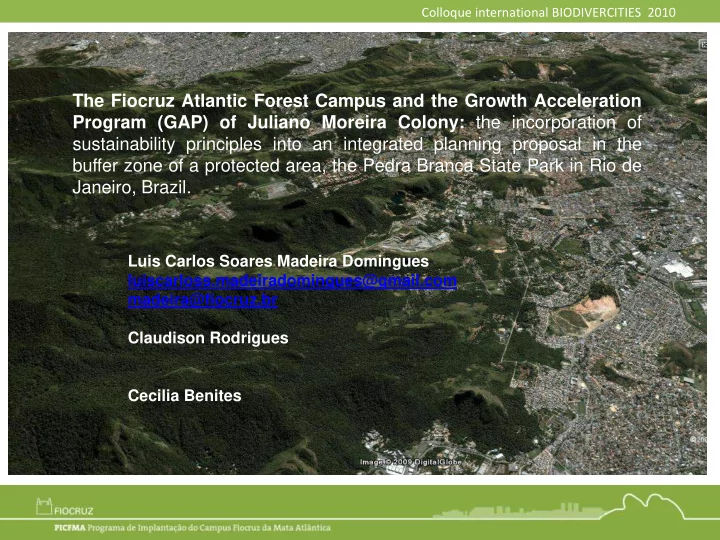
The Fiocruz Atlantic Forest Campus and the Growth Acceleration Program (GAP) of Juliano Moreira Colony: the incorporation of sustainability principles into an integrated planning proposal in the buffer zone of a protected area, the Pedra Branca State Park in Rio de Janeiro, Brazil.
Luis Carlos Soares Madeira Domingues luiscarloss.madeiradomingues@gmail.com madeira@fiocruz.br Claudison Rodrigues Cecilia Benites
SLIDE 2
FIOCRUZ
Colloque international BIODIVERCITIES 2010
1 - Tijuca National Park (~1500 ha) 2 – Pedra Branca State Park (12.500 ha) 3 – Mendanha Natural Municipal Park (~3.500)
Three urban parks in the metropolis
SLIDE 3 FIOCRUZ
Colloque international BIODIVERCITIES 2010
conservation of water potential .
- Devastation of city – since
XVI.
expansion – one of the mains problems along the boundaries today.
The Pedra Branca State Park
SLIDE 4 FIOCRUZ
Colloque international BIODIVERCITIES 2010
1970 / 1980 1980 / 1991 1991 / 2000 1970 a 2000
0,0 50,0 100,0 150,0 200,0 Rio - Evolução percentual da população das AP - 1970/2000
Áreas de Planejamento
1 2 3 4 5
Rio – Population Evolution (%) in the 5 Planning Areas 1970/2000
- relevant population loss in
downtown area (AP1) and descrete in AP2 (south and north zones);
and AP5 (west zone). Redistribution of population since the 1970 decade:
SILVEIRA, Carmen B. In: Uso Residencial na Área Central do Rio de Janeiro: Um estudo na periferia do centro. Dissertação de
- mestrado. Rio de Janeiro: Universidade Federal do Rio de Janeiro/IGEO/PPGG, 1995. Fonte: IBGE - décadas de 1970 a2000.
Elaboração de SILVEIRA, Carmen B.
City growth toward west – surround PBSP
SLIDE 5
FIOCRUZ
Colloque international BIODIVERCITIES 2010
Olimpic Games projects near PBSP
TRANSOLÍMPICA TRANSCARIOCA
CFMA
Olimpic Games Facilities BRT´s projects for Olimpic Games
TRANSOESTE
SLIDE 6
FIOCRUZ
Colloque international BIODIVERCITIES 2010
Sector 1: FIOCRUZ Fiocruz Atlantic Forest Campus (FAFC) Sector 2 : S.M. Health Sector 3: S.M. Habitat Sector 4: Property Developers. Sector 4A: S.M. Habitat Sector 5: S.M. Health Sector 6: C.R.P.H.F./Fiocruz
PEDRA BRANCA STATE PARK
Juliano Moreira Colony: 786 hectares
Limits of Juliano Moreira Colony
SLIDE 7 FIOCRUZ
Colloque international BIODIVERCITIES 2010
Use and Occupation Map
Área Predominantemente Residencial Área Predominantemente Comercial Área Predominantemente Institucional Área Predominantemente Industrial Área de Uso Agrícola Área de Lazer Limites de Setor da Colônia Juliano Moreira Rios e Canais Área Não Ocupada Área Não Ocupada com Cobertura Vegetal
SLIDE 8
FIOCRUZ
Colloque international BIODIVERCITIES 2010
Environmental and social exceptionality
SLIDE 9
FIOCRUZ
Colloque international BIODIVERCITIES 2010
Cultural exceptionality - Historic Core Rodrigues Caldas
SLIDE 10
FIOCRUZ
Colloque international BIODIVERCITIES 2010
Photos: Historic Core Rodrigues Caldas – Fiocruz/Casa de Oswaldo Cruz -2008/2010.
Cultural exceptionality - Historic Core Rodrigues Caldas
SLIDE 11
FIOCRUZ
Colloque international BIODIVERCITIES 2010
Limits of Sectors Juliano Moreira Colony Rivers Forest regeneration Mainly roads City growth Fluxo impedido Possible conections Large properties Plantting areas Residencial occupation sector 1
Diagnostic Map
SLIDE 12
FIOCRUZ
Colloque international BIODIVERCITIES 2010
1999 – With the signing of the Cession of Use Juliano Moreira Colony to PCRJ (SMS), given by the Ministry of Health with the participation of the SPU was established a Working Group to study regulation of the JMC on the municipality, preservation, allocation and equity jurisdiction. 2001 – It was created by the City the Team Local Juliano Moreira - SMS, SMG, SMO, SMAC, SMC. 2003 – The Juliano Moreira Colony was divided into six sectors; 2004 – Fiocruz receives the Sector 1, to implement research activities and teaching and initiates a series of studies aimed at planning the occupation and the viability of projects for the area; 2006 – Fiocruz joins the Working Group of the Municipality of Rio de Janeiro, seeking to integrate planning activities in the area. This process also sought to overcome the common challenges of management, enabling the strategic projects of Fiocruz, and presents itself as a condition to the effectiveness of any future actions in the area. 2007 – Definition of JMC as the object of the Growth Acceleration Program (CAP), with the proposal elaborated by the Workgroup. 2008 – Beginning of Colonia GAP contract. Implementation Management Committee.
Planning process
SLIDE 13 FIOCRUZ
Colloque international BIODIVERCITIES 2010
Vision
The Juliano Moreira Colony may represent a type of occupation and the beginning of a process of regeneration of the area targeting the concept of sustainability in its social, economic and environmental.
- Regularization of land and improving the quality of housing families of Juliano
Moreira Colony;
- Restructuring urban Sector;
- Protection and restoration of cultural heritage and environmental;
- Consolidation of the occupation of Juliano Moreira Colony consistent with the
role it should play as a buffer zone of PEPB;
- Consolidation of equipment mental health portion of the site of the former
Colony;
- Allocation of areas to support activities and projects of Fiocruz and public
facilities in order to overcome local and regional demands Jacarepaguá;
- Search for greater effectiveness of all existing and proposed equipment;
- The
proposed use and
seeks to incorporate principles
sustainable employment and deployment of a territory healthy;
Urban Concept and guidelines
SLIDE 14
FIOCRUZ
Colloque international BIODIVERCITIES 2010
F E E D A D C C B C B C F F
A Forest areas B Institucional area - Fiocruz C Institucional area PCRJ D Low density occupation E Media density occupation F High density occupation Limits of JMC Limits of sectors
A A C C
Gradient definition of occupation
SLIDE 15 FIOCRUZ
Colloque international BIODIVERCITIES 2010
integration with Sector 2
APP acima da cota 100 Áreas non edificandi ou com restrição de usos e atividades que serão objeto de recuperação ambiental Áreas sem restrições ambientais Clareiras Reflorestamento Corredores Verdes
Associates the conservation area still preserved, environmental restoration of degraded areas, sustained occupation
- f only part of the existing voids, with
the definition of environmentally
Proposal for general use and occupancy for the FAFC
integration with Sector 2 integration with Sector 2
SLIDE 16
FIOCRUZ
Colloque international BIODIVERCITIES 2010
Master Plan (Zoning)
INTANGIBLE ZONE - 262ha PRIMITIVE ZONE - 91,6ha RECOVERY ZONE - 76,5ha PLANTING ZONE - 3,4ha EXTENSIVE USE ZONE - 29,6ha INTENSIVE USE ZONE - 12,4ha LAND REGULARIZATION ZONE - 24,5ha
SLIDE 17 FIOCRUZ
Colloque international BIODIVERCITIES 2010
JMC Use and Occupation Proposal - Zoning Map
Sector1
Forest area (cota > 100) Enrichment and reforestation areas (cota < 100) Área de ocupação controlada Uso institucional Fiocruz
Sector2
Forest area (cota > 100) Enrichment and reforestation areas (cota < 100) Reserva de área para uso institucional Fiocruz - equipamento público Institucional use - PCRJ Controlled area (density) Urbanization and Sustainable Land Regularization of existing families, resettlement
- f families and deployment of new housing units.
Historic Core – urban and heritage restoration.
Sector 3
Urbanization and Land Regularization of slums
Limits of JMC Limits of sectors
SLIDE 18 FIOCRUZ
Colloque international BIODIVERCITIES 2010
JMC Management Commite
One of the most important outcomes of this process that is expected to conclude in 2012 will be the regularization and improvement of urban and housing about 6,000 families and formal access to land for housing for other 5000 families. The mangement commite has decisive influence in:
- Consolidation and enhancement of GAP project settings;
- Discussion and decision making of a interinstitutional form,
transparent and democratic;
- Incorporation of a sector within the scope of GAP Colony;
- Definition and implementation of municipal ordinances (AEIF and
AEIS) which define areas of particular interest in the área.
- Definition of guidelines for land regularization to be replicated.
- Orientation of public and private stakeholders for use and occupation
- f Sectors 4 and 4A.
- Definition of strategies and concrete actions from the perspective of
regional planning.
SLIDE 19 FIOCRUZ
Colloque international BIODIVERCITIES 2010
Other actions
The GAP Project is associated with a set of actions that are being captained by Fiocruz, in coordination with partners in the GAP Manegement Committee and other partners, seeking to promote:
- healthier environments;
- strategies for employment generation and income;
- structuring networks of health and education services;
- strategies for environmental conservation;
- strategies for integrated management of cultural heritage.
SLIDE 20
FIOCRUZ
Colloque international BIODIVERCITIES 2010
Other actions – reforestation and enrichment of APPs
Was approved by BNDES financing a reforestation project in forestry and enrichment of approximately 100 ha of permanent preservation areas within the Park and its surroundings.
SLIDE 21 FIOCRUZ
Colloque international BIODIVERCITIES 2010
Preliminary considerations
Fiocruz Atlantic Forest Campus and the GAP Colony proposals may incorporate an important role in its context to allow the minimization of negative impacts of the buffer zone and offer greater protection to the park in its most preserved portion. The scale and effectiveness of the strategy can be broadened considerably if we evaluate the participation of owners bordering the north and south of the area and those responsible for management of
- ther sectors of the former colony as well as the institutions included in
the process of planning and management of GAP Colony and the participation of population. The success of this venture and achieving the intended goals depend, among other things, the institutional competence of the various partners in planning and managing the area in an integrated manner and in the process of land regularization and negotiation with the families living in the former Juliano Moreira Colony.
SLIDE 22 FIOCRUZ
Colloque international BIODIVERCITIES 2010
Preliminary considerations
- A planning process consistent and continuous that already has
approximately 10 years, a situation rare in our public experience;
- A local development strategy that effectively try to integrate the
social, economic and environmental;
- A territorial planning policies in an integrated housing, mobility,
infrastructure and environment policies;
- Action in defense of a proposed city healthy and sustainable, and
that, in the particular case, may offer a promising alternative for the direct relationship between town and PBSP.
SLIDE 23
FIOCRUZ
Colloque international BIODIVERCITIES 2010
Land Regularization Sector 1 – diagnostic
Unidades domiciliares a serem tituladas no local Unidades domiciliares a serem tituladas no local com melhorias habitacionais Unidades domiciliares em edificações funcionais Unidades domiciliares em risco sanitário Unidades domiciliares em risco geológico/geotécnico Unidades domiciliares próximas a bem de interesse histórico-cultural Cultura/plantio
SLIDE 24
FIOCRUZ
Colloque international BIODIVERCITIES 2010
Unidades domiciliares tituladas no local Unidades domiciliares de reassentamento
Land Regularization Sector 1 – urban design
SLIDE 25
FIOCRUZ
Colloque international BIODIVERCITIES 2010
Historic Core restauration – urban proposal
Projeto de Revitalização do Núcleo Histórico Rodrigues Caldas – Fiocruz/Casa de Oswaldo Cruz -2009.