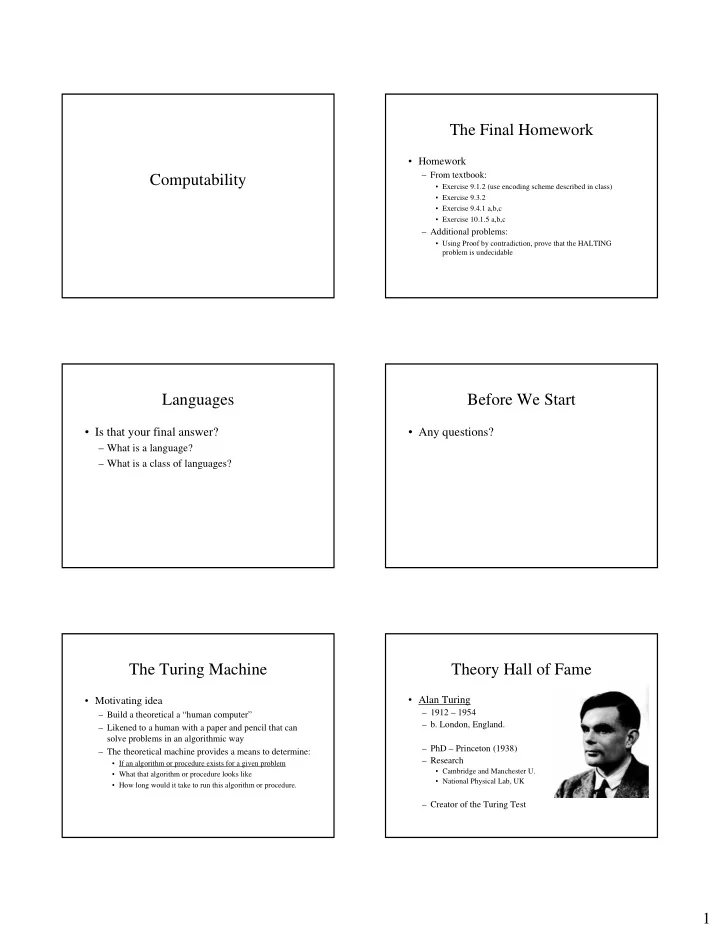
The Final Homework Homework From textbook: Computability - - PDF document

the final homework
SMART_READER_LITE
LIVE PREVIEW

The Final Homework Homework From textbook: Computability - - PDF document

The Final Homework Homework From textbook: Computability Exercise 9.1.2 (use encoding scheme described in class) Exercise 9.3.2 Exercise 9.4.1 a,b,c Exercise 10.1.5 a,b,c Additional problems: Using Proof by


slide-1
SLIDE 1

1

Computability The Final Homework

  • Homework

– From textbook:

  • Exercise 9.1.2 (use encoding scheme described in class)
  • Exercise 9.3.2
  • Exercise 9.4.1 a,b,c
  • Exercise 10.1.5 a,b,c

– Additional problems:

  • Using Proof by contradiction, prove that the HALTING

problem is undecidable

Languages

  • Is that your final answer?

– What is a language? – What is a class of languages?

Before We Start

  • Any questions?

The Turing Machine

  • Motivating idea

– Build a theoretical a “human computer” – Likened to a human with a paper and pencil that can solve problems in an algorithmic way – The theoretical machine provides a means to determine:

  • If an algorithm or procedure exists for a given problem
  • What that algorithm or procedure looks like
  • How long would it take to run this algorithm or procedure.

Theory Hall of Fame

  • Alan Turing

– 1912 – 1954 – b. London, England. – PhD – Princeton (1938) – Research

  • Cambridge and Manchester U.
  • National Physical Lab, UK

– Creator of the Turing Test

slide-2
SLIDE 2

2

The Church-Turing Thesis (1936)

  • Any algorithmic procedure that can be

carried out by a human or group of humans can be carried out by some Turing Machine”

– Equating algorithm with running on a TM – Turing Machine is still a valid computational model for most modern computers.

Theory Hall of Fame

  • Alonso Church

– 1903 -- 1995 – b. Washington D.C. – PhD – Princeton (1927) – Mathematics Prof (1927 – 1967) – Advisor to both Turing and Kleene

Undecidability

  • Informally, a problem is called unsolvable
  • r undecidable if there no algorithm exists

that solves the problem.

  • Algorithm

– Implies a TM that computes a solution for the problem

  • Solves

– Implies will always give an answer

Decision Problem

  • Let’s formalize this a bit

– A decision problem is a problem that has a yes/no answer – Example:

  • Is a given string x a palindrome (Is x ∈ pal?)
  • Is a given context free language empty?

Decision Problems

  • For regular languages

1. Is the language empty? 2. Is the language finite? 3. Is a given string in the language? 4. Given 2 languages, are there strings that are in both? 5. Is the language a subset of another regular language? 6. Is the language the same as another regular language?

Decision Problems

  • For Context Free Languages

1. Is a given string in the language? 2. Is the language empty? 3. Is the language finite?

slide-3
SLIDE 3

3

Decision Problems

  • For recursively enumerable languages
  • 1. Is the language accepted by a TM empty?
  • 2. Is the language accepted by a TM finite?
  • 3. Is the language accepted by a TM regular?
  • 4. Is the language accepted by a TM context

free?

  • 5. Is the language accepted by 1 TM a subset of
  • r equal to the language accepted by another?

Decision Problem

  • Running a decision problem on a TM.

– The problem must first be encoded – Example:

  • Is a given string x a palindrome (Is x ∈ pal?)

– x is an instance of the problem

  • Is a given context free language empty?

– Instance of a problem is a CFG…must be encoded.

Decision Problem

  • Running a decision problem on a TM.

– Once encoded, the encoded instance in provided as input to a TM. – The TM must then

  • Determine if the input is a valid encoding
  • Run, halt,

– Place 1 on the tape if the answer for the input is yes – Place 0 on the tape if the answer for the input is no

– If such a TM exists for a given decision problem, the problem is decidable or solvable. Otherwise the problem is called undecidable or unsolvable.

Solvability

  • In other words, a problem is solvable if the

language of all of its encoded “yes” instances is recursive.

– There is a TM that recognizes the language.

Universal Language

  • Universal Language (Lu)

– Set of all strings wi such that wi ∈L(Mi) – All strings w that are accepted by the TM with w as it’s encoding. – All encodings for TMs that do accept their encoding when input

  • We showed that Lu is not recursive.

An unsolvable problem

  • Lu corresponds to the “yes encodings” of

the decision problem:

– Given a Turing Machine M, does it accept it’s

  • wn encoding. (Self-accepting)
  • Since Lu is not recursive, this problem is

unsolvable.

slide-4
SLIDE 4

4

Reducing one language to another

  • One method of showing whether a given

decision problem is unsolvable is to convert the encoding of the problem into another that we know to be either solvable or unsolvable.

  • This is called reducing one language to

another.

Reducing one language to another

  • Formally,

– Let L1 and L2 be languages over Σ1 and Σ2 – We say L1 is reducible to L2 if

  • There exists a Turning computable function
  • f: Σ1

* → Σ2 * such that

  • x ∈ L1 iff f(x) ∈ L2

Reducing one language to another

  • Informally,

– We can take any encoded instance of one problem

  • Use a TM to compute a corresponding encoded

instance of another problem.

  • If this other problem has a TM that recognizes the

set of “yes encodings”, we can run that TM to solve the first problem.

Reducing one language to another

Conversion TM TM recognizing L2 Instance

  • f P1

Corresponding Instance of P2 YES NO

Reducing one language to another

  • Key facts:

– If L1 is reducible to L2 then

  • If L2 is recursive then L1 is also recursive
  • If L1 is not recursive then L2 is not recursive.

– If P1 and P2 are decision problems with L1 and L2 the languages of “yes encodings” respectively and if L1 is reducible to L2 then

  • If P2 is solvable then P1 is also solvable
  • If P1 is unsolvable then P2 is also unsolvable

Reducing one language to another

– If L1 is reducible to L2 then

  • If L1 is not recursive then L2 is not recursive.

– Proof

  • Assume L2 recursive
  • Consider x1 ∈ L1
  • Consider x2 ∉ L1
  • We found a TM for recognizing L1
  • Contradiction!
  • L2 is not recursive
slide-5
SLIDE 5

5

The halting problem

  • Let’s consider a more general problem about TMs.

– Given a TM, M, and a string w, is w ∈ T(M)? – Given a TM, M and a string w

  • Will M halt and accept on input w?

– Note: original TM only halted when accepted

– We simply cannot just run the string on the TM since if w ∉ L(M), M might go into an infinite loop.

The halting problem

  • The halting problem is unsolvable
  • Proof:

– We can use an argument similar to that used to show that Lu is not recursive. – Instead, let’s use reduction

The halting problem

  • If L1 is reducible to L2 then
  • If L2 is recursive then L1 is also recursive
  • If L1 is not recursive then L2 is not recursive.
  • Let’s show that Self-Accepting can be

reduced to the halting problem.

– L1 = Self Accepting – L2 = Halting

The halting problem

  • Let’s show that Self-Accepting can be

reduced to the halting problem.

– For an encoding of an instance of SA, I, we can define a function

  • f(I) = I’
  • Such that I’ is an encoding of an instance of Halt

and

  • I will be self-accepting iff I’ halts/accepts.

Reducing one language to another

Conversion TM TM recognizing HALT Instance

  • f SA

Corresponding Instance of HALT YES NO

The halting problem

  • Instance of SA = (T) an encoded TM, T
  • Instance of halt = (T’, w) an encoded TM T’

and encoded string w to run on the TM

  • We want T to accept e(T) iff T’ accepts w

– Instance of halt:

  • f(x) = (x, e(x))
slide-6
SLIDE 6

6

The halting problem

  • f(x) = (x, e(x))
  • Does this meet our requirement?

– If x is an encoding for a TM that self-accepts, – Then x will certainly accept e(x) as specified by f. – If x is not an encoding for a TM that self-accepts then either:

  • x is a bogus encoding or
  • x is an encoding for a TM that will not accept it’s own

encoding.

  • In either case (x, e(x)) will not be in halt.

The halting problem

  • We showed that L1 is reducible to L2 where

– L1 is the set of encodings for “yes instances” of the self-accepting problem – L2 is the set of encodings for “yes instances” of the halting problem. – We know that the self-accepting problem is unsolvable, thus, the halting problem is unsolvable.

The halting problem

  • Practical considerations:

– Since the halting problem is unsolvable, there is no algorithm to determine:

  • Given a computer program
  • Will this program always finish?

– Alternately will it ever enter an infinite loop.

Reducing one language to another

  • Important observations

– Reduction operates on strings from languages

  • Reducing encodings of different problems

– If L1 is reducible to L2 then

  • If L2 is recursive then L1 is also recursive
  • If L1 is not recursive then L2 is not recursive.

– Questions? Break?

To show a problem is unsolvable

  • Find a problem known to be unsolvable
  • Reduce this known unsolvable problem to

the problem you wish to show is unsolvable.

  • Only need one to start the ball rolling

– Self-accepting fits the bill.

Decision Problems

  • For recursively enumerable languages
  • 1. Is the language accepted by a TM empty?
  • 2. Is the language accepted by a TM finite?
  • 3. Is the language accepted by a TM regular?
  • 4. Is the language accepted by a TM context

free?

  • 5. Is the language accepted by 1 TM a subset of
  • r equal to the language accepted by another?
slide-7
SLIDE 7

7

Rice’s Theorem

  • The Self-Accepting problem can be reduced

to each one of these decision problems.

  • Rice’s Theorem

– Every non-trivial property of recursively enumerable languages is unsolvable.

  • Where a non-trivial property is a property satisfied

by any non-null subset of the set of recursively enumerable languages.

Decision Problems

  • For recursively enumerable languages
  • All unsolvable.

1. Is the language accepted by a TM empty? 2. Is the language accepted by a TM finite? 3. Is the language accepted by a TM regular? 4. Is the language accepted by a TM context free? 5. Is the language accepted by 1 TM a subset of or equal to the language accepted by another?

Questions?

  • Let’s look at some more unsolvable

problems…

Post Correspondence Problem

  • Given 2 lists of strings (each list with the

same number of elements) can one pick a sequence of corresponding strings from the two lists and form the same string by

  • concatenation. (PCP)

– Attributed to Emil Post (1946).

Theory Hall of Fame

  • Emil Post

– 1897 – 1954 – b. Augustów, Poland. – PhD – Columbia (1920) – Research

  • Princeton.
  • Columbia
  • Cornell

– Plagued by mental illness

Post Correspondence Problem

  • Example:

– Choose a sequence of indicies : 1,3,4

  • List1: 10 0 100 List 2: 101 10 0

00 010 10 100 101 1 100 01 10

1 2 3 4 5 6 List 1 List 2

slide-8
SLIDE 8

8

Post Correspondence Problem

  • Is there a set of indices such that both lists produce

the same string

– Note: Indicies can be repeated

  • Try 1, 4, 6
  • List 1: 101000 List 2 :101000

00 010 10 100 101 1 100 01 10

1 2 3 4 5 6 List 1 List 2

Post Correspondence Problem

  • There is a Modified version of the Post

Correspondence Problem (MPCP)

– Requires that the index 1 appears as the first index in any solution. – This can be shown to be unsolvable by reducing the halting problem to MPCP

  • HALTING ≤ MPCP

– MPCP can be reduced to PCP

  • HALTING ≤ MPCP ≤ PCP

– Since halting is unsolvable

  • MPCP is unsolvable
  • PCP is unsolvable.

Recall: Parse trees

S S + S a S * S a a S S * S S + S a a a Same string, 2 derivations

CFG Ambiguity

  • A CFG is said to be ambiguous if there is at

least 1 string in L(G) having two or more distinct derivations.

  • We said many weeks ago that there is no

algorithm to determine if a given CFG is ambiguous.

– Now we shall prove it

CFG Ambiguity

  • Given a CFG, the problem of whether this

grammar is ambiguous is unsolvable.

– Reduce PCP to Ambiguity. – Meaning:

  • Take an instance of PCP and convert it to a CGF G

such that:

– G is ambiguous iff the instance of PCP has a solution.

CFG Ambiguity

  • Instance of PCP

– 2 Lists of strings A & B, all strings ∈ Σ*

  • A = (w1, w2, …, wn)
  • B = (x1, x2, …, xn)
  • Build a CFG, G with

– Terminal set that includes Σ plus special symbols { a1, a2, …an } which represent indicies into lists A & B

slide-9
SLIDE 9

9

CFG Ambiguity

  • Instance of PCP

– 2 Lists of strings A & B, all strings ∈ Σ*

  • A = (w1, w2, …, wn)
  • B = (x1, x2, …, xn)
  • Productions of G

– A → w1Aa1 | w2Aa2 | … | wnAan

– A → w1a1 | w2a2 | … | wnan

– B → x1Ba1 | x2Ba2 | … | xnBan

– B → x1a1 | x2a2 | … | xnan – S → A | B

CFG Ambiguity

  • Must show that G is ambiguous iff PCP instance

has a solution.

– Assume PCP has a solution (i1,i2, …,im) – Consider the derivations

  • S ⇒ wi1 Aai1 ⇒ wi1 wi2Aai2ai1 ⇒ … ⇒
  • wi1 wi2 … wim A aim …ai2ai1 ⇒ wi1 wi2 … wimaim …ai2ai1
  • S ⇒ xi1 Bai1 ⇒ xi1 xi2Aai2ai1 ⇒ … ⇒
  • xi1 xi2 … xim A aim …ai2ai1 ⇒ xi1 xi2 … ximaim …ai2ai1

– Since (i1,i2, …,im) is a solution to PCP, wi1 wi2 … wim will be the same as xi1 xi2 … xim, thus we have 2 separate derivations for the same string.

  • G is ambiguous.

CFG Ambiguity

  • Example

00 010 10 100 101 1 100 01 10

1 2 3 4 5 6 List A List B

Productions:

A → 10Aa1 | 01Aa2 | 0Aa3 | 100Aa4 | 1Aa5 | 0Aa6 A → 10a1 | 01a2 | 0a3 | 100a4 | 1a5 | 0a6 B → 101Ba1 | 100Ba2 | 10Ba3 | 0Ba4 | 010Ba5 | 00Ba6 B → 101a1 | 100a2 | 10a3 | 0a4 | 010a5 | 00a6 S → A | B

CFG Ambiguity

  • (1,4,6) is a solution

– Consider 101000

– S ⇒ 10Aa1 ⇒ 10100Aa4a1 ⇒ 101000a6a4a1

– S ⇒ 101Ba1 ⇒ 1010Ba4a1 ⇒ 101000a6a4a1 Productions:

A → 10Aa1 | 01Aa2 | 0Aa3 | 100Aa4 | 1Aa5 | 0Aa6 A → 10a1 | 01a2 | 0a3 | 100a4 | 1a5 | 0a6 B → 101Ba1 | 100Ba2 | 10Ba3 | 0Ba4 | 010Ba5 | 00Ba6 B → 101a1 | 100a2 | 10a3 | 0a4 | 010a5 | 00a6 S → A | B

CFG Ambiguity

  • Must show that G is ambiguous iff PCP instance

has a solution.

– Assume G is ambiguous

  • A given string could have only 1 derivation starting from A

and 1 starting from B

  • If there are 2 derivations, one must derive from A and the other

from B

  • The string with 2 derivations will have the tail:

– ai1ai2 … aim for some m ≥ 1 – On the A derivation the head will be wi1wi2…wim – On the B derivation the head will be xi1xi2…xim – wi1wi2…wim = xi1xi2…xim – (i1, i2, …im) is a solution to the PCP

CFG Ambiguity

  • Finally,

– Since PCP is unsolvable, so too is the problem

  • f ambiguity.

– SA ≤ HALTING ≤ MPCP ≤ PCP ≤ ambiguity

slide-10
SLIDE 10

10

Summary

  • Solvable vs Unsolvable problems
  • An unsolvable problem

– Self-accepting

  • Reducing one language to another

– Rice’s Theorem – Post Correspondence Problem – Ambiguity of CFGs.

  • Questions?