SLIDE 1 The Evolution of Geometric Structures
Curtis T McMullen Harvard University
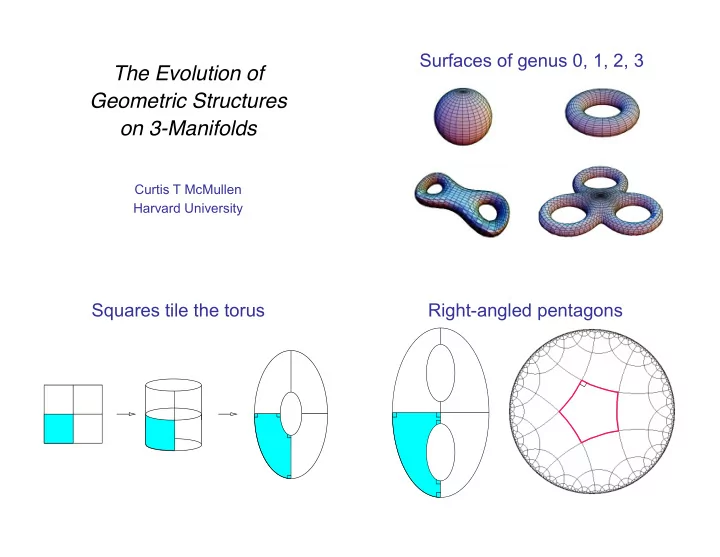
Surfaces of genus 0, 1, 2, 3 Squares tile the torus Right-angled pentagons
SLIDE 2 All surfaces can be built using one
g=1 g=0 g=2,3,4,…
Klein 1870s
Uniformization
Poincaré 1881 To produce algebraic functions on /G: Poincaré series H
Θ(f) =
g∗(f)
Hyperbolic surfaces = algebraic curves
f = f(z) dz2
holomorphic quadratic differential on
H
G
H
y2 = x5-1
The world of 3-manifolds
Thurston, 1982
The Geometrization Conjecture All 3-manifolds can be built using just 8 geometries.
Perelman, 2003
SLIDE 3
The Eight Geometries
S3 E3 H3
constant curvature
R × S2 E3 R × H S3 Nil ⇥ SL2 R
sphere torus
g ≥2 S1→M→∑g
E3 Nil R ⇥R 2
elliptic parab hyperbolic
S1xS1→M→S1 Products and twisted products: dimension 2+1/2
The 3-sphere Poincaré’s fake sphere, M=S3/G
Hyperbolic Geometry
SLIDE 4 Poincaré Conjecture The only solution to π1(M3)=(1) is M3=S3. Fermat’s Last Theorem The only solutions to xn+yn = zn, n>2, are trivial. Every elliptic curve E
by a modular curve,
Q
H/Γ(N) → E.
Every M3 is built from geometric pieces; typically
H3/Γ → M.
Geometrization Conjecture
⇒
Modularity Conjecture
⇒
Catalog of elliptic curves/Q
(Cremona, 1992)
Knot Theory
Mostow: Topology ⇒ Geometry SL2(Z[ω]) SL2(Z[i])
H3/Γ = S3\K
Arithmetic Examples
SLIDE 5 Hyperbolic volume
as a topological invariant K K =
= 2.0298832128193...
vol(S3− ) = 6 (π/3) = 6 π/3 log
1 2 sin θ dθ
The Perko Pair
Hoste, Thistlethwaite and Weeks,1998:
The First 1,701,936 knots (Up to 16 crossings)
Almost all knot complements are hyperbolic.
1980s
Thurston’s breakthroughs
Almost all surgeries of S3 along knot and links yield hyperbolic manifolds. The result of gluing together two hyperbolic 3-manifolds is hyperbolic, unless it contains a 2-torus.
SLIDE 6 → ← τ
Riemann surface boundary hyperbolic 3-manifold hyperbolic 3-manifold
Evolution and gluing
Theorem(Thurston) M/τ hyperbolic ⇔ π1(M/τ) does not contain
Z2
(Analytic approach: at a given X in Teich(∂M), we have |Dσ| ≤ ||ΘX||; and ||ΘX|| < 1.)
⇔ σ○τ : Teich(∂M) →Teich(∂M) has a fixed point.
Hamilton, Perelman
Evolution by curvature
Darwin recognized that his weak and negative force... could only play [a] creative role if variation met three crucial requirements: copious in extent, small in range of departure from the mean, and isotropic.
Gould, 2002
Evolution by curvature
Singularities
Thanks to Dmitri Gekhtman
2002-3
Geometrization Conjecture is true Poincaré Conjecture is true
Singularities always undo connect sums Evolution with surgery continues for all time
Eventually, architecture of M becomes visible
Perelman’s papers
SLIDE 7
``General relativity places no constraints on the topology of the Universe.’’
Cosmological Corollary
K<0 K>0 K=0
Iteration on Teich(∂M) Ricci flow PL, geometric, classical, algorithmic C∞, infinite-dimensional, variable curvature Iteration on Teich(∂M) Ricci flow PL, geometric, classical, algorithmic C∞, infinite-dimensional, variable curvature Bottom up Uses hierarchy Top down General Iteration on Teich(∂M) Ricci flow
SLIDE 8
PL, geometric, classical, algorithmic C∞, infinite-dimensional, variable curvature Bottom up Uses hierarchy Top down General Holomorphic Contracting Monotone Iteration on Teich(∂M) Ricci flow PL, geometric, classical, algorithmic C∞, infinite-dimensional, variable curvature Bottom up Uses hierarchy Top down General Holomorphic Contracting Monotone General case - surgery, cone manifolds? Diffuse Welcomes singularities Iteration on Teich(∂M) Ricci flow
Surfaces in 3-manifolds?
Conjecture. If M is a closed hyperbolic 3-manifold, then a finite cover of M contains an incompressible surface.
Theorem (Kahn-Markovic). If M is a closed, hyperbolic 3-manifold, then π1(M) contains a surface group.
The Jones polynomial (1983)
skein theory t-1V+ - tV- = (t1/2 - t-1/2) V0 V(O,t) = 1
SLIDE 9 V(t) = t-2-t-1+1-t+t2
Jones polynomial for figure 8 knot
Quantum fields (Witten)
⟨K⟩ = ∫Tr(∮ A) e2πik CS(A) DA
K
= (q1/2+q-1/2) V(K,1/q)
q = exp(2πi/(2+k)) → 1 as k → ∞
⟨unknot⟩ → 2
Volume Conjecture
Murakami-Murakami Kashaev
Cable K2 for figure eight knot K 2π log |Vn(K,e2πi/n)|
n
→ hyperbolic vol(S3-K)
Vn+1(K, t) =
n/2
⇤
j=0
(−1)j n − j j ⇥ V (Kn−2j, t)
quantum fields general relativity