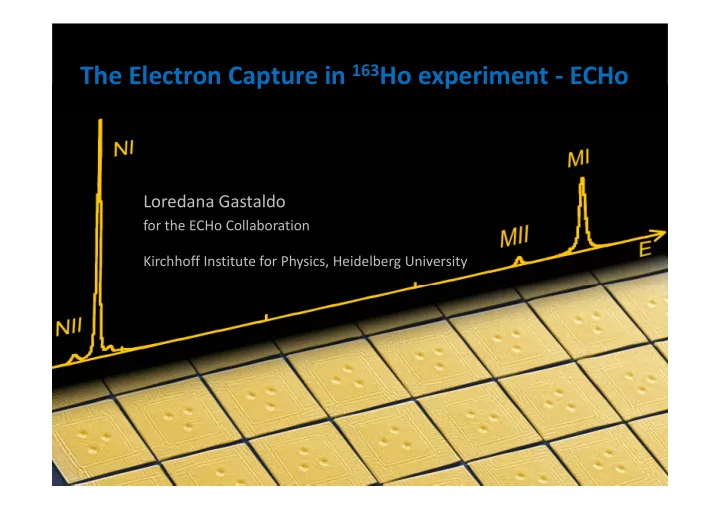
The Electron Capture in 163 Ho experiment ECHo Loredana Gastaldo - - PowerPoint PPT Presentation

the electron capture in 163 ho experiment echo
SMART_READER_LITE
LIVE PREVIEW

The Electron Capture in 163 Ho experiment ECHo Loredana Gastaldo - - PowerPoint PPT Presentation

The Electron Capture in 163 Ho experiment ECHo Loredana Gastaldo for the ECHo Collaboration Kirchhoff Institute for Physics, Heidelberg University 163 Ho electron capture decay e 163 163 * Ho Dy 67 66 e e


slide-1
SLIDE 1

The Electron Capture in 163Ho experiment ‐ ECHo

Loredana Gastaldo

for the ECHo Collaboration Kirchhoff Institute for Physics, Heidelberg University

slide-2
SLIDE 2

163Ho electron capture decay

n p p p n n

e‐ e‐ e‐ e‐

n p p p n n n

e‐ e‐

p

e

e‐ e‐ e‐

C 163 66 * 163 66 e * 163 66 163 67

Dy Dy Dy Ho E     

  • 1/2  4570 years (2*1011 atoms for 1 Bq)
  • QEC = (2.833  0.030stat  0.015syst) keV
  • S. Eliseev et al., Phys. Rev. Lett. 115 (2015) 062501

1

slide-3
SLIDE 3

163Ho electron capture decay

n p p p n n

e‐ e‐ e‐ e‐

n p p p n n n

e‐ e‐

p

e

e‐ e‐ e‐

C 163 66 * 163 66 e * 163 66 163 67

Dy Dy Dy Ho E     

  • 1/2  4570 years (2*1011 atoms for 1 Bq)
  • QEC = (2.833  0.030stat  0.015syst) keV
  • S. Eliseev et al., Phys. Rev. Lett. 115 (2015) 062501

AME 2012 AME 2017

Penning Trap Mass Spectroscopy

@TRIGA TRAP (Uni‐Mainz) () @SHIPTRAP (GSI – Darmstadt) ()

) Dy ( ) Ho (

163 163 EC

m m Q  

Future goal: 1 eV precision: PENTATRAP @MPIK, Heidelberg (*)

() F. Schneider et al., Eur. Phys. J. A 51 (2015) 89 () S. Eliseev et al., Phys. Rev. Lett. 115 (2015) 062501 (*) J. Repp et al., Appl. Phys. B 107 (2012) 983 (*) C. Roux et al., Appl. Phys. B 107 (2012) 997 1

slide-4
SLIDE 4

n p p p n n

e‐ e‐ e‐ e‐

n p p p n n n

e‐ e‐

p

e

e‐ e‐ e‐

163Ho electron capture decay

MI MII NI NII OII OI

  • A. De Rujula and M. Lusignoli,
  • Phys. Lett. 118B (1982)

C 163 66 * 163 66 e * 163 66 163 67

Dy Dy Dy Ho E     

  • 1/2  4570 years (2*1011 atoms for 1 Bq)
  • QEC = (2.833  0.030stat  0.015syst) keV
  • S. Eliseev et al., Phys. Rev. Lett. 115 (2015) 062501

1

slide-5
SLIDE 5

Statistics in the end point region

  • Nev > 1014

→ A ≈ 1 MBq Unresolved pile‐up (fpu ~ a  r)

  • fpu < 10‐5
  • r < 1 µs  a ~ 10 Bq
  • 105 pixels

Precision characterization of the endpoint region

  • EFWHM < 3 eV

Background level

  • < 10‐6 events/eV/det/day

fpu = 10‐6 EFWHM = 2 eV

Requirements for  mass determination

2

slide-6
SLIDE 6

Sensitivity of 163Ho based experiments ‐ ECHo

m(e) < 10 eV 90% C.L.

ECHo‐1k – revised (2015 – 2018+) ECHo‐100k (2018 – 2021+) A  300 Bq t = 1 y A  100 kBq t = 3 y Activity per pixel: 1 ‐ 5 Bq Number of detectors: 60 ‐ 100 Readout: parallel two stage SQUID Activity per pixel: 10 Bq Number of detectors: 12000 Readout: microwave SQUID multiplexing

m(e) < 1.5 eV 90% C.L.

Supported by DFG Research Unit FOR 2022/1 Supported by DFG Research Unit FOR 2022/2

3

slide-7
SLIDE 7

Experimental aspects

ECHo uses large arrays of low T metallic magnetic calorimeters with enclosed 163Ho

4

slide-8
SLIDE 8

Experimental aspects

ECHo uses large arrays of low T metallic magnetic calorimeters with enclosed 163Ho

tot

C E ΔT 

G C = τ

tot

t

T

T 

A.Fleischmann, C. Enss and G. M. Seidel, Topics in Applied Physics 99 (2005) 63 A.Fleischmann et al., AIP Conf. Proc. 1185 (2009) 571

  • L. Gastaldo et al.,
  • Nucl. Inst. Meth. A, 711 (2013) 1

5

slide-9
SLIDE 9

Experimental aspects

G C = τ

tot

t

T

T 

ECHo uses large arrays of low T metallic magnetic calorimeters with enclosed 163Ho

tot

C E ΔT 

A.Fleischmann, C. Enss and G. M. Seidel, Topics in Applied Physics 99 (2005) 63 A.Fleischmann et al., AIP Conf. Proc. 1185 (2009) 571

  • L. Gastaldo et al.,
  • Nucl. Inst. Meth. A, 711 (2013) 1

200 µm

5

slide-10
SLIDE 10

Experimental aspects

G C = τ

tot

t

T

T 

ECHo uses large arrays of low T metallic magnetic calorimeters with enclosed 163Ho

tot

C E ΔT 

Operated at T  20 mK

5

slide-11
SLIDE 11

Experimental aspects

ECHo uses large arrays of low T metallic magnetic calorimeters with enclosed 163Ho

tot

C E ΔT 

G C = τ

tot

t

T

T 

55Fe 55Fe, K 55Fe

Fast risetime  Reduction un‐resolved pile‐up Extremely good energy resolution Reduced smearing in the end point region Excellent linearity  precise definition of the energy scale

5

slide-12
SLIDE 12

Experimental aspects

ECHo uses large arrays of low T metallic magnetic calorimeters with enclosed 163Ho Required activity in the detectors for sub‐eV  >106 Bq  >1017 atoms  >27 µg Neutron irradiation Excellent chemical separation (n,)‐reaction on 162Er 95% efficiency Available 163Ho  2  1018 atoms (10 MBq)

  • H. Dorrer et al, Radiochim. Acta 106(7) (2018) 535–48

6

slide-13
SLIDE 13

Experimental aspects

ECHo uses large arrays of low T metallic magnetic calorimeters with enclosed 163Ho Required activity in the detectors for sub‐eV  >106 Bq  >1017 atoms  >27 µg Neutron irradiation Excellent chemical separation (n,)‐reaction on 162Er 95% efficiency available 163Ho  2  1018 atoms (10 MBq)

  • F. Schneider et al., NIM B 376 (2016) 388
  • T. Kieck et al., Rev. Sci. Inst. 90 (2019) 053304
  • T. Kieck et al., NIM A 945 (2019) 162602
  • H. Dorrer et al, Radiochim. Acta 106(7) (2018) 535–48

Mass separation and ion implantation in MMC pixels RISIKO @ Institute of Physics, Mainz University

‐ Resonant laser ion source efficiency (69 ± 5stat ± 4syst )% ‐ Reduction of 166mHo in MMC

166mHo/163Ho < 4(2)10‐9

‐ Optimization of beam focalization

6

slide-14
SLIDE 14

Experimental aspects

ECHo uses large arrays of low T metallic magnetic calorimeters with enclosed 163Ho Required activity in the detectors for sub‐eV  >106 Bq  >1017 atoms  >27 µg Neutron irradiation Excellent chemical separation (n,)‐reaction on 162Er 95% efficiency available 163Ho  2  1018 atoms (10 MBq)

  • F. Schneider et al., NIM B 376 (2016) 388
  • T. Kieck et al., Rev. Sci. Inst. 90 (2019) 053304
  • T. Kieck et al., NIM A 945 (2019) 162602
  • H. Dorrer et al, Radiochim. Acta 106(7) (2018) 535–48

Mass separation and ion implantation in MMC pixels RISIKO @ Institute of Physics, Mainz University

‐ Resonant laser ion source efficiency (69 ± 5stat ± 4syst )% ‐ Reduction of 166mHo in MMC

166mHo/163Ho < 4(2)10‐9

‐ Optimization of beam focalization

6

slide-15
SLIDE 15

Experimental aspects

ECHo uses large arrays of low T metallic magnetic calorimeters with enclosed 163Ho Required activity in the detectors for sub‐eV  >106 Bq  >1017 atoms  >27 µg Neutron irradiation Excellent chemical separation (n,)‐reaction on 162Er 95% efficiency available 163Ho  2  1018 atoms (10 MBq)

  • F. Schneider et al., NIM B 376 (2016) 388
  • T. Kieck et al., Rev. Sci. Inst. 90 (2019) 053304
  • T. Kieck et al., NIM A 945 (2019) 162602
  • H. Dorrer et al, Radiochim. Acta 106(7) (2018) 535–48

Mass separation and ion implantation in MMC pixels RISIKO @ Institute of Physics, Mainz University

‐ Resonant laser ion source efficiency (69 ± 5stat ± 4syst )% ‐ Reduction of 166mHo in MMC

166mHo/163Ho < 4(2)10‐9

‐ Optimization of beam focalization

6

slide-16
SLIDE 16

Experimental aspects

ECHo uses large arrays of low T metallic magnetic calorimeters with enclosed 163Ho

maXs‐20 16 pixels 4 pixels used for low background experiment

7 250 µm

slide-17
SLIDE 17

Experimental aspects

ECHo uses large arrays of low T metallic magnetic calorimeters with enclosed 163Ho

maXs‐20 16 pixels 4 pixels used for low background experiment ECHo‐1k 32 channels + 4 for diagnostics present working horse

7 250 µm 5 mm

slide-18
SLIDE 18

Experimental aspects

ECHo uses large arrays of low T metallic magnetic calorimeters with enclosed 163Ho

maXs‐20 16 pixels 4 pixels used for low background experiment ECHo‐1k 32 channels + 4 for diagnostics present working horse ECHo‐100k 32 channels ‐ in fabrication

7 250 µm 5 mm 5 mm

slide-19
SLIDE 19

163Ho theory

A large number of theoretical works to interpret the 163Ho spectral shape

  • A. Faessler et al., J. Phys. G 42 (2015) 015108
  • R. G. H. Robertson, Phys. Rev. C 91, 035504 (2015)
  • A. Faessler and F. Simkovic, Phys. Rev. C 91, 045505 (2015)
  • A. Faessler et al., Phys. Rev. C 91, 064302 (2015)
  • A. Faessler et al., Phys. Rev. C 95, (2017) 045502
  • A. De Rujula and M. Lusignoli, JHEP 05 (2016) 015
  • P. C.‐O. Ranitzsch et al.,
  • Phys. Rev. Lett. 119 (2017) 122501

8

slide-20
SLIDE 20

New approach Ab inito calculation of the 163Ho electron capture spectrum Restricted to bound‐states only, i.e. the spectrum is given by a finite number of resonances  Include decay to the continuum states  Study the effect of metallic host

Brass et al., Phys. Rev. C 97 (2018) 054620

163Ho theory

9

slide-21
SLIDE 21

Final analysis of the „Modane Data“

  • Detector chip: maXs 20 design

4 pixels 4 days

  • Activity ≈ 0.2 Bq
  • 275 000 counts

10

slide-22
SLIDE 22

From signal to spectrum

Fit all pulses with time template key parameters are extracted to perform cuts

  • C. Velte et al., submitted to EPJC

11

slide-23
SLIDE 23

Fit all pulses with time template key parameters are extracted to perform cuts

From signal to spectrum

  • C. Velte et al., submitted to EPJC

11

slide-24
SLIDE 24

Fit all pulses with time template key parameters are extracted to perform cuts

From signal to spectrum

  • C. Velte et al., submitted to EPJC

11

slide-25
SLIDE 25

From signal to spectrum

  • C. Velte et al., submitted to EPJC

11

slide-26
SLIDE 26

163Ho spectral shape analysis

Energy resolution EFWHM = 9.2 eV

  • C. Velte et al., submitted to EPJC

12

slide-27
SLIDE 27

163Ho spectral shape analysis

Two background events: @ 3.742 keV @ 6.250 keV Background level b < 1.6  10‐4 events/eV/pixel/day

  • C. Velte et al., submitted to EPJC

12

slide-28
SLIDE 28

163Ho spectral shape analysis

test of analysis routines: QEC = (2838 ± 14) eV m(e) < 150 eV (95% C.L.) profile log‐likelihood ratio hypothesis test

  • C. Velte et al., submitted to EPJC

12

slide-29
SLIDE 29

Outlook (1): end of ECHo‐1K

ECHo‐1k chip‐Au

  • 163Ho activity per pixel a  1 Bq
  • 4 Front‐end chips each with 8 dc‐SQUIDs for parallel readout

13

slide-30
SLIDE 30

Outlook (1): end of ECHo‐1K

ECHo‐1k chip‐Au

  • 163Ho activity per pixel a  1 Bq
  • 4 Front‐end chips each with 8 dc‐SQUIDs for parallel readout
  • 14 channels  1 month data acquisition = 3  107 163Ho events
  • Data Analysis on‐going:

background model theoretical description of the spectrum  adding decay to the continuum

13

slide-31
SLIDE 31

Outlook (1): end of ECHo‐1K

ECHo‐1k chip‐Au

  • 163Ho activity per pixel a  1 Bq
  • 4 Front‐end chips each with 8 dc‐SQUIDs for parallel readout
  • 14 channels  1 month data acquisition = 3  107 163Ho events
  • Data Analysis on‐going
  • Refurbishing of readout channels for more channels and lower noise

ECHo‐1k chip‐Ag

  • First characterization: 0.7 Bq average activity

Excellent energy resolution

14

slide-32
SLIDE 32

Outlook (1): end of ECHo‐1K

ECHo‐1k chip‐Au

  • 163Ho activity per pixel a  1 Bq
  • 4 Front‐end chips each with 8 dc‐SQUIDs for parallel readout
  • 14 channels  1 month data acquisition = 3  107 163Ho events
  • Data Analysis on‐going
  • Refurbishing of readout channels for more channels and lower noise

ECHo‐1k chip‐Ag

  • First characterization: 0.7 Bq average activity

Excellent energy resolution

  • Refurbishing of the readout channel to increase the number of channels

Starting a new higher statistics measurement soon! Goal of ECHo‐1k: limit on m(e) from 225 eV * to 20 eV in 2020

15 * P. T. Springer et al.,

  • Phys. Rev. A 35 (1987) 679
slide-33
SLIDE 33

Outlook (2): towards ECHo‐100k

ECHo‐100k chip in fabrication

  • single pixel optimization:

163Ho activity per pixel a  10 Bq

reduced absorber thickness  increase signal to noise ratio

  • F. Mantegazzini et al., in preparation
  • M. Herbst et al., to be submitted

16

slide-34
SLIDE 34

Outlook (2): towards ECHo‐100k

ECHo‐100k chip in fabrication

  • single pixel optimization:

163Ho activity per pixel a  10 Bq

reduced absorber thickness  increase signal to noise ratio

  • suitable for parallel and multiplexed readout

17

slide-35
SLIDE 35

Outlook (2): towards ECHo‐100k

ECHo‐100k chip in fabrication

  • single pixel optimization:

163Ho activity per pixel a  10 Bq

reduced absorber thickness  increase signal to noise ratio

  • suitable for parallel and multiplexed readout

 163Ho implantation on several chips foreseen before the end of the year

18

slide-36
SLIDE 36

Outlook (2): towards ECHo‐100k

ECHo‐100k chip in fabrication

  • single pixel optimization:

163Ho activity per pixel a  10 Bq

reduced absorber thickness  increase signal to noise ratio

  • suitable for parallel and multiplexed readout

 163Ho implantation on several chips foreseen before the end of the year Microwave multiplexed readout of MMC demonstrated

19

  • M. Wegner et al., J. Low Temp. Phys. 193, 462 (2018)
slide-37
SLIDE 37

Outlook (2): towards ECHo‐100k

ECHo‐100k chip in fabrication

  • single pixel optimization:

163Ho activity per pixel a  10 Bq

reduced absorber thickness  increase signal to noise ratio

  • suitable for parallel and multiplexed readout

 163Ho implantation on several chips foreseen before the end of the year Microwave multiplexed readout of MMC demonstrated

  • adapt room temperature electronics for larger number of detectors/channel (goal 400 det/ch)
  • install 13 new microwave channels in ECHo cryostat

 163Ho spectrum acquired at GHz frequency foreseen early 2020

20

slide-38
SLIDE 38

Outlook (2): towards ECHo‐100k

ECHo‐100k chip in fabrication

  • single pixel optimization:

163Ho activity per pixel a  10 Bq

reduced absorber thickness  increase signal to noise ratio

  • suitable for parallel and multiplexed readout

 163Ho implantation on several chips foreseen before the end of the year Microwave multiplexed readout of MMC demonstrated

  • adapt room temperature electronics for larger number of detectors/channel (goal 400 det/ch)
  • install 13 new microwave channels in ECHo cryostat

 163Ho spectrum acquired at GHz frequency foreseen early 2020 Preparation of background model for ECHo

  • Experiments with muon veto demonstrate that

muon related events discriminated via pulse shape

  • Effect of low energy secondary radiation is being

investigated via Monte Carlo simulations

  • A. Göggelmann et al. Muon induced background in ECHo,

in preparation

21

slide-39
SLIDE 39

Conclusions

 The determination of the electron neutrino effective mass with 163Ho is complementary to

the determination of the electron antineutrino effective mass with 3H

 ECHo has already demonstrated:

production and purification of mg‐size sample of 163Ho sample

  • peration of large arrays of high resolution low temperature detectors

first low energy background studies

 Determination of the 163Ho spectral shape is of major importance for the reduction of

systematic errors: ab‐initio calculation precise independent determination of QEC via PTMS

 ECHo is now a running experiment on the way to provide a new limit on the electron

neutrino mass and ready for upgrades to larger arrays

22

slide-40
SLIDE 40