
SLIDE 1
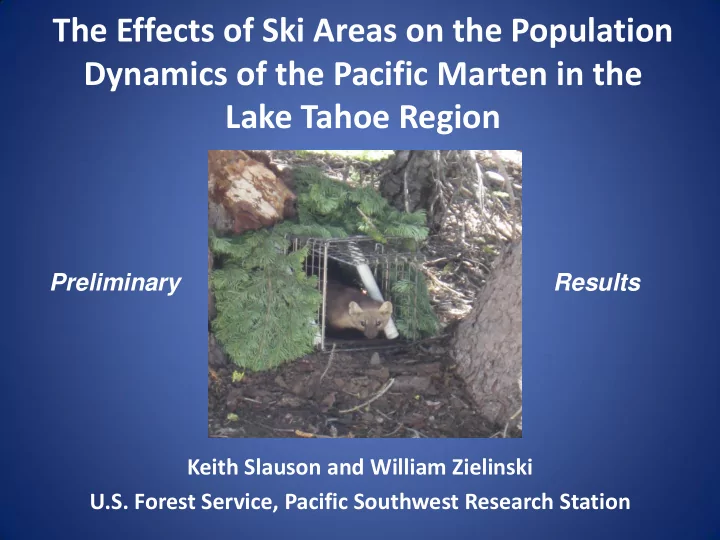
The Effects of Ski Areas on the Population Dynamics of the Pacific Marten in the Lake Tahoe Region
Keith Slauson and William Zielinski U.S. Forest Service, Pacific Southwest Research Station Preliminary Results
The Effects of Ski Areas on the Population Dynamics of the Pacific - - PowerPoint PPT Presentation
The Effects of Ski Areas on the Population Dynamics of the Pacific Marten in the Lake Tahoe Region Preliminary Results Keith Slauson and William Zielinski U.S. Forest Service, Pacific Southwest Research Station Marten Life History
Keith Slauson and William Zielinski U.S. Forest Service, Pacific Southwest Research Station Preliminary Results
Mating System: Polygamous, females solely responsible for raising young Total Length: 500-680 mm Weight: 500-1400 g Sexually dimorphic: adult males 40% larger than females Reproduction: ≥2 year-old females 1-3 kits / litter Longevity: Most individuals 5 years Diet: Varies seasonally, dominated by Squirrels, Voles & Birds
Bissonette et al. 1997 Potvin et al. 2000
movements energy loss reproduction and /or survival risk of predation survival prey species or abundance reproduction and/or survival
extrinsic sources
direct energy gain reproduction and/or survival populations
energy gain reproduction and/or survival
Response variable: marten abundance Response variable: survival estimates (MARK) Response variable: distribution of females relative to remnant forest fragments
Potential Marten Habitat Heavenly Ski Area Sierra At Tahoe Ski Area Homewood Ski Area Pre-development Marten Habitat Topography Elevation Range Macro Aspect Proximity
15-day Station Durations Bait: Chicken Lure: Gusto Age 1st premolar
January-March May-July Winter 5-day Visits Spring daily Visits
Spring: PIT tag
Individual ID
Winter: DNA
Survival (S) ‘Seniority’ (G) probability that if alive and in the population at time i (this year), that you were also alive and in the population at time i-1 (last year) Capture Probability (P) Recapture Probability (C) Population Size (N)
Parameter
Survival (Spring-Spring)
Covariate Effect
Seniority (Winter-Spring) Seniority (Spring-Spring) Control
Estimate (95% CI)
Survival (Winter-Spring) 0.60 (0.44-0.75) 0.38 (0.28-0.49) 0.79 (0.11-1.69) 0.56 (0.40-0.71) 0.49 (0.35-0.64) Control 1.67 (0.51-2.82)
Marten Survival is Significantly REDUCED on Ski Areas Turnover Rates are Significantly HIGHER on Ski Areas
Captured on Edge Captured in Core Ski Areas Controls Total 14 12 10 5 4 7 Proportions Test Z-value P = 0.06
Sierra At Tahoe
Homewood: 1 residual patch >20 hectares No reproductive females within
0.0% 20.0% 40.0% 60.0% 80.0% 100.0%
<10 10-20 20-40 >40
Available Used
Heavenly
the distribution of reproductive females
population ‘sink’ conditions on all (Homewood) or portions of resorts (Heavenly & Sierra At Tahoe)
development conditions
Lake Tahoe Environmental Improvement Program Sierra Nevada Land Management Act Tahoe Science Consortium Field Crews: Mark Linnell, Matt Delheimer, Pete Lundberg,
Nathan Shea, Katlin Mansfield, Katie Greller, Dustin Marsh, Devin Crenshaw, Natalie Craven, Michelle Rann, Tim Sichmeller, Wes Watts, Conor MacNamara, Natalie Mesce, Kathleen Sholty, Kirsty Lawson
Lake Tahoe Basin Management Unit El Dorado National Forest Tahoe Region Planning Agency Heavenly Resort Sierra At Tahoe Resort Homewood Mountain Resort Pacific Southwest Research Station