The Economic $ and Epidemiology of I have the following financial - - PowerPoint PPT Presentation

the economic and epidemiology of
SMART_READER_LITE
LIVE PREVIEW

The Economic $ and Epidemiology of I have the following financial - - PowerPoint PPT Presentation

The Economic $ and Epidemiology of I have the following financial interests or relationships to disclose: Intravitreal Injections Alcon Laboratories, Inc.: Consultant/Advisor Allergan, Inc.: Consultant/Advisor, Grant Support 2016


slide-1
SLIDE 1

The Economic$ and Epidemiology of Intravitreal Injections

George A. Williams, M.D.

Beaumont Eye Institute

2016 Proctor Lecture

¥ I have the following financial interests or relationships to disclose:

¥ Alcon Laboratories, Inc.: Consultant/Advisor ¥ Allergan, Inc.: Consultant/Advisor, Grant Support ¥ ThromboGenics: Equity Owner ¥ ForSight: Consultant/Advisor, Equity Owner ¥ Johnson & Johnson: Consultant/Advisor ¥ OMIC-Ophthalmic Mutual Insurance Company: Employee ¥ OptiMedica: Consultant/Advisor, Equity Owner ¥ Retrosense: Consultant/Advisor, Equity Owner ¥ Vitamin Health: Consultant/Advisor ¥ Covalent Medical: Equity Owner

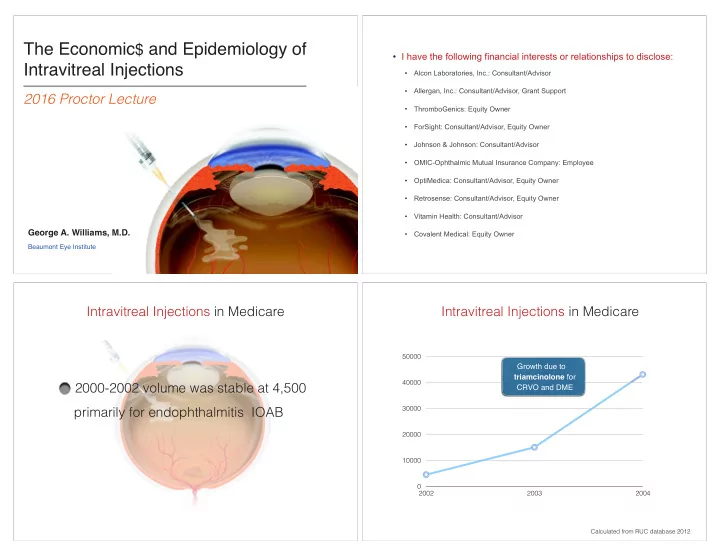
2000-2002 volume was stable at 4,500 primarily for endophthalmitis IOAB Intravitreal Injections in Medicare

10000 20000 30000 40000 50000 2002 2003 2004

Calculated from RUC database 2012

Intravitreal Injections in Medicare

Growth due to triamcinolone for CRVO and DME

slide-2
SLIDE 2

200000 400000 600000 800000 1000000 1200000 2002 2003 2004 2005 2006 2007 2008 2009

Calculated from RUC database 2015

Macugen

(2004)

Avastin (2005) Lucentis (2006)

Intravitreal Injections in Medicare

500000 1000000 1500000 2000000 2500000 3000000 2004 2005 2006 2007 2008 2009 2010 2011 2012 2013 2014 2015

Calculated from RUC database 2016

Intravitreal Injections in Medicare

Only Medicare fee-for service Estimate including Medicare Advantage and non-Medicare for 2016

Intravitreal Injections in Medicare

Calculated from RUC database 2016

5 million Future projections based on growth of Medicare beneÞciary pool, growth in diabetes, and prior growth.

Intravitreal Injections Future

slide-3
SLIDE 3

10% vs 20% growth 2016: 4.8M vs 5.8M 2017: 5.3M vs 6.9M

Intravitreal Injections Future

Calculated from RUC database 2016

Intravitreal Injections in Medicare Epidemiology

22% > 65 years 78% > 75 years 34% > 85 years 37% male 63% female 97% age-eligible 2% disability 1% ESD

Calculated from RUC database 2016

Intravitreal Injections in Medicare Epidemiology Intravitreal Injections in Medicare Epidemiology

Calculated from RUC database 2016

White Black Hispanic Other

slide-4
SLIDE 4

Calculated from RUC database 2016

ICD 362 Diabetes ICD 250 Glaucoma ICD 365 Other

Intravitreal Injections in Medicare Epidemiology

Calculated from RUC database 2016

Physician OfÞce Outpatient hospital ASC

Intravitreal Injections in Medicare Epidemiology

New source of real world data Constantly updated Disease speciÞc Patient speciÞc Drug speciÞc

Intravitreal Injections in Medicare Epidemiology

IRIS Registry

Useful for clinical analysis Health policy Payment policy Practice and physician analysis

Intravitreal Injections in Medicare Epidemiology

IRIS Registry

slide-5
SLIDE 5

2,230,755 patients with AMD

Intravitreal Injections in IRIS Registry AMD from January 2013 thru June 2016

2,230,755 patients with AMD 344,654 patients received at least one intravitreal injection

Intravitreal Injections in IRIS Registry AMD from January 2013 thru June 2016

2,230,755 patients with AMD 344,654 patients received at least one intravitreal injection 3,320,740 injections

Intravitreal Injections in IRIS Registry AMD from January 2013 thru June 2016

IRIS AMD from January 2013 thru June 2016

(1,357,983) (1,122,086) (840,671)

slide-6
SLIDE 6

Average LogMAR Visual Acuity over Time for AMD Patients, by Anti-VegF Treatment Agent

0.579 0.559 0.618 0.571 0.603 0.555 Baseline 0-3 months PRE injection 4-8 months POST-injection 10-14 months POST-injection 16-20 months POST-injection 22-24 months POST-injection Aflibercept Bevacuzimab Ranibizumab

Data source: IRIS¨ Registry, January 2013 to June 2016

logMAR 0.6 = ~20/80 logMAR 0.5 = ~20/63

Ongoing Visual Acuity Analysis

Visual acuity 20/40 or better and 20/200 or worse Correlation of visual acuity with number and timing of injections Visual acuity in eyes receiving combination therapy with steroids and anti-VEGF drugs

Endophthalmitis Rates within 15 days among ! AMD Patients, by Anti-VEGF Agent Injection

Data source: IRIS¨ Registry, January 2013 to June 2016

0.0059% 0.0071% 0.0052% Aflibercept Bevacizumab Ranibizumab

*Chi-square tests show that differences in rates are not statistically significant at p<0.05 level

Average IOP Reading over Time for Eyes Receiving anti-VEGF for Wet AMD

Data source: IRIS¨ Registry, January 2013 to June 2016

15.17 14.82 15.99 15.53 15.67 15.36 Baseline PRE-injection 4-8 months POST-injection 10-14 months POST-injection Aflibercept Bevacizumab Ranibizumab ^In progress: longitudinal analysis accounting for confounders to determine if changes over time and differences between anti-VEGF are statistically significant

slide-7
SLIDE 7

IRIS Registry and Retina

Data source: IRIS¨ Registry, January 2013 to June 2016

Real world data analysis of retinal disease natural history and treatment response on an unprecedented scale

Data source: IRIS¨ Registry, January 2013 to June 2016

Real world data analysis of retinal disease natural history and treatment response on an unprecedented scale If we can measure it, we can improve it

IRIS Registry and Retina

Data source: IRIS¨ Registry, January 2013 to June 2016

Real world data analysis of retinal disease natural history and treatment response on an unprecedented scale If we can measure it, we can improve it In a value-based world, will demonstrate the immense value of retinal treatments

IRIS Registry and Retina IRIS Injections by Disease

Disease Frequency Percent Cumulative Frequency Cumulative Percent AMD

699,468 66.25 699,468 66.25

DR

133,902 12.68 833,370 78.94

BOTH AMD + DR

43,382 4.58 881,752 83.52

OTHER

173,975 16.48 1,055,727 100

slide-8
SLIDE 8

Market Share per 2016 ASRS PAT Survey

If Avastin, Lucentis, and Eylea cost the same, which would you use for new-onset wet AMD?

Avastin (bevacizumab, Genentech, Inc) Lucentis (ranibizumab, Genentech, Inc) Eylea (aßibercept, Regeneron Pharmaceuticals, Inc)

20 40 60 80

68.0 25.0 6.0 79.0 11.0 9.1 US Intl

IRIS DR by Drug

IRIS Other by Drug

Drug Frequency Percent Avastin

97,566 56.08

Lucentis

47,404 27.25

Eylea

29,005 16.67

IRIS Drugs per Patient

Total Drugs Frequency Percent Cumulative Frequency Cumulative Percent 1

118,619 82.87 118,619 82.87

2

22,222 15.52 140,841 98.4

3

2,297 1.6 143,138 100

slide-9
SLIDE 9

IRIS DR Drugs per Patient

Total Drugs Frequency Percent Cumulative Frequency Cumulative Percent 1

28,494 85.85 28,494 85,85

2

4,292 12.93 32,786 98,78

3

404 1.22 33,190 100

IRIS Other Drugs per Patient

Total Drugs Frequency Percent Cumulative Frequency Cumulative Percent 1

27,409 86.83 27,409 86.83

2

3,774 11.96 31,183 98.79

3

382 1.21 31,565 100

67028 Payment 2016

1.44 work RVU 1.34 non facility/1.29 facility PE RVU $103.50/101.68 non facility/facility

RUC database 2016

Part B Drugs

June 28, 2013

slide-10
SLIDE 10

Part B Drugs

June 28, 2013

Part B Drugs

MedPAC June 2015

Part B Drugs

MedPAC June 2015

Part B Drugs

MedPAC June 2015

slide-11
SLIDE 11

Part B Drugs 2014

MedPAC June 2015

Lucentis $1.73B Eylea $1.35B Total Part B drugs 2014 $20B

340B Drug Discount Program

Health Affairs 2014;33:1786

340B Drug Discount Program

Started in 1992 for 95 safety net organizations to access

  • utpatient drugs at discount to be given to low income patients

In 2014, 28,306 sites through 3,200 entities >$7.5B in sales (2.3% of prescription sales) Entities buy drugs at discount but are reimbursed full payment Duke reported 5 year proÞt of $282 M from 340B program in 2012

Site Neutral Payment IVI 2016

Eylea Payment in ofÞce including drug margin: $183.09 Payment in HOPD with 340B margin: $920.30 Same drug, same service, same patient at 5 times the cost

slide-12
SLIDE 12

Conclusion

The growth in intravitreal injections and cost of drugs over the past decade is unprecedented New payment models are the likely result Part B drug demonstration