The Disunity of Computing The Disunity of Computing Pan- -Computer - - PowerPoint PPT Presentation

the disunity of computing the disunity of computing
SMART_READER_LITE
LIVE PREVIEW

The Disunity of Computing The Disunity of Computing Pan- -Computer - - PowerPoint PPT Presentation

The Disunity of Computing The Disunity of Computing Pan- -Computer Professionalism and the Computer Professionalism and the Pan Tensions of Science and Trade Tensions of Science and Trade 04- -Dec Dec- -03 03 Thomas Haigh 1 04 Thomas


slide-1
SLIDE 1

04 04-

  • Dec

Dec-

  • 03

03 Thomas Haigh Thomas Haigh 1 1

The Disunity of Computing The Disunity of Computing

Pan Pan-

  • Computer Professionalism and the

Computer Professionalism and the Tensions of Science and Trade Tensions of Science and Trade

slide-2
SLIDE 2

04 04-

  • Dec

Dec-

  • 03

03 Thomas Haigh Thomas Haigh 2 2

Dissertation Project Dissertation Project

“Technology, Information & Power: Technology, Information & Power: Administrative Technicians in Corporate America, Administrative Technicians in Corporate America, 1917 1917-

  • 2000

2000” ”

  • Organizational & Institutional

Organizational & Institutional

  • Identity & Professionalism

Identity & Professionalism

  • Technology & Practice

Technology & Practice

  • This paper based primarily on one of four main

This paper based primarily on one of four main sections sections

“Professional Identity in Administrative Computing Professional Identity in Administrative Computing” ”

slide-3
SLIDE 3

04 04-

  • Dec

Dec-

  • 03

03 Thomas Haigh Thomas Haigh 3 3

Methodology Methodology

  • Primarily qualitative

Primarily qualitative

  • With extensive use of published & unpublished survey

With extensive use of published & unpublished survey data data

  • Wide variety of sources

Wide variety of sources

  • Books, magazine, journals

Books, magazine, journals

  • Precis

Precis prepared of more than 3,000 articles prepared of more than 3,000 articles

  • Consulting reports

Consulting reports

  • Archival records

Archival records

  • Organizations

Organizations

  • Individuals

Individuals

“New Institutionalism New Institutionalism” ”

slide-4
SLIDE 4

04 04-

  • Dec

Dec-

  • 03

03 Thomas Haigh Thomas Haigh 4 4

Informatics & Professionalism Informatics & Professionalism

“ “The School of Informatics will be foremost in The School of Informatics will be foremost in the country to graduate the country to graduate professionals professionals with with formal preparation in Information Technology formal preparation in Information Technology with subject area expertise. with subject area expertise.” ”

  • What is the profession?

What is the profession?

slide-5
SLIDE 5

04 04-

  • Dec

Dec-

  • 03

03 Thomas Haigh Thomas Haigh 5 5

Computers & Professionalism Computers & Professionalism

  • Different communities around a single

Different communities around a single technology technology

1.

  • 1. Computation and Computer Science

Computation and Computer Science

  • Professionalism as scientists and researchers

Professionalism as scientists and researchers

2.

  • 2. Punched Cards and Data Processing

Punched Cards and Data Processing

  • Professionalism as accountants or managers

Professionalism as accountants or managers

3.

  • 3. Pan

Pan-

  • Computer Professionalism

Computer Professionalism

  • Professionalism as

Professionalism as “ “Computer People Computer People” ”

  • Implies existence of single field

Implies existence of single field

slide-6
SLIDE 6

04 04-

  • Dec

Dec-

  • 03

03 Thomas Haigh Thomas Haigh 6 6

Professional vs. Profession Professional vs. Profession

  • Everyone wants to be professional

Everyone wants to be professional

  • This means having a profession

This means having a profession

  • Two things needed

Two things needed

  • Self

Self-

  • conscious group of practitioners to push

conscious group of practitioners to push professionalization process professionalization process

  • A well defined occupation to professionalize

A well defined occupation to professionalize

  • Creation of new occupations less studied

Creation of new occupations less studied

  • Hughes, 1958:

Hughes, 1958: “ “cultural mandate cultural mandate” ”

  • Many emerge around new technologies

Many emerge around new technologies

slide-7
SLIDE 7

04 04-

  • Dec

Dec-

  • 03

03 Thomas Haigh Thomas Haigh 7 7

The Classic Professions The Classic Professions

  • Slow emergence over centuries

Slow emergence over centuries

  • Law

Law

  • Medicine

Medicine

  • Key elements well studied

Key elements well studied

  • Foundation of national association

Foundation of national association

  • Definition of formal knowledge linked to practice

Definition of formal knowledge linked to practice

  • System to train and certify new members

System to train and certify new members

  • Right to self regulation

Right to self regulation

  • Legal recognition of monopoly (licensing)

Legal recognition of monopoly (licensing)

  • Based on claims to serve public good

Based on claims to serve public good

slide-8
SLIDE 8

04 04-

  • Dec

Dec-

  • 03

03 Thomas Haigh Thomas Haigh 8 8

The Modern Professions The Modern Professions

  • Self

Self-

  • conscious professionalization in early 20

conscious professionalization in early 20th

th C

C

  • Public service professions

Public service professions

  • Social workers, Teachers, Librarians

Social workers, Teachers, Librarians

  • Many other groups

Many other groups

  • e.g. hairdressers

e.g. hairdressers

  • All won many of the key formal attributes

All won many of the key formal attributes

  • Specialist qualifications required for many jobs

Specialist qualifications required for many jobs

  • Supported by state monopoly (licensing)

Supported by state monopoly (licensing)

slide-9
SLIDE 9

04 04-

  • Dec

Dec-

  • 03

03 Thomas Haigh Thomas Haigh 9 9

Professions Within Organizations Professions Within Organizations

  • General shift toward professionals within

General shift toward professionals within bureaucratic structures bureaucratic structures

  • Particularly true of more recent professions

Particularly true of more recent professions

  • Accountants

Accountants

  • Most work within businesses

Most work within businesses

  • Engineers

Engineers

  • Mandate covers tightly demarcated sphere

Mandate covers tightly demarcated sphere

  • Advancement leads into management

Advancement leads into management

  • Co

Co-

  • evolution of occupation and corporate

evolution of occupation and corporate department department

  • Professionalism often means upgrading of occupation

Professionalism often means upgrading of occupation and elevation on organization chart and elevation on organization chart

slide-10
SLIDE 10

04 04-

  • Dec

Dec-

  • 03

03 Thomas Haigh Thomas Haigh 10 10

Technicians Technicians

  • Ethnographic & theoretical examinations by

Ethnographic & theoretical examinations by Stephen R. Barley Stephen R. Barley

  • Often work as

Often work as “ “buffers buffers” ” for true professionals for true professionals

  • May be

May be “ “brokers brokers” ” between technology and users between technology and users

  • Strong occupational subcultures

Strong occupational subcultures

  • My

My “ “Managerial technicians Managerial technicians” ”

  • Systems analysts, Office Managers, CIOs, etc.

Systems analysts, Office Managers, CIOs, etc.

  • Claim technical sphere within management itself

Claim technical sphere within management itself

  • Expertise spanning technological means and organizational

Expertise spanning technological means and organizational ends ends

  • Never entirely successful in bridging cultures

Never entirely successful in bridging cultures

slide-11
SLIDE 11

04 04-

  • Dec

Dec-

  • 03

03 Thomas Haigh Thomas Haigh 11 11

1: Computing 1: Computing & Computer Science & Computer Science

Scientific Professionalism Scientific Professionalism

slide-12
SLIDE 12

04 04-

  • Dec

Dec-

  • 03

03 Thomas Haigh Thomas Haigh 12 12

Origins of Origins of “ “Computing Computing” ”

  • A computer: someone who performs

A computer: someone who performs computations computations

  • Scientific tables

Scientific tables

  • Calculations of orbits, etc.

Calculations of orbits, etc.

  • Obscure, low

Obscure, low-

  • status job

status job

  • By hand or with mechanical calculator

By hand or with mechanical calculator

  • Labor for graduate students and assistants

Labor for graduate students and assistants

slide-13
SLIDE 13

04 04-

  • Dec

Dec-

  • 03

03 Thomas Haigh Thomas Haigh 13 13

ENIAC ENIAC – – 1 1st

st Electronic Computer

Electronic Computer

slide-14
SLIDE 14

04 04-

  • Dec

Dec-

  • 03

03 Thomas Haigh Thomas Haigh 14 14

Electronic Computing Electronic Computing

  • New market for in Cold War

New market for in Cold War

  • IBM

IBM’ ’s first computer, the 701, called the s first computer, the 701, called the “ “Defense Defense Calculator Calculator” ”

  • Sold to aerospace firms and labs

Sold to aerospace firms and labs

  • $2 million for complete system

$2 million for complete system

  • Fits into R&D and engineering groups

Fits into R&D and engineering groups

  • Separate from administrative work

Separate from administrative work

  • Performed by science graduates, often with

Performed by science graduates, often with Ph.Ds Ph.Ds

slide-15
SLIDE 15

04 04-

  • Dec

Dec-

  • 03

03 Thomas Haigh Thomas Haigh 15 15

Early Academic Computing Early Academic Computing

  • Computer as tool

Computer as tool – – piece of lab equipment piece of lab equipment

  • Scientists may develop interest in

Scientists may develop interest in

  • Universities set up computer centers

Universities set up computer centers

  • NSF(& later DARPA) supplies grants to buy machines

NSF(& later DARPA) supplies grants to buy machines

  • NOT an area of study in its own right

NOT an area of study in its own right

  • Incidental to work in established disciplines

Incidental to work in established disciplines

  • Electrical engineers interested

Electrical engineers interested

  • Numerical analysis specialists

Numerical analysis specialists

slide-16
SLIDE 16

04 04-

  • Dec

Dec-

  • 03

03 Thomas Haigh Thomas Haigh 16 16

The ACM The ACM

  • Association for Computing Machinery

Association for Computing Machinery

  • Founded 1947

Founded 1947

  • Journal of the ACM launched 1953

Journal of the ACM launched 1953

  • Theoretical

Theoretical

  • Focused on scientific programming

Focused on scientific programming

slide-17
SLIDE 17

04 04-

  • Dec

Dec-

  • 03

03 Thomas Haigh Thomas Haigh 17 17

Computer Science Computer Science

  • Term coined circa 1959

Term coined circa 1959

  • First departments in mid

First departments in mid-

  • 1960s

1960s

  • A

A “ “science of the artificial science of the artificial” ”

  • Have to figure out the where the

Have to figure out the where the “ “science science” ” is is

  • Focus on theory & rigor

Focus on theory & rigor

  • Computer language principles

Computer language principles

  • Theory of algorithms

Theory of algorithms

  • Hardware architectures

Hardware architectures

  • Numerical analysis

Numerical analysis

  • Long struggle for acceptance

Long struggle for acceptance

slide-18
SLIDE 18

04 04-

  • Dec

Dec-

  • 03

03 Thomas Haigh Thomas Haigh 18 18

Scientific Professionalism Scientific Professionalism

  • Thomas

Thomas Gieryn Gieryn – – “ “boundary work boundary work” ”

  • Control of own discipline

Control of own discipline

  • Separate Academic Departments

Separate Academic Departments

  • Specialist and advanced degrees

Specialist and advanced degrees

  • Acceptance by academics

Acceptance by academics

  • Research and publication

Research and publication

  • Examination and review by peers

Examination and review by peers

  • ACM fosters this

ACM fosters this

  • Produces model curricula

Produces model curricula

  • Representation in National Academy of Sciences

Representation in National Academy of Sciences

slide-19
SLIDE 19

04 04-

  • Dec

Dec-

  • 03

03 Thomas Haigh Thomas Haigh 19 19

Academic Professionalism as Academic Professionalism as Computer Scientists Computer Scientists

Computer Science Applications Programmer Scientific Programmer Corporate Academic Tenured Systems Programmer researcher researcher Professor Highly professional Comp.Sci. Sub Professional Comp.Sci.

slide-20
SLIDE 20

04 04-

  • Dec

Dec-

  • 03

03 Thomas Haigh Thomas Haigh 20 20

2: Punched Cards & 2: Punched Cards & Data Processing Data Processing

Managerial Professionalism Managerial Professionalism

slide-21
SLIDE 21

04 04-

  • Dec

Dec-

  • 03

03 Thomas Haigh Thomas Haigh 21 21

The Computer Enters Business The Computer Enters Business

slide-22
SLIDE 22

04 04-

  • Dec

Dec-

  • 03

03 Thomas Haigh Thomas Haigh 22 22

Organizational Place Unclear Organizational Place Unclear

  • Where to put

Where to put computer department? computer department?

  • What duties to assign

What duties to assign it? it?

  • Are they management

Are they management experts or machine experts or machine

  • perators?
  • perators?
slide-23
SLIDE 23

04 04-

  • Dec

Dec-

  • 03

03 Thomas Haigh Thomas Haigh 23 23

(Electronic) Data Processing (Electronic) Data Processing

  • New term

New term

  • Traditional punched card machines, and

Traditional punched card machines, and

  • Use of computers for administrative purposes

Use of computers for administrative purposes

  • Ubiquitous through 1970s

Ubiquitous through 1970s

  • Serves as name of department, occupation, activity

Serves as name of department, occupation, activity and technology and technology

  • Emphasizes continuities

Emphasizes continuities

  • Good for IBM

Good for IBM

  • Good for tabulating staff

Good for tabulating staff

slide-24
SLIDE 24

04 04-

  • Dec

Dec-

  • 03

03 Thomas Haigh Thomas Haigh 24 24

Computers Installed in the USA 1959-1965 (cumulative)

5000 10000 15000 20000 25000 1959 1960 1961 1962 1963 1964 1965 1966 Number of Installations Large Medium Total

In 1959 there are 45,000 punched card installations. In 1962, IBM revenue from computer products

  • vertakes that from punched card products
slide-25
SLIDE 25

04 04-

  • Dec

Dec-

  • 03

03 Thomas Haigh Thomas Haigh 25 25

Data Processing Applications Data Processing Applications

Leading data processing applications in 1963 Leading data processing applications in 1963

Application Percentage of data processing departments performing Payroll and Wage Records 90% Accounts Receivable 74% Accounts Payable 66% Cost Account, Gen. Expense Distribution 63% Inventory Control 59% Personnel Records 58%

slide-26
SLIDE 26

04 04-

  • Dec

Dec-

  • 03

03 Thomas Haigh Thomas Haigh 26 26

Evolution in Practice Evolution in Practice

  • Fundamental continuities from punched

Fundamental continuities from punched card days card days

  • People and culture

People and culture

  • Corporate departments

Corporate departments

  • Technologies (punched cards still used)

Technologies (punched cards still used)

  • Data processing people want

Data processing people want

  • Higher organizational position

Higher organizational position

“Professional Professional” ” status in eyes of managers, status in eyes of managers, accountants accountants

slide-27
SLIDE 27

04 04-

  • Dec

Dec-

  • 03

03 Thomas Haigh Thomas Haigh 27 27

“ “The Hopper The Hopper” ”

  • Magazine of the

Magazine of the (National) Machine (National) Machine Accountants Accountants Association Association

  • First issue

First issue produced in 1950 produced in 1950

slide-28
SLIDE 28

04 04-

  • Dec

Dec-

  • 03

03 Thomas Haigh Thomas Haigh 28 28

Machine Men Machine Men

  • Craft

Craft-

  • based job

based job

  • High school education

High school education

  • On

On-

  • the

the-

  • job training

job training

  • Gradual progression from operator to chief

Gradual progression from operator to chief

  • Many aspire to managerial recognition

Many aspire to managerial recognition

  • To shape systems as well as run them

To shape systems as well as run them

  • Look up to accountants (their bosses)

Look up to accountants (their bosses)

slide-29
SLIDE 29

04 04-

  • Dec

Dec-

  • 03

03 Thomas Haigh Thomas Haigh 29 29

Managers have Low Opinion Managers have Low Opinion

  • According to Controller of Met Life addressing

According to Controller of Met Life addressing 1958 Conference, 1958 Conference,

“In the recent past such men were regarded by In the recent past such men were regarded by management in very much the same way as management in very much the same way as management regarded factory workers or automobile management regarded factory workers or automobile

  • mechanics. In other words, they have been though of
  • mechanics. In other words, they have been though of

in large part, and to the extent they may have been in large part, and to the extent they may have been given any though at all, was blue collar workers, or at given any though at all, was blue collar workers, or at the very least as having blue piping on their white the very least as having blue piping on their white collars. collars.” ”

  • Fixation on machinery means that they

Fixation on machinery means that they

  • 'put a lot of unnecessary frosting on a cake which

'put a lot of unnecessary frosting on a cake which was only half baked to start with.' was only half baked to start with.'

slide-30
SLIDE 30

04 04-

  • Dec

Dec-

  • 03

03 Thomas Haigh Thomas Haigh 30 30

Data Processing Data Processing Management Association Management Association

  • In 1962, the NMAA (National Machine Accounting

In 1962, the NMAA (National Machine Accounting Association) renames itself the Association) renames itself the

  • DPMA (Data Processing Management Association

DPMA (Data Processing Management Association

  • Leading computer

Leading computer-

  • related association into 1970s

related association into 1970s

  • Core membership (70%) remains punched

Core membership (70%) remains punched-

  • card supervisors

card supervisors

slide-31
SLIDE 31

04 04-

  • Dec

Dec-

  • 03

03 Thomas Haigh Thomas Haigh 31 31

Data Processing Staff, 1971 Data Processing Staff, 1971

Data Processing Management 5% Analyst 9% Programmer 17% Punched Card 2% Key Punch 31% Operations 25% Analyst/ Programmer 11%

slide-32
SLIDE 32

04 04-

  • Dec

Dec-

  • 03

03 Thomas Haigh Thomas Haigh 32 32

Data Processing Professionalism Data Processing Professionalism

General Manager Data Processing Manager Supervisor of Analysis Supervisor of Programming Analyst Applications Programmer Systems Programmer Computer Operator Punched Card Machine Operator Data Entry Clerk Data Processing Sub professional DP Highly professional DP

slide-33
SLIDE 33

04 04-

  • Dec

Dec-

  • 03

03 Thomas Haigh Thomas Haigh 33 33

A Manifesto in Org Charts, 1969 A Manifesto in Org Charts, 1969

Closeups: above is endpoint Below is start point

slide-34
SLIDE 34

04 04-

  • Dec

Dec-

  • 03

03 Thomas Haigh Thomas Haigh 34 34

DPMA Professionalism Program DPMA Professionalism Program

  • Career trajectory

Career trajectory

  • Operator

Operator -

  • > Programmer

> Programmer -

  • > Analyst

> Analyst -

  • >

> Manager Manager

  • On

On-

  • going education programs

going education programs

  • Seminars, films, textbook

Seminars, films, textbook

  • Volunteer work in community

Volunteer work in community

  • Boy scout badge

Boy scout badge

  • High school students

High school students

slide-35
SLIDE 35

04 04-

  • Dec

Dec-

  • 03

03 Thomas Haigh Thomas Haigh 35 35

Certificate in Data Processing Certificate in Data Processing

  • Inspired by CPA qualification in accounting

Inspired by CPA qualification in accounting

  • Original plans very ambitious (1962

Original plans very ambitious (1962-

  • 1967)

1967)

  • 3 year experience requirement

3 year experience requirement

  • Good character

Good character

  • College requirements amount to degree in DP

College requirements amount to degree in DP

  • Main content areas include

Main content areas include

  • Computers

Computers

  • Punched cards

Punched cards

“Systems Systems” ” Technologies Technologies

  • Mathematics

Mathematics

  • Management

Management

  • Accounting

Accounting

slide-36
SLIDE 36

04 04-

  • Dec

Dec-

  • 03

03 Thomas Haigh Thomas Haigh 36 36

Goals of CDP Goals of CDP

  • Key qualification of new profession

Key qualification of new profession

  • Strengthen professional & technical

Strengthen professional & technical qualifications of punched card supervisors for qualifications of punched card supervisors for electronic age electronic age

  • Set them aside from machine operators

Set them aside from machine operators

  • Prove competence in computer technology

Prove competence in computer technology

  • Tie together different data processing

Tie together different data processing activities into profession activities into profession

  • Give programmers something to aspire to

Give programmers something to aspire to

slide-37
SLIDE 37

04 04-

  • Dec

Dec-

  • 03

03 Thomas Haigh Thomas Haigh 37 37

Falters in Practice Falters in Practice

  • Lack of college courses

Lack of college courses

  • Multiple choice test becomes substitute rather than

Multiple choice test becomes substitute rather than complement from 1962 complement from 1962-

  • 65

65

  • 7,000 people gain the certificate

7,000 people gain the certificate

  • Imposition of college requirements causes massive

Imposition of college requirements causes massive decline decline

  • 1967 applicants down 90% from 1965

1967 applicants down 90% from 1965

  • Certificate not attainable by existing members

Certificate not attainable by existing members

  • Resent subsidizing professionalism of outsiders

Resent subsidizing professionalism of outsiders

  • Degree requirements weakened (1968), later

Degree requirements weakened (1968), later dropped dropped

  • Limits external appeal

Limits external appeal

slide-38
SLIDE 38

04 04-

  • Dec

Dec-

  • 03

03 Thomas Haigh Thomas Haigh 38 38

Plans for Further Certification Plans for Further Certification

  • RBP (Registered Business Programmer)

RBP (Registered Business Programmer) launched in 1970 launched in 1970

  • Registration less professional than certification

Registration less professional than certification

  • Discussed for future introduction

Discussed for future introduction

  • Systems Analyst test

Systems Analyst test

  • Systems programmer test

Systems programmer test

slide-39
SLIDE 39

04 04-

  • Dec

Dec-

  • 03

03 Thomas Haigh Thomas Haigh 39 39

3: Tensions Develop 3: Tensions Develop

Status of Programmers Status of Programmers

slide-40
SLIDE 40

04 04-

  • Dec

Dec-

  • 03

03 Thomas Haigh Thomas Haigh 40 40

Two Communities Divided By a Two Communities Divided By a Common Technology Common Technology

  • Computing vs. Data Processing differed

Computing vs. Data Processing differed

  • In computer models used

In computer models used

  • Programming practices adopted

Programming practices adopted

  • Background and skills of participants

Background and skills of participants

  • Programming languages

Programming languages

  • Culture and status mechanisms

Culture and status mechanisms

  • Kinds of organization working within

Kinds of organization working within

  • Concept of what is

Concept of what is “ “professional professional” ”

slide-41
SLIDE 41

04 04-

  • Dec

Dec-

  • 03

03 Thomas Haigh Thomas Haigh 41 41

Overlap Is Programmers Overlap Is Programmers

General Manager Data Processing Manager Supervisor of Analysis Supervisor of Programming Analyst Computer Science Applications Programmer Scientific Programmer Corporate Academic Tenured Systems Programmer researcher researcher Professor Computer Operator Punched Card Machine Operator Data Entry Clerk Data Processing Sub professional DP Highly professional DP Highly professional Comp.Sci. Sub Professional Comp.Sci.

slide-42
SLIDE 42

04 04-

  • Dec

Dec-

  • 03

03 Thomas Haigh Thomas Haigh 42 42

Limited Initial Contact Limited Initial Contact

  • Gradually become aware of each other in

Gradually become aware of each other in the 1960s the 1960s

  • CDP misperceived by some as general

CDP misperceived by some as general certification for programmers certification for programmers

  • ACM has its own concept of professionalism

ACM has its own concept of professionalism

  • Working on first CS syllabus standards

Working on first CS syllabus standards

slide-43
SLIDE 43

04 04-

  • Dec

Dec-

  • 03

03 Thomas Haigh Thomas Haigh 43 43

Stigma 1: Machine Operator Stigma 1: Machine Operator

  • Most ACM leaders are contemptuous of DPMA

Most ACM leaders are contemptuous of DPMA and punched card staff (boundary work) and punched card staff (boundary work)

  • Call them

Call them “ “sorter operators sorter operators” ”, , “ “tape jockeys tape jockeys” ”

  • Uneducated, unscientific, vocationally oriented

Uneducated, unscientific, vocationally oriented

  • View DPMA certification program with contempt

View DPMA certification program with contempt

  • Setting fixed base of knowledge will produce

Setting fixed base of knowledge will produce “ “sub sub-

  • professional technicians

professional technicians” ”

  • Managers are not professional

Managers are not professional

slide-44
SLIDE 44

04 04-

  • Dec

Dec-

  • 03

03 Thomas Haigh Thomas Haigh 44 44

Stigma 2: Long Hair Stigma 2: Long Hair

  • DPMA leaders dislike academics

DPMA leaders dislike academics

  • Refer to as

Refer to as “ “long hairs long hairs” ”

  • Stigmatize as the

Stigmatize as the “ “sweatshirt and sneaker sweatshirt and sneaker” ” crowd crowd

  • One leader speaking of Joint Computer Conference

One leader speaking of Joint Computer Conference says says

“In the long hair. In the Bell Laboratory computer people, In the long hair. In the Bell Laboratory computer people, they think that is wonderful, joint computer conference, and they think that is wonderful, joint computer conference, and engineering people, once they are elected, you know, the engineering people, once they are elected, you know, the long haired guys. They think that is where they belong. long haired guys. They think that is where they belong.” ”

  • Mostly just ignore them

Mostly just ignore them

  • Don

Don’ ’t see as part of same occupation t see as part of same occupation

slide-45
SLIDE 45

04 04-

  • Dec

Dec-

  • 03

03 Thomas Haigh Thomas Haigh 45 45

4: Pan 4: Pan-

  • Computing

Computing Professionalism Professionalism

Federal Professionalism Federal Professionalism

slide-46
SLIDE 46

04 04-

  • Dec

Dec-

  • 03

03 Thomas Haigh Thomas Haigh 46 46

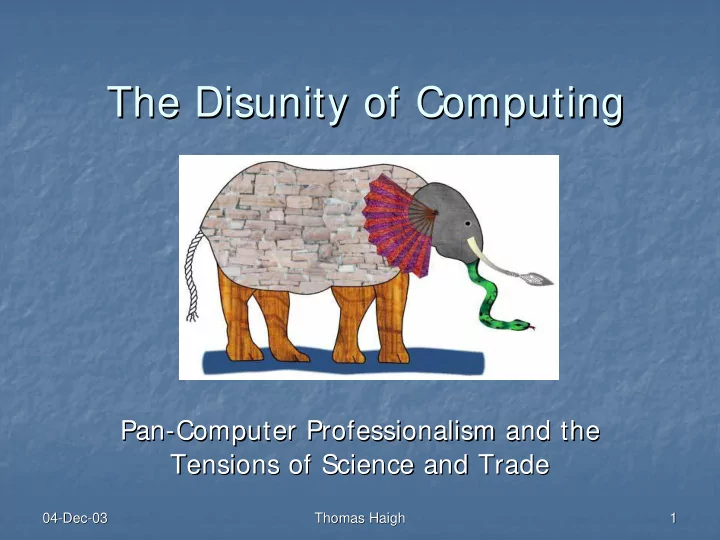
Making an Elephant Making an Elephant

  • The Computer Field

The Computer Field

  • Information

Information Processing Processing

  • Computer People

Computer People

  • Computer

Computer Professionals Professionals

slide-47
SLIDE 47

04 04-

  • Dec

Dec-

  • 03

03 Thomas Haigh Thomas Haigh 47 47

Pan Pan-

  • Computer Professionalists

Computer Professionalists

  • Small in numbers, but prominent

Small in numbers, but prominent

  • Single cohort

Single cohort

  • All know each other

All know each other

  • Scientific backgrounds

Scientific backgrounds

  • Followed by exposure to

Followed by exposure to “ “systems thinking systems thinking” ”

  • And to some form of business management role

And to some form of business management role

  • Work in multiple roles

Work in multiple roles

  • Often as independent consultants

Often as independent consultants

  • Often as application experts for computer firms

Often as application experts for computer firms

slide-48
SLIDE 48

04 04-

  • Dec

Dec-

  • 03

03 Thomas Haigh Thomas Haigh 48 48

One Graphic Vision One Graphic Vision

  • Familiarity with all areas

Familiarity with all areas needed needed

  • Expert in at least two

Expert in at least two

  • Presented at ACM SIG

Presented at ACM SIG Computer Personnel Computer Personnel Research, 1969 Research, 1969

  • by Bob Patrick,

by Bob Patrick, Independent computer Independent computer consultant consultant

  • Had worked for computer

Had worked for computer services firms services firms

  • Consulted for IBM

Consulted for IBM

  • Worked for RAND

Worked for RAND

slide-49
SLIDE 49

04 04-

  • Dec

Dec-

  • 03

03 Thomas Haigh Thomas Haigh 49 49

“ “Federal Federal” ” Profession is Possible Profession is Possible

  • Medicine is best example

Medicine is best example

  • Core education followed by

Core education followed by

  • Residency in specialist field

Residency in specialist field

  • Possible specialist examinations

Possible specialist examinations

  • Even additional specialist degrees

Even additional specialist degrees

“Overhead Overhead” ” can be considerable can be considerable

  • Dentists, psychiatrists and vets receive general

Dentists, psychiatrists and vets receive general training training

slide-50
SLIDE 50

04 04-

  • Dec

Dec-

  • 03

03 Thomas Haigh Thomas Haigh 50 50

Origins of Pan Computer Origins of Pan Computer Professionalism Professionalism

  • Overlapping Circles in Greater LA, 1950s

Overlapping Circles in Greater LA, 1950s

  • Aerospace firms

Aerospace firms

  • Los Angeles ACM chapter

Los Angeles ACM chapter

  • ACM Special Interest Group

ACM Special Interest Group – – Business Data Business Data Processing (SIGBDP) grows out of this Processing (SIGBDP) grows out of this

  • Origin of SIG structure

Origin of SIG structure

  • SHARE user group

SHARE user group

  • Managers of computation centers in corporations

Managers of computation centers in corporations

  • RAND Corporation

RAND Corporation

slide-51
SLIDE 51

04 04-

  • Dec

Dec-

  • 03

03 Thomas Haigh Thomas Haigh 51 51

The The “ “Rand Symposium Rand Symposium” ”

  • Sponsored by Fred Gruenberger of RAND

Sponsored by Fred Gruenberger of RAND

  • Scientific computation background

Scientific computation background

  • Starts newsletter covering computing and

Starts newsletter covering computing and data processing data processing

  • Devotes himself to profession building

Devotes himself to profession building

  • Education

Education

  • Annual

Annual “ “Rand Symposium Rand Symposium” ” for like for like-

  • minded

minded people people

slide-52
SLIDE 52

04 04-

  • Dec

Dec-

  • 03

03 Thomas Haigh Thomas Haigh 52 52

AFIPS AFIPS

  • American Federation of Information

American Federation of Information Processing Societies Processing Societies

  • Umbrella organization:

Umbrella organization: ACM & IEEE Computer Society ACM & IEEE Computer Society

  • Serves as

Serves as “ “money tree money tree” ”

  • Runs leading computer industry expo

Runs leading computer industry expo

  • DPMA is initially excluded

DPMA is initially excluded

  • Then refuses to join

Then refuses to join

  • Long, bitter controversy, enters in 1975

Long, bitter controversy, enters in 1975

slide-53
SLIDE 53

04 04-

  • Dec

Dec-

  • 03

03 Thomas Haigh Thomas Haigh 53 53

PCP in the 1970s PCP in the 1970s

  • New cooperation between DPMA and ACM

New cooperation between DPMA and ACM

  • PCP supporters lead ACM for much of 1970s

PCP supporters lead ACM for much of 1970s

  • Walter Carlson, Dan McCracken, Herb Grosch

Walter Carlson, Dan McCracken, Herb Grosch

  • ACM ruling council retains academic bias

ACM ruling council retains academic bias

  • Progress and reform proves slow

Progress and reform proves slow

  • Walter Carlson, 1970

Walter Carlson, 1970-

  • 1972 leader

1972 leader

  • Hopes for DPMA merger

Hopes for DPMA merger

  • Target increase 25K to 75K

Target increase 25K to 75K

slide-54
SLIDE 54

04 04-

  • Dec

Dec-

  • 03

03 Thomas Haigh Thomas Haigh 54 54

Institute for Certification of Institute for Certification of Computer Professionals Computer Professionals

  • Certification effort spun out of DPMA

Certification effort spun out of DPMA

  • Set up in separate institute

Set up in separate institute

  • Co

Co-

  • sponsored by ACM & several others

sponsored by ACM & several others

  • Starved of resources and support

Starved of resources and support

  • Several new qualifications

Several new qualifications

  • Included Certificate in Computer Programming

Included Certificate in Computer Programming (1977) (1977)

  • Just 2,750 people attain by 1986

Just 2,750 people attain by 1986

  • Still lingers on today

Still lingers on today… …

slide-55
SLIDE 55

04 04-

  • Dec

Dec-

  • 03

03 Thomas Haigh Thomas Haigh 55 55

Pan Pan-

  • Computer Professionalism

Computer Professionalism Very Broad in Scope Very Broad in Scope

General Manager Data Processing Manager Supervisor of Analysis Information Retrieval Computer-using Scientist Supervisor of Programming Computer-using Manager Analyst Applications Programmer Scientific Programmer Corporate Academic Tenured Systems Programmer researcher researcher Professor Computer Operator Hardware Developers Managers in computer firms Punched Card Machine Operator Data Entry Clerk

slide-56
SLIDE 56

04 04-

  • Dec

Dec-

  • 03

03 Thomas Haigh Thomas Haigh 56 56

Relevance Relevance

slide-57
SLIDE 57

04 04-

  • Dec

Dec-

  • 03

03 Thomas Haigh Thomas Haigh 57 57

No Single Version Dominates No Single Version Dominates

  • Computer Science

Computer Science

  • remains marginal to rank

remains marginal to rank-

  • and

and-

  • file programmers

file programmers

  • Software Engineering grows as an alternative

Software Engineering grows as an alternative

  • Some efforts now to license and certify (IEEE CSDP)

Some efforts now to license and certify (IEEE CSDP)

  • Data Processing

Data Processing

  • Certification fails, never becomes profession

Certification fails, never becomes profession

  • Relationship between technical and managerial work

Relationship between technical and managerial work very problematic very problematic

  • Pan

Pan-

  • Computing Professionalism

Computing Professionalism

  • No overall professional identity of

No overall professional identity of “ “computer people computer people” ” takes hold takes hold

  • ACM/IEEE CS mix roles as academic society and

ACM/IEEE CS mix roles as academic society and pragmatic service to practitioners pragmatic service to practitioners

slide-58
SLIDE 58

04 04-

  • Dec

Dec-

  • 03

03 Thomas Haigh Thomas Haigh 58 58

Computing Does Well Anyway Computing Does Well Anyway

  • Both CS and corporate computing see continual

Both CS and corporate computing see continual growth from 50s to 90s in growth from 50s to 90s in

  • Pay, prestige, public recognition, numbers

Pay, prestige, public recognition, numbers

  • Most organizational

Most organizational “ “practitioners practitioners” ” (circa 10 (circa 10 million) have little perceived need for profession million) have little perceived need for profession

  • Vast majority have no computer science training

Vast majority have no computer science training

  • Certification is low

Certification is low-

  • level, vendor specific

level, vendor specific

  • Few join any

Few join any “ “professional professional” ” society society

  • Proportionally much lower rate than in 1960s

Proportionally much lower rate than in 1960s

  • Does this mean traditional professionalism is no

Does this mean traditional professionalism is no longer necessary? longer necessary?

  • Will it follow as change slows, conditions worsen?

Will it follow as change slows, conditions worsen?

slide-59
SLIDE 59

04 04-

  • Dec

Dec-

  • 03

03 Thomas Haigh Thomas Haigh 59 59

What Is Informatics? What Is Informatics?

“ “The School of Informatics will be foremost in The School of Informatics will be foremost in the country to graduate the country to graduate professionals professionals with with formal preparation in Information Technology formal preparation in Information Technology with subject area expertise. with subject area expertise.” ”

  • What is the profession?

What is the profession?

  • Is this pan

Is this pan-

  • computing professionalism reborn?

computing professionalism reborn?

  • One profession or many?

One profession or many?

  • What is the coherent core?

What is the coherent core?

  • How can the overhead be justified?

How can the overhead be justified?

slide-60
SLIDE 60

04 04-

  • Dec

Dec-

  • 03

03 Thomas Haigh Thomas Haigh 60 60

Once Discipline or Many? Once Discipline or Many?

  • Circulated by Gary Wiggins

Circulated by Gary Wiggins “ “Therefore, informatics is the discipline that covers the Therefore, informatics is the discipline that covers the structure and the qualities of professional applications structure and the qualities of professional applications involving various academic disciplines known as involving various academic disciplines known as computer science, information studies, information computer science, information studies, information management, systems engineering, mathematics, management, systems engineering, mathematics, statistics, human statistics, human-

  • computer interaction, medicine,

computer interaction, medicine, linguistics, psychology, and cognitive science. linguistics, psychology, and cognitive science.” ”

  • Source: He,

Source: He, Shaoyi Shaoyi. . “ “Informatics: a brief survey. Informatics: a brief survey.” ” The The Electronic Library 2003, 21(2), 117 Electronic Library 2003, 21(2), 117-

  • 122. p. 118
  • 122. p. 118