The Cosmic Ray energy spectrum measured by the Pierre Auger - - PowerPoint PPT Presentation

the cosmic ray energy spectrum measured by the pierre
SMART_READER_LITE
LIVE PREVIEW

The Cosmic Ray energy spectrum measured by the Pierre Auger - - PowerPoint PPT Presentation

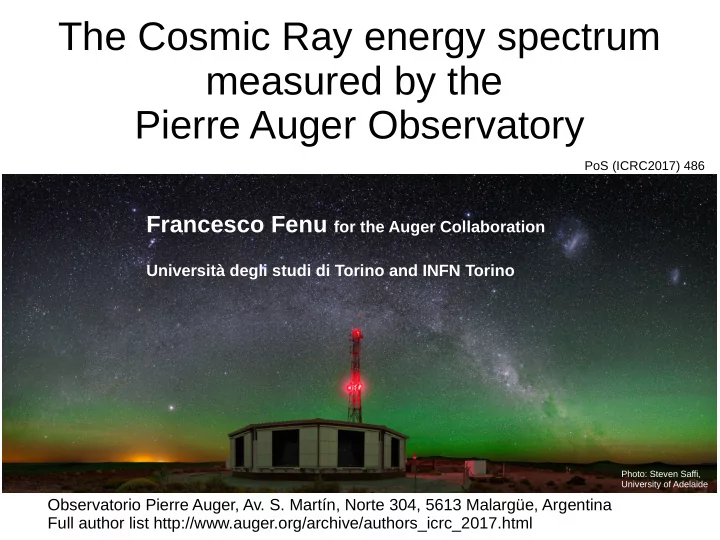
The Cosmic Ray energy spectrum measured by the Pierre Auger Observatory PoS (ICRC2017) 486 Francesco Fenu for the Auger Collaboration Universit degli studi di Torino and INFN Torino Photo: Steven Saffi, University of Adelaide Observatorio


slide-1
SLIDE 1

The Cosmic Ray energy spectrum measured by the Pierre Auger Observatory

Francesco Fenu for the Auger Collaboration

Università degli studi di Torino and INFN Torino Observatorio Pierre Auger, Av. S. Martín, Norte 304, 5613 Malargüe, Argentina Full author list http://www.auger.org/archive/authors_icrc_2017.html

Photo: Steven Saffi, University of Adelaide

PoS (ICRC2017) 486

slide-2
SLIDE 2

2

The Pierre Auger Observatory

Surface detector (SD)

  • 1500 m array

3000 km2 – 1600 detectors 1500 m grid E > 3 Eev

750 m array

24 km2 – 61 detectors 750 m grid E > 0.3 EeV

Fluorescence detector (FD)

24 telescopes in 4 building

Elevation 0-300 E > 1 EeV

3 additional telescopes

Elevation 30-600 E > 0.1 EeV

“The Pierre Auger Cosmic Ray Observatory”, NIM A 798 (2015) 172-213

slide-3
SLIDE 3

3

EFD∝∫ dE dX dX

S(1000)∝E Duty Cycle ~ 13% Duty Cycle ~100%

The hybrid detection

slide-4
SLIDE 4

4 1500 m Θ < 60º E > 3EeV E = A S38

B

1500 m 60 < Θ < 80º E > 4EeV E = A N19

B

750 m Θ < 55º E > 0.3EeV E = A S35

B

FD + 1 SD stat. E > 1EeV Calorimetric

Four different data sets

slide-5
SLIDE 5

5

  • Improved aerosols estimation (M. Malacari, PoS(ICRC2017) 398)
  • Telescope-wise optical efficiency
  • Improved Gaisser-Hillas fit
  • Improved estimation of the invisible energy

Ecal= dE dX dX

Improvements in the reconstruction of FD events

Fluorescence photons

dE dX

slide-6
SLIDE 6

6

The invisible energy is carried by muons and neutrinos New estimation from inclined SD showers (previously estimated using vertical showers) Extension to low energies taking into account the mass composition inferred from Auger Xmax data

Improvements in the invisible energy E = Ecal+Einv

Updates

Inclined showers are muon dominated

Barbosa et al., Astrop.. Phys. 22 (2004) 159.

slide-7
SLIDE 7

7

Improvements in the longitudinal profile fit

At low energy the profile is detected only around the maximum Bias on the GH fit fGH ( E )

Ecal=∫ f GH(E)dE

Solution: constraint k in the likelihood minimization

k= Ecal (dE/dX)max

k fluctuates in a limited range and is determined through simulations dE / dX measured around the maximum Non biased energy estimate Only relevant below 1018 eV! k = (332 ± 13) log10 ( Ecal ) g/cm2 σ = 29 g / cm2

Updates

At low energy: k constraint Better pixel selection and determination

  • f shower axis ~-1% in EFD
slide-8
SLIDE 8

8 Improved aerosols treatment

  • Phase function of aerosol

scattering

  • Multiple scattering

(M. Malacari, PoS(ICRC2017) 398)

Telescope-wise measurement of

  • ptical efficiency

Improved estimation of photomultiplier calibration constants for the first years Changes affect EFD < +3%

Further improvements

Changes affect EFD ~ +1%

Updates Updates

LA CO LM LL

slide-9
SLIDE 9

9

Total FD energy shift below +4%

Fluorescence yield 3.6% Atmosphere 3.4% ÷ 6.2% FD calibration 9.9% FD profile rec. 6.5% ÷ 5.6% Invisible energy 3% ÷ 1.5% Other contrib. ≈ 5%

TOTAL 14%

  • V. Verzi, ICRC13 arXiv:1307.5059

Improvements in the reconstruction of FD events

FD energy systematic uncertainties unchanged

slide-10
SLIDE 10

10

S (1000)(θ ,E )=S38(E)CIC (θ)

New parameters Data up to Dec 2016 Weather and geomagnetic corrections on S(1000)

Updates

CIC (θ)=1+a X+b X2+c X3 X (θ)=cos

2(θ)−cos 2(38

  • )

The zenith angle dependence of the attenuation

  • The attenuation depends on the

zenith angle

  • Model independent

Constant Intensity Cut (CIC) to correct for the attenuation

slide-11
SLIDE 11

11

The SD-1500 energy calibration

High quality hybrid events

(Jan. 2004 – Dec 2015)

New calibration parameters Data up to Dec 2015 Including updates on S(1000) and EFD

Updates

^ S=S38 ,S35, N19 E FD=A ^ S

B

Resolution: SD–1500 ~ 15% SD-1500 inclined ~ 17% SD-750 ~ 13% FD ~ 7%

slide-12
SLIDE 12

12

  • Jan. 2004 – Dec. 2016
  • 183332 events for log(E)>18.4

Exposure = 51588 km2 sr yr

(~20% more than for ICRC15)

14 events above 1020 eV

The SD-1500 vertical spectrum

  • Systematic uncertainty on energy 14%

Systematic uncertainty on flux 5.8%

slide-13
SLIDE 13

13 No evidence of declination dependence of the spectrum Compatible with large scale dipole anisotropy published by Auger

The declination dependence of the spectrum

( O. Taborda , PoS (ICRC2017) 523 )

slide-14
SLIDE 14

14 No evidence of declination dependence of the spectrum Compatible with large scale dipole anisotropy published by Auger

The declination dependence of the spectrum

( O. Taborda , PoS (ICRC2017) 523 )

slide-15
SLIDE 15

15

SD-1500 vertical 183332 events log(E/eV)>18.4 Exposure: 51588 km2 sr yr (20% increase wrt 2015) Flux uncertainty: 5.8%

Different measurements of the flux

SD-750 vertical 87402 events log(E/eV)>17.5 Exposure 228 km2 sr yr (50% increase wrt 2015) Flux uncertainty 14 – 7% @ (0.3 – 3) EeV SD-1500 inclined 19602 events log(E/eV) >18.5 Exposure: 15121 km2 sr yr (38% increase wrt 2015) Flux uncertainty: 5% Hybrid 11680 events log(E/eV)>18 Exposure: 1946 km2 sr yr @ 1019 eV (25% increase wrt 2015) Flux uncertainty: 10% Energy systematic uncertainty (dominated by the FD energy scale)

ΔE/E = 14%

slide-16
SLIDE 16

16

The combined spectrum

Exposure = 67000 km2 sr yr

slide-17
SLIDE 17

17

The combined spectrum

ϕ(E)∝E−γ1

E< Eankle

ϕ(E)∝E−γ2[1+( E E s )

Δ γ] −1

E> Eankle

E1/2 = (22.6±0.8±4.3) EeV

slide-18
SLIDE 18

18

 Improvements in the FD reconstruction  Cumulative FD energy increase below 4%  Full consistency with the 14% systematic uncertainty previously

quoted

  • Robust determination of the CR spectrum with four independent

data sets

  • Spectral features measured with unprecedented precision and

fully consistent with previous results

  • No dependence of the spectrum on declination

Summary

slide-19
SLIDE 19

19

Thanks a lot for your attention

slide-20
SLIDE 20

20

S(1000) is affected by a modulation due to

variable pressure and density

 Parametrized the dependence of S(1000) on

pressure and density Total effect of corrections ~-2% in flux

Updates

Weather and geomagnetic effects corrected S(1000) depends on the angle between shower direction and geomagnetic field

  • A. Coleman, PoS (ICRC2017) 326

Weather and geomagnetic corrections

arXiv:1702.02835

slide-21
SLIDE 21

21

Exposure calculation Exposure is a purely geometrical calculation Unfolding Calculation of spectrum without the resolution effects Forward folding to calculate the correction factor C(E)

1 Hexagon = 4.59 km2 sr

Exposure=∫∫ N cell(t )acellcos (θ)dtd Ω=πacell∫ N cell (t )dt 6T5 trigger

ϕ

unfolded (E )=C (E) ϕ measured ( E )

The calculation of the spectrum

  • Nucl. Instrum. Methods A 613 (2010) 29-39
slide-22
SLIDE 22

22

ICRC 2017 – ICRC 2015 Vertical

slide-23
SLIDE 23

23 Muons are the dominant component at ground EM component is largely absorbed The energy estimator N19 is the normalization of the muon content relative to a reference 2D distribution N19 independent of zenith angle

ρμ(⃗ r)=N 19ρμ,19(⃗ r ,θ,ϕ)

The SD-1500 energy estimator (θ>60°)

Example of the reference muon distribution Proton shower, 10EeV, ZA=80º

JCAP 08 (2015) 049, arXiv:1503.07786v2

slide-24
SLIDE 24

24

The combined spectral parameters

Parameter Value Eankle 4.8±0.1 (±0.8) EeV Es 42.1±1.7 (±8) EeV γ1 3.29±0.02 (±0.05) γ2 2.6±0.02 (±0.1) Δγ 3.14±0.2 (±0.4) E1/2 24.7±0.1 (-3.4+8.2) Parameter Value Eankle 5.08±0.06 (±0.8) EeV Es 39±2 (±8) EeV γ1 3.293±0.002 (±0.05) γ2 2.53±0.02 (±0.1) Δγ 2.5±0.1 (±0.4) E1/2 22.6±0.8 (±4.3 EeV)

ICRC 2015 ICRC 2017