SLIDE 1 46
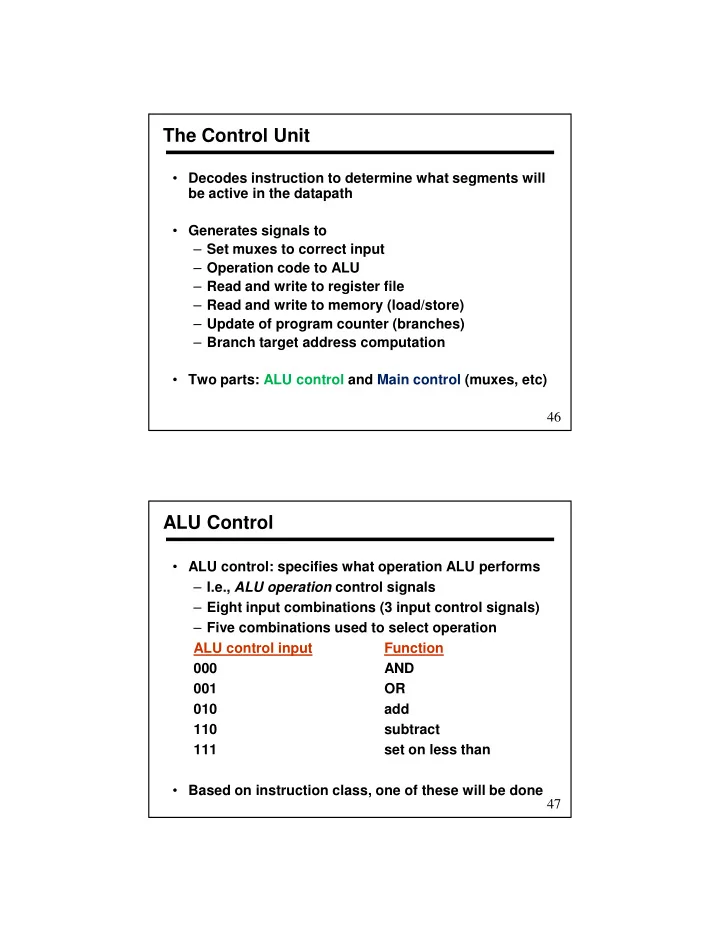
The Control Unit
- Decodes instruction to determine what segments will
be active in the datapath
– Set muxes to correct input – Operation code to ALU – Read and write to register file – Read and write to memory (load/store) – Update of program counter (branches) – Branch target address computation
- Two parts: ALU control and Main control (muxes, etc)
47
ALU Control
- ALU control: specifies what operation ALU performs
– I.e., ALU operation control signals – Eight input combinations (3 input control signals) – Five combinations used to select operation ALU control input Function 000 AND 001 OR 010 add 110 subtract 111 set on less than
- Based on instruction class, one of these will be done
SLIDE 2 48
ALU Control - Selecting Operation
Class (Opcode) Operation Control Load/store Addition (memory address) 010 Branch Subtraction (comparison) 110 Arithmetic Depends on funct field: 100000 add 010 100010 subtract 110 100100 and 000 100101
001 101010 set on less than 111
- Generate ALU control based on opcode and funct field
49
ALU Control Unit
- Small control unit associated with ALU
– Generates appropriate control signals to ALU ALU Control Instruction (funct) 5 2 3 ALU control input ALU operation type ALU operation type Input Add for L/S 00 Sub for beq 01 From funct field 10
SLIDE 3 50
Building the ALU Control Unit
- Use truth table to determine how output will be
generated based on the inputs Operation ALUOp Funct Output Load/Store 00 XXXXXX 010 (add) Beq X1 XXXXXX 110 (sub) Arithmetic 1X XX0000 010 (add) 1X XX0010 110 (sub) 1X XX0100 000 (and) 1X XX0101 001 (or) 1X XX1010 111 (slt)
- From truth table, we can derive the control circuit
51
Main Control Unit
- Use fields from instruction to generate control
– We will “connect” the fields of the instruction to the datapath via the main control unit
31-26 rs 25-21 rt 20-16 rd 15-11 shamt 10-6 funct 5-0
R-type instruction
35 / 43 31-26 rs 25-21 rt 20-16 address 15-0
Load/Store
4 31-26 rs 25-21 rt 20-16
Branch (beq)
address 15-0
SLIDE 4 52
Main Control Unit
- Use fields from instruction to generate control
– We will “connect” the fields of the instruction to the datapath via the main control unit
31-26 rs 25-21 rt 20-16 rd 15-11 shamt 10-6 funct 5-0
R-type instruction
35 / 43 31-26 rs 25-21 rt 20-16 address 15-0
Load/Store
4 31-26 rs 25-21 rt 20-16
Branch (beq)
address 15-0
Opcode is always in same position (31-26), called “Op[5-0]” 53
Main Control Unit
- Use fields from instruction to generate control
– We will “connect” the fields of the instruction to the datapath via the main control unit
31-26 rs 25-21 rt 20-16 rd 15-11 shamt 10-6 funct 5-0
R-type instruction
35 / 43 31-26 rs 25-21 rt 20-16 address 15-0
Load/Store
4 31-26 rs 25-21 rt 20-16
Branch (beq)
address 15-0
Registers to be read are always rs and rt (always in fixed place)
SLIDE 5 54
Main Control Unit
- Use fields from instruction to generate control
– We will “connect” the fields of the instruction to the datapath via the main control unit
31-26 rs 25-21 rt 20-16 rd 15-11 shamt 10-6 funct 5-0
R-type instruction
35 / 43 31-26 rs 25-21 rt 20-16 address 15-0
Load/Store
4 31-26 rs 25-21 rt 20-16
Branch (beq)
address 15-0
Base register for load/store is always rs in position 25-21 55
Main Control Unit
- Use fields from instruction to generate control
– We will “connect” the fields of the instruction to the datapath via the main control unit
31-26 rs 25-21 rt 20-16 rd 15-11 shamt 10-6 funct 5-0
R-type instruction
35 / 43 31-26 rs 25-21 rt 20-16 address 15-0
Load/Store
4 31-26 rs 25-21 rt 20-16
Branch (beq)
address 15-0
16-bit offset for branch equal, load, and store always in 15-0
SLIDE 6 56
Main Control Unit
- Use fields from instruction to generate control
– We will “connect” the fields of the instruction to the datapath via the main control unit
31-26 rs 25-21 rt 20-16 rd 15-11 shamt 10-6 funct 5-0
R-type instruction
35 / 43 31-26 rs 25-21 rt 20-16 address 15-0
Load/Store
4 31-26 rs 25-21 rt 20-16
Branch (beq)
address 15-0
Destination register in one of two places: 15-11 for arithmetic and 20-16 for load; need multiplexor on write register address 57
Full Datapath and Control Signals
- Control includes four muxes, ALU control unit, and
control to register file and data memory
SLIDE 7 58
The Control Signals
- Two ALUOp signals
- Seven other signals
– RegDst - which field for write register – RegWrite - write to register file – ALUSrc - source for second ALU input – PCSrc - source for PC (PC + 4 or target address) – MemRead - read input address from memory – MemWrite - write input address/data to memory – MemToReg - source of write register port data input
- Branch control signal (set when instruction is branch)
59
Full Datapath and Full Control
SLIDE 8
60
Operation - R-type instructions
Let’s do a add $t1,$t2,$t3 61
FETCH - add $t1,$t2,$t3
On fetch - PC, increment PC by 4, read from instruction memory
SLIDE 9
62
READ REGISTERS (t1,t2) - add $t1,$t2,$t3
Read source registers, main control unit computed all settings 63
EXECUTE - add $t1,$t2,$t3
ALU operates on data from register file, ALU control determined
SLIDE 10 64
WRITE DESTINATION (t3) - add $t1,$t2,$t3
Result from ALU is written to register file 65
Remember...Combinational Single Cycle
- Distinct steps shown for clarity
- Reality - information flows in those steps but it’s all
combinational logic
- Signals within the datapath vary and stabilize
roughly in the flow of steps given
- All units and paths as marked during each step are
active throughout the process!
SLIDE 11
66
Load Word - lw $t1, offset($t2)
Only one source reg to read, sign extend, form address, write to destination in different position in instruction (bits 20-16) 67
Branches - beq $t1,$t2,offset
Read and compare sources, generate zero & branch control, compute target address, update PC if zero and branch
SLIDE 12
68
Jumps - j label
Shift address, concatenate with PC, extra mux (three possible sources now for program counter)