The construction technique of the high granularity and high - - PowerPoint PPT Presentation

the construction technique of the
SMART_READER_LITE
LIVE PREVIEW

The construction technique of the high granularity and high - - PowerPoint PPT Presentation

The construction technique of the high granularity and high transparency Drift Chamber of MEG II Tassielli G.F. - INFN Lecce, & Mathematics and Physics Dept., University of Salento , on behalf of the MEG2 Collaboration Instrumentation for


slide-1
SLIDE 1

02/28/2017 G.F. Tassielli - INSTR 2017 (BINP) Novosibirsk 1/29

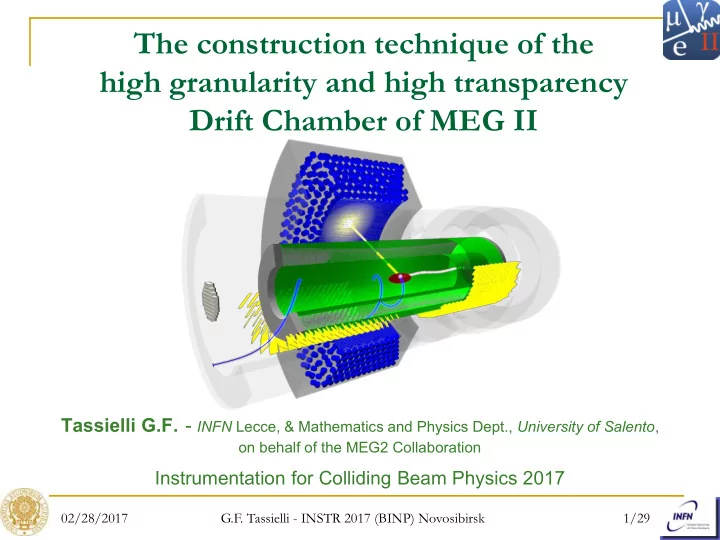
The construction technique of the high granularity and high transparency Drift Chamber of MEG II

Tassielli G.F. - INFN Lecce, & Mathematics and Physics Dept., University of Salento,

  • n behalf of the MEG2 Collaboration

Instrumentation for Colliding Beam Physics 2017

slide-2
SLIDE 2

02/28/2017 G.F. Tassielli - INSTR 2017 (BINP) Novosibirsk 2/29

Outline

 MEG-I Drift Chamber  MEG-II Drift Chamber

 Novel approach at construction technique of high granularity and

high transparency Drift Chambers

 The wiring Robot and the stringing procedures  The assembly procedures  Front End electronics  Expected performance

 Summary

2

slide-3
SLIDE 3

02/28/2017 G.F. Tassielli - INSTR 2017 (BINP) Novosibirsk 3/29

MEG-I Drift Chambers

 16 chambers  Each chamber is composed of

 2 staggered arrays of drift cells  1 signal wire (25 µm NiCr) and 2x2 Vernier

cathode strip made 0,45 µm alluminum strip

  • n 15 µm kapton foil

 He:C2H6 (50/50)

 Single chamber ~ 2.6 10-4 X0  Full e+ turn : ~ 2.0 10-3 X0

3

σxy ~ 210 µm (t drift) σZ ~ 800 µm (Vernier)

  • Eur. Phys. J. C 73 (2013) 2365
slide-4
SLIDE 4

02/28/2017 G.F. Tassielli - INSTR 2017 (BINP) Novosibirsk 4/29

MEG-I DC: Performance

transverse coordinate resolution sr,core = 210 mm sr,tail = 780 mm

  • frac. = 87%

sr,design = 200 mm longitudinal coordinate resolution sz,core= 800 mm sz,tail = 2100 mm

  • frac. = 91%

sz,design = 300 mm

r z

vertex resolution sy,core = 1.1±0.1 mm sy,tail = 5.3±3.0 mm

  • frac. = 87%

sz = 2.5±1.0 mm sy,z,design= 1.0 mm DC – TC matching efficiency 

DC-TC = 41%

DC-TC,design = 90%

positron energy resolution sE,core = 330±16 keV sE,tail = 1.13±0.12 MeV

  • frac. = 82%

sr,design = 180 keV

E

. . . . . . . . . . . . . . . . . . . . . . . .

θ φ

polar angular resolution s = 9.4±0.5 mrad s,design = 5.0 mrad azimuth angular resolution sφ,core = 8.4±1.4 mrad sφ,tail = 38±6 mrad

  • frac. = 80%

sφ,design = 5.0 mrad

slide-5
SLIDE 5

02/28/2017 G.F. Tassielli - INSTR 2017 (BINP) Novosibirsk 5/29

MEG-I DC: need to be upgraded

5

 MEG-I DC did not perform as expected.  Main problems were:

 Few hits on the positron track (8-16)  Active volume of the detector only partly instrumented  Unmatched coverage with Timing counter  Large track extrapolation to Timing counter

slide-6
SLIDE 6

02/28/2017 G.F. Tassielli - INSTR 2017 (BINP) Novosibirsk 6/29

The MEG upgrade (MEG II)

1.

Increase the number of stopped muons on target

2.

Reduce the target thickness

3.

Reduce the tracker radiation length and improve on granularity, resolution and efficiency

4.

Improve matching DC-TC

5.

Improve TC granularity

6.

Extend calorimeter acceptance

7.

Improve photon energy, position and timing resolution for shallow events

8.

New RMD conters

9.

New DAQ for higher bandwidth

3. 8. 3. 3.

minimum materials between DC and TC; efficiency of transfer from DC to TC improves 40% → 80%

Goal: 10x improvement in sensitivity (~5×10-14)

Magnetic field is designed to have a constant bending tracks

slide-7
SLIDE 7

02/28/2017 G.F. Tassielli - INSTR 2017 (BINP) Novosibirsk 7/29

MEG-II Drift Chamber

 Single volume, small cells, full stereo cylindrical

drift chamber;

 A large field to sense wires ratio (5 : 1) allows

for thinner field wires, thus reducing the wire contribution to multiple scattering and the total wire tension on the the end-plates.

 Light gas mixture (85% He − 15% iC4H10)  Positron efficiency > 90% (better coupling with

TC, very short extrapolation needed);

 Single hit resolution (~110 µm) and gas aging

effects verified on prototypes and test stations (at 7x10⁷µ/s and 105 gain, Δg/ΔV ~ 4%/V over 3 years equivalent).

 Cluster Timing readout capabilities (high

bandwidth, high sampling rate) to further reduce spatial resolution *.

7

Item Description Thickness 10-3 X0 MEG target (140 mm plastic) 0.28 0.28 Sense wires (20 mm W) 0.41 0.78 Field wires (40 and 50 mm Al) 0.33 guard wires (40 mm Al) 0.04 inner cylinder (20 mm Kapton) 0.21 0.21 Inner gas (pure He) 0.06 0.59 Tracker gas (He/iBut. 85/15) 0.53 Total 1 full turn w/o target 1.58 * For details see G.Chiarello’s poster: “Application of the Cluster Counting and Timing techniques to improve the performance of the high transparency Drift Chambers for modern High Energy Physics experiments.”

slide-8
SLIDE 8

02/28/2017 G.F. Tassielli - INSTR 2017 (BINP) Novosibirsk 8/29

MEG-II Drift Chamber

Chamber characteristics:

rin~ 16cm rout~ 30cm

L ~ 2m

10 layers

12 cylindrical sectors

16 cells per sector

full stereo with large stereo angles (102÷147 mrad)

small square cells (5.8÷7.8 mm at z=0, 6.7÷9.0 at z=±L/2)

(see pictures:)

1920 sense wires: W(Au) 20 μm 7680 field wires: Al(Ag) 40 μm 2688 guard wires: Al(Ag) 50 μm 12288 wires in total (~ 12 wires/cm2)

High wire densities prevent the use of feed-through, needing novel approaches to the wiring procedures

z = ± 40cm z = 0

The wire net created by the combination of + and –

  • rientation generates a more uniform equipotential plane
slide-9
SLIDE 9

02/28/2017 G.F. Tassielli - INSTR 2017 (BINP) Novosibirsk 9/29

DC stringing: the old way

The Old Way

The Three Μοῖρα (Fates)

  s  

Bernardo Strozzi – Le tre Parche – Venezia, circa 1620

The KLOE Drift Chamber 45 m3 > 52,000 wires He/iC4H10

slide-10
SLIDE 10

02/28/2017 G.F. Tassielli - INSTR 2017 (BINP) Novosibirsk 10/29

MEG-II DC: the novel way

 Separate the end-plate function: mechanical

support for the wires and gas sealer;

 Find a feed-trough-less wiring procedure.

 end-plates numerically machined from solid Aluminum (mechanical support only);  Field, Sense and Guard wires placed azimuthally by Wiring Robot with better than

  • ne wire diameter accuracy;

 wire PC board layers (green) radially spaced by numerically machined peek

spacers (red) (accuracy < 20 µm);

 wire tension defined by homogeneous winding

and wire elongation (ΔL = 100μm corresponds to ≈ 0.5 g);

 Drift Chamber assembly done on a 3D digital

measuring table;

 build up of layers continuously checked and

corrected during assembly

 End-plate gas sealing will be done with glue.

The solution found for MEG II:

peek spacer wire PC board spoke

slide-11
SLIDE 11

02/28/2017 G.F. Tassielli - INSTR 2017 (BINP) Novosibirsk 11/29

MEG-II DC: the novel way

G-G ( 1:8 ) H-H ( 1:8 ) J-J ( 1:8 ) K-K ( 1:8 ) L-L ( 1:8 ) M ( 1:1 ) N ( 1 : 2 ) G G H H J J K K L L M N

1 1 2 2 3 3 4 4 5 5 6 6 7 7 8 8 9 9 10 10 11 11 12 12 A A B B C C D D E E F F G G H H camera_360

raffaell 11/13/2013 Progettato da Controllato da Approvato da Data

1 / 1

Edizione Foglio Data

2850 1940 318 Ø 290 180 107,5 3 7 280 R M5 M 8 2 9 6 580 ISO K320 2640

gas seal with slots for PC wire boards electronics shield front-end electronics cards Outer Cylinder (carbon-fiber) electronics shield electronics shield

Inner Cylinder made of 20 mm Mylar tube containing the target

The carbon fiber outer cylinder is the only mechanical structure supporting the wire tension

slide-12
SLIDE 12

02/28/2017 G.F. Tassielli - INSTR 2017 (BINP) Novosibirsk 12/29

The tasks of the wiring robot are:

 the wiring of a multiwire layer made of 32 parallel wires;  settable wire tension (±0.05g);  20µm of accuracy on wire position.

12

LACHESIS Winding the thread cylinder, wire PCB KLOTHO Spinning the thread coil, clutch, wire spool LABIRINTH The Extraction System ATROPOS Cutting the thread laser solder system THESEUS The wire handling system Its main parts are:

 a winding drum;  an electromagnetic brake;  a system of pulleys;  a strain gauge;  an high resolution

camera;

 5 linear synchronized

axes;

 a CompactRIO controller;  a contactless soldering

system;

 a PCB extraction system.

MEG-II DC: stringing (the Wiring Robot)

reference edge for alignment

400 μm PCB

slide-13
SLIDE 13

02/28/2017 G.F. Tassielli - INSTR 2017 (BINP) Novosibirsk 13/29

WIRING SYSTEM (Klotho and Lachesis): wire position

13

100 mm

cathode anode 20µm of accuracy on wire position

slide-14
SLIDE 14

02/28/2017 G.F. Tassielli - INSTR 2017 (BINP) Novosibirsk 14/29

WIRING SYSTEM (Klotho and Lachesis): wire tension

The wire mechanical tension is delivered by an electromagnetic clutch and its

  • n-line monitored by a high precision strain gauge, a real-time feedback

system correct any variation.

14

wire

mean wire tension is stable at the level of 0.05 g

acceleration/deceleration ramps first/last turn (discarded) constant winding speed (32 wires)

0.1 g 16 sense wires 0.1 g 16 field wires

For single wire (turn):

slide-15
SLIDE 15

02/28/2017 G.F. Tassielli - INSTR 2017 (BINP) Novosibirsk 15/29

SOLDERING SYSTEM (Atropos)

 The soldering phase is accomplished by an LASCON 501 IR laser soldering

System using a low temperature (180 °C) melting tin.

 The laser system is controlled by the NI CompactRIO and is synchronized

with the positioning system.

 The wires, during the soldering phase, are protected with a Mylar foil to

avoid flux splashing.

3

15

2 1 Mylar strip

slide-16
SLIDE 16

02/28/2017 G.F. Tassielli - INSTR 2017 (BINP) Novosibirsk 16/29

EXTRACTION SYSTEM (Labirinth and Theseus)

 The wound layer of soldered wires must be unrolled from the winding drum

and de-tensioned for storage and transport to the assembly station at INFN Pisa.

 The wire PCBs are lifted off from the cylinder with a linear actuator

connected to a set of vacuum operated suction cups.

16

slide-17
SLIDE 17

02/28/2017 G.F. Tassielli - INSTR 2017 (BINP) Novosibirsk 17/29

CHECK MECHANICAL TENSION WIRE

 The system measures the resonant frequency of the wire oscillations

induced by a sinusoidal HV signal.

 The system cycles on each wire by multiplexing the HV signal.  Each cycle of 16 wires takes about 10 min.

17

Δf [mHz] f [Hz] f2 L

slide-18
SLIDE 18

02/28/2017 G.F. Tassielli - INSTR 2017 (BINP) Novosibirsk 18/29

TRASPORT FORM LECCE TO PISA

 During transport, 3 sets of 13 frames each are wrapped in a welded sealing

bag, to avoid contamination, and flushed with dry gas, to avoid water vapor condensation

18

slide-19
SLIDE 19

02/28/2017 G.F. Tassielli - INSTR 2017 (BINP) Novosibirsk 19/29

MEG-II DC: assembly-I

19

DC End plate: spokes support the pcbs Central removable structural shaft

 During the assembly phase, the endplates are placed at a shorter distance

than nominal to avoid stressing the wires

wire tension compensating wheels 3D measuring table

slide-20
SLIDE 20

02/28/2017 G.F. Tassielli - INSTR 2017 (BINP) Novosibirsk 20/29

MEG-II DC: assembly-II

20

 The mounting procedure is performed with an adjustable arm and a flipping

arm (used only for flipped layers);

 The wire-PCBs, fixed on the transport frame, are anchored to the mounting

arm with a clip and released from the frame.

Flip arm

slide-21
SLIDE 21

02/28/2017 G.F. Tassielli - INSTR 2017 (BINP) Novosibirsk 21/29

MEG-II DC: assembly-III

21

 The mounting arm (with the multi-wire layer) is then placed next to the end

plates for the engagement procedure.

 The mounting arm is fixed to a support structure to prevent damaging the

wires.

 This structure transfers the multi-layer wire on the end plates between two

spokes.

Spoke used as reference for the alignment of the pcb

slide-22
SLIDE 22

02/28/2017 G.F. Tassielli - INSTR 2017 (BINP) Novosibirsk 22/29

MEG-II DC: assembly-IV

22

 This procedure is repeated for each of the 12 sectors.  After completing the installation of one layer, a survey is performed on the

radial layer position.

 Half cell spacers are pressed and glued in position with a calibrated

pressure-sensitive film.

 The procedure is repeated for all layers.

Spacer

slide-23
SLIDE 23

02/28/2017 G.F. Tassielli - INSTR 2017 (BINP) Novosibirsk 23/29

MEG-II DC: assembly-V

23

 After assembling all layers, the DC is closed with the carbon fiber outer

panels.

 The DC will be put vertically to seal the end plate (wire-pcb and spacer).  After sealing, the mechanical supports and the extender structure for the

front-end electronics will be mounted.

 The inner mylar cylinder will be mounted after shipping the DC to PSI.

All mounting procedure, together with the DC insertion in the COBRA magnet has been successfully tested with a Mock-up chamber mechanically identical

slide-24
SLIDE 24

02/28/2017 G.F. Tassielli - INSTR 2017 (BINP) Novosibirsk 24/29

MEG-II DC: Status

At today:

The first 4 layers have been

  • wired. In the last weeks a wiring

rate better than expected has been reached;

The first 3 layers have been mounted, the assembly procedure has been reliably tested.

slide-25
SLIDE 25

02/28/2017 G.F. Tassielli - INSTR 2017 (BINP) Novosibirsk 25/29

MEG-II DC: Front End electronics

Requirements:

 High bandwidth

>700 MHz

 Good gain: ~10  High density < 7mm

channel width

 Fully differential matching 2° stage/

  • utput driver

1° stage amplification

8 channels prototype card

Layout:

2 stage amplifiers based on commercial devices:

ADA4927 (AD) Ultralow distortion current feedback

THS4509 (TI) Wideband low noise fully differential amplifier

Pre-emphasis implemented on both stages in

  • rder to balance the attenuation of output cable

High overall (after 5m of cable) bandwidth (FE input to DRS WaveDream input): ~1GHz

Low power: 50mW @ ±2.5V

analog gain and Bandwidth after 5m cable: 19db and ~ 900MHz

1280 out of 1920 channels (2/3) readout on both ends

slide-26
SLIDE 26

02/28/2017 G.F. Tassielli - INSTR 2017 (BINP) Novosibirsk 26/29

MEG-II DC: expected performance

layer occupancy /250 ns

hits in 250 ns window both views segment fit + turn merging discard short segments and isolated hits full track fit zoom

3D track finding and fit

signal track

22 kHz/cm

slide-27
SLIDE 27

02/28/2017 G.F. Tassielli - INSTR 2017 (BINP) Novosibirsk 27/29

MEG-II DC: expected performance

σϕ = 6.2 mrad σϑ = 6.5 mrad σp = 93.4 KeV/c ε ≈ 90%

slide-28
SLIDE 28

02/28/2017 G.F. Tassielli - INSTR 2017 (BINP) Novosibirsk 28/29

MEG-II DC: summary

remember! MEG MEG2

single hit contribution to m.s. 2.6×10-4 X0 4.6×10-5 X0 transverse position resolution 210 mm 110 mm e+ momentum resolution 330 KeV/c 94 KeV/c e+  angle 9.4 mrad 6.2 mrad e+  angle 8.4 mrad 6.5 mrad e+ y vertex 1.6 mm 0.9 mm e+ z vertex 2.5 mm 1.1 mm DC−TC matching efficiency 41% 89%

slide-29
SLIDE 29

02/28/2017 G.F. Tassielli - INSTR 2017 (BINP) Novosibirsk 29/29

Summary

Strong motivations for an upgraded MEG experiment aiming at setting an upper limit B(μ+e+ + γ) < 5 × 10-14.

The upgrade of the positron tracker consists in a a full stereo and high transparency Drift Chamber.

The high density of wires constituting the DC has required a novel approach to the wiring procedure.

Reached chamber accuracy:

stereo angle < 35 μrad

wire position on PCB pad < 25 μm

cell width (wire pitch) < 1 μm

cell height (spacer) < 50 μm

wire tension < 0.1 g

PCB offset vs spoke < 50 μm

chamber length < 200 μm

Its expected performance is in line with the requirements.

The DC will start commissioning at PSI in fall 2017.

slide-30
SLIDE 30

02/28/2017 G.F. Tassielli - INSTR 2017 (BINP) Novosibirsk 30/29 28/02/2017 G.F. Tassielli - INSTR 2017 (BINP) Novosibirsk 30/12

Backup

slide-31
SLIDE 31

02/28/2017 G.F. Tassielli - INSTR 2017 (BINP) Novosibirsk 31/29 28/02/2017 G.F. Tassielli - INSTR 2017 (BINP) Novosibirsk 31/12

The MEG CoBRa Magnet

Gradient field Uniform field

  • Constant bending radius independent of emission angles
  • High pT positrons quickly swept out

Gradient field Uniform field

Michel hit rate versus radial distance

slide-32
SLIDE 32

02/28/2017 G.F. Tassielli - INSTR 2017 (BINP) Novosibirsk 32/29 28/02/2017 G.F. Tassielli - INSTR 2017 (BINP) Novosibirsk 32/12

PRODUCTION PHASE

  • 1. Place wire PCB on

the cylinder

  • 2. Control the alignment

and start wiring

  • 3. Finish wiring
  • 3. Start soldering phase: 128 different soldered

32

slide-33
SLIDE 33

02/28/2017 G.F. Tassielli - INSTR 2017 (BINP) Novosibirsk 33/29 28/02/2017 G.F. Tassielli - INSTR 2017 (BINP) Novosibirsk 33/12

PRODUCTION PHASE

  • 4. Placement for

extraction phase

  • 5. Lift first wire PCB from

cylinder

  • 6. Unwind layer from

cylinder

  • 7. Lift second wire pcb and

place in the storage frame

  • 8. Storage in clean room,

waiting the trasport

33

slide-34
SLIDE 34

02/28/2017 G.F. Tassielli - INSTR 2017 (BINP) Novosibirsk 34/29 28/02/2017 G.F. Tassielli - INSTR 2017 (BINP) Novosibirsk 34/12

MEG-II DC: aging

gain drop

@ 7×10⁷ /s and 105 gas gain expect ≈ 6 nA/cm in the hottest point ≈ 0.32 C/cm integrated over 3 years data taking

(however, @ G = 105, dG/dV ≈ 3-4%/Volt)

prototype #2

slide-35
SLIDE 35

02/28/2017 G.F. Tassielli - INSTR 2017 (BINP) Novosibirsk 35/29 28/02/2017 G.F. Tassielli - INSTR 2017 (BINP) Novosibirsk 35/12

MEG-II DC: single hit resolution

Staggered 3-tubes method with cosmic rays

85% He − 15% iC4H10 : drift ≈ 130 mm averaged over all impact parameters and angles

(leading edge discrimination, no cluster timing)

Spatial resolution I

2D

slide-36
SLIDE 36

02/28/2017 G.F. Tassielli - INSTR 2017 (BINP) Novosibirsk 36/29 28/02/2017 G.F. Tassielli - INSTR 2017 (BINP) Novosibirsk 36/12

MEG-II DC: single hit resolution

Staggered 3-cells method under Si telescope Average hit resolution drift = 108 ± 5 mm

85% He − 15% iC4H10

Spatial resolution II

slide-37
SLIDE 37

02/28/2017 G.F. Tassielli - INSTR 2017 (BINP) Novosibirsk 37/29 28/02/2017 G.F. Tassielli - INSTR 2017 (BINP) Novosibirsk 37/12

MEG-II DC: single hit resolution

Spatial resolution III Average hit resolution drift = 116 ± 4 mm

Beam test at BTF − LNF

normal incidence tracks

slide-38
SLIDE 38

02/28/2017 G.F. Tassielli - INSTR 2017 (BINP) Novosibirsk 38/29 28/02/2017 G.F. Tassielli - INSTR 2017 (BINP) Novosibirsk 38/12

MEG-II DC: single hit resolution

Longitudinal resolution

vs = 13.2 cm/ns sDt ≈ 0.5 ns

sz ≈ 10 cm

Rw = 150 /m 20 mm W wire

sz ≈ 10 cm time difference charge division

slide-39
SLIDE 39

02/28/2017 G.F. Tassielli - INSTR 2017 (BINP) Novosibirsk 39/29 28/02/2017 G.F. Tassielli - INSTR 2017 (BINP) Novosibirsk 39/12 For any given first cluster (FC) drift time, the cluster timing technique exploits the drift time distribution of all successive clusters to determine the most probable impact parameter, thus reducing the bias and the average drift distance resolution with respect to what is obtained from with the FC only.

ti

cl

{ }

Cluster Timing

From the ordered sequence

  • f the electrons arrival

times, considering the average time separation between clusters and their time spread due to diffusion, reconstruct the most probable sequence of clusters drift times:

ti

cl

{ } i =1, Ncl Maximum Possible Spacing algorithm First Cluster impact parameter bias acquired signal reconstructed signal

slide-40
SLIDE 40

02/28/2017 G.F. Tassielli - INSTR 2017 (BINP) Novosibirsk 40/29 28/02/2017 G.F. Tassielli - INSTR 2017 (BINP) Novosibirsk 40/12

MEG-II DC: gas system

mixing and distribution pressure control monitoring

basic gas mixture: 85% He − 15% iC4H10 (+ H2O vapor?) DC volume ≈ 350 liters 1 volume exchange /10 h

general layout

slide-41
SLIDE 41

02/28/2017 G.F. Tassielli - INSTR 2017 (BINP) Novosibirsk 41/29 28/02/2017 G.F. Tassielli - INSTR 2017 (BINP) Novosibirsk 41/12

MEG-II DC: HV distribution

1 HV channel (≈ 1450 V) / 16 cells / sector / layer × 8 sectors × 10 layers = 80 channels instrumented active region (2/3 of chamber) 1 HV channel / 64 cells / 4 sectors / layer × 4 sectors × 10 layers = 10 channels not instrumented region (1/3 of chamber) only for field distribution 2 HV channels /2 double guard layers × 2 layers = 2 channels + 4 spares = total 96 channels

6 boards ISEG EHS F230p 305F SHV 16ch 3kV , 3mA in a 10 slot crate

slide-42
SLIDE 42

02/28/2017 G.F. Tassielli - INSTR 2017 (BINP) Novosibirsk 42/29 28/02/2017 G.F. Tassielli - INSTR 2017 (BINP) Novosibirsk 42/12

The MEG-I Detector

 Dedicated detector with non-symmetric coverage (ΩMEG/4π = 11%):

1.

Photon detector with excellent spatial, time & energy resolutions

2.

Positron spectrometer with excellent energy & timing capabilities

3.

Stable and well monitored & calibrated detector (multitude of calibration & monitoring tools)

4.

High performance DAQ system (multi-GHz waveform digitization of nearly all 3k channels)

42

3D view: Front view: Lateral view:

  • Eur. Phys. J. C 73 (2013) 2365