
SLIDE 1
The Connection Between Nutrition and School Success
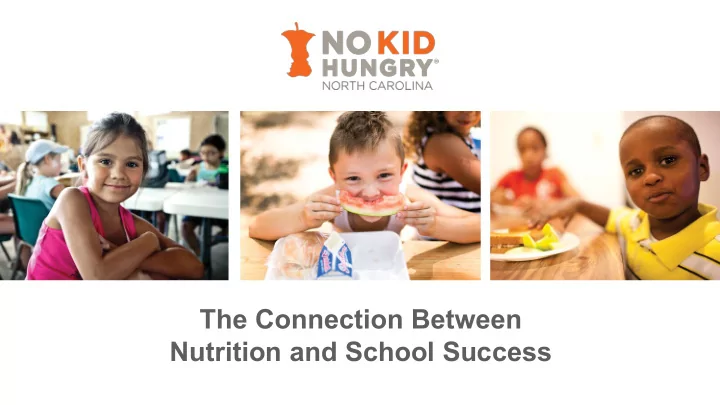
The Connection Between Nutrition and School Success No Kid Hungry - - PowerPoint PPT Presentation
The Connection Between Nutrition and School Success No Kid Hungry No Kid Hungry is a national campaign launched by the non-profit Share Our Strength in 2010. Its goal is to end child hunger in the United States. No Kid Hungry North Carolina
The Connection Between Nutrition and School Success
NoKidHungryNC.org • @NoKidHungryNC
No Kid Hungry
No Kid Hungry is a national campaign launched by the non-profit Share Our Strength in 2010. Its goal is to end child hunger in the United States.
No Kid Hungry North Carolina
The NC campaign was formed in the Office of the Governor in 2011. No Kid Hungry NC becomes an initiative of the UNC-Chapel Hill Center for Health Promotion and Disease Prevention in 2014. The focus of No Kid Hungry NC is promoting and increasing participation in federally-funded nutrition programs, including school breakfast, summer meals, and afterschool meals.
NoKidHungryNC.org • @NoKidHungryNC
When it comes to hungry kids, there is a big need in North Carolina.
Almost 900,000 students in NC’s traditional public schools are eligible for Free or Reduced-Price (FRP) school meals. That’s nearly 60 percent of NC’s almost 1.5 million public school students.
NoKidHungryNC.org • @NoKidHungryNC
North Carolina:
115 public school districts Almost 2,500 public schools Virtually all participate in the school breakfast program 1.5 million public school students Nearly 60 percent – or almost 900,000 – public school students qualify for free or reduced price school meals
NoKidHungryNC.org • @NoKidHungryNC NoKidHungryNC.org • @NoKidHungryNC
Only 58% of FRP-eligible children — who often depend on school for their nutrition — eat both school lunch and school breakfast.
There is a huge BREAKFAST GAP between the number of: FRP-eligible students who eat school lunch
and
FRP-eligible students who eat school breakfast
NoKidHungryNC.org • @NoKidHungryNC NoKidHungryNC.org • @NoKidHungryNC
students statewide in the Breakfast Gap
That’s 251,000 students who: 1) Qualify for Free or Reduced-price school meals. 2) Eat school lunch. 3) But DON’T eat school breakfast.
NoKidHungryNC.org • @NoKidHungryNC
Breakfast is already served in school. So what barriers are keeping students from eating it? Time
Traditional breakfast in the cafeteria is served before school begins. Students often have to make a choice between getting to class on time and eating.
Place
Traditional breakfast in the cafeteria keeps students from heading straight into the learning environment, and requires supervision by instructors, pulling everyone out
Stigma
Students may face shaming or embarrassment for eating school meals, especially if they receive them for a free or reduced price.
NoKidHungryNC.org • @NoKidHungryNC
These models lead to 70% to 90% participation
To close the gap and overcome these barriers, we need modern, innovative methods of serving school breakfast. They are collectively known as Breakfast After the Bell and include:
NoKidHungryNC.org • @NoKidHungryNC
The best way to increase access to the school breakfast program is to make it part of the school day.
Average Participation in School Breakfast By Model of Delivery:
Second Chance Breakfast
Grab and Go to the Classroom
to access locations before and after the bell
Traditional Cafeteria Breakfast in the Classroom (BIC)
consumed in the classroom
NoKidHungryNC.org • @NoKidHungryNC
Maslow’s Needs
“Kids need to know that they’re safe, they’re loved, and they’re gonna be supported. That means being fed… I can’t see academic increases if my students are hungry.”
– Principal Thyais Maxwell, formerly at Hampton Elementary University Partnership Magnet in Guilford County
NoKidHungryNC.org • @NoKidHungryNC
The impact of students eating a healthy school breakfast includes:
Increased ability to focus. Fewer behavior problems. Better attendance and less tardiness. Improved academic performance.
NoKidHungryNC.org • @NoKidHungryNC
Equity
Teachers see access to breakfast as an education issue.
NoKidHungryNC.org • @NoKidHungryNC
Remember: there is a huge BREAKFAST GAP between the number of: FRP-eligible students who eat school lunch
and
FRP-eligible students who eat school breakfast Currently, the breakfast gap statewide is 59% filled. Further filling it to reach just 70% would mean almost
in additional federal funds brought in annually to North Carolina, directly to school districts. That’s an average of about $213,000 per district.
Source: FRAC North Carolina School Breakfast Report, 2016-2017 School Year, March 2018
NoKidHungryNC.org • @NoKidHungryNC
Beginning a new Breakfast After the Bell program costs about
from administrators, staff, and educators.
NoKidHungryNC.org • @NoKidHungryNC
What can Teachers of the Year do?
If your school or district is already using Breakfast After the Bell method to serve more kids, share the story of that program's success with other teachers and encourage them to adopt similar programs. If your school still has a big need when it comes to breakfast participation, approach your principal or leadership team to raise the idea of making a change to how breakfast is served in
Start at NoKidHungryNC.org/TOY
where you can find data on your school, district, or region, as well as other helpful resources.
NoKidHungryNC.org • @NoKidHungryNC
No Kid Hungry NC is a resource:
Julie Pittman Educator Programming Manager No Kid Hungry twinologist@gmail.com NoKidHungryNC.org/TOY NoKidHungryNC@gmail.com
Questions?
NoKidHungryNC.org • @NoKidHungryNC
NoKidHungryNC.org/TOY