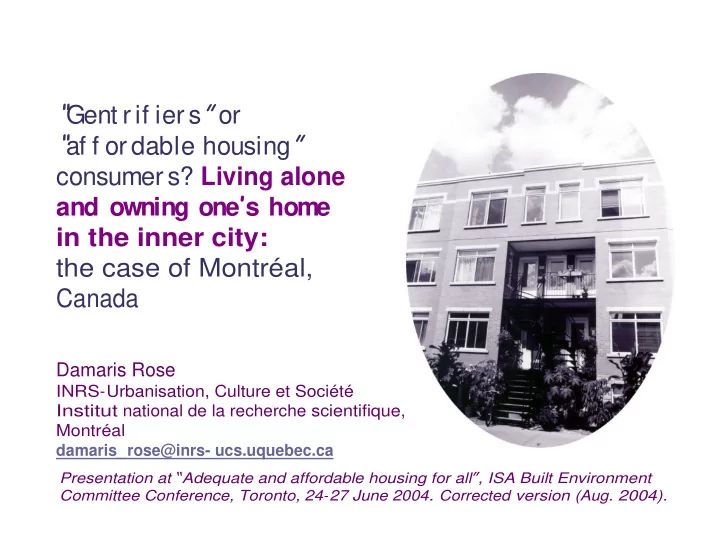
the case of Montral, Canada Damaris Rose INRS - Urbanisation, - - PowerPoint PPT Presentation
Gent rif iers or af f ordable housing consumers? Living alone and owning one s home in the inner city: the case of Montral, Canada Damaris Rose INRS - Urbanisation, Culture et Socit Institut national de la recherche scientifique ,
dr, Toronto
2
Plan of present at ion
Introduction Objectives of paper Context of case study of purchasers of
non-luxury new condominiums in Montréal Selected findings re sub-group of one- person households
drawn both from postal questionnaire survey and from follow-up qualitative interviews
dr, Toronto
3
- N. Am, Euro cities c.1970-:
1-person
households [1PH]
major societal changes
(Hall & Ogden 2003)
Since 1990s: prevalence of homeownership
among this group
- Imp. subgroup = key part of inner-city new
condominium mkt (infill; brownfield)
envt appeals to single Yuppie lifestyle , is supportive of non-family living arrangements
luxury units, pieds-à-terre (mobile elite workers) affordable hsg for 1st-time buyers (incl. new
economy workers) local state may facilitate/ subsidize construction
I nt roduct ion (1 of 3)
dr, Toronto
4
I nt roduct ion (2 of 3)
Paradox in existing literature:
sees homeownership by 1PH, incl. women, as
important in the aggregate;
however, lit. on housing careers + meanings of home vis-à-vis life course still neglects those who buy 1st home while living alone
moreover,most work on gentrifying consumption landscapes portrays single
Yuppie as young, footloose monotype (rare
exceptions: Wynne & O Connor 1998; Authier et al. 2001)
Little known re motivations of 1PH for this form of homeownership, re values they attach to home, neighbourhood
dr, Toronto
5
I nt roduct ion (3 of 3)
Why this paradox? Living alone still equated with low income, instability, transient phase in life course/ housing career
this presumes living alone = single ,
unattached want live-in partner also ignores age differences in economic + personal stability, and in aspirations (critique:
Feijten et al. 2003)
lack of longitudinal/retrospective data in rare qualitative studies, gentrifiers living alone are mostly 35 (e.g. Bondi 1999)
dr, Toronto
6
Obj ect ives of paper
Draw on exploratory case study of people living alone among 1st-time buyers of non-luxury new condos in gentrifying Montréal neighbourhoods
Source: broader study (for metho, see Annex 1): 1) mail survey, Mar. 2001, N=423 (45% response rate) 2) 50 qualitative interviews, Feb.-Apr. 2002
- Shed light on group obscured behind stereotypes
by presenting selected findings re: Sample characteristics Motivations for shift renting
- wning?
What qualities of neighbourhood sought out, appreciated significance of centrality ?
dr, Toronto
7
Mont réal case st udy some local cont ext
Sampled condos small-scale (physically integrated) infill + recycled bldgs in pre-1920 central nhoods in various stages of gentrification
Municipal supply- + demand-side subsidies
reduced purchase/initial carrying costs;
property tax base ( 80% of City revenue) diversify tenure choice for existing + new residents with modest/middle incomes
historically, local culture of property = city of tenants
(Choko & Harris 1990)
proactive municipal policy (1979-) to reverse population loss to suburbs (Germain & Rose 2000)
NB also includes facilitating non-profit rental hsg
to extent possible given federal + provincial
policies
dr, Toronto
8
City of Montréal leaflet* promoting property
t ax credit on purchase of a newly-built home
*reproduced here by permission
dr, Toronto
9
Examples of inf ill condos in st udy: Cent re-sud Gay Village
photos: Damaris Rose, 2003
note physical integration into streetscape
dr, Toronto
10
Examples of inf ill condos in st udy: Plat eau Mont -Royal / Mile End
- built on ex-factory land;
area still industrial
- units in these buildings
bought for $70-90,000 in
late 1990s
photos: Damaris Rose, 2003
foreground: community garden plots
dr, Toronto
11
Locat ion of 423 quest ionnaire respondent s and sub-group of 50 part icipant s in semi-st ruct ured int erview
superimposed on census tract map of mean incomes of all households, 2001
dr, Toronto
12
Quest ionnaire respondent s by living arrangement s and gender
112 100 48 79 44
3
20 11
50 100 150 200 250
N = 417
lives alone in couple,
- pposite
sex in couple, same sex
- ther*
Females (49%) Males (51%)
* living with related or unrelated people; lone parent
(Only 8% of respondents have children living at home)
50% of respondents lived alone
dr, Toronto
13
Quest ionnaire respondent s living alone, by age and 1st-time buyer status
10 20 30 40 50 60
18-34 35-44 45-54
55 +
First-time buyer (n=124) Repeat buyer (n=75)
n
NB: Fluidity of hsg careers vis-à-vis life course, esp. among
women 1st-time buyers (not shown) older than male counterparts
dr, Toronto
14
I ncomes (2000) of respondent s living alone, by 1st-time buyer status
0% 10% 20% 30% 40% 50%
First-time buyer (n=124)
Repeat buyer (n=75)
under $30 000
$30 000 - $49 999 $50 000 - $69 999 $70 000 - $99 999 $100 000 +
dr, Toronto
15
Educational and occupational profile of 1st-time buyer respondents
Highly educated almost ½ with
bachelor s degree or higher
50% are professionals/managers but sample also includes variety of white- collar, clerical occupations, even service workers Somewhat broader occupational range than stereotypical images of gentrifiers
nevertheless, qualitative interviews revealed
subjective affiliations to new urban middle class not limited to university-educated
professionals
dr, Toronto
16
Quest ionnaire respondent s living alone vs t hose living in couples (1)
those living alone are significantly older (esp. the women)
- bviously, have lower household incomes
50% had incomes in $30-$50,000 range
(= 18-30,000)
shift from renting to homeownership
- ccurs later in life
effect of lower household incomes on housing career delays aspiration for / possibility of
- wning one s home
(Findings consistent with Feitjen et al. (2003) longitudinal
study)
dr, Toronto
17
Quest ionnaire respondent s living alone vs t hose living in couples (2)
aspects of condo they most appreciate:
more likely to report becoming a home-
- wner
more likely to report its location
more likely to call their neighbourhood by a heritage name (= aesthetic
attachment/ distinction strategy?)
eat at home less often (esp. men) (= less home-centred?)
dr, Toronto
18
Quest ionnaire f indings suggest issues f or qualit at ive* f ollow-up
Partial support to popular images of
single Yuppie , yet suggests need for
nuance + deeper exploration, e.g. range of motivations for and meanings
- f home-ownership
what qualities of location and neighbourhood are valued high number (45%) of over-45s among
1st-time buyers living alone, so need
better understanding of this group
*seeks to uncover range of different perspectives, factors, types among sampled group no numerical weighting
dr, Toronto
19
Qualit at ive int erviews wit h 1st-t ime buyers: sample charact erist ics
Persons living alone: 33 (out of 50)
Gender
18 women 15 men
Age
18-34 : 7 35-44 : 14 45-54 : 9
55+ : 3
NB: Irrespective of age, living alone necessarily single :
from interviews, it
emerged that some were unat t ached ,
- thers have stable
non-live-in
relationships
dr, Toronto
20
Homeownership: motivations, perceived use, exchange, symbolic values according to
existing (esp. Anglo-American) literature
stability material, ontological control of immediate surroundings secured access to valued attributes of a particular [type of] neighbourhood financial security / investment vis-à-vis housing
career social status self-image
Critique/caveat: these are not universals all are context-dependent
need for contextual-
ization vis-à-vis local socio-cultural context and available housing alternatives
dr, Toronto
21
I nt erviews: What led you t o make t he leap int o home-ownership? (1)
Push factors : rents, rental scarcity
belief that one should
invest for oneself
gains ground concern to secure access to valued qualities of central city
Evolving cultures of property
Younger buyers: see ownership as the norm - get onto housing career ladder (no longer associated with fixed life course expectations) versus Older buyers: I was sure I d be a renter all my
life : then discovery of affordable condo
- ption
shift in aspirations
dr, Toronto
22
I nt erviews: What led you t o make t he leap int o home-ownership? (2)
Establish personal autonomy, find an anchor-point. One of the most telling comments:
A separation. I could have rented but for me, it was really
- Listen. I don t know if it
was a rational choice? I d say it was really a way to ensure that I d have my
- independence. That I d have peace. And it
was mine. In a context of separation ( )
To get back on my feet and make a clean
- break. ( Julianna , no. 479, age 25-34)
dr, Toronto
23
I nt erviews: Why a new (rat her t han renovat ed) condominium?
Low maintenance
avoid risk of unanticipated repair bills less time-consuming than a house
I m too fond of my way of life to get a
lawn-mower, (
) weed the garden. To
spend time like that, I would go crazy! If I want some of that, all I have to do is visit
my parents!
( Martine Reno , no. 121, late
30s, flight attendant)
More affordable than a renovated unit
(inflationary effect of earlier gentrification)
Privacy / quiet (soundproofing)
dr, Toronto
24
Interviews: Valued qualities of living
cent rally: (1) accessibility
Lifestyle aspects: easy access to cultural activities, leisure pursuits outside home
"I adore, um..., being here, I'm close to everything,
my whole life is 90% even 95% on foot ( Jean-Pierre
- D. , no. 171, age 45-54, college teacher)
Utilitarian aspects: convenience for work
main factor for the footloose, no symbolic investment in n/h (see Simon 1997)
Why distance yourself [ from centre] when you get
- lder? It s the city that you need. I don t even
drive
( Ginette Caron , no. 814, age 52, admin.
assistant, ex-suburbanite, divorced)
Many expressed strong anti-car sentiments; others had to give up their car for financial reasons once
they bought their condo
dr, Toronto
25
Valued qualities of living cent rally: (2) comfortable ambience for singles
pedestrian activity safety neighbourhood commercial streets: practical, aesthetic, sociability dimensions
frequent trips to small food stores buy specialty take-out foods rather than making meals at home alone
urban serendipity (Nyström 2003)
chance encounters with friends/acquaintances
possible to both socialize with like-minded and sample difference demographic/life-cycle diversity (vs suburbs)
helps singles get out of house more often
dr, Toronto
26
Concluding comment s (1 of 2)
In this case study, non-luxury infill condominiums
in gentrifying central neighbourhoods seem to both stimulate and respond to a new type of demand by people living alone across the age spectrum (diverse and little-understood group)
They are participants to varying degrees in the
economic + social practices of gentrification; they practice particular styles of urban consumption even if not urban professionals Their motivations for homeownership conform to aspects flagged in existing literature, but are context-dependent and are strongly cross-cut by
use- and/or symbolic values associated with a
central location
dr, Toronto
27
Concluding comment s (2 of 2)
But this new product also offers this group a form of inclusivity affordable housing in comfortable neighbourhood that reduces risk of social isolation that can come with living alone Housing/urban policy challenge: how to extend this inclusivity to people living alone who lack the means to purchase it on the private market
need for (local) state intervention to facilitate delivery of non-profit housing suitable for different kinds of 1PH wanting to live in inner-city precondition: 1PH must be recognized as groups having legitimate claims to stable housing at
diffent points in the life course i.e. this must be
seen as an integral component of their urban and social citizenship
dr, Toronto
28
Acknowledgment s
Social Sciences and Humanities Research Council of Canada, Standard Research Grants Program (grant no. 416-99-0266)
Student RAs : Stéphane Charbonneau, Greta
Marini (both in INRS-UQAM Joint Master s in Urban
Studies), Emma Garrard (Geography, Concordia Univ.)
Jaël Mongeau (INRS-UCS)
for mounting and interrogating questionnaire data base
Suzanne Chantal, Martin Wexler (Ville de Montréal, Habitation)
for sampling frame
assistance and other info and advice
dr, Toronto
29
I f youd like t o be kept inf ormed about t his research
please contact me (the full paper
will be written up in due course):
- Prof. Damaris ROSE
INRS-Urbanisation, Culture et Société
Institut national de la recherche scientifique 3465 rue Durocher Montréal, QC, H2X 2C6
Canada
damaris_rose@inrs-ucs.uquebec.ca
dr, Toronto
30
References cited
Authier, Jean-Yves (ed.) (2001) Du domicile à la ville. Vivre en quartier ancien. Paris: Anthropos.
Bondi, Liz (1999) Gender, class and gentrification: enriching the debate.
Environment and Planning D: Society and Space 17: 261-282. Choko, Marc & Richard Harris (1990) The local culture of property: a comparative history of housing tenure in Montréal and Toronto. Annals of the Association of American Geographers 80 (1): 73-95 Feijten, Peteke, Clara H. Mulder & Pau Baizán (2003) Age differentiation in the effect of household situation on first-time homeownership. Journal of Housing and the Built Environment 18: 233-255.
Germain, Annick & Damaris Rose (2000) Montréal: The Quest for a Metropolis. Chichester, UK: Wiley. Hall, Ray & Philip E Ogden (2003) The rise of living alone in Inner London: trends among the population of working age. Environment and Planning A 35 (5): 871-888.
Nyström, Louise (2003) Quality of urban life in Europe in the 21st century with a focus on three Nordic capitals. In Frank Eckardt / Dieter Hassenpflug
(eds) Consumption and the Post-Industrial City (Series, The European City
in Transition, vol. 1), Frankfurt/M: Peter Lang GmbH, 103-113.
Simon, Patrick (1997) Les usages sociaux de la rue dans un quartier cosmopolite. Espaces et sociétés (90/91): 43-68. Wynne, Derek & Justin O'Connor (1998) Consumption and the postmodern
- city. Urban Studies 35: 841-864.
Annex 1: St udy met hodology
Sampling frame: lists of condo projects in Habiter Montréal leaflets 1995-1998 new condo projects PRQC; + property tax
roll 2000/09
try to get complete civic
addresses for each projet, then identify
- wner-occupiers
filters: infill projects in central areas
built-up pre-1946; owner-occupiers;
municipal evaluation $150 000 ( non-luxury)
- 1. Postal
questionnaire (March 01)
Questionnaire (11p.) mailed to 960 individuals, by name, 2001/03 (after sending letter announcing survey)
Response rate 45%, N= 423 (lower
in downtown & south-west; higher
among women)
coding of closed, some open questions;
entered into Excel, SAS
- 2. Semi-
structured interviews (Feb.-Apr. 02)
- Summary of results mailed 2001/11 to
the 132 persons who had expressed interest in a qualitative interview
- Design of semi-structured interview
guide
filter: only first-time buyers selected (n=79)
50 agreed to semi-structured
interviews, carried out by 3 student assistants
49 verbatim transcriptions;
manipulation/analysis assised
byl Nud*ist software, with
initial analytical categories
based on interview guide
+ photos of condo buildings, description
- f immediate
neighbourhood
This document was created with Win2PDF available at http://www.daneprairie.com. The unregistered version of Win2PDF is for evaluation or non-commercial use only.