
SLIDE 1
The Battle for the Historicity of the Bible
German I dealism, Theological Romanticism (Liberalism/ Existentialism), Biblical Criticism & Postmodern Fascism
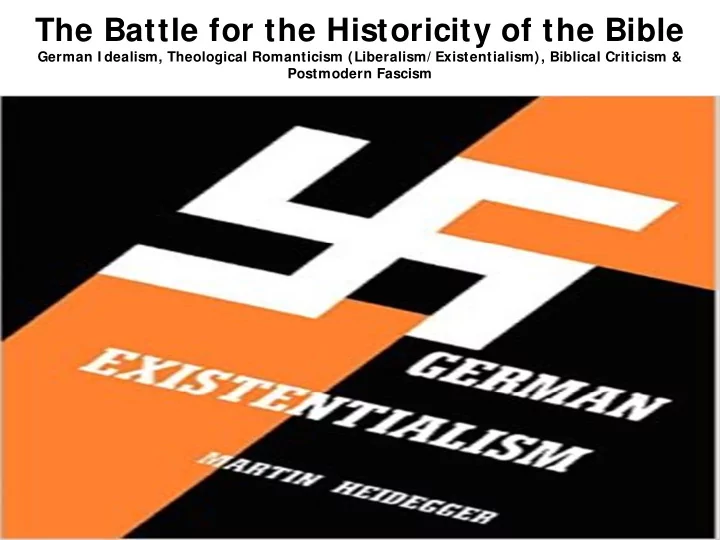
The Battle for the Historicity of the Bible German I dealism, - - PowerPoint PPT Presentation
The Battle for the Historicity of the Bible German I dealism, Theological Romanticism (Liberalism/ Existentialism), Biblical Criticism & Postmodern Fascism Divine Revelation in History = Bible Divine Revelation/ Testimony in Creation &
German I dealism, Theological Romanticism (Liberalism/ Existentialism), Biblical Criticism & Postmodern Fascism
Search for the Historical Jesus – w hich is a Rom antic Search for the Sim ple Jesus w ithout Theology.
Kingdom of God w as im m inent – but w hen it did not m aterialize after He w as crucified the Disciples cunningly postponed it indefinitely – claim ing that Jesus had risen from the Dead & had gone to Heaven.
betw een the Historical Jesus that is depicted in the Gospels & the Jesus that is seen in the New Testam ent Epistles – m ost of w hich is Pure Theology attributed to the Historical Jesus.
W orshiper of God but did not have it published.
the Bible w as not w ell know n until after He died.
w as a Germ an Critic, Philosopher & Dram atist.
Lutheran Orthodoxy before follow ing the Enlightenm ent & becom ing a Deist.
w hich divides from Faith from History.
used to establish the Necessary Truths
Particularistic like History.
Biblical History can be used to m ake Truthful Statem ents – since there is no Modern Proof of Miracles in the Bible this am ounts to Reasoning Pow er w ithout Proof.
developed in European Religious Thought w as across Lessing’s Ditch.
Berkeley’s Subjective I m m aterial Realism .
being destroyed through Em piricism by lim iting Reason.
a com plicated Schem e that allow ed Autonom ous Reason to prevail over the I m placability of the Real Experiential W orld that often Sullies I dealism .
History as Heterenom ous – Other Law - as Outside Forces of Legalism that coerce People to subm it & believe rather than use Reason.
Natural Theology to substantiate itself as such Know ledge is beyond Reason & cannot be Objectively Know n.
dependent on Natural Theology so that Scientific Em piricism does not devolve into Determ inism so that Man & Nature are reduced to the Level of a Machine.
from both Morality & Metaphysics since such Content w as largely presum ed to be unknow able – w hich led to a Radical Secularization of the Bible & further led to an em ptying of the Mind.
as an Em pirical Obstacle that needed to be ‘euthanized’ in order to establishm ent a Rational European Order in w hich its Biblical Heteronom y w ould be overcom e.
Only ‘Appearance’
Subjectively Known – not its Inner Objective Essence
Karl Lowith, Meaning in History, p. 245.
Environm ental Sciences.
about Old Testam ent Jew ish Nonsense, “Had Hom er rem ained our Bible how Different a Form w ould Mankind had achieved.”
Relationship w ith Nature against the Dualistic-Mechanistic New tonian Science of the Judeo-Christian tradition.
Biology because it exem plified Holism & Organic I nterdependence.
illusion/ One & m any are the sam e.”
Nationalism rooted in the soil of the Hom eland to keep itself Pure from outside Heteronom ous Forces.
in its Holistic W orldview .
w as a Strong Nationalist Rom antic during Napoleon’s I nvasion.
I dealism w ith J.S. Sem ler’s De-Judaization & Rationalistic Historical Criticism of the Bible.
Spiritual Experience w as m ore im portant than Doctrinal Creeds – thus a Theological Rom antic.
his ow n Natural Theology– not Christianity against the Rationalism of the Enlightenm ent.
Historicity of the Bible and its Theological Doctrines, but w as a Rom antic Mystic of Liberal Theology w hose Teaching is sum m arized by His W ork entitled The Christian Faith.
w ith God through Experiential Know ledge rather than Theoretical or Theological Know ledge so that Authentic Spiritual Progress m ust get beyond Rational Categories and the Kantian Lim its of Reason.
Herm eneutical Circle w hich w as Holistically & Rom antically & I dealistically Understood undergirded by Deistic Criticism of the Bible.
Ability of Language to express I tself.
I ntuition & Feeling Free from Dogm atism since Language I tself is too Legalistic to Express True Spirituality.
not express the True Nature of Thought.
kills, but the Spirit gives life,” w hich he interpreted to m ean the Biblical Text itself is a Dead Letter Barren of Spiritual Meaning along Kantian I dealistic Lines that the Progress of the I m m anent Spirit of the W orld so that God’s Revelation is based on the Universal History of Man’s Grow ing Spirituality.
transform Him self into the Author so that He can grasp in Full I m m ediacy His Mental Processes into a Holistic Merging of the Minds along Rom antic Mystical Lines.
m ust transcend it to get at the True I nner Process of Understanding.
Spiritual Artists.
( 8 5 -1 6 0 ) had show n so m uch antipathy tow ards Judaism as Schleierm acher.”
text, the less valuable it w as.
Christianity.
Com m unity’s Belief in a com ing Earthly Messianic Kingdom w as a Childish Form of Religion, the Very Last “fruits of Judaism .”
Antiquated Bloodthirsty “religion of punishm ent and recom pense, instead of being a religion that challenges and educates people.”
from Backw ardness, Particularism , Legalism , Judgm entalism , and the Heteronom ous in Contrast to the Progressive, Scientific, Open-Minded, Autonom ous & Free.
after serving in both Jena & Bern Universities becam e Philosophy Professor at the University of Berlin from 1 8 1 8 -1 8 3 0 thanks to Schleierm acher’s Help.
Secular w ith Schelling & Spiritual Schleierm acher) w ith Historicism to create a Progressive Philosophy of History know n as Absolute I dealism .
an Eternal One m ade in God’s I m age.
Spirit or Reason that I m m anently & Providentially w orks behind History to advance Mankind into a Greater & Greater Synthesis of Antithetical Movem ents that is transform ing Religion into an advancing Secular Philosophy w here Reconciliation is found in Thought Alone.
Progressive Sem i-Pantheism as a New Philosophy of History.
contributed to the Grow th of the W orld Spirit except for Judaism that has been fossilized since the Tim e of Christ.
used by Germ an Higher Critics to attack the Historicity
Higher Criticism that not onnly attacked the Historicity
Schleierm acher’s Natural Theology.
Philosophy of History to Reconstruct the Gospels, Baur w ill use it to Reconstruct the History of Acts and the New Testam ent.
teach the Early Church w as full of Conflict that w as only later reconciled by the Catholic Church.
that sharply distinguished Peter’s Jew ish understanding
Hegelian lines.
and Paul’s Gentile Christianity w as the Antithesis that is taken up by Rom ans, Galatians & 1 -2 Corinthians ( the
he considered the rest of the New Testam ent a form of early Catholicism rather than genuinely w ritten by Paul, John, and Jam es, etc.
rather than during the 1 st Century as portrayed by the Docum ents them selves.
Bishop of Durham .
– both of w hom stood up against the I nfluences of the Enlightenm ent & Germ an Higher Criticism .
Historian.
w ritten by Church Fathers that destroyed Baur’s Assertion the New Testam ent w as not finished until the 3 rd Century.
to the Close of the First Century w ho had quoted from m uch of the New Testam ent itself.
agreed w ith Lightfoot’s Assessm ent w hich should have put to rest Baur’s W ild Radical Higher Criticism .
Studies confirm ed Acts had to have been w ritten in the 1 st Century.
at Tubingen & even initially accepted their Radical Historical View s on the New Testam ent, after he finished his Research he concluded Luke w as the Greatest Historian of the Ancient W orld.
Hegelianism w ith a m ore Strict Historicism - yet Hegel’s Progressive View of History rem ained.
to explain the Origins of the Old Testam ent – w hich w as a m ore Com plex Synthesis than Hegel’s Triad.
Elohistic Docum ent dates to Northern Kingdom ; P = Priestly Docum ent codified Rituals & Form alistic Religion in Leviticus around 5 0 0 B.C.; D = Deuteronom ic Docum ent w hich w as com piled during Josiah’s Reign before the Exile ( 1 Kings 2 2 :1 -2 0 ) in 6 2 0 B.C.
His JEPD Theory to Rom antic & Nationalist Theologian Leberecht de W ette ( 1 7 8 0 -1 8 4 9 ) .
that devolved from the Pure & Sim ple Original Hebraism into Deuteronom ic Legalism .
More Materialistic in their History.
Speculative Reconstruction in the last 4 0 Years.
Social Gospel deepened Schleierm acher’s Theological Rom anticism & Liberal Nationalism .
Scholarship in the Rabid Attem pt to de-Judaize the New Testam ent – stem m ing from Schleierm acher & Kant.
Exclusivism derived from the Old Testam ent w as keeping Germ an Christianity from becom ing Progressive, Liberal & Universal.
surpassed Ecclesiastical Christianity to now enter an Ethical-Political Spiritual Age functioning as a Spiritual Pow er in Germ any.
considered to be Jew ish Segregation, Backw ard Legalism & Restrictive Cerem onialism as they hindered their Freedom s in Many W ays.
under the Spiritual Pow er of Liberal Protestantism w here Rom anticism & Nationalism and Socialism all m ixed together through the Propagation of the Social Gospel.
Theological Liberal Scholar in Germ any from the Late 1 8 0 0 ’s until the First W orld W ar.
very Active Academ ically & Socially & Politically – a Leader of Germ an Academ ia.
Past that needs to be abandoned for Modern Christianity to prosper in the 2 0 th Century.
Testam ent w ere having a Paralyzing Effect on the Progress of Religion & the Church.
that Kicked off W orld W ar I .
Harnack’s Attitudes about the W ar, Karl Barth ( 1 8 8 6 -1 9 6 8 ) revolted against His Teachers.
& that Rat w as Schleierm acher and his Natural Theology = Theological Rom anticism .
continued His De-Judaization of the Bible.
had predated it & grow n alongside it to fill in the Vacuum .
Values of Man in his Environm ent, Nationalism , Natural I nstinct & Feelings against Judeo-Christian Melting Pot Universalism & the Cold Rationality & Calculation of the Enlightenm ent’s Glorification
Nature, Natural I nstincts & W ill over Essence, Mind, Reason & Rational Thought.
Germ an Rom anticism of the 1 7 0 0 ’s and early 1 8 0 0 ’s.
Rom anticism , National Socialism , Postm odernism & Environm entalism .
Muir – it w as both Anti-Sem itic & Anti-Christian in Germ any ala Goethe, Hum boldt, Schopenhauer, Arndt, Riehl & Nietzsche.
Darw inism that jettisoned the Subject/ Object Distinction of the Medieval & Enlightenm ent Sciences so that Nature now studies Nature = Subject Melds w ith the Object = Scientists are Evolved/ Glorified Anim als of som e sort.
Foundations for Postm odernism w ith His Em phasis on “Being” that abolishes the Subject in Favor of a Localized I rrational W orld that exhibits or unveils Beauty to Him .
Concepts are Hindrances to know Reality – or Being.
through Reason ( w hich Kant show ed w as I m possible) , but by follow ing Schopenahuer/ Nietzshce’s Existentialism – particularly w ith regard to His Dark & Anxious Feelings of Dread & Guilt.
Being there w ill be Conflict & Contradiction that cannot be resolved through Reason – but can be dealt w ith through Feelings.
Absurdities w henever it attem pts to explore Deep I ssues of Being.
Being to unm ask Reason’s Separation from Reality – w hich is Nothing = Meaning that Reason is I llusory & Not Real.
are sim ply allow ed to be in the Face of Being & its inherent Logical Absurdities.
w hich is a m ore evolved Form of Philosophical Fascism & Metaphysical Nihilism .
the Judeo-Christian W orldview & Reason.
as a Student in the 1 9 2 0 ’s – after the W ar she forgave Him of His Nazi Sins & rehabilitated Him back into W estern Academ ia.
Father of Existentialism , Heidegger quipped, “W hen the French w ant to think, they have to think in Germ an.”
Deconstruction into Herm eneutics.
( 1 9 2 1 -1 9 9 7 ) w ere instrum ental in developing Postm odern Reader Response Herm eneutical Theories.
says, the interpretation is at an end ( 2 nd phase) , but actually it has just begun.”
stand in the w ords and is nevertheless said.”
be found by the scientific interpretation that brands as unscientific everything that transcends its lim its.”
som e Light/ Revelation so that w hat w as concealed in the W oods of the W ords is now opened up ( lebensraum onto the text) to get Som e Exposure on the Poem to set the Stage for the Unveiling ( not Conceptual I nterpretation) of the Artistic Beauty of w hat w as said & not said as the Reader takes His Stand in the Middle of the Poem to enjoy its very Existential Being – just let being be.
Herm eneutics sw allow s up the Science of Herm eneutics = Heart of Postm odernism & Hollyw ood.
I tself as I rrational Being.
hearkens back to the Historical Past to answ er Today’s Spiritual Problem s – Biblically ( Deut 4 :3 2 -4 0 ; Psalm 7 8 ; 2 Pet 3 :1 -2 ; Jude 1 :3 , 1 7 ) .
I rrational & is Text & Historically Based ( Eccl 1 :9 -1 4 : Rom 9 :1 4 -2 1 ; Eph 1 :5 -1 2 ; 1 Cor 1 :1 8 -2 :9 ) .
Strict Rational or Theological Point of View – but this does not dem and an I rrational/ Dialetical Approach ala Kierkegaard & Barth to Faith & Truth ( I saiah 4 0 :1 2 -2 6 ; 5 5 :8 -1 1 ; 1 Cor 2 :7 -1 6 ; Rom 1 1 :3 3 -3 6 ) .
Know ledge is never abandoned in the Process ( 1 Cor 8 :1 -3 ; 1 3 :1 -1 3 ; Eph 3 :1 4 -1 9 ; Phil 1 :9 -1 2 ; Col 1 :8 -1 2 ; 2 Pet 1 :2 -8 ) .
Language ( Genesis 1 -3 ; Exodus 4 :1 1 -1 2 ; Proverbs 2 :6 ; 8 :1 -1 4 ) .
Testam ents w here God Personally reveals Him self & intervenes into the Historical Process culm inating in the I ncarnation of Christ – all of w hich is described w ith Real W ords & Verbiage ( 1 John 1 :1 -4 ; Luke 1 :1 -4 ; John 1 :1 -1 8 ) .
( Psalm 1 9 :1 -4 ; Acts 1 4 :8 -1 8 ; 1 7 :2 2 -2 9 ; Rom 1 :1 8 -2 5 ) .